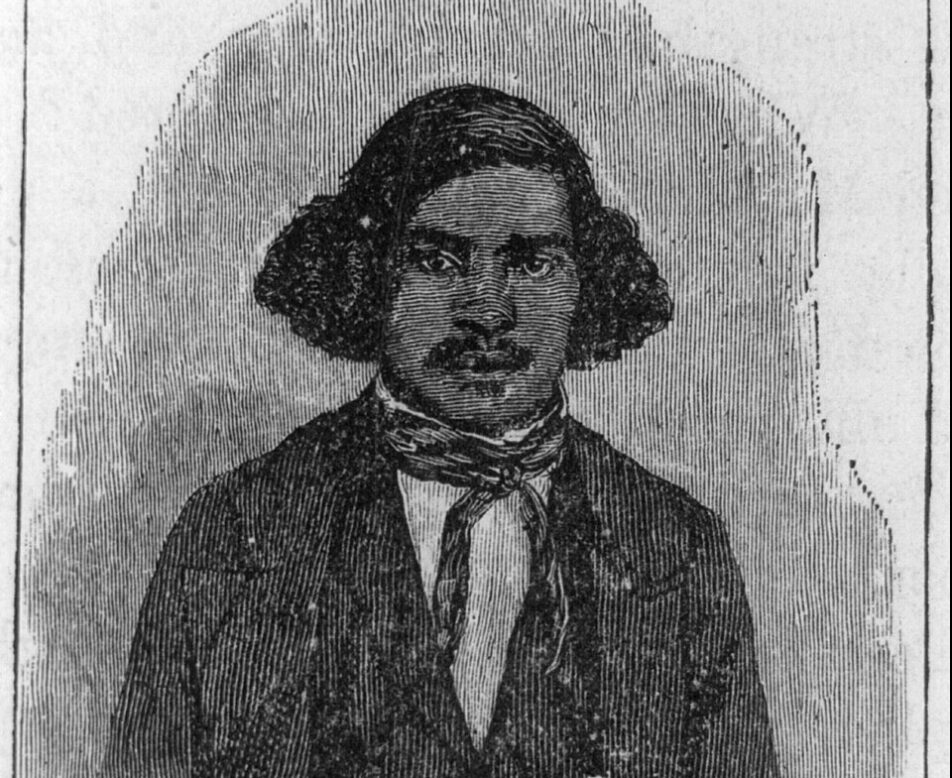
In 1838, a teenage slave from Kentucky was given a rare opportunity. Rather than breaking his back in the fields with his peers, he was tasked with mapping Kentucky’s Mammoth Cave. Trudging through the dark with a dimly lit lantern, braving uncharted subterranean rivers, forcing his body through impossible tunnels, and leading rich visitors into the unknown, Stephen Bishop became a daring explorer in his own right and master of Mammoth Cave.
Background
Stephen Bishop was born to a black mother and a rumored white father (also his owner). Not much is known about his childhood apart from records of his supposed father, Lowry Bishop, who owned him and was an abusive serial adulterer. Though all slaves took the surname of their masters, investigations by authors and journalists found letters showcasing Lowry as his biological father.
Writers Angelo I. George and Gary A. O’Dell suggest that Stephen Bishop and other illegitimate biracial children were under the care of Lowry’s wife, Catherine. This could be the reason why Stephen had some knowledge of reading, writing, history, and languages.
Eventually, when he was 17 years old, Bishop was bought by a lawyer named Franklin Gorin. All things considered, Stephen’s life was not typical of a slave in the Antebellum South. Instead of toiling in the fields and suffering daily brutality, his master had another plan in store for him.
The cave
Franklin Gorin had made a unique investment: acquiring a cave. To him, a cave was a money-making machine that could bring tourists from around the country and beyond. However, he first had to learn what it had to offer. And Gorin had no idea just how deep his acquisition went.
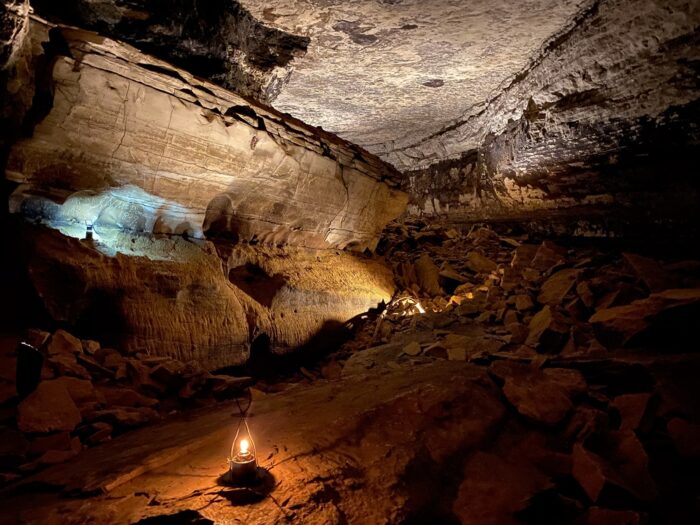
Mammoth Cave interior. Photo: SveKo/Shutterstock
Mammoth Cave is over 640km long, but it continues to grow as more passages, tunnels, and shafts are discovered almost annually. The cave is also home to large deposits of a substance called saltpeter. This is another name for potassium nitrate, which is used to make gunpowder. This made Mammoth Cave a highly coveted spot for mining, especially during the War of 1812.
Gorin instructed Stephen to map out the cave as accurately as possible. Gorin regarded Bishop fondly, saying:
A self-educated man…He had a fine genius, a great fund of wit and humor, some little knowledge of Latin and Greek, and much knowledge of geology, but his great talent was his knowledge of man…his talents were of the first order.
He was trustworthy and reliable; he was companionable; he was a hero and he could be a clown. He knew a gentleman or a lady as if by instinct. He learned whatever he wished to learn without trouble or labor, and professors of geology spoke highly of his knowledge in that department of science.
An author named Nathaniel Parker Willis described Bishop as “middle-sized but built like an athlete, with broad chest and shoulders, narrow hips and legs slightly bowed.”
Almost from the beginning, Gorin noted how remarkably sharp Bishop’s memory was. He remembered every claustrophobic passageway in that dark labyrinth. He discovered and named several features inspired by his own sense of humor and fondness for mythology. For example, for visitors who were fat or tall, Bishop named two sections, Fat Man’s Misery and Tall Man’s Misery.
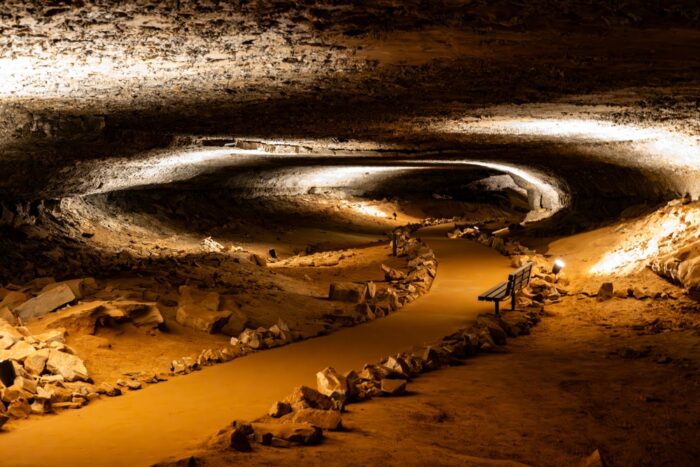
Mammoth Cave pathways. Photo: Cole Kujawa/Shutterstock
For sections that reminded him of Greek mythology, he named bodies of water the River Styx and Lake Lethe, which were rivers in the Greek underworld. He named one cavern with sparkling ceilings and floor the Star Chamber. Another incredible feature was the Bottomless Pit, which was 32 meters deep.
A guest paid Bishop handsomely to take him across the opening of the hole. Bishop fashioned a ladder for the two of them to cross. Bishop also took visitors in small boats on the rivers and lakes while telling them folk stories.
He knew every stalactite, stalagmite, column, chasm, and tunnel. This made visitors trust him with their lives.
Great storyteller
His slave status did not seem to affect how the cave’s visitors saw him. They were enraptured by his storytelling, which blended geology about the cave’s features with myths and legends he had read about as a child. Most likely, his animated tales calmed the nerves of the visitors who found the dark and small spaces anxiety-inducing.
His education inspired unusual legends. A visitor named Thomas Kite wrote in 1847:
Mosher our landlord said he [Bishop] knew how to read and write and received his education in the cave. On noticing our looks of surprise, he explained by saying that he learned the alphabet by seeing visitors writing their names on the smooth ceiling of the cave, with the smoke of their lamps.
Apart from Bishop, two other black guides joined him in conducting tours of the cave. Mat and Nick Bransford also earned fame and respect from visitors. Mammoth Cave’s exploration is what it is today due to this pioneering trio of black guides who surpassed their status and captured the hearts of those they led through the darkness.
Another owner
In 1839, a Dr. John Croghan bought the cave and the surrounding land. Naturally, his purchase included Bishop as well. This was a situation Bishop greatly feared, as he worried that it would spell an end to his guiding career. However, Croghan needed Bishop’s help. He wanted to use the cave to treat tuberculosis patients, believing that the cave’s air could somehow relieve the sick patients. Croghan set up cabins within the cave, stocked with sick beds and supplies.
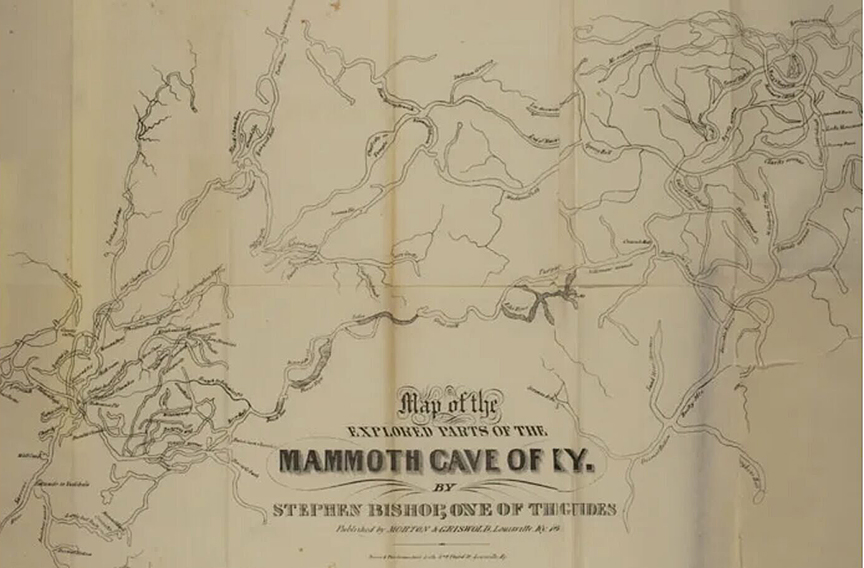
Stephen Bishop’s map. Photo: American Antiquarian Society
Sadly, the doctor’s thesis, which the scientific community of the time initially backed, was upside-down. The damp, still air made patients worse and die faster. Inevitably, the entrepreneurial doctor caught the disease himself and passed away.
During his time under Croghan, Bishop drew a map of Mammoth Cave. Published in 1842, the map was praised for its accuracy and wealth of topographical information. Bishop received full credit for his work.
Conclusion
In 1856, seven years after Groghan died, Bishop became a free man. He and his family dreamed of moving to Liberia, but circumstances did not allow this dream to come true, despite selling their belongings to make the move. Bishop died suddenly in 1857. Some suspect it was from tuberculosis, but this was never confirmed. Making his death even more tragic, this esteemed guide and explorer was buried in an unmarked grave.
Many years later, a wealthy man named James R. Mellon commissioned a grave marker for Bishop. It stated:
Stephen Bishop, first guide and explorer of the Mammoth Cave. Died June 15, 1859, in his 37 year.
Unfortunately, there is an error in his death date. Regardless, he has gone down in Kentucky history as the man who explored the world’s longest known cave system.