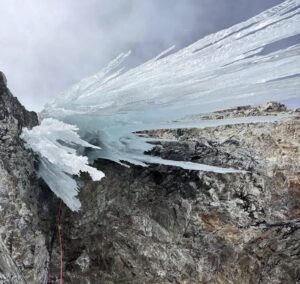
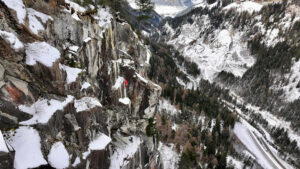
American guide and skier Justin Sackett posted a picture of a thin ice line on the vertical southwest face of Kilimanjaro that he saw last month.
“Apparently, after the rainy season, the ice is thick all the way to the ground, whereas the bottom pitches aren’t in right now, but that upper pillar looks spectacular,” Sackett said. He noted that the ice line was about 900m from bottom to top.
Mystery ice line
Sackett wanted to know if the line had ever been climbed. Although he had not climbed it himself, he wondered if it was worth a return trip to Africa. The comments section on his post quickly filled with information, names, history, and in a short time, a description by one of the ice climbers himself: Canadian Will Gadd.
Gadd had climbed on the Kilimanjaro glacier in the year 2000, sponsored by Red Bull:
Here is what he had to say about that rocky face and the ice line:
It’s the Breach Wall…The upper pillar used to form every year, and Messner has an incredible story about climbing it.
The pillar doesn’t form every year now. The last time I went there to climb, it had fallen down, and [there was] very little ice below that point. The glacier feeding it is much smaller than it used to be…But if you got lucky and didn’t get killed by rockfall (the major hazard, it’s a choss pile up there), then it might still go. The whole lower face was glacier/neve when Messner did it, now bare rock, so much rockfall in there…
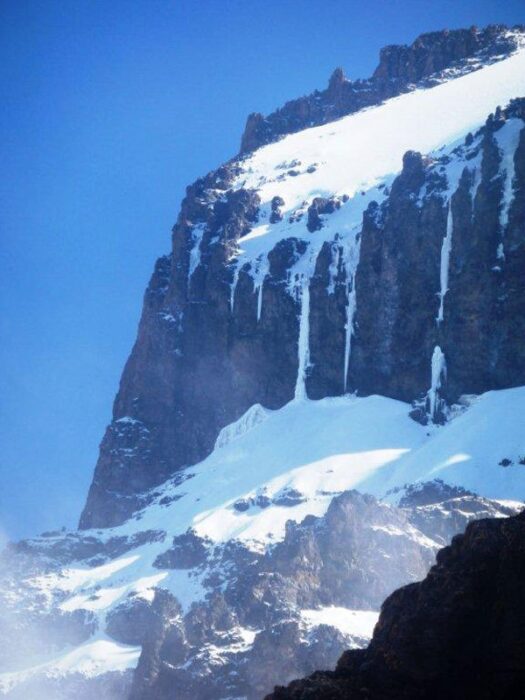
The Breach Wall and the Icicle, published by Planet Mountain in 2012.
The message prompted us to look for historical information about the route and whether climbing it is still possible.
The old times
There was a time when Kilimanjaro was wild rather than crowded like today. During the 1970s and 1980s, climbers opened several lines on the Breach Wall, but the first and best-known was the one Sackett singled out, known as the Breach Wall Icicle. Reinhold Messner and Konrad Renzler made its first ascent in February 1978 in a 12-hour push. They graded the line VI/WI 5/AD.
The Breach Wall begins at Arrow Glacier Camp and follows the volcanic rift straight to the top. The vertical wall was formed by the crater’s collapse, and it was considered impassable until Messner and his partner first climbed it.
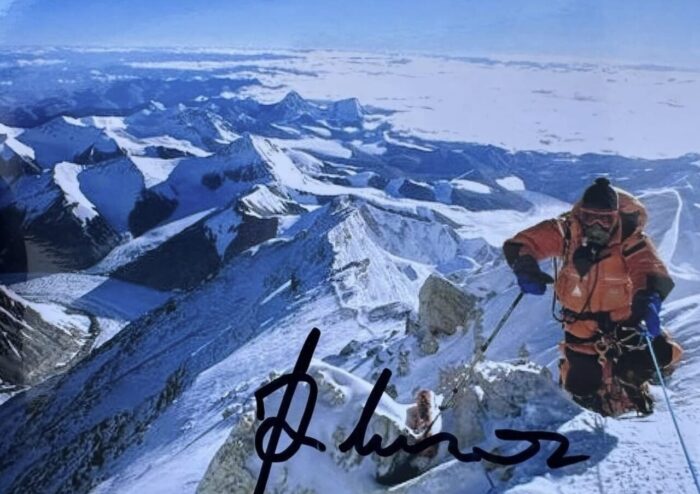
Autographed photograph of Reinhold Messner, kept in the Altezza Travel Kilimanjaro Museum. The photo itself was taken in the Himalaya in the 1970s or 80s.
SummitPost has a description of the route that starts at the base of the Breach Wall (4,600m) and ascends the icefall to the Balletto Ice Field. It then continues on the 90m-long Breach Wall Icicle, located at 5,450m. After the Icicle, the route follows the Diamond Glacier north to Uhuru Peak.
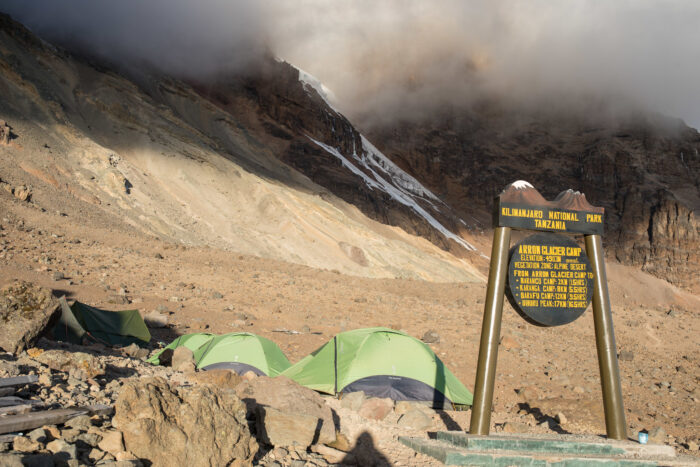
The Arrow Glacier is now extinct. Photo: Tranquil Kilimanjaro
Global warming effects
The problem was not only the technical difficulty but most of all, the objective dangers that Messner highlighted: “The ice was like glass, so the ice screws barely gripped, [but] in the sun, the ice turned into a liquid mush,” Messner told German magazine Der Bergsteiger at the time. He also mentioned brittle rock prone to falling. That problem has increased as temperatures have risen.
There were a few repetitions of the Breach Wall Icicle during the next few years, one of them by Scott Fischer and Wes Krause in 1984.
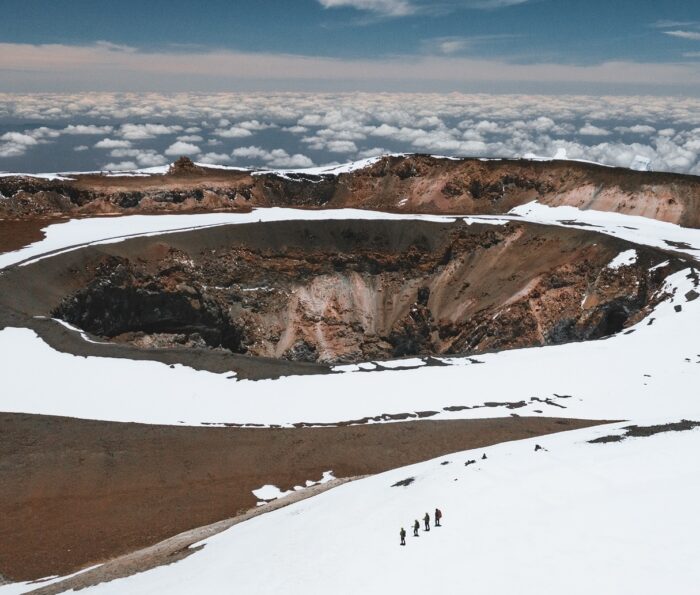
Climbers approach the summit of Kilimanjaro, above the Kibo Crater. Photo: Altezza Travel Kilimanjaro
Unclimbable today
As for Hackett’s question about whether this route (or any ice on Kilimanjaro) can be climbed nowadays, the short answer is no.
“Due to extensive glacial melting and evaporation, it is no longer possible to ascend the Breach Wall safely today,” Alex Andreichuk, head of Moshi-based Altezza Travel Kilimanjaro told Explorersweb. “The terrain has become extremely unstable, with a high level of rock loss and frequent rockfalls, and the era of this route effectively ended more than 40 years ago.”
Andreichuk added, “All remaining glaciers are visibly shrinking year by year. I am saying this not only as a guide and operator, but also as someone who lives on the slopes of Kilimanjaro, with a direct view of the volcano from my bedroom.”
He explained that the ice tends to sublimate (turn directly into water vapor) rather than melt. Deforestation at lower elevations and much less rain over the past century have combined with higher temperatures to hasten the ice’s disappearance.
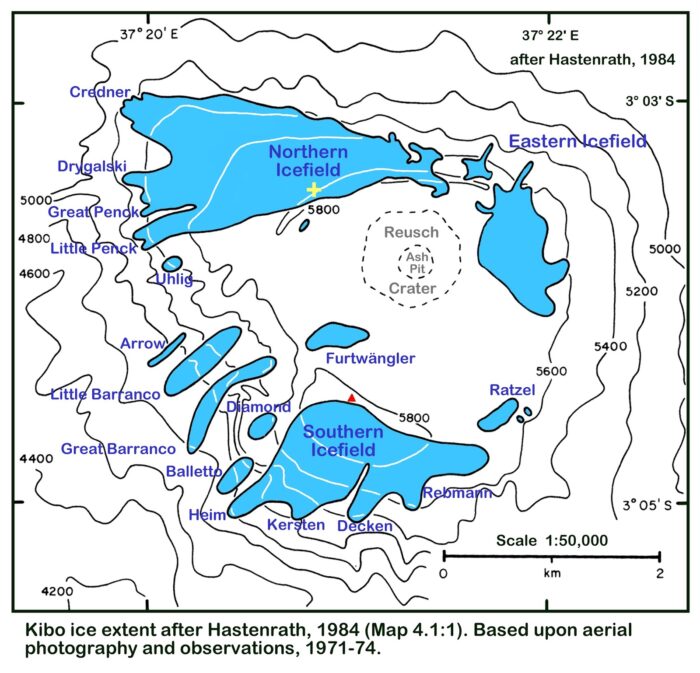
Map of Kilimanjaro’s glaciers as they were in 1984, with the breach Wall marked with a red triangle. Map by Altezza Travel Kilimanjaro
The unstable volcanic rock that composes Kilimanjaro gives poor climbing, to say the least. “While a hybrid approach involving technical walking with limited scrambling is still possible in some areas, Kilimanjaro has never been a suitable mountain for pure rock climbing,” Andreichuk explained.
Climbing restrictions
It is a common belief that Kilimanjaro can only be climbed via normal routes, using local porters and guides. This is not completely accurate, but those wanting to defy the poor rock conditions on climbing routes must definitely hire the services of a local company and accept a list of limitations.
“Non-standard or technical routes on Kilimanjaro can still be requested through a special permit, and these permits are generally not difficult to obtain,” Andreichuk explained. “In the past, our team has successfully organized activities such as BASE jumping, paragliding, and ice climbing, all of which were approved by Kilimanjaro National Park authorities, provided strict precautions and written instructions were followed.”
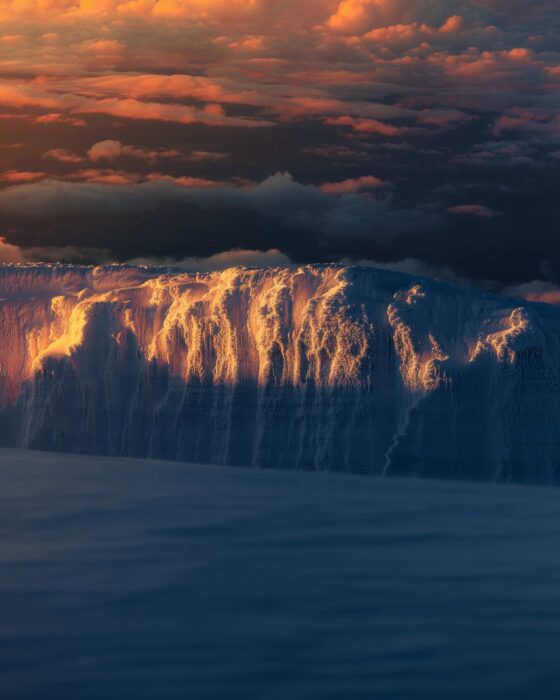
The remaining glaciers on Kilimanjaro at dusk. Photo: Altezza Travel Kilimanjaro
Suicidal types only
Under current park regulations, at least one certified guide is required for every two guests. Porters are not mandatory on technical routes, but local entrepreneurs note that they significantly improve logistical comfort.
“That said, finding a climber who would realistically be willing to attempt the historic Southwest Face route today would be extremely difficult,” Andreichuk concluded. “In its current condition, such an attempt would be reckless and potentially suicidal.”