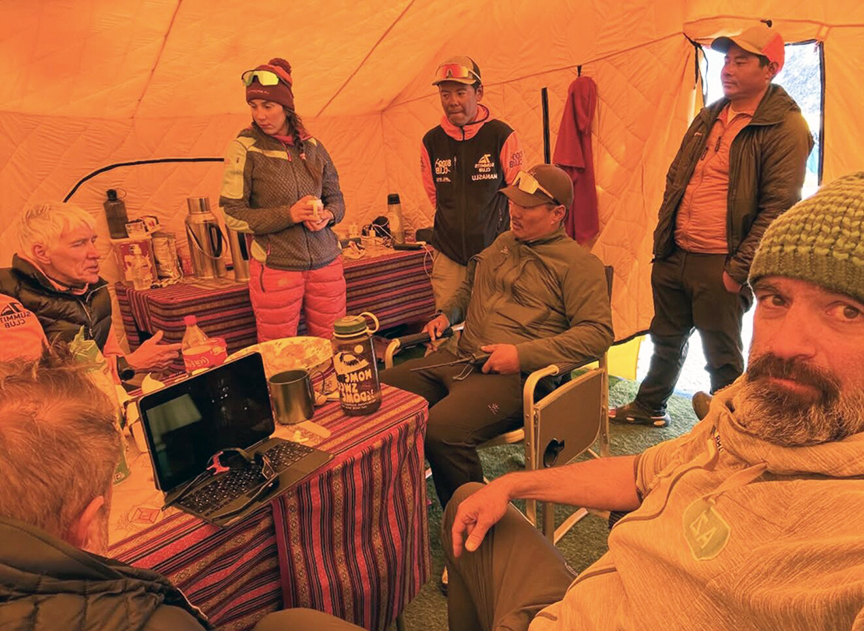
Climbers are on their way to the summit on an 8,000m peak for the first time this season, and a significant number of them are going without bottled oxygen.
The summit plans on Annapurna were discussed today at a meeting in Base Camp, Israfil Ashurli reported.
Almost everyone in Base Camp will join the push, and most of them will leave tomorrow, April 14, for Camp 1. The Sherpa team fixing the ropes will continue to Camp 2, so they will be one day ahead of the rest, Charles Page of Canada told ExplorersWeb from Base Camp.
On the previous rotation, the Sherpas fixed ropes until slightly above Camp 3. Since then, a long spell of bad weather, with snowfall and high winds, has hit Annapurna. It remains unclear whether the ropes may be damaged or buried.
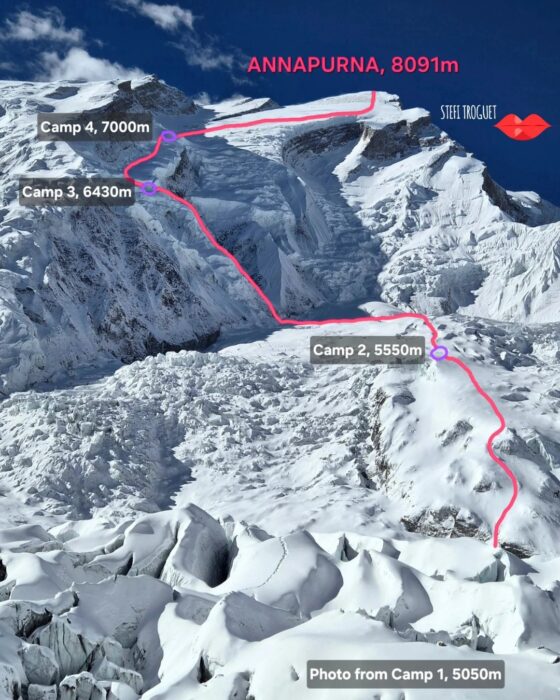
Annapurna’s summit route as seen from Camp 1. Photo: Stefi Troguet
Most climbers will advance one camp a day until they reach Camp 3 on April 17. There, the group will split: Those using supplementary oxygen will rest there for the night, while the no-O2 climbers — who have to spend as little time at altitude as possible — will continue to Camp 4 for a final, short rest before attempting the summit on April 18.
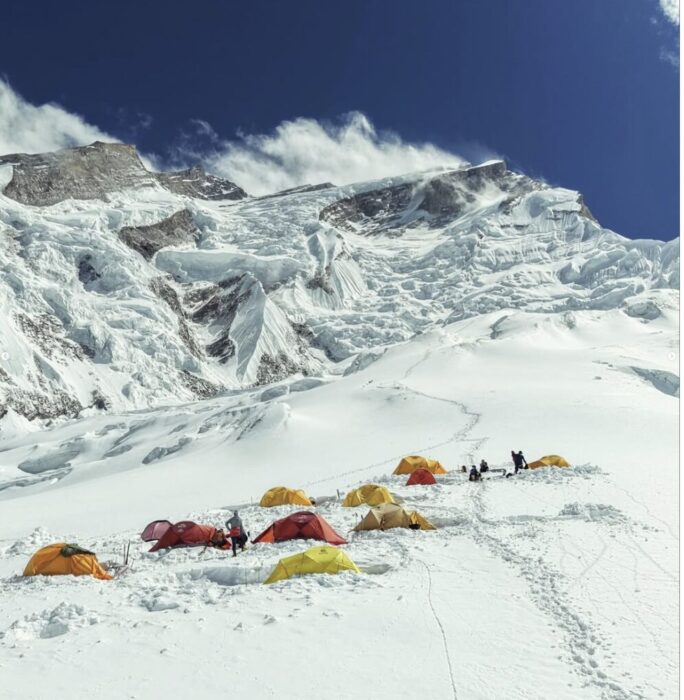
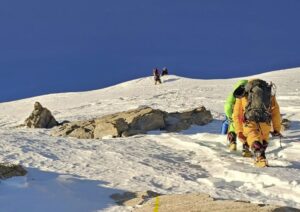
A very snowy Camp 1 on Annapurna this year. Photo: Charles Page
The no-O2 eight
Of the 27 foreign climbers with permits to climb Annapurna (according to Nepal’s Department of Tourism), eight have confirmed they will not use supplementary O2. They are Stefi Troguet of Andorra, Charles Page of Canada, Israfil Ashurli of Azerbaijan, Marie Saame of Estonia, Andreas Frydensberg of Denmark, and Russians Valery Babnov, Anton Pugovkin, and Vitali Shipilov. There was a ninth no-O2 climber, Piotr Krzyzowski of Poland, who ran out of time and had to return home for professional reasons before the summit push.
That makes 30 percent of the total number of climbers on Annapurna going without bottled oxygen. That may not be an impressive number compared to the ascents in the 20th century and the first decade of the 21st — at the time, oxygen was hardly used on Annapurna, which, at 8,091m, is a “low” 8,000m peak. However, it is noticeable in the current commercialization of the mountain.
Massive use of gas
Last year, according to The Himalayan Database, 40 people summited Annapurna with supplementary oxygen, and only five reached the top without bottled gas: Cesar Rosales of Peru, Eduard Kubatov of Kyrgyzstan, Sirbaz Khan of Pakistan, Anja Blacha of Germany, and Chun-Qi Yan of China.
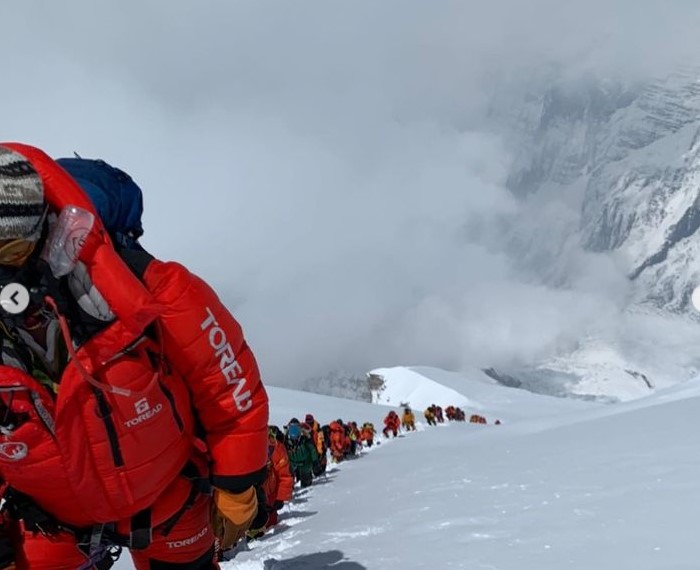
Long queues of climbers lined up toward the summit of Annapurna in the spring of 2021. Photo: Pasang Lamu Sherpa Akita
It’s worth noting that no-O2 ascents are less risky nowadays, since there are usually spare supplies high on the mountain that no-O2 climbers can use in emergencies. In the pre-commercial times, even with big teams climbing in heavy expedition-style, there would rarely be any canned oxygen on the mountain, except in Base Camp for medical use.