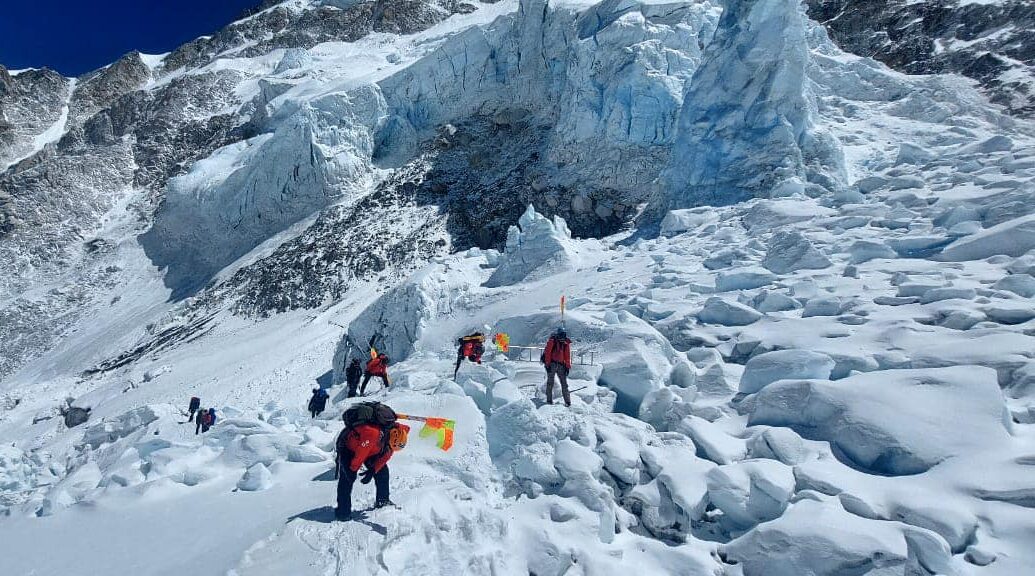
The Icefall Doctors fixing the route to Camp 1 on Everest across the Khumbu Icefall have encountered what they feared most: a giant, unstable serac above the route, posing an unacceptable risk to workers and climbers.
The pathfinders will either have to find an alternative way, or more likely, wait for the serac to fall. Meanwhile, climbers are approaching a Base Camp that grows day by day.
Route delayed
Nepal celebrated Naya Barsha, its New Year, yesterday. Usually, the route to Camp 1 on Everest is ready by then, but because of the serac, not this year.
“Due to the high risk of collapse, work in this section has been temporarily halted,” Everest Today reported. The outlet explained that the Sherpa team deployed by the Sagarmatha Pollution Control Committee (SPCC) is carefully monitoring the situation and waiting for the serac to fall naturally before continuing. “Until then, route opening efforts remain on hold.”
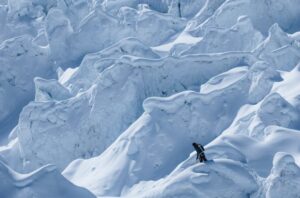
The huge seracs and crevasses of the Khumbu Icefall are the most serious objective danger on Everest, Lhotse, and Nuptse. (All three peaks share that part of the route.) Here, a swiftly moving glacier generates gigantic chunks of ice, some as tall as a multi-story building. The glacier’s constant movement makes these blocks so unstable that they eventually collapse, burying anything underneath in tons of ice. Many have died from such collapses in the Khumbu Icefall.
On April 18, 2014, for example, one such serac fall killed 14 Sherpa workers. The 2015 earthquake killed a further 19 when the resulting avalanches from nearby Pumori hit Everest Base Camp. It was the most lethal accident ever on Everest. Since then, the Icefall Doctors try to avoid the terrain below the Western Shoulder of Everest and instead look for a passage in the middle of the Icefall, or toward the flank of Nuptse.
Three other Sherpa workers died in a similar accident in April 13, 2023. They were buried in a serac collapse as they carried equipment to higher camps.
In recent years, a looming serac threatened several Everest expeditions in the off-season, including Andrzej Bargiel’s first attempt to ski down the mountain and Alex Txikon’s winter attempt.
This is also not the first time that circumstances have delayed the start of the Everest season: the same happened in 2024.
The Icefall Doctors must not only find a relatively safe route across the Icefall and fix the way with ropes and ladders across crevasses and among the seracs. They also have to maintain this route through the season, readjusting the ropes and ladders almost daily while monitoring potentially deadly seracs. Last year, for instance, one of those walls of ice prompted an early closure of the Everest route.
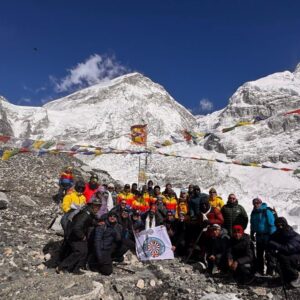
The 2026 Icefall Doctors some days ago in Base Camp. Photo: Sagarmatha Pollution Control Committee
Everest Base Camp
Meanwhile, Everest Base Camp swells in population by the day. Check the video below, shot today:
“It’s insane; this base camp is hosting 3,500 people!” posted Justin Sackett, a no-oxygen climber from the U.S.
Meanwhile, Sackett’s partner, Ryan Mitchell, came down with a gastrointestinal bug shortly after arriving at Base Camp and is now on oxygen in his tent. We’ll look into whether this invalidates a future attempt to climb the mountain without oxygen once he recovers.
Luckily for expedition leaders, most Everest climbers are still acclimatizing on lower peaks or at home in hypoxic tents and are not yet waiting in Base Camp. However, more newcomers will arrive this week. Lucas Extreme, the Polish adventurer traveling from the Bay of Bengal in a vintage bicycle, is already in Lobuche and expected in Base Camp tomorrow.