Two weeks ago, we reported on several Arctic expeditions scheduled to begin in late March and April. Some are already underway, while others are about to start. Here, we round up the latest progress and preview upcoming expeditions across Greenland, Svalbard, the Canadian Arctic, and beyond.
Greenland
Australian glaciologist Marcus Arnold completed a shakedown trip in Svalbard and has now moved on to Greenland. He is preparing for a 400km solo, unsupported ski circumnavigation of Milne Island, the territory’s third-largest island. After waiting out poor weather for four days, Arnold plans to take a helicopter to his starting point. His latest update suggests he will leave in the next day or two.
Looking ahead, an international four-man team kiting from Kangerlussuaq to Qaanaaq has yet to begin. Likewise, Mike Keen’s manhauling trek across Melville Bay. Both are scheduled to begin next month.
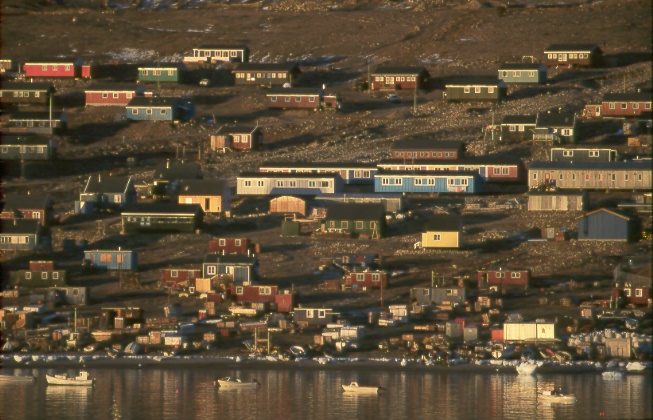
Qaanaaq, Greenland, the world’s northernmost town. Photo: Jerry Kobalenko
Svalbard
Guides Thomas Sorensen and Morten Rejkjaer are five days into an unsupported snow-kite circumnavigation of Svalbard. The remote Arctic archipelago lies far north of mainland Norway, a scenic white land of glaciers, sea ice, and mountains. Setting out from Longyearbyen, their route takes them north to Verlegenhugen, the archipelago’s northernmost point, then south to Soreneset, before returning to Longyearbyen. They estimate that the entire journey will cover around 1,000km.
Writing on social media, Sorensen and Rejkjaer explained their initial objective:
“The first distance goal is to reach Verlegenhugen and kite back — hopefully with the time and conditions to reach the full route and get the chance to be in the fascinating national park in the south.”
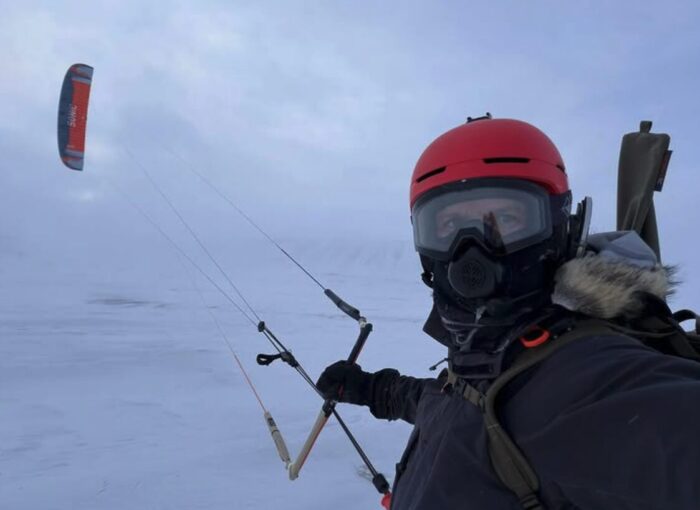
Sorensen on the first day of the expedition. Photo: Thomas Sorensen
Their first expedition update, shared at the end of day one after covering approximately 60km, highlighted the challenging conditions. “The start of the trip has been really tough. Lots of rocks and gusty headwinds. Crossed a narrow, long valley where there was more stone than snow. There has been a lot of crossing against the wind.”
Elsewhere, Alexander Read and his 10-year-old daughter Mina will set out on a 600km sled journey south to north across Spitsbergen five days from now.
Following a similar route, a team of six women, Christine and Veronica Fore, Cecilie Rydberg, Ellen Burchard, Ingvild Ferangen, and Karen Kylleso, are preparing for a 35-day, 650km sled expedition. Their journey will take them from southernmost Svalbard to Verlegenhuken in the north. It will begin soon, although they haven’t announced the exact start date.
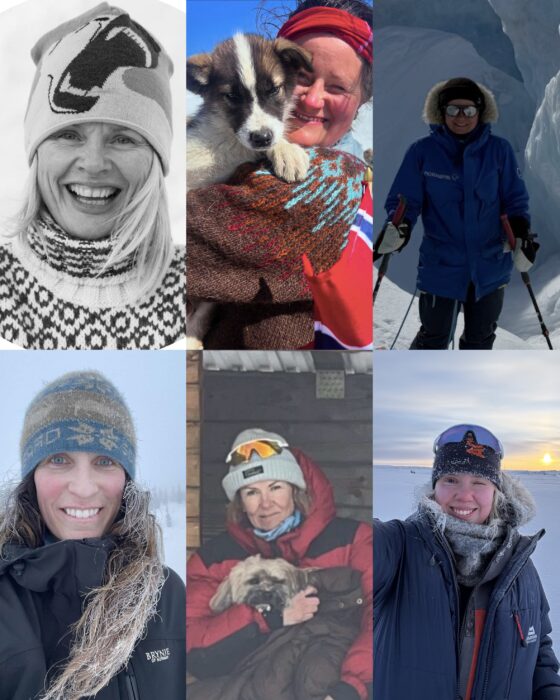
The all-female and all-Norwegian team, with Kylleso at bottom right. Photo: Karen Kylleso
Two women’s expeditions
Speaking to ExplorersWeb, Kylleso, the youngest person to ski solo and unsupported to the South Pole, outlined the trip ahead: “The biggest challenges waiting for us will be moving sea ice, unstable glaciers, and of course, polar bears. We have been glacier training, discussed different scenarios, and practiced with our rifles.”
In northwestern Spitsbergen, an international team of five women known as Girls Trip will ski 200km across glaciated terrain from Ekmanfjorden to Magdalenefjorden next month.
Finland
Finnish adventurer Juho Kara is about to finish snow-kiting 700km along Finland’s west coast. He has around 120km remaining.
Kara set out from Rauma on February 20, a coastal town on the Gulf of Bothnia in southwest Finland. His route follows the length of the gulf, traveling primarily over sea ice, to Tornio on the northern border with Sweden.
Throughout the expedition, his social media updates have highlighted challenging conditions, including stretches of weak ice and the need to navigate across active shipping lanes.
On day six, Kara fell through thin ice into coastal waters. He avoided injury and frostbite thanks to a lightweight drysuit worn beneath his outer layers.
More recently, he shared footage showing how he has been bypassing shipping lanes by kiting across sections of open water, towing his sled while wearing the drysuit.
As of yesterday, he had reached the area near Oulu, a city roughly halfway up Finland’s west coast, and was continuing over ice covered in surface water, with the final 120km still ahead.
Canadian Arctic
Preet Chandi of the UK is now nine days into a 1,000km+ sled journey from Resolute, on the southern coast of Cornwallis Island in the Canadian High Arctic, to Ellef Ringnes Island and back. Although she hasn’t said as much, she seems to be following a once-popular route to the old location of the North Magnetic Pole. In the 1990s and early 2000s, dozens skied that route from Resolute, but no one has done a round trip.
Her route rounds Nunavut’s Cornwallis Island, site of the hamlet of Resolute, one of the northernmost communities in Canada and a historic hub for polar expeditions and scientific research. It then proceeds north along the frozen east coast of Bathurst Island and over the sea ice to Ellef Ringnes, first named by Norwegian explorer Otto Sverdrup in the early 1900s.
Chandi set off on March 12 from Resolute, hauling two sleds with 60 days’ worth of food and fuel.
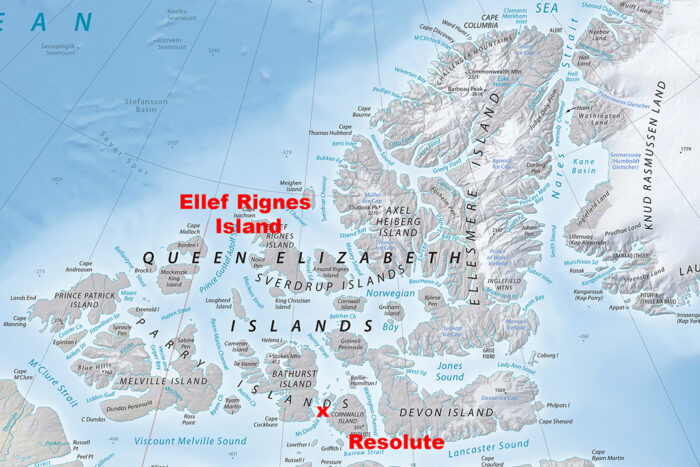
Map showing Resolute and Ellef Ringnes Island, with Chandi’s current location marked with an X. Map source: shadedrelief.com
She has since reached the southeastern coast of Truro Island, a small, low-lying island between Cornwallis and Bathurst Islands, surrounded by shifting sea ice that can make travel particularly complex.
Progress has been relatively slow, with 89km covered by day eight. Yesterday, she reported: “total whiteout conditions, jagged rough ice, and 50kph winds.”
Chandi had originally planned a solo expedition to the North Pole from northern Ellesmere Island, the northernmost island in Canada and a common launch point for past North Pole expeditions.
However, she was unable to secure sufficient funding in time to arrange a flight with the charter airline Kenn Borek, which has not flown to North Pole starting points on Ellesmere since 2014.
Lake Baikal
Irish adventurers Stafford Tyrrell, 31, and Mark McInerney, 32, are now 17 days into their attempt to circumnavigate Lake Baikal. So far, they have covered approximately 230km.
They set out from Listvyanka, a small town on the lake’s southwestern shore, initially heading south to Kultuk. After reaching Kultuk, they turned back and began traveling north along the western shoreline.

The glassy surface of Lake Baikal. Photo: Scott Gilmour/weatherised.com
At present, the pair is a few days north of Listvyanka. Their current trajectory, continuing up the western side rather than crossing toward the eastern shore, suggests they may have revised their plan to circumnavigate the lake in favor of a south-to-north journey. It is unlikely at their current pace that they would be able to complete their original 1,400km+ route.
Tyrrell and McInerney have provisions for around 50 days.
Alaska
There has been no recent update from Kyle Sprenger, who was expected to be five days into a roughly 600km solo sled journey across a remote region of northwest Alaska. His social media accounts have since been deleted, and his current status is unclear.