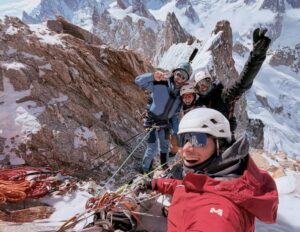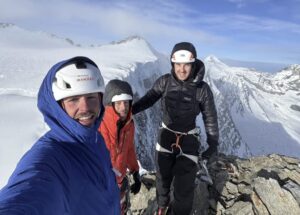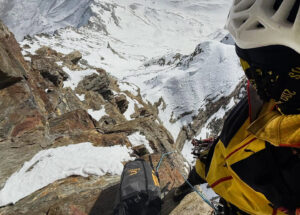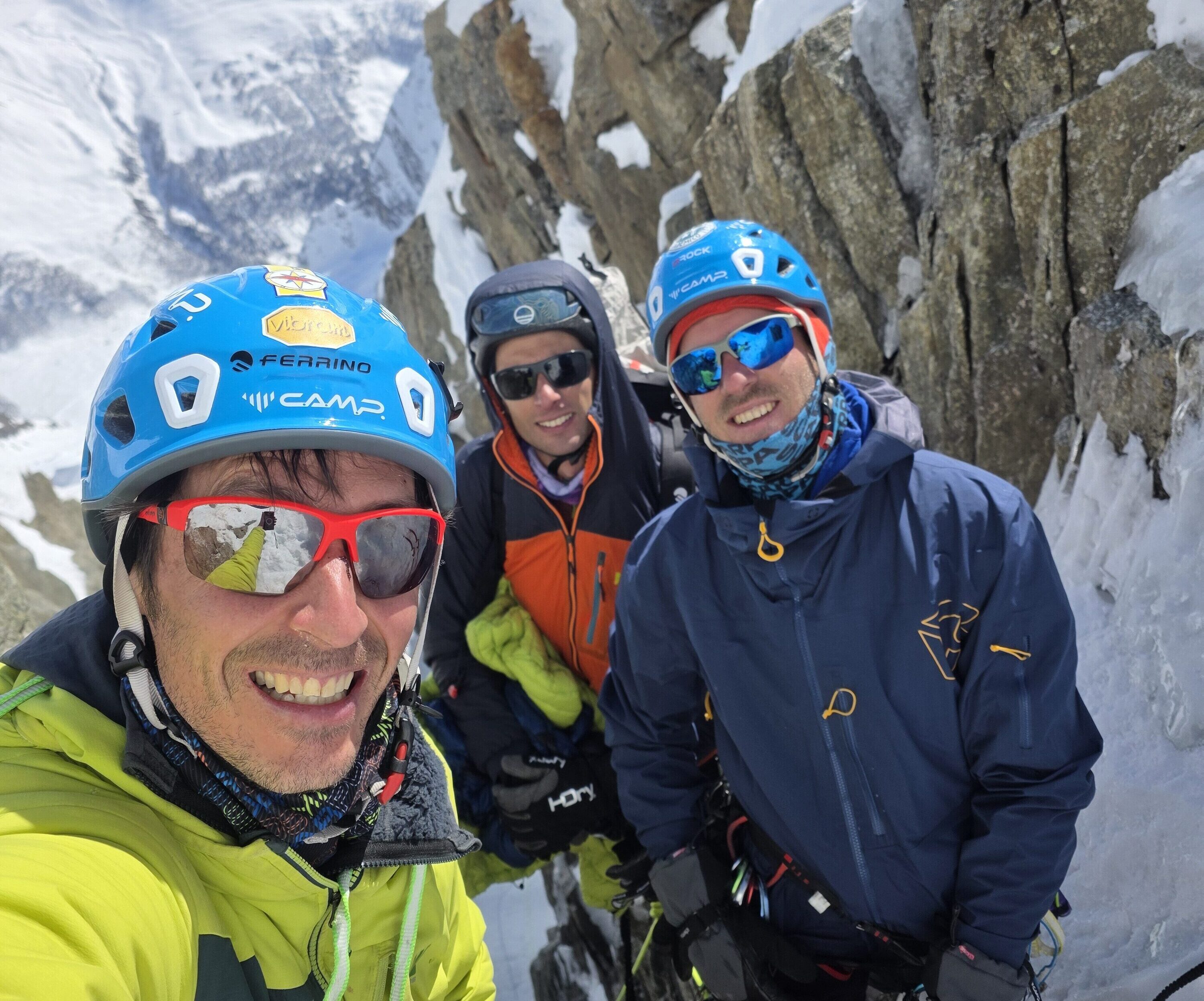
Ice, rock, mixed terrain, dry tooling, and impressive views of Mont Blanc combine in the new route just opened by Italians Matteo Della Bordella, Mirco Grasso, and Giacomo Mauri on the south face of the Petit Jorasses.
Their new 520m line Mutante has an estimated difficulty of M8 in the mixed sections, 6c on rock, and AI4+ on the glacial ice sections.
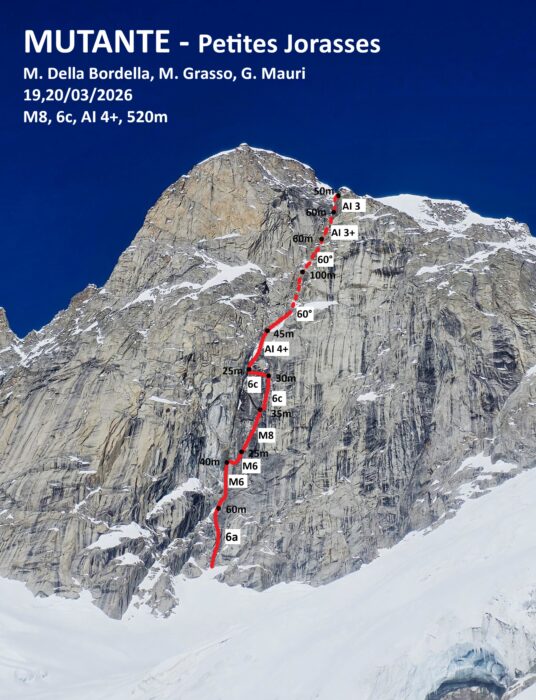
Route topo: Matteo Della Bordella
Unusual in winter
The Petit Jorasses is popular in summer with hard-core trad rock climbers, thanks to the shelter provided by the Gervasutti bivouac and classic routes such as the Bonatti-Mazeaud (some 50m away from the new line). However, it is rarely visited in winter, when climbers usually aim for shadowy north faces and not south sides like this one. In winter, sun-exposed faces usually have more unstable snow.
“And yet there’s this obvious line, which goes up a gully and, at a certain point, requires [surmounting] an overhanging section to get out,” Della Bordella said in a press release.
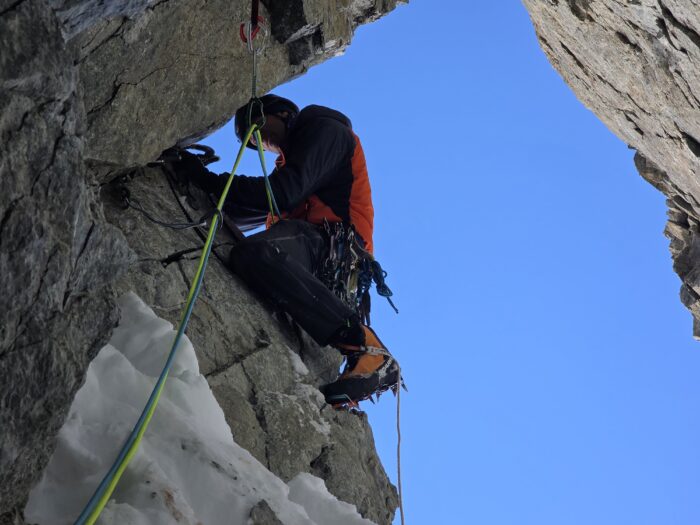
The gully section, plastered in ice. Photo: Matteo Della Bordella
In summer, climbers avoid that gully, which is usually dark and wet. Della Bordella thought the gully would prove interesting when iced up in winter. It was also a great opportunity to find a new route on the overclimbed Mont Blanc massif. This is something of a speciality for Della Bordella, who has already opened three other routes on Mont Blanc. Grasso and Mauri signed up for the climb as soon as they were told about it.
New line in known terrain
“For me, this route came completely out of nowhere: I had never been on this face and only started looking at it when Matteo suggested I join,” explained Mirco Grasso. “It seemed almost impossible that such an obvious line on Mont Blanc hadn’t already been climbed.”
The team faced a great deal of uncertainty about the conditions on a south face in late winter. In the end, their audacity paid off.
“It turned out to be a beautiful route, not extreme but still challenging, with some ice pitches that make it special,” Della Bordella said.
A bit of everything
On such varied terrain, each section required different progression techniques:
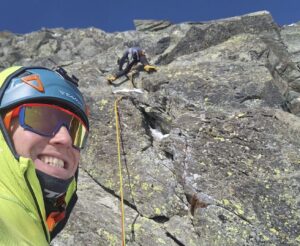
The route begins with pitches on mixed rock and snow, followed by sections of dry tooling — including one particularly aesthetic and challenging pitch — before moving on to a section of smooth rock, where ice axes and crampons must be abandoned for climbing with hands and boots, including a delicate traverse slab.
An ice section on a mostly rocky route. Photo: Matteo Della Bordella
The upper section features a beautiful pitch on ice that leads to the mouth of a snow gully, where the difficulties ease and the route takes on the characteristics of a classic Mont Blanc goulotte all the way to the summit.
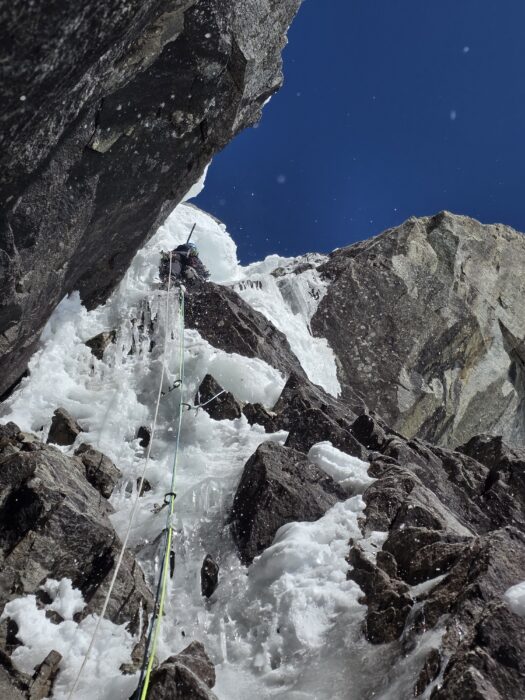
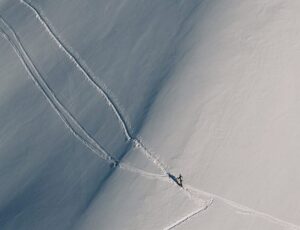
The ascent took place on March 18-20. On the first day, the team approached the face on skis, opened the first four pitches, then spent the night at the Gervasutti bivouac. They completed the rest of the route on the following day.
“We found a belay station and some pitons at the top of the first pitch, evidence of a previous attempt,” the team noted. They descended by rappelling down the route.