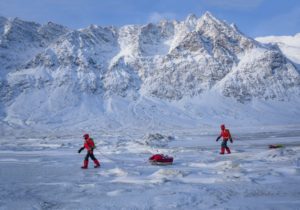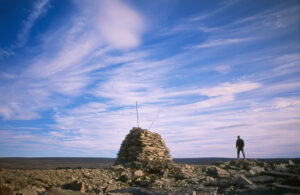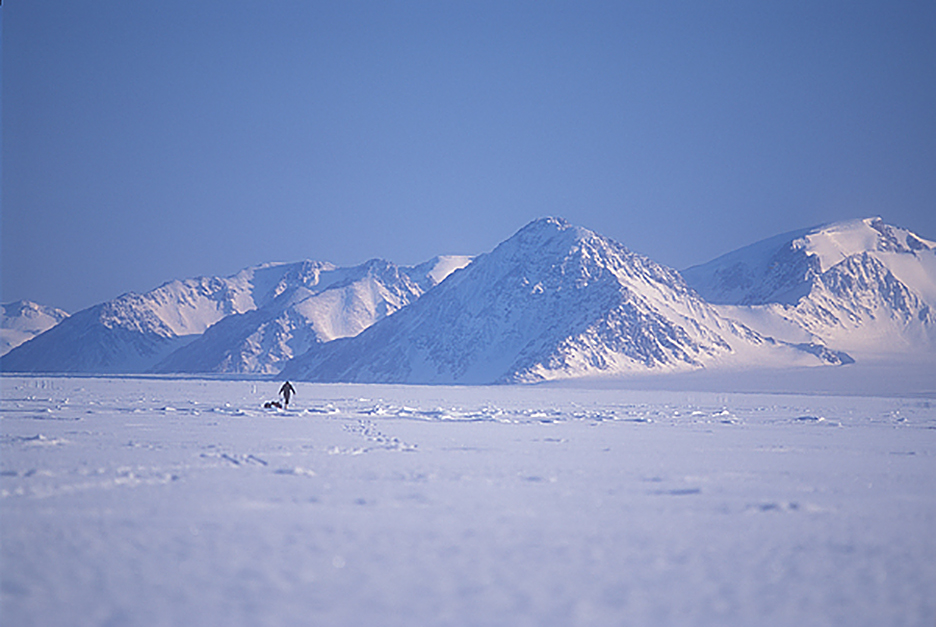
A manhauler’s pace depends on snow conditions, temperature, and walking or skiing cadence.
Of these, snow quality is the most important. Hauling a heavy sled through knee-deep powder is gruesome aerobic exercise. You have to stop to catch your breath every 50 or 100 steps. After six hours of this, consider yourself luck if you’ve covered six kilometers. In such snow, you have to put aside all expectations of gobbling distance. I’ve hauled as little as five kilometers in bad snow and as much as 70km in a day on good snow, and the 70km was easier.
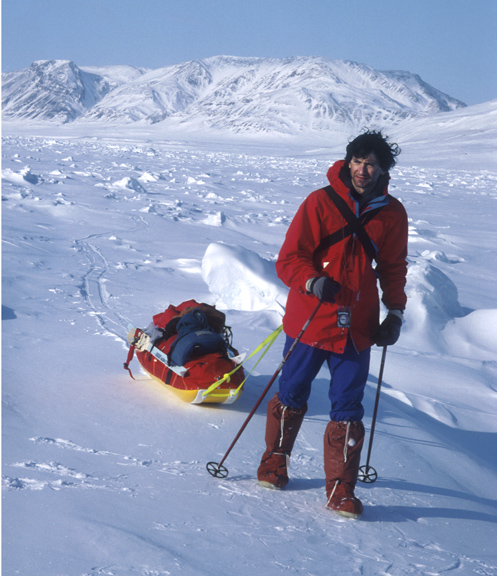
Sidewalk snow. A good cadence can allow a pace of 4-5kph. Photo: Jerry Kobalenko
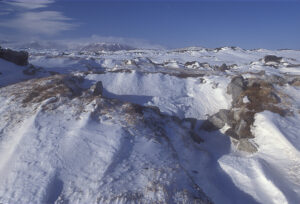
What makes sledding with heavy loads possible in the polar regions is that wind and cold transform powder snow into a hard surface. The best is so hard that the feet barely make an impression. I call it sidewalk snow, because it’s no harder than walking on a sidewalk.
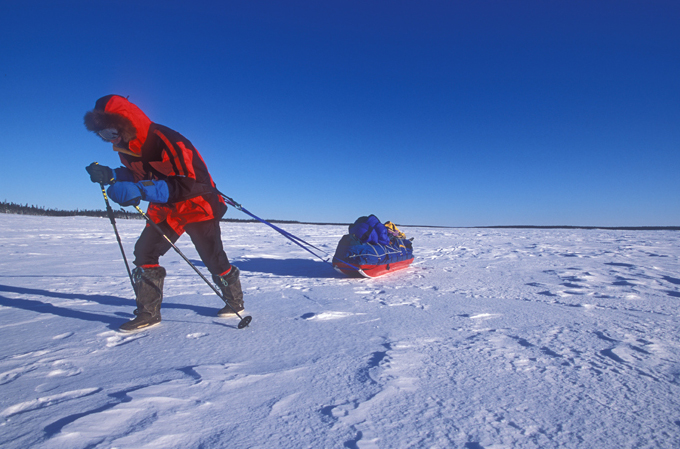
Even if the snow is hard, a sled glides poorly over very cold snow. The colder it is, the more sled hauling feels like dragging a sack of potatoes. If it’s milder than -17˚C or so, you don’t notice the friction much. Photo: Jerry Kobalenko
Tribology: the study of friction on lubricated surfaces
Temperature is also important in a manhauler’s pace. One theory suggests that we glide on skates or skis because the friction from forward motion melts a microthin layer of water that lubricates the interface between snow and ski. That is also the case when a sled glides easily. I’ve also read that this isn’t the case, or that the gliding mechanism is unclear. However, a recent paper reinforces that old theory.
Part of the theory is that below a certain temperature, the lubricating film of water does not form. Skis — and sleds — then move more reluctantly. Whatever the explanation, in extreme cold, sleds are much harder to pull. It’s easy to notice the difference. In milder conditions, when a manhauler stops, the sled glides forward for an extra 30cm or so. When it’s very cold, below -30˚C, it stops dead.
The colder it is, the more the friction increases. It never seems to level out. Even -54˚C (the coldest I’ve been in) hauls worse than -50˚C. Friction becomes noticeable below about -20˚C. This refers to actual temperature, not windchill.
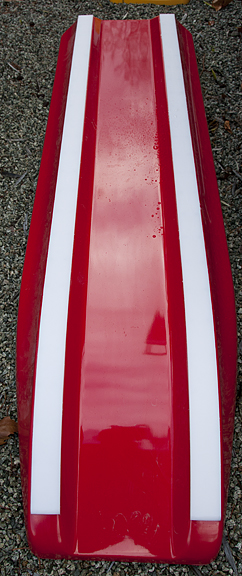
A slight catamaran style of sled reduces the surface area in contact with the snow — less friction — but doesn’t deprive the interior of too much space, like a more exaggerated style of catamaran sled would. Photo: Jerry Kobalenko
Skis vs snowshoes
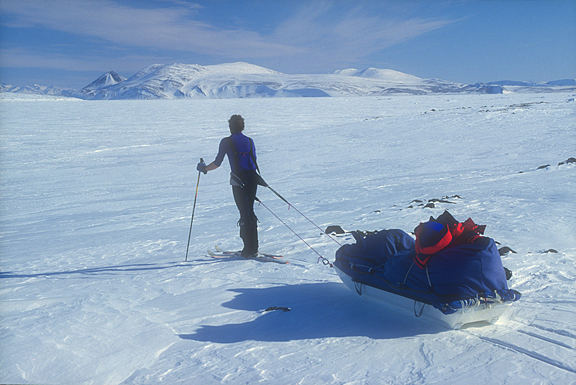
Skiing on hard snow is faster than walking only if you ski well enough to get a little glide with each stride. If you’re just shuffling on skis, walking is faster, as long as you have comfortable walking footwear, such as soft mukluks, and the snow is hard enough to support you. Photo: Jerry Kobalenko
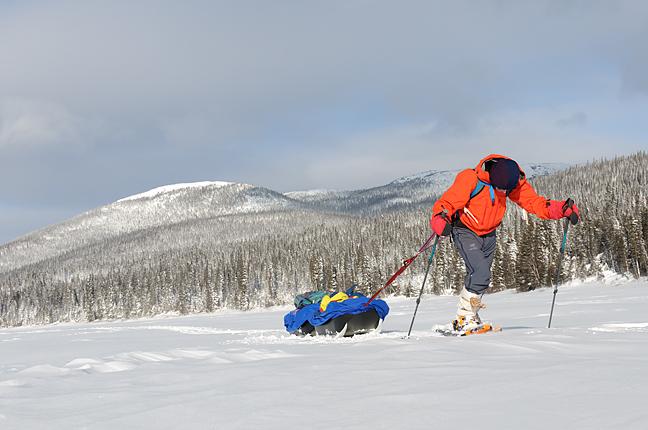
Skis vs snowshoes: You have to lift a snowshoe on every step, while skis take less effort, because you just push them forward with each stride. You are never lifting the entire weight of the ski. Photo: Jerry Kobalenko
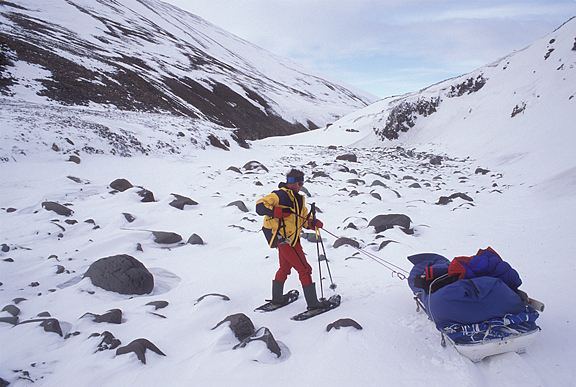
In very deep, soft snow, or in forests, broken sea ice, or rock gardens where tight maneuvering is required, snowshoes are better. Photo: Jerry Kobalenko
Cadence
Cadence is one’s natural walking pace. Try it outside: How many steps do you take in a minute on a sidewalk? That’s your cadence.
We all have a natural cadence, and that applies to sledding too. I did a couple of sledding expeditions with a partner who was a great guy and very strong, but he was an ambler. He ambled on the street, and he ambled as a sledder. Because of that slow pace, 86 to 88 steps/minute on good snow, we could never hit 35km/day, even after a long day.
For whatever reason, I’m a fast walker. My sledding cadence on good snow matches the beat of Bonnie Tyler’s It’s a Heartache. While sledding, I sometimes listen to that song over and over to drive me along.
On one of my early Ellesmere Island expeditions, I wanted to see how fast I could go. Today, adventurers might market such a project as a speed record attempt, but I was just curious. The snow was good, and I covered 500km in 11 days, almost all walking. The pace was a little slower than Vincent Colliard’s 1,000km speed record from Hercules Inlet to the South Pole. (Colliard skied.)
A future project?
I spoke to Colliard last fall about the 1,100km Ellesmere north-to-south expedition he and Borge Ousland did in 2025. Based on my early experience, I’ve long felt it was possible to manhaul the island from north to south, unsupported, in under a month. It took Colliard and Ousland 49 days, but they weren’t hurrying, and the two previous north-to-south expeditions were supported and took considerably longer. Colliard agreed that a sub-30-day crossing was possible.
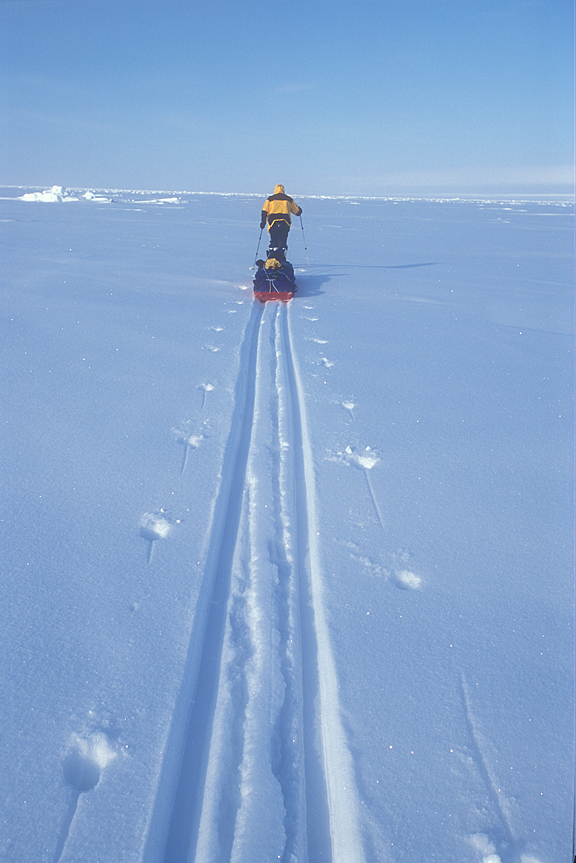
Regardless of your preference, softer snow needs skis or snowshoes; no walking on this. Photo: Jerry Kobalenko
I kept notes of my cadence on that fast early trip. For the first couple of hours, it was 119 steps/minute. After three hours, it was 114 steps/minute. After seven hours, 110 steps/minute. After 10 hours, 100 steps/minute. And at the end of the day, after 12 or 13 hours, it was down to 92 steps/minute. I averaged about four kilometers an hour.
The 119 steps/minute was about as fast as I could naturally go. A few years later, I kept pace with an athlete friend at 122 steps/minute for two hours one morning when he was feeling energetic. I managed, but it was a little fast for me. At that cadence, we were half trotting.
One’s cadence changes over time. Recently, as a mature sledder, my maximum sustainable pace is 112 steps/minute.
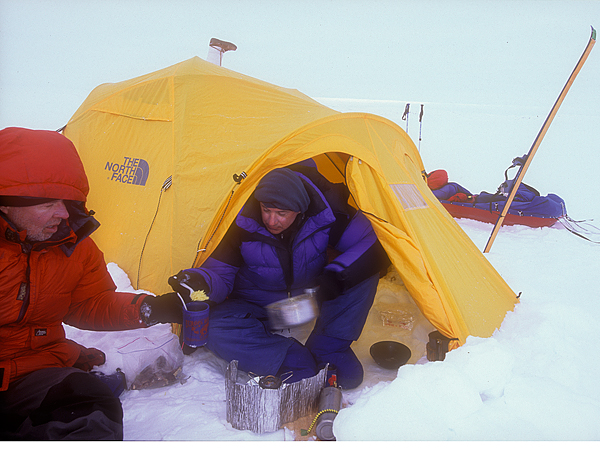
Full-width climbing skins, above, give lots of grip but no glide. Cutting the skins lengthwise in two, so they are just 2.5cm wide, is adequate for any sled hauling. Photo: Jerry Kobalenko
Cadence slower on skis
Again, pace depends on the snow, temperature, the weight of the sled, your natural cadence, and whether you’re skiing or walking. I don’t think anybody except competitive skiers can ski at 119 strides/minute. My manhauling cadence on skis is 90 to 92/minute. This covers just 2.5km/hour and feels very slow. Note also that when manhauling, whether walking or skiing, you’re not on a trail unencumbered, but on an uneven surface, towing a heavy sled behind you.
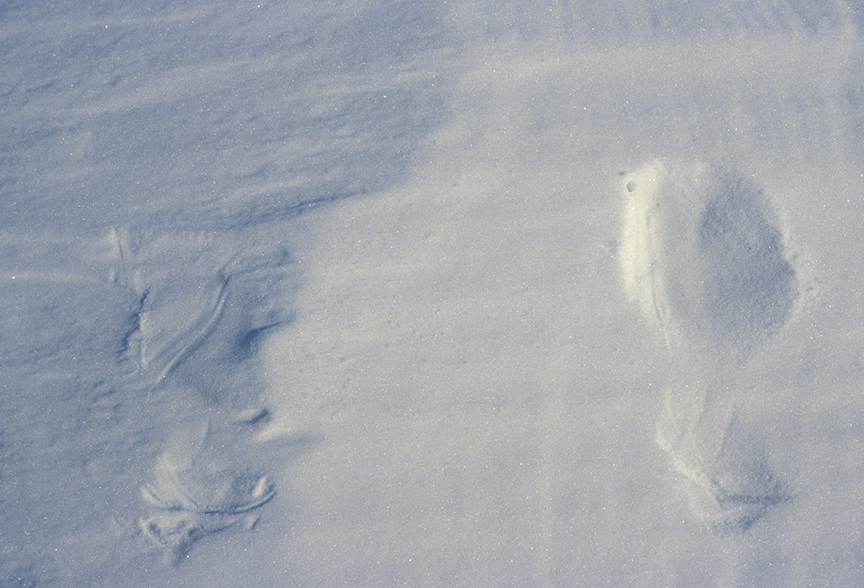
The snow on the upwind side of sastrugi, left, is always harder than snow on the downwind side. In this case, the snow is so hard overall that the difference doesn’t matter. But in marginal conditions, it does. The upwind side may support you, while you might sometimes break through the crust on the downwind side. Then you have to decide whether it is easier to ski or to walk. Photo: Jerry Kobalenko