As soon as we started leaving the farm for cities, there emerged a few who thought: Maybe we should go back to farming. If you know someone who posts a lot about “cottagecore” but has never done manual labor, you are familiar with the type. You may also be that type — there’s no shame in it.
In 1841, a group of literary figures and philosophers, including author Nathaniel Hawthorne and social reformer George Ripley, founded a farming community based on the Romantic ideals of Transcendentalism. Like many before and after, their utopian dreams were quickly dashed by the reality of actually building a self-sufficient community. Hard work, disease, interpersonal drama, crop failure, and the occasional burning building quickly ended the experiment.
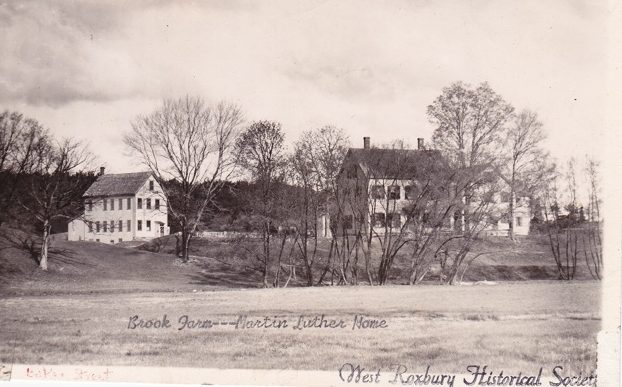
Unsuccessful farm commune, Brook Farm, in Massachusetts. Photo: West Roxbury Historical Society
Everyone loves farming (in theory)
Since classical times, great writers and thinkers have extolled the virtues of a simple life, connected to the land, with lots of physical work and fresh air. For some reason, very few of them actually chose to follow that ideal life. The Venn diagram of people who can farm and those who have the political and economic power to establish a utopian community looks like two non-overlapping circles.
Thomas More’s influential 1516 work Utopia described an ideal society where all classes worked side by side in the fields. The work was dignified and honorable. But More himself never tried it. He was a lifelong city-dweller, and besides, he was too busy being beheaded.
A few groups that actually knew how to farm tried starting utopian communities. The Diggers were a small radical group during the English Civil War, led by a failed cloth merchant named Gerrard Winstanley. With a few dozen followers, he established a rural commune in Surrey. His many pamphlets espoused a sort of religious proto-communism which held all land in common and emphasized the nobility and rights of farmers.
Unfortunately, local landowners and the government did not agree with sharing the land. Organized harassment and mob violence forced the Diggers to disband.
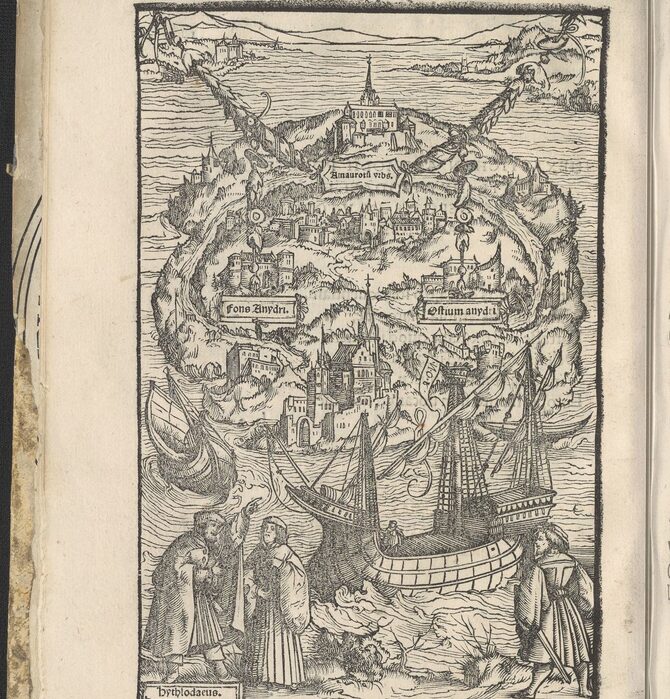
A map of More’s theoretical Utopia. Photo: Library of Congress
Anti-sharks and anti-whales
Utopian communes exploded in popularity in America in the 18th and 19th centuries, inspired partly by earlier English efforts. American utopianism goes back to the days of the Pilgrims, who themselves went to the colonies to pursue their imagined religious utopia.
Many of these groups, who isolated themselves from broader society in tightly knit farming communities, were religious. Fourierist communities — named for French theorist Charles Fourier — enjoyed a brief popularity in 1840s America, decades after Fourier’s death.
Fourier’s peculiar beliefs — that once the new world was established, humans would live for 144 years and develop prehensile tails, living in harmony with a new rideable animal called an “anti-lion” — did not enjoy the same popularity as his notions about communal living. I can’t imagine why. I need to move on, but you should know he also believed that there would be anti-sharks and anti-whales.
Over a dozen Fourierist communities sprouted up, blended with Transcendentalist principles. These groups attempted a form of collective living, where women participated equally. Instead of wages, everyone shared the profits.
The Owenites were another quasi-utopian rural movement, though they were explicitly anti-religious. Their most famous community, New Harmony in Indiana, quickly failed due to a lack of laborers and skilled craftsmen, and the shocking discovery that it is actually quite difficult to produce enough to be self-sufficient.
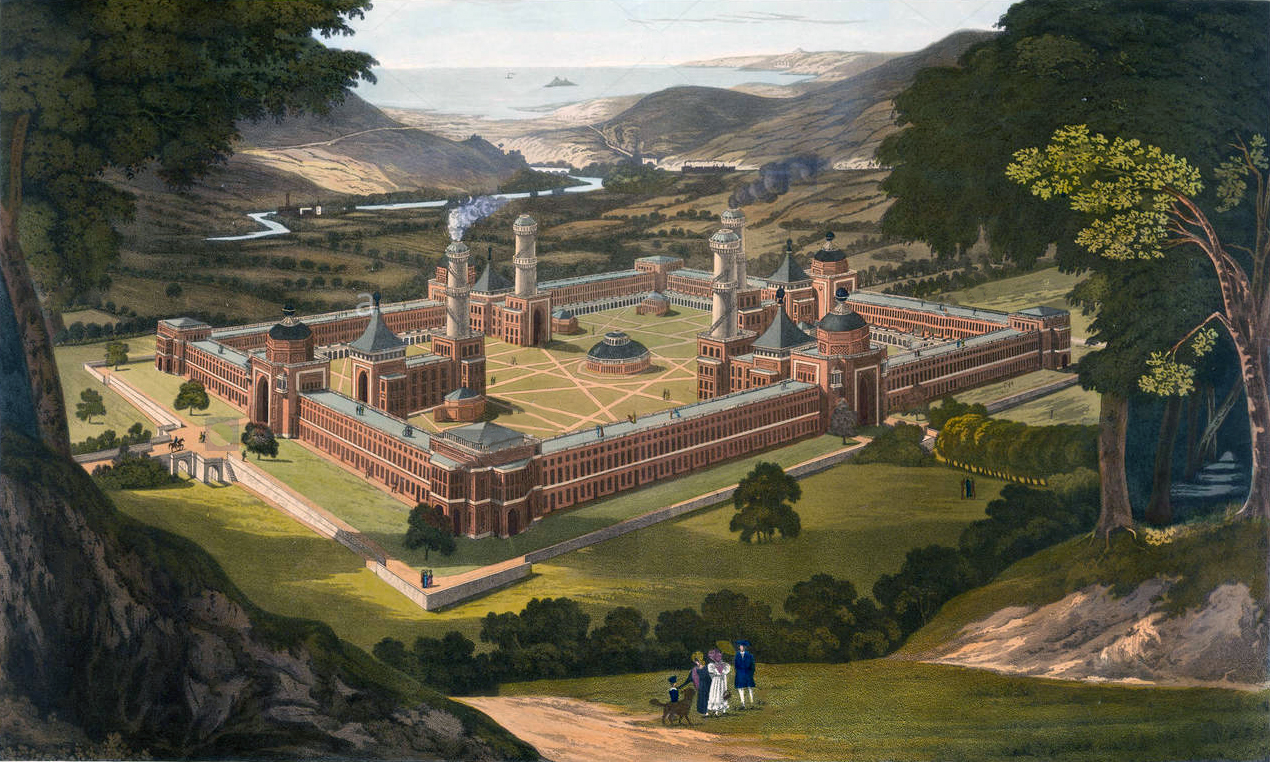
A 1838 engraving of what New Harmony was supposed to look like. It did not actually look like this.
A Transcendentalist Eden in Massachusetts
The final would-be farm commune sprouted from Transcendentalism. A philosophical, religious, literary, and political movement emerging in early 19th-century New England, its practitioners placed the spiritual over the rational and empirical.
For our purposes, it’s most useful to understand it as a movement committed to experimental social reforms and oneness with nature. It was particularly popular among New England literary types. These included Ralph Waldo Emerson, Louisa May Alcott, Henry Thoreau, Walt Whitman, and Nathaniel Hawthorne.
Along with the literary crowd were those with a religious angle, such as Unitarian ministers like George Ripley. In 1836, about a decade after graduating from Harvard Divinity School, Ripley hosted the first meeting of the Transcendental Club. As he became more entrenched in the emerging Transcendental scene, Ripley came into more conflict with the Unitarian church, which he began to see as too moderate.
In 1840, he left the ministry. A year later, he bought the 69-hectare Brook Farm, after raising the money with his wife, Sophia, and a dozen other founding members. As a ringing example of what can happen when intellectuals play at being farmers, let’s examine in detail the fate of this utopian experiment.
It worked this way: Members purchased shares and were then entitled to part of the profits. A number of members failed to pay up, though. As we will come to see, the profit side fell short, too.
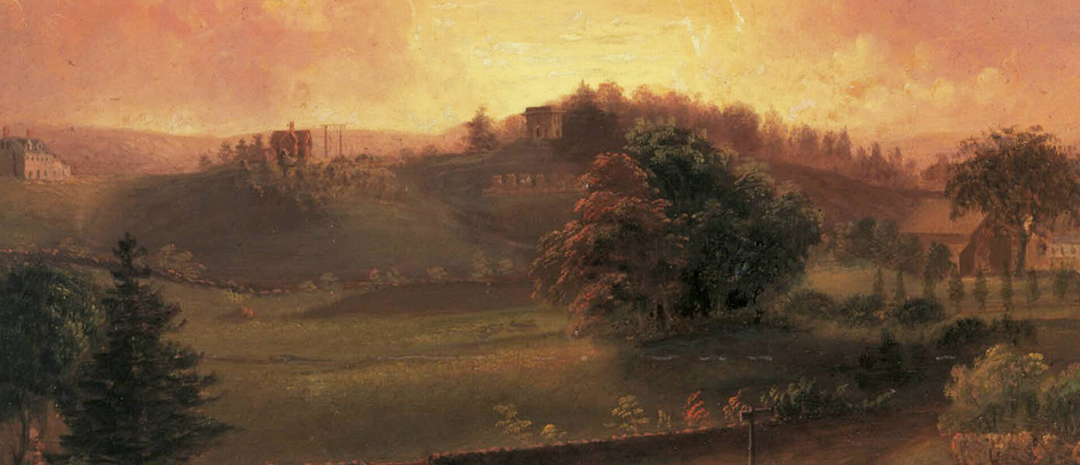
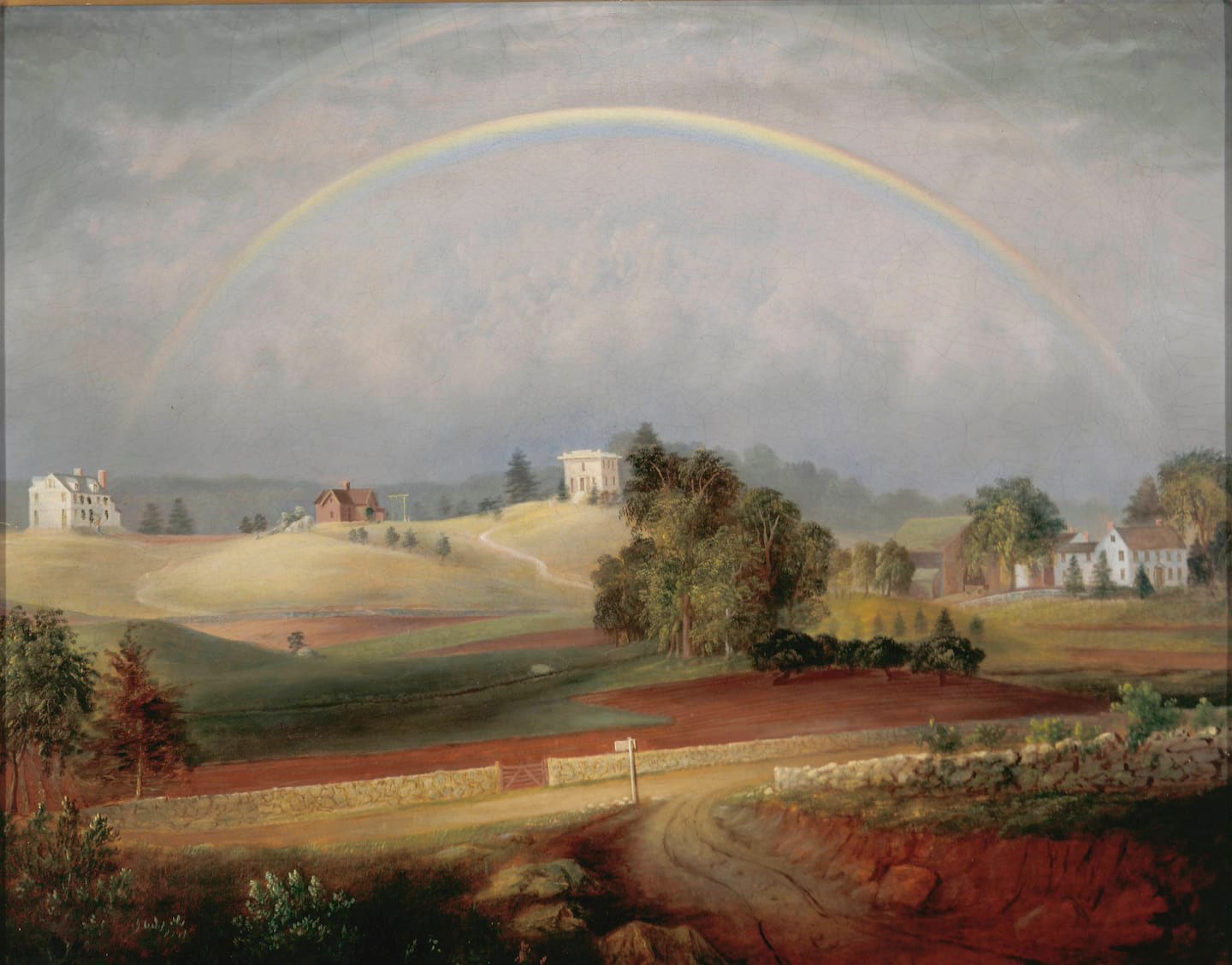
Another Brook Farm painting by Josiah Wolcott. Photo: Massachusetts Historical Society
Early hopeful days
The project launched with 12 members, including the Ripleys. Other founders were printer and naturalist Minot Pratt, his wife Maria, clergyman Warren Burton, and then-aspiring author Nathaniel Hawthorne. Soon, more romantic hopefuls were offering to cough up the $500 to buy a share and become a Brook Farmer.
In a letter to Ralph Waldo Emerson, who declined to join the project, Ripley explained their aims. The goal was “to ensure a more natural union between intellectual and manual labor…guarantee the highest mental freedom, by providing all with labor…[to] permit a more simple and wholesome life.”
The company quickly went into further debt, building houses and workspaces that they christened with poetic names like The Hive, The Eyrie, Pilgrim House, and The Cottage. The farm filled with unique characters, who split their time between manual labor and academic pursuits.
It was an attractive deal for a certain sort of person. A year’s room, board, and tuition at the community school in exchange for 300 days of labor, paid at an equal rate no matter the work or the worker’s gender. The work itself depended, theoretically, on the talents and predilections of the individual. Some worked in the manufacturing shop, others on the farm, still others taught in the school or did household labor.
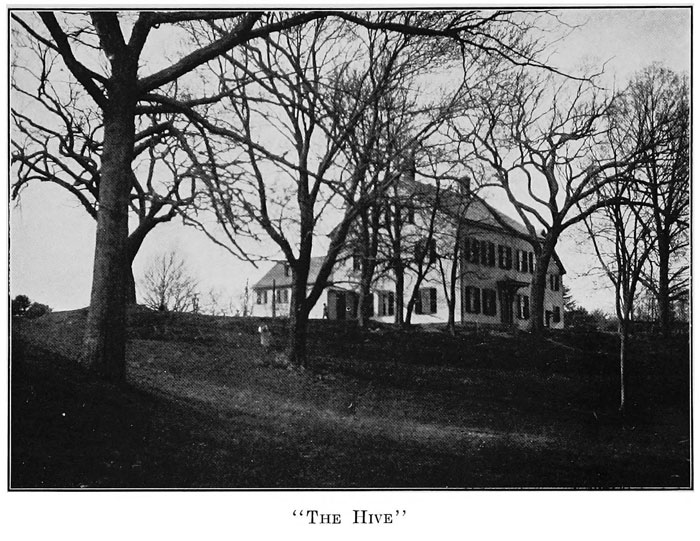
‘The Hive,’ so named because it was the center of activity, pictured in John Van Der Zee Sears’ book.
Life at Brook Farm
At its peak, the farm had around 70 residents, of whom around 30 were paying pupils. While the “farm” part of the farm wasn’t going so hot, they did make some money by educating the children of progressive Boston elites. Many prominent visitors stopped by, including Transcendentalist icons Margaret Fuller, Elizabeth Peabody, and Thoreau.
The lifestyle was fairly simple. One student-resident, John Van Der Zee Sears, wrote with disdain that he was fed mainly brown bread, milk, and brown bread boiled in milk. Hawthorne wrote that they woke at 4:30 am, ate breakfast two hours later, had their main meal at 12:30 pm, and went to sleep by 9 pm.
Peat was the farm’s main source of fuel, and it had to be dug and transported by hand. Even the paying pupils had to work at least eight hours a week. Minot Pratt served as head farmer in the early days, making the most of the poor soil and instructing both children and adult Transcendentalists in botany and agriculture.
Women at Brook Farm wore a uniform that allowed them to move more freely. While the work allocations weren’t quite gender-neutral, women did enjoy greater freedom than in broader society. Brook Farm women were paid equally, worked in the fields, and had full access to the education the farm offered.
The community operated a print shop that published their socialist magazine, The Harbinger, a resource drain on their modest community. For other luxuries, like a new piano, they put on public concerts and gave up butter to save money.
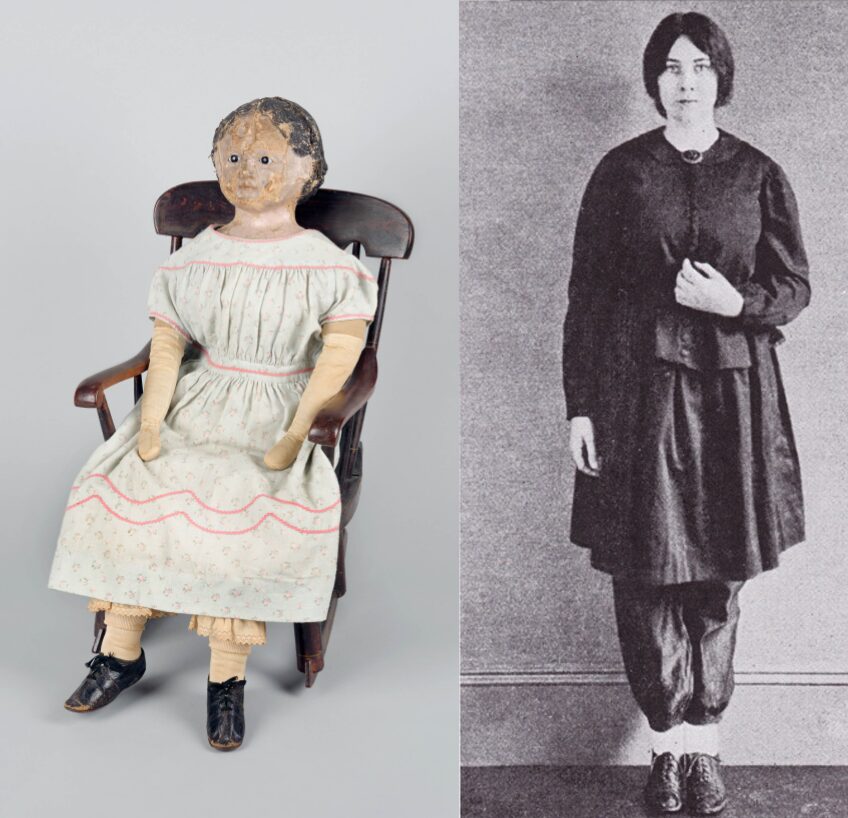
Left, a doll owned by a Brook Farm child. Right, Brook Farm woman in uniform. Photo: Massachusetts Historical Society
Labor is the curse of the world
Hawthorne failed to tame a cow and broke a machine for chopping hay, but frequently praised the beauty of nature and the seclusion from civilization. Toil, he concluded, “defiles the hands, but not the soul.” Soon, however, he tired of the novelty and was writing how “labor is the curse of the world, and nobody can meddle with it without being proportionably brutified!”
Georgiana Bruce Kirby, a young woman who joined Brook Farm for an education, kept a diary of her experience. According to her, Hawthorne was awkward and out of place, “morbidly shy and reserved, needing to be shielded from his fellows.”
Complaining of blistered hands, insufficient time for writing, and a complete lack of financial returns, Hawthorne left Brook Farm after about a year. In his defense, he wasn’t the only literary type dissatisfied with the supposed spiritual benefits of toil.
Emerson, for his part, was increasingly skeptical of the community. It was a bit strange, he wrote, that “one man plowed all day and one looked out of a window all day,” but both were paid equally. Others felt that the work was too hard and it wasn’t really egalitarian, anyway.
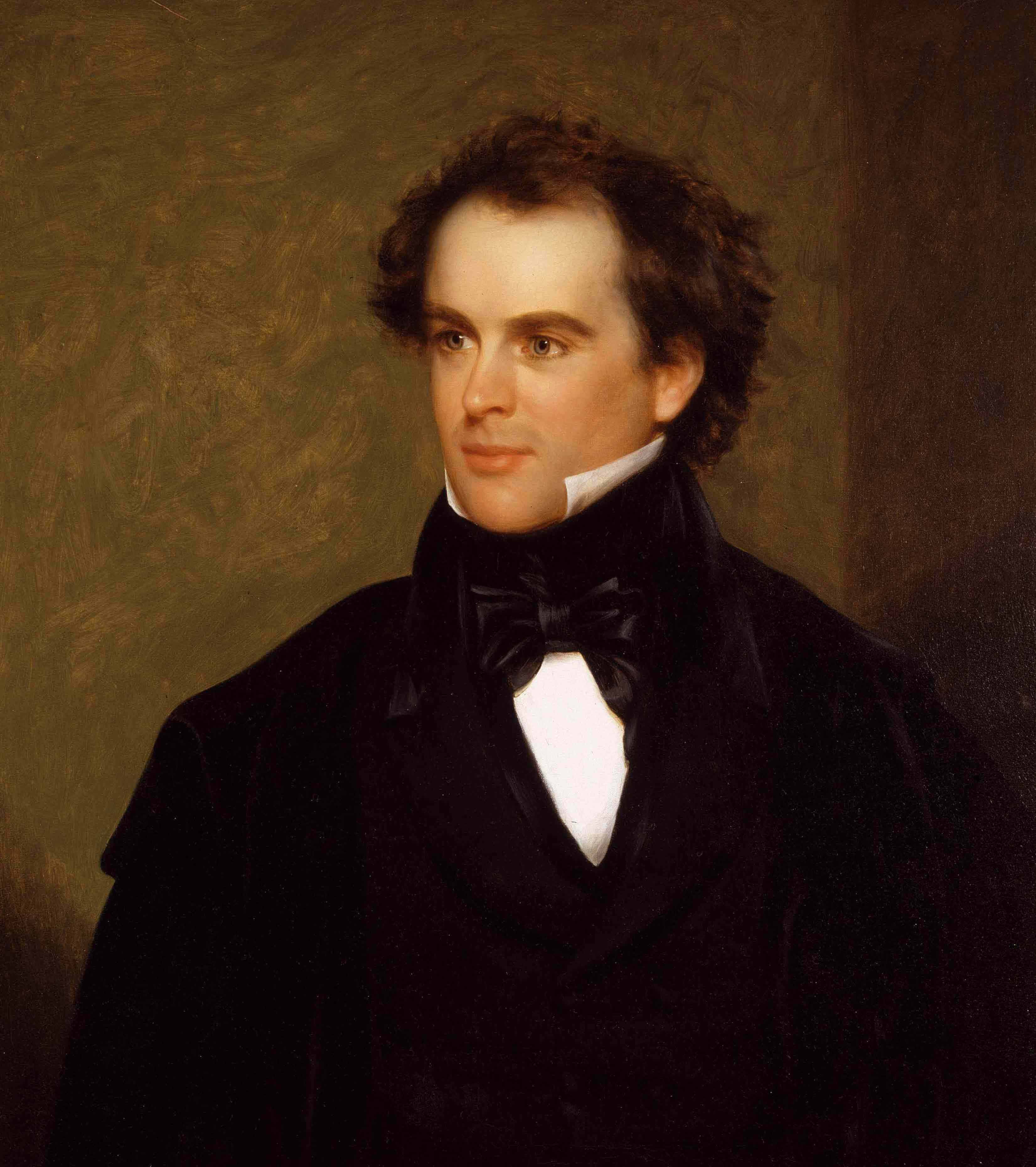
The ‘shyest grape,’ Nathaniel Hawthorne, whom I’m making fun of despite the fact that I, also, would not succeed at subsistence farming. Photo: Peabody Essex Museum
Fruitlands
While Brook Farm stumbled on, a competing Transcendental commune had started up. Amos Bronson Alcott, father of the writer Louisa May, founded the 36-hectare Fruitlands, also in Massachusetts, in 1843.
Where Brook Farm hoped to gain a profit by their labor and social experimentation, the Fruitlanders were philosophically opposed to trade, property, and material possessions. Strict vegans, they forbade coffee, tea, molasses, and for reasons I am still unclear on, rice. Seeking greener grass, a number of Brook Farmers became Fruitlanders.
Alcott argued that animals were spiritually polluting, and humans needed to separate entirely from them. But farming without animal labor was very hard, so they eventually caved in and bought an ox to help plow the fields. The two dozen members successfully planted four hectares of grain, melons, and vegetables. When the ever-skeptical Emerson visited, he noted that they were doing well in July. He was less confident about how they’d be doing in December.
Winter proved Emerson right. Either the ox came too late or the amount of time spent on spiritual wanderings was too great in proportion to that spent farming. By mid-winter, they realized they had not produced nearly enough food. They could stay and starve, or they could give up and return to society. They returned to society.
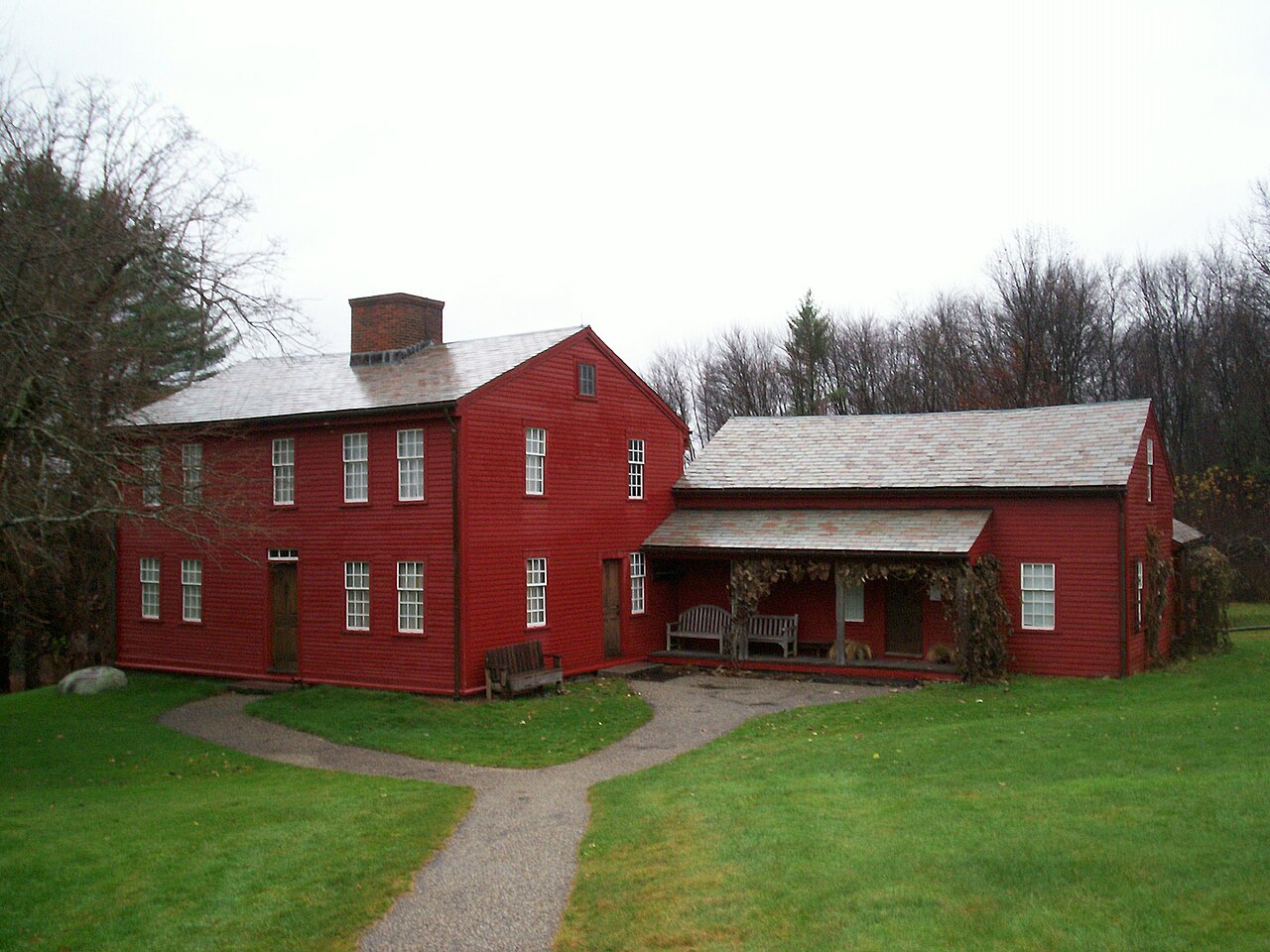
The Fruitlands farmhouse still stands today. Photo: Wikimedia Commons
The final days of Brook Farm
As well as waning interest and growing financial failures, end-of-days Brook Farm suffered two major disasters. The first was a smallpox epidemic.
Sears records that he and a Mrs. Ryekman were quarantined after they spent the afternoon keeping a sick girl company, and a doctor announced that she had smallpox. A dozen members quickly became ill, and all work stopped. Though no one died, the scare closed their only real source of profit, the boarding school.
As the boarders fled and the finances continued to worsen, a rash of mysterious fires destroyed several buildings. First the Pilgrim Hall, then the Eyrie went up in flames. Finally, in 1846, while the residents threw a party celebrating the near-completion of a massive new communal residence, that residence caught fire and burned to the ground. Also, it was uninsured. Whoops.
By 1847, bankruptcy proceedings were wrapping up, and Ripley was selling off all he could to pay the remaining debts. So ended Brook Farm.
Even earlier, in 1845, Hawthorne had sued Ripley for his initial $500 back and won. Like his sometime-friend Herman Melville, Hawthorne fictionalized his misadventures. He insisted that his 1852 work, The Blithedale Romance, was only loosely inspired by his experiences. Many former Brook Farmers, however, recognized their companions within its pages.