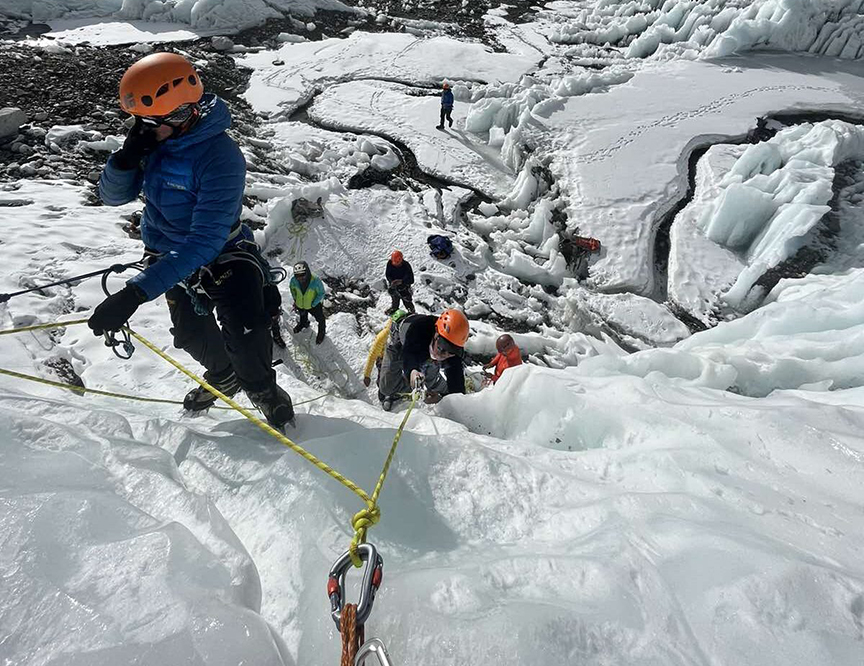
As days go by, the route across the Khumbu Icefall to Camp 1 on Everest remains closed because of a dangerous serac poised to fall over any potential route.
In 2014, a serac fall on Everest killed 16 Sherpas. Everyone is aware of that dark history and is understandably reluctant to play chicken with a precariously poised chunk of ice the size of an apartment building.
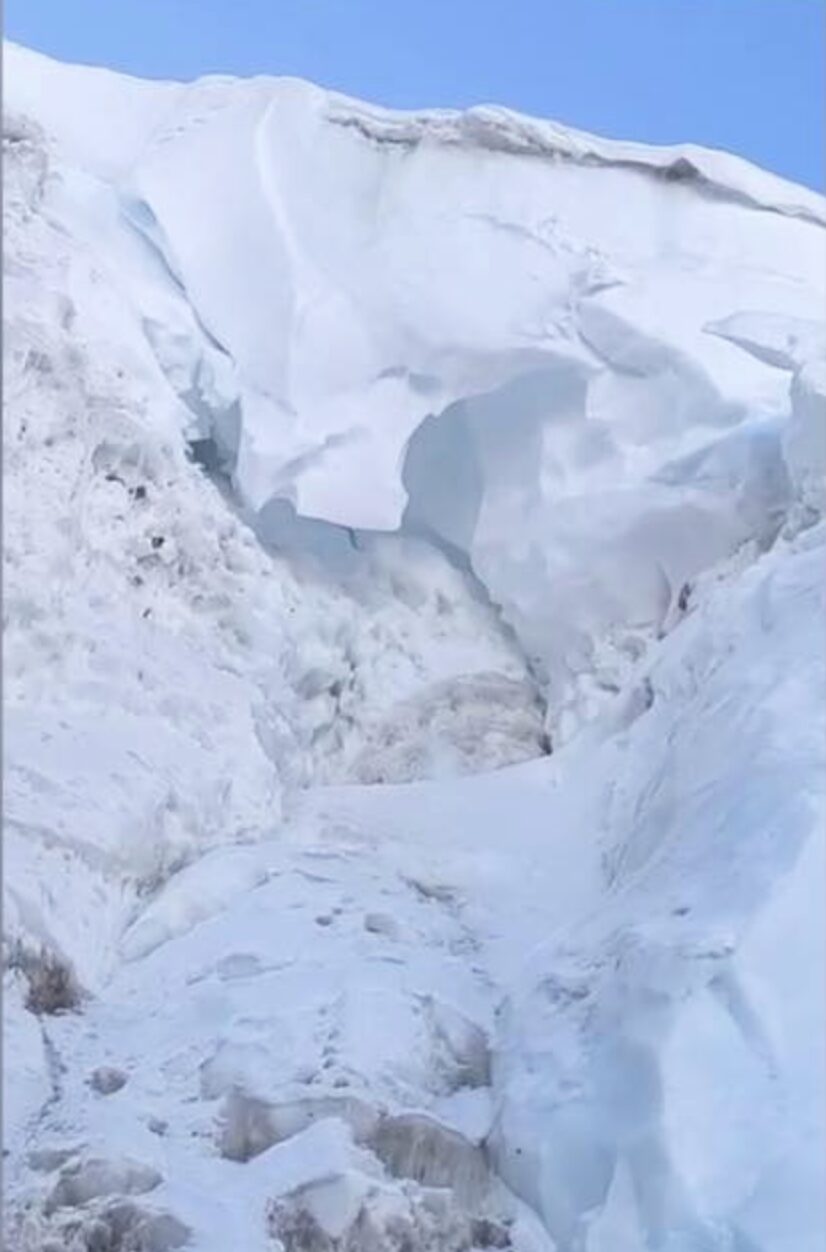
Everest serac ready to fall. But when will it go? Photo: Jen Willis/Facebook
Meanwhile, as 3,000 people wait in Base Camp, authorities scramble for ways to open the route. Just today, the Expedition Operators Association of Nepal (which handles the route from Camp 1 to the summit) and the Sagarmatha Pollution Control Committee (responsible for the Icefall Doctors, who fix the route to Camp 1) received the go-ahead from the Department of Tourism to coordinate with each other, in the hope of finding a solution. The two entities usually work separately.
The route to Camp 1 has not remained closed for so long in over 10 years. Recent delays have occurred, but never for this long. In 2024, the Icefall Doctors twice came to a dead end while trying to find a route through the maze. Still, the Icefall opened on April 17. Last year, icy conditions also hindered progress, but the route was ready by April 10.
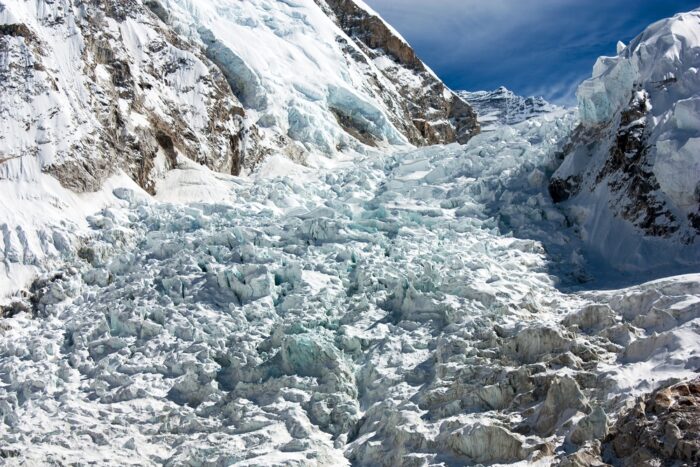
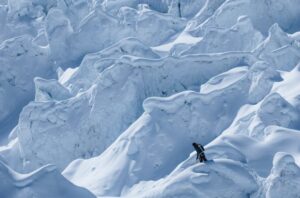
The Khumbu Icefall and Everest’s West Shoulder on the left. Photo: Shutterstock
Current state of things
There is no sign that the situation will self-repair any time soon. Some chunks of ice are falling from the serac — a piece of it broke off between Wednesday and Thursday — demonstrating how unstable it is. But the hope that the entire serac will sluff off in good time and allow the Sherpas to continue their work is proving illusory.
And Tshering Tenzing Sherpa, base camp manager at the Sagarmatha Pollution Control Committee, told The Tourism Times that even if it fell, it would take the Icefall Doctors two to three more days to finish fixing the route to Camp 1.
The problem is not just the short time left for climbers to acclimatize by doing partial routes up and down the mountain before their final summit push. It is the huge amount of work it takes to pitch and supply four higher camps with shelter, food, and oxygen for over 1,000 climbers and staff.
With everybody on the move once the route opens, the queues will be endless, further heightening the danger in the Icefall, where speed is the key to safety.
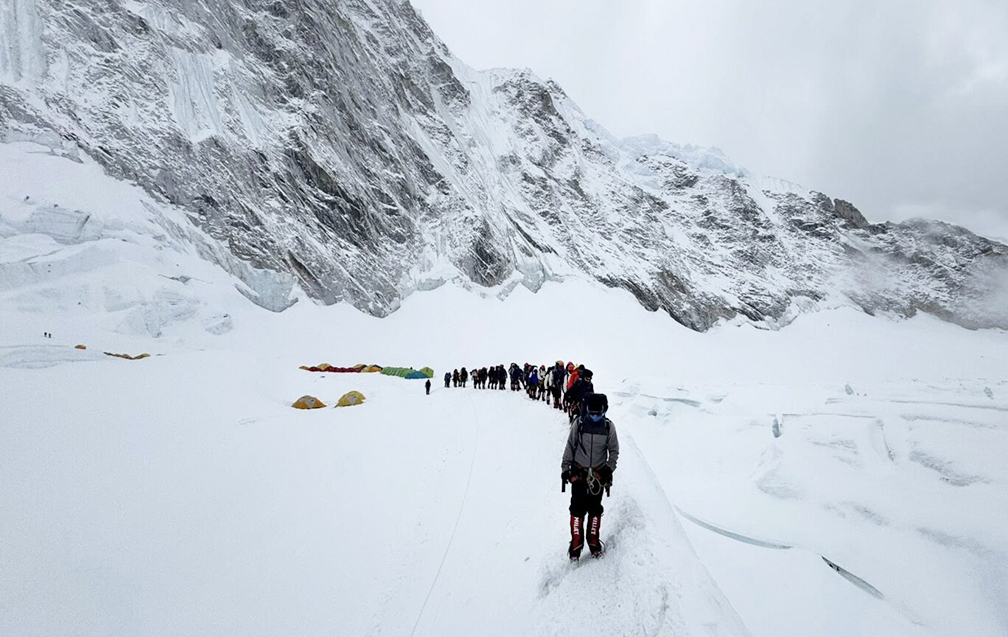
A line of climbers from a single huge team advances toward Camp 2 in a previous year. Photo: Kami Rita Sherpa
Even higher numbers this spring
Everest Base Camp is expected to be even more populated this spring. With Tibet closed and the threat of higher prices next year, more climbers than usual have flocked to the Nepalese side of Everest.
According to the latest update on climbing permits issued yesterday by Nepal’s Department of Tourism, 410 foreign climbers now have a permit to climb Everest. A further 86 have permits for Lhotse, and another 42 for Nuptse.
Unlike the Tibetan side of Everest, where the route is rather straightforward until the upper sections, the normal route from Nepal starts with the hardest part first — the huge, perpetually moving Khumbu Glacier. Finding a way through the ever-changing maze of seracs and crevasses is the Ice Doctors’ annual job. The team must then maintain the route almost every day until the end of the season. They replace ladders crushed by ice movement, tweak the route as the blocks shift, and make sure the route doesn’t become too hazardous because a fragile chunk of ice weighing tons threatens to collapse.
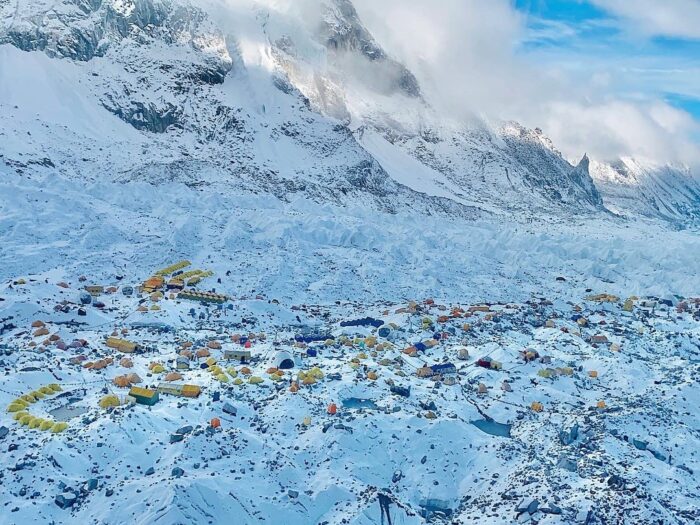
Everest Base Camp. Photo: Seven Summit Treks
What to do
In the last four days, we have heard several theories and rumors of potential solutions.
One involves airlifting the Sherpas by helicopter to Camp 1 and letting them work their way down from there. Finding an alternative route from above is often easier. Second, they can continue to wait for the 30m high serac to fall. Time is limited, because the arrival of the monsoon and its heavy snows ends the season at the beginning of June.
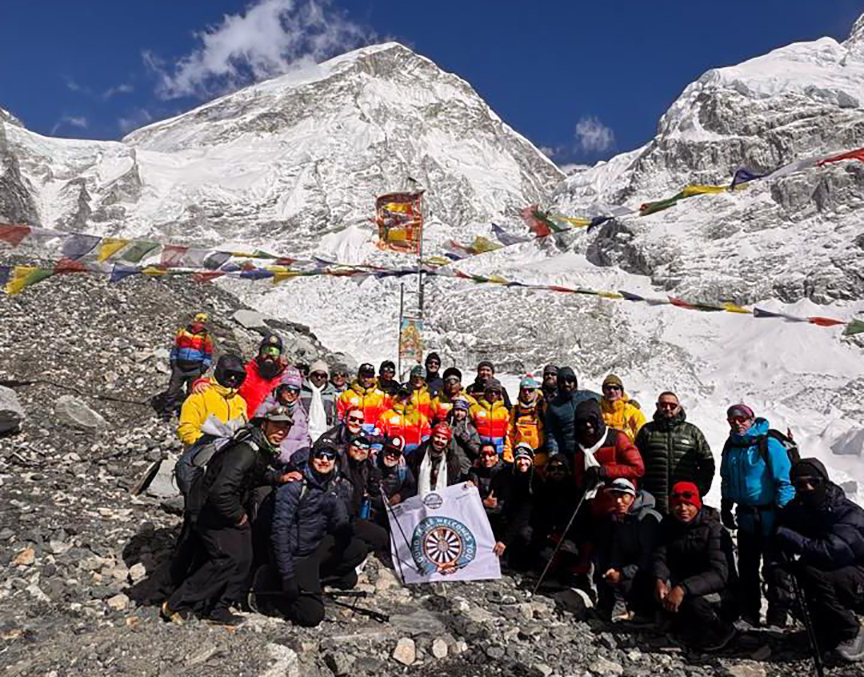
This year’s team of Icefall Doctors poses at Everest Base Camp with the Khumbu Icefall behind them. Photo: SPCC
The Baruntse option
Some climbers have chosen to begin acclimatizing elsewhere, including Saulius Damulevicious, who went to Baruntse.
“I hope to use Baruntse to compensate for the rotation in the Khumbu Icefall,” he told ExplorersWeb. “Given the situation in the Khumbu, this is still the best option for me, as I need to acclimatize and also want to minimize the number of rotations through the Icefall.”
Damlevicius, together with other climbers, intends to try to summit Baruntse this weekend.
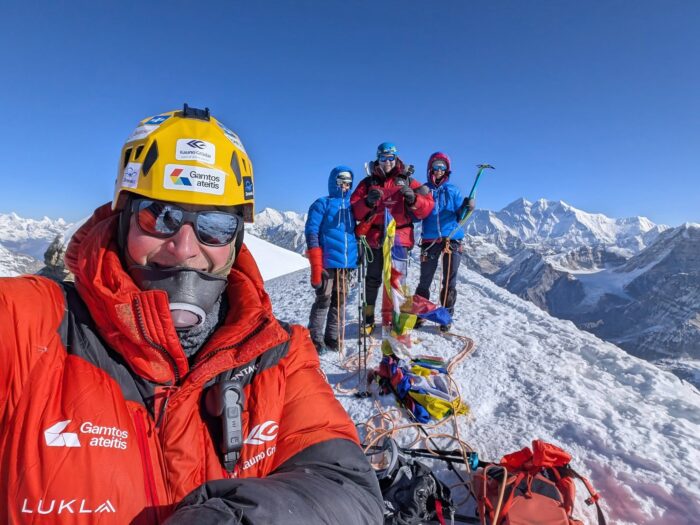
Saulius Damulevicius, some days ago, on the summit of Mera Peak. Photo: Saulius Damulevicius
The YouTube Channel Everest Mystery mentions that other climbers were considering training on Makalu, where the route is fixed all the way to the summit, and where at least two summits were reported today.