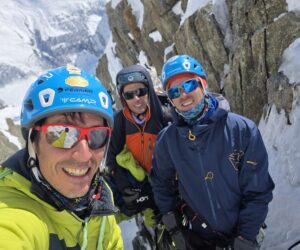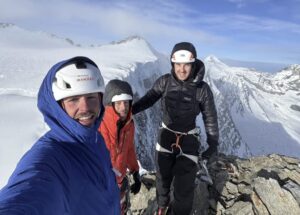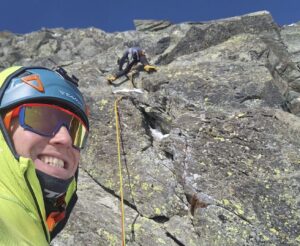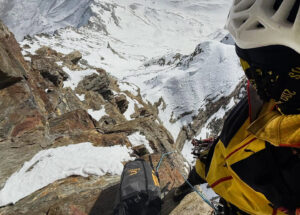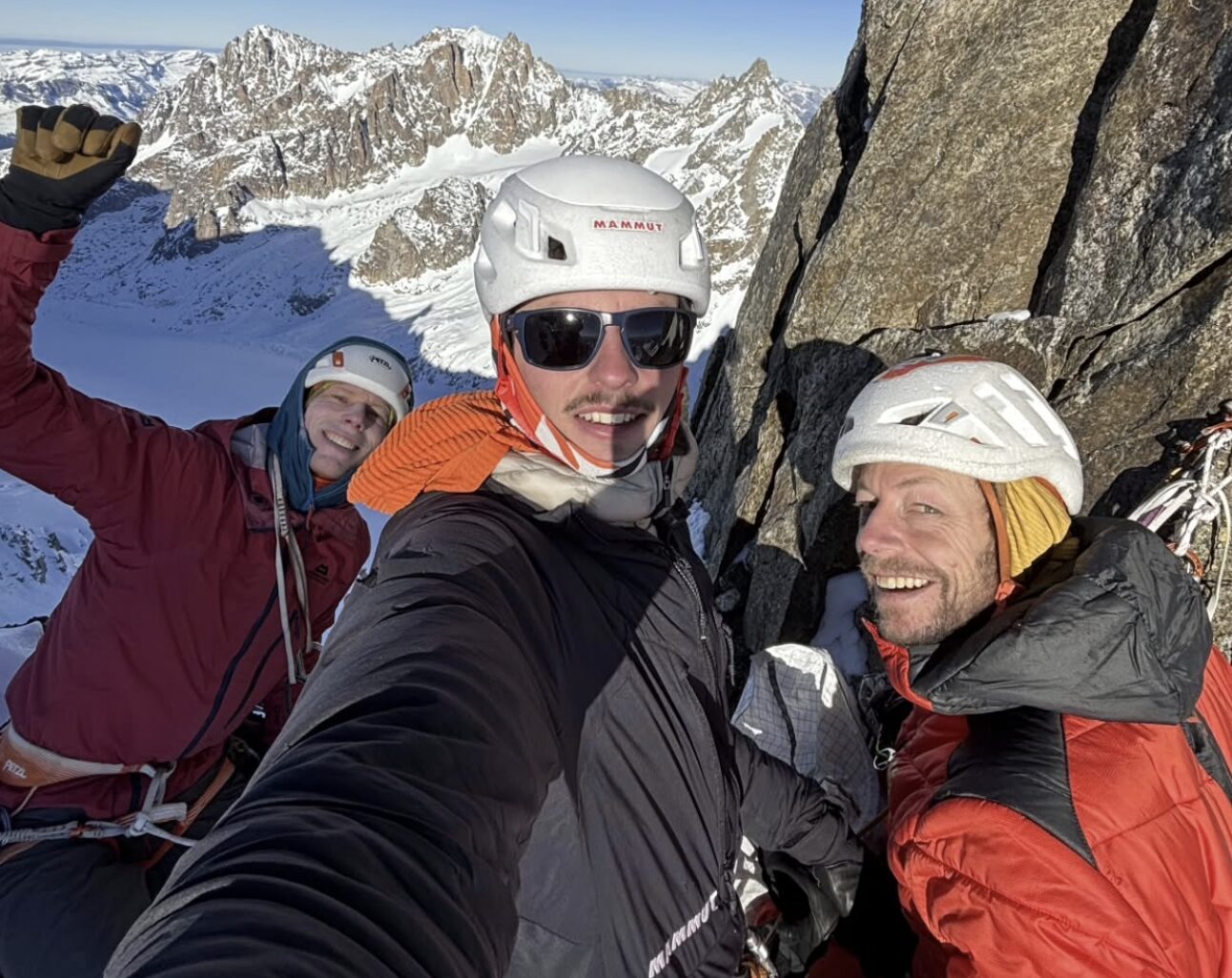
Last weekend, Silvan Schupbach of Switzerland did the third new line on a long-term alpine project he calls the Six Forgotten North Faces.
He wants to point out that there is more to alpine north faces than the classic routes up such peaks as the Matterhorn, the Eiger, and the Grandes Jorasses. There are difficult and lonely alternatives on slightly lower, less accessible, or lesser-known peaks.
In February 2025, Schupbach climbed a new route, called The Cuckoo’s Nest, on Switzerland’s Nesthorn (3,820m) with Peter Von Kanel and Carlos Molina. One month later, he did the first ascent of the north face of 3,237m Punta Pioda, also in the Swiss Alps, with Filippo Sala and Roger Schaeli. The resulting route was called Luce e Tenebre (“Light and Shadow”).
For this third stage, he went to the rarely visited north face of 3,870m Aiguille de Triolet in the Mont Blanc massif. Here, he chose a variation route up the center of the headwall.
His partners were Filippo Sala of Switzerland and Tom Livingstone of the UK, who continued to climb in the Alps rather than attend the recent Piolets d’Or ceremony in Italy to receive an award for his 2024 route on Gasherbrum III.
The problem with this most recent goal, Schupbach admitted, was finding a forgotten face around the hyper-popular Mont Blanc massif. Triolet seemed like the perfect candidate, but he soon found out that the place was not as deserted as he expected.
Direct route
The climbers completed the line in two days, December 13-14. After approaching the wall via the classic route, they tackled the face via the Jin-Go-Lo-Bar route, first opened in 1998. Then at one point, they continued on unclimbed terrain, following a direct line through the headwall. Here is Schupbach’s description:
The chosen corner offered good, exposed climbing. We found a rather poor bivy spot in the middle of the crux pitches. After an uncomfortable night, we finished our climb to the east ridge.
Schupbach also noted that the climbers followed the standard summit ridge for a while, but seeing how far away the highest point was, they eventually stopped without reaching it.
The team has called their 750m variation route You didn’t ask. They proposed a difficulty of M7+ for the line, which ranged up to 80º.
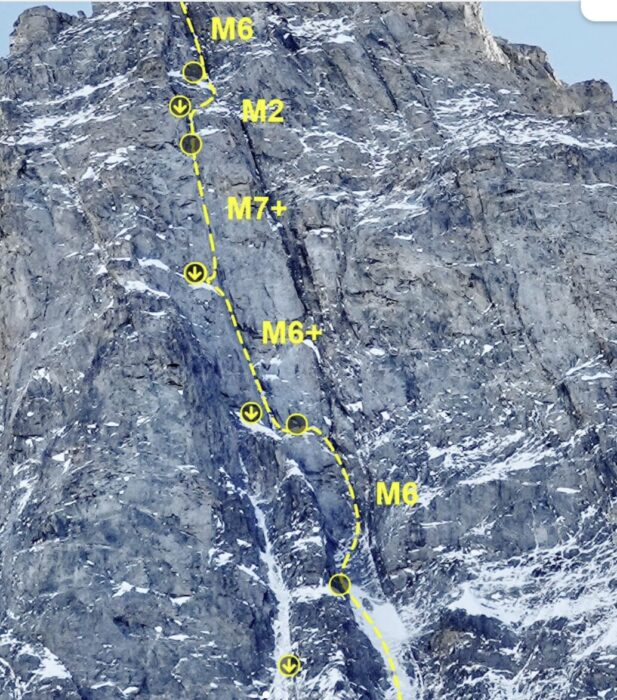
The new variation on the headwall of Triolet’s north face. Photo: Silvan Schupbach
Competition arrives
Ironically, another team did the first repetition of the new variation that same day. As they approached the ridge, Schupbach and his party looked down to find other climbers following their footsteps.
” caption=”false”]
“This is the story of two climbing parties who decided to open the same face on the same weekend, except the second party was half a day late,” aspiring guide Amaury Fouillade wrote on social media yesterday.
The second party included himself and partners Olivier Kolly and Philippe Bruley. They only discovered they had company when they saw three pairs of skis at the base of the face.
“Damn!” was Fouillade’s first impression. But at least, he knew his plan was a good one, as the new pitches were “substantial, enjoyable, and well-protected.”
Different edges, same crux
Fouillade’s team started by the Greloz-Roch route — the first route climbed on that north face in 1931. For a time, it was considered the most difficult in the Alps. At a certain point, they continued up the central gully, “which was untouched by any prior information or traces,” according to the Groupe Militaire de Haute Montagne (The High Mountain Military Group of Chamonix).
Fouillade, Bruley, and Kolly climbed the crux pitches, following exactly the line of the previous team. They then climbed one pitch of the Pellissier-Pessi line to reach a direct exit to the summit ridge. The team summited together.
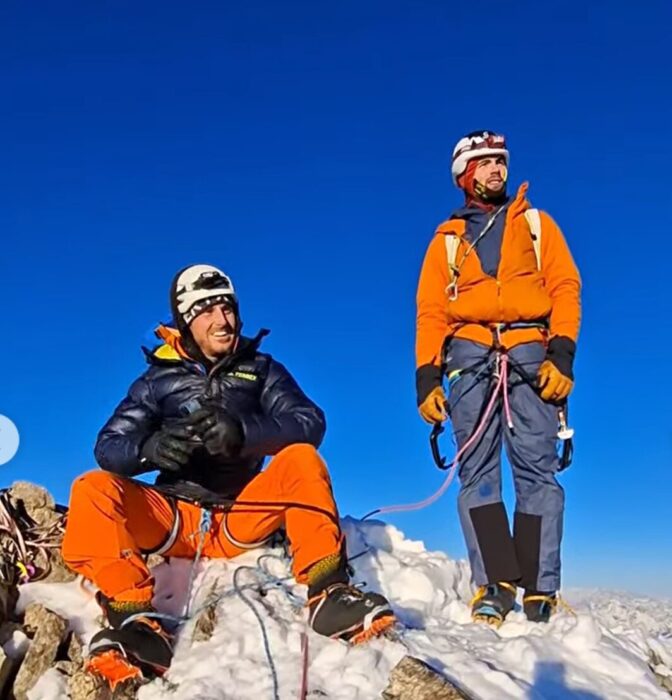
Two members of the second team on the summit. Photo: Amaury Fouillade/Instagram
Fouillade has confirmed the new section is 750 vertical meters and agrees on a grade of M7+. He has posted a topo of his climb, which he temporarily named Inedite, although the section on new terrain is actually a repetition.
Fouillade recommends the route to future climbers. “All the lines are awesome, it’s got real scale, the birdbeaks are in place…and usually there’s nobody there 🤣,” he wrote.
Shortly after posting their climb’s report on Instagram, Filippo Sala replied to Fouillade: “It was a first ascent for all [of us] together, in my opinion! So cool to see you all!”