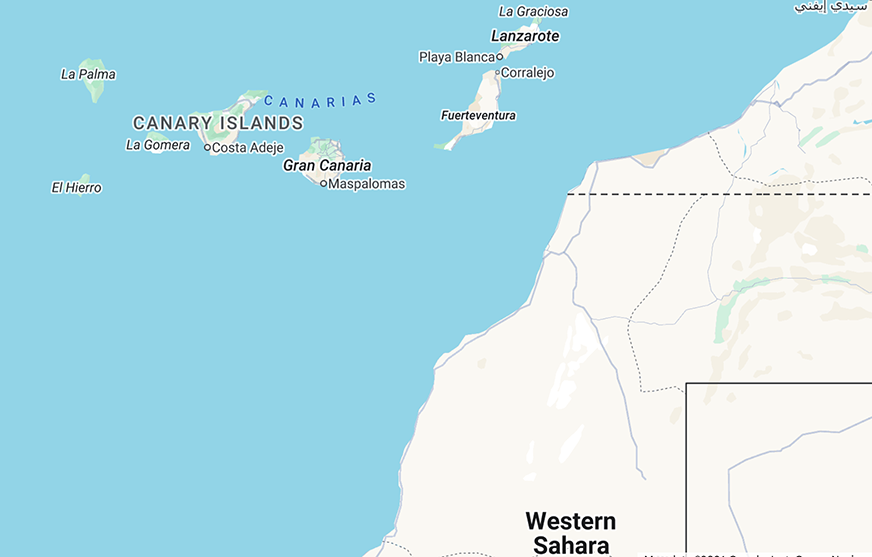
“Don’t ever tell Julin all that has happened to me. You know that God wanted this fate for me. Love you…” Those were the haunting last words of a mummified corpse aboard the fishing vessel Fausto, found adrift in the Atlantic off the Canary Islands in mid-October 1968. Local islanders Miguel Acosta, Ramon Hernandez, Eliberto Hernandez, and Julio Garcia were supposed to sail a short distance from El Hierro to La Palma. They never made it.
A routine trip
The Fausto was an average fishing vessel, neither large nor small. It measured 14m in length, had a decent engine, and could reach a modest speed of 13kph. The boat typically traveled throughout the Canaries, transporting local produce and agricultural goods, and catching fish.
The owner, Rafael Acosta, employed four regulars to crew his boat. Brothers Ramon and Eliberto Hernandez, as well as Miguel and Viterbo Acosta, were sailors with years of experience and family men of good character. In their hands, the Fausto was a safe and reliable vessel that served the needs of the Canarian community.
On July 20, 1968, Ramon, Eliberto, and Miguel sailed the Fausto from La Palma to El Hierro, with a cargo of explosives meant for land clearing, irrigation, and other farming uses.
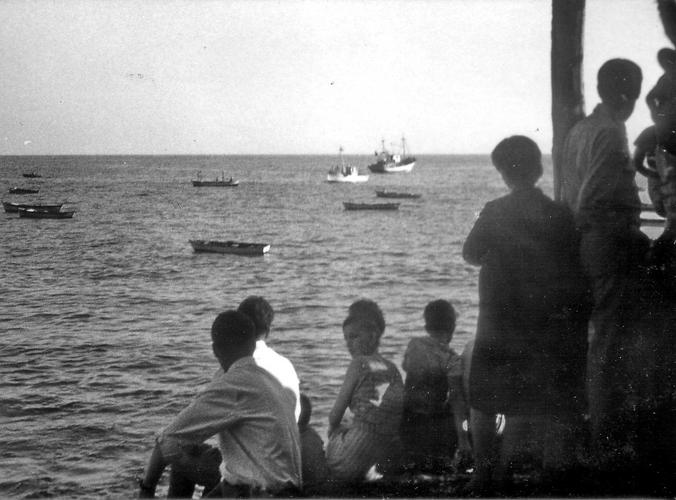
Residents of Tazacorte, La Palma eagerly await the Fausto’s arrival. Photo: Public Domain
Just as they were about to leave, a man named Julio Garcia, a mechanic on the island, stopped them in a panic. Garcia received a distressing call from his wife in La Palma that his one-and-a-half-month-old daughter urgently needed medicine. We don’t know what illness the baby had, but it was enough for Garcia to seek out any vessel heading back to La Palma.
The crew of the Fausto, the only vessel in port, took pity on Garcia and were willing to help without payment. He did his part and did what he could to help on board. They all loaded fruits and water onto the boat and left the island in good weather and spirits.
The first vanishing
The Fausto was due at Tazacorte, La Palma, on July 21 at 10 am, but no ship arrived. Careful not to alarm anyone, owner Rafael Acosta reassured the men’s families. Sometimes, he said, odd weather or a slight mechanical problem could delay things. Since the Fausto’s crew plied this route regularly, nobody panicked at first. But when the horizon remained empty, their loved ones eventually realized that something had gone wrong.
The next day, a full-scale search was launched by both air and sea. Four days later, a British vessel contacted Spanish authorities with good news: They had found the Fausto and its crew.
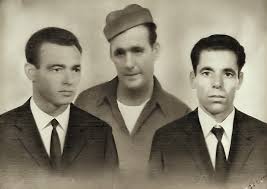
Ramon, Miguel and Eliberto. Photo: Spacebattles forum
Apparently, the missing crew used a flashlight to catch the attention of the British ship, the Duchess. They were out of fuel, hungry and thirsty, but well. Reports also noted that they were on edge and irritated. They also did not appear to have any mechanical issues, contrary to previous theories.
The Duchess suggested that they tug the boat back to La Palma, since they had drifted 190km into the Atlantic. You would think that the men would have been jumping for joy at the idea of resting after such an ordeal. However, this is where the story gets weird. Rather than cooperating, the men repeatedly refused the tug assist. Even Julio, who was desperate to see his family and his sick little girl, did not want to get on board the Duchess. Instead, they wanted to sail back themselves.
Bemused, the crew of the Duchess relented. The Fausto’s crew asked for food, water, cigarettes, and fuel, which would last them 18 hours for their trip back home. After receiving their supplies, they sailed for La Palma.
The second vanishing
The community came together to throw the men a welcome-home party. But when the Fausto again did not turn up, their worst fears returned. This prompted local authorities to reach out to the mainland for assistance. This second search cost the Spanish government $2.2 million in today’s money, as several planes covered not just the Canary Islands but also the coast of Spain and Portugal.
Despite the searchers’ best efforts, the Fausto never turned up. Two months passed. The men were most likely dead. But what happened to them?
Found but not found
On October 9, 1968, an Italian ship called the Anna Di Maio came across an abandoned vessel 3,000km from the Canary Islands while sailing to Venezuela. The hull clearly spelled out the name “Fausto” along with its identifier “TE-2-12-68.” When a crew member boarded it, he discovered a grim scene. All the men were missing, except one, who was dead. An official telegram read:
At 10:54 GMT on October 9, the fishing boat Fausto with license plate TE-2-12-68 was found adrift, with a single crew member dead long ago in the engine room of the ship, next to a small radio device. The corpse was completely naked and seemed to be that of a young man; no logbook, documentation, etc., were on board.
According to the captain of the Anna Di Maio, “In the engine room was the body of a young man in an advanced state of decomposition.” The body was almost mummified. Nearby was a notebook with 28 pages torn out. On the last page, there was a note to a wife, giving instructions on how to access money from her husband’s life insurance policy for her and her children.
On the page, the man wrote, “Don’t ever tell Julin all that has happened to me. You know that God wanted this fate for me. Love you…” Julin was the son of Julio Garcia, the man with the distressed baby back home and the youngest on board.
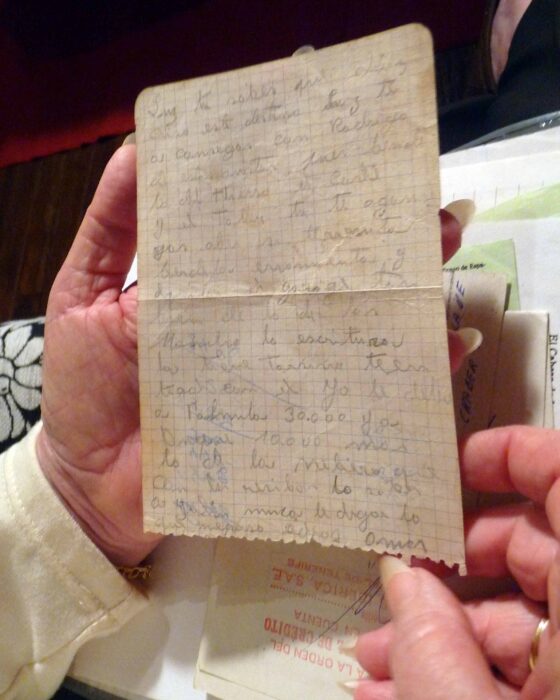
A page from Julio Garcia’s book. Photo: Public Domain
After alerting the Spanish authorities, the Anna Di Maio tried to tow the Fausto to Venezuela, which was much closer than the Canaries. Sadly, the boat immediately started to sink and was beyond the point of salvage. Before the sinking, they collected any documents they could find, including Garcia’s notebook, and sent them to the Spanish consulate. When Julio Garcia’s wife received the book, she recognized her husband’s handwriting.
Theories
Since then, there have been no explanations for what happened. Some educated guesses make little sense. Though the Fausto is not as well-known as other mysterious disappearances, some online communities are dedicated to finding out what happened to the passengers. Let’s cover some popular theories first.
First, there is a prevailing theory that the disappearance was planned. Some believe the men were trying to go to Venezuela for a better life. There are many holes in this. Ramon, Miguel, Eliberto, and Julio were very close to their families and community. The Canarian economy was doing well, quality of life was on the rise, and life was generally good. They had no reason to abandon their families.
A second theory is that they were involved in shady business. If they were transporting drugs or contraband, they might have been intercepted by people who either tried to steal the cargo or punish them for something. It seems a bit far-fetched in this case. Drugs were not very popular in the Canaries at the time, and the men did not have questionable debts or financial difficulties. Again, life was good in the islands.
Some also cited a possible connection to the MPAIAC, the Movement for the Self-Determination and Independence of the Canary Archipelago. This was a nationalist movement and a terrorist organization founded by Spanish lawyer Antonio Cubillo in 1964. Cubillo, who lived in Algeria, believed that violent attacks could free the Canary Islands from Spain. He promoted the idea of the Canaries as a future part of Africa, since the indigenous Guanches might have originated there.
The group launched attacks in Gran Canaria, but this did not happen until years later, in the 1970s. But did the nationalist group in its infancy have something to do with the disappearance? Maybe the men witnessed illegal activities. Or were they transporting explosives for the movement? But this does not explain why Julio was the only one on board.
Why did the men behave so strangely when they encountered the Duchess? Julio’s behavior raises the most alarm bells. His daughter was gravely ill (verified), and yet he did not want to go with the Duchess. His note to his wife also implied that he knew he was going to die. This brings us to another theory explored by Reddit users: The boat and crew were being held hostage.
When the Duchess met them, perhaps someone was hiding on the ship. Reports did not specify whether anyone from the Duchess boarded or not. But if a pirate on board threatened them and their families, this would have prompted them to decline assistance.
Was it a classic case of delirium leading to death? Picture this: there’s a mechanical or navigation issue. They get lost when they stray off course. It is the height of summer, the heat is intense, dehydration sets in, accompanied by minimal food and water. It is possible the men were not in their right minds when the Duchess came around.
Perhaps, they died one after the other, with Julio being the last one to die. He could have given his crew members burials at sea before he himself succumbed. It does not seem like a fight broke out, as there were no signs of struggle.
The 28 missing pages do suggest that someone did not want their deaths investigated. If they were held hostage, the perpetrator could have killed Miguel, Ramon, and Eliberto. Julio might have been spared, then left for dead. The perpetrator would have taken the 28 pages to destroy anything Julio might have written about what had happened.
Conclusion
From examining the information, the Fausto’s crew perished either as hostages or by starvation. When we examine the men’s character through the personal testimonials of family and friends, we can eliminate shady dealings. As for being part of some nascent political movement, it seems a bit of a stretch.