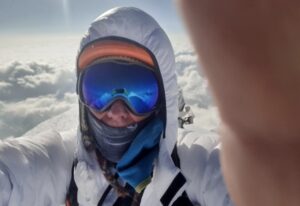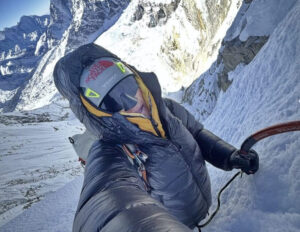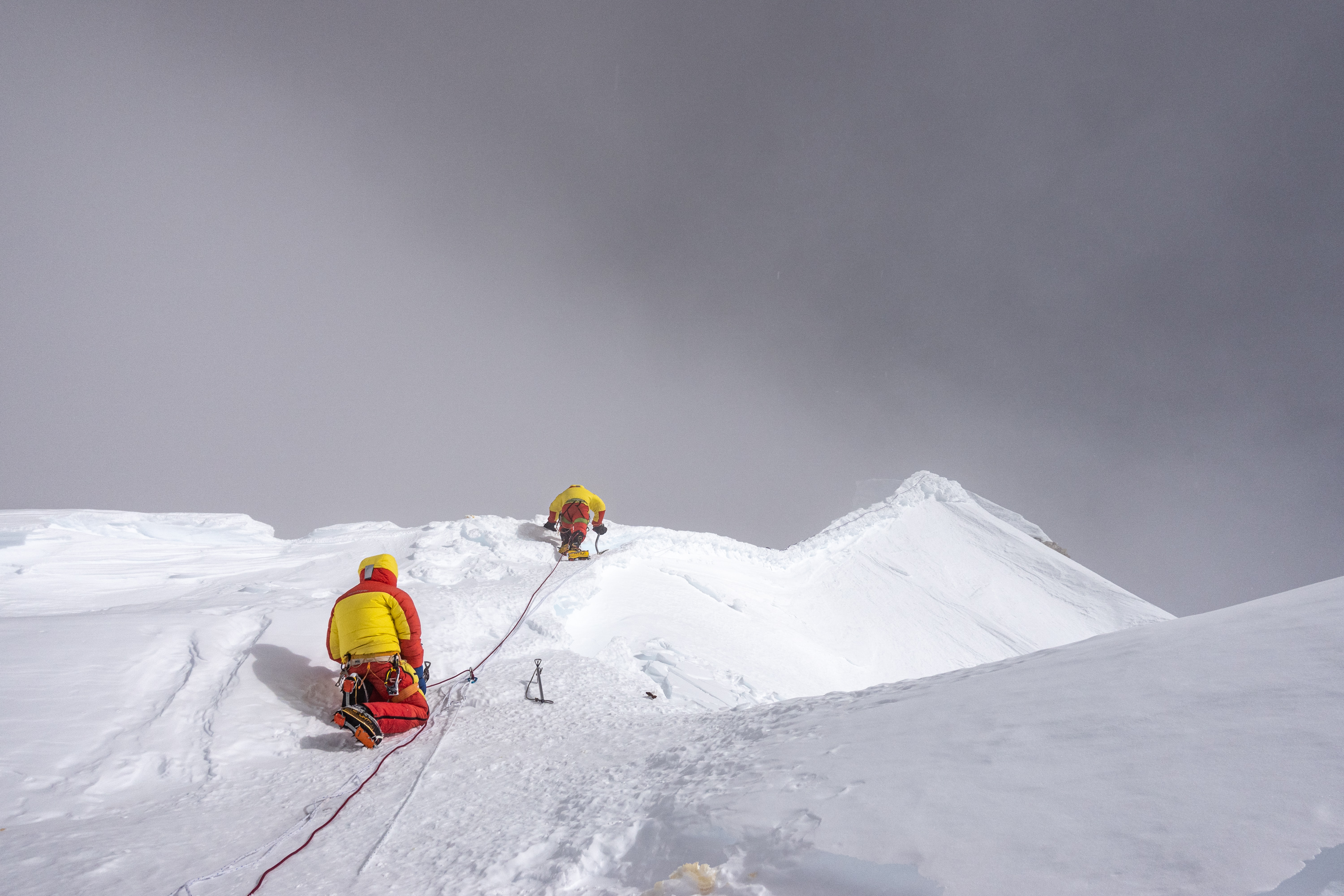
To those who claim that all the interesting lines on the 8,000m giants have been done, Andrey Vasilyev, Sergey Kondrashkin, Vitaly Shipilov, Kirill Eizeman, and Natalia Belyankina would beg to differ. The five Russians climbed a new route on the rarely visited Southwest Face of Manaslu. After topping out, they descended a different way in uncertain conditions.
Their onsight climb was a single push in unknown terrain, both on the way up and the way down. They all returned safe and healthy; there was no drama. Rather, this was an expedition demonstrating meticulous planning, methodical performance, good teamwork, and alpine-style values.
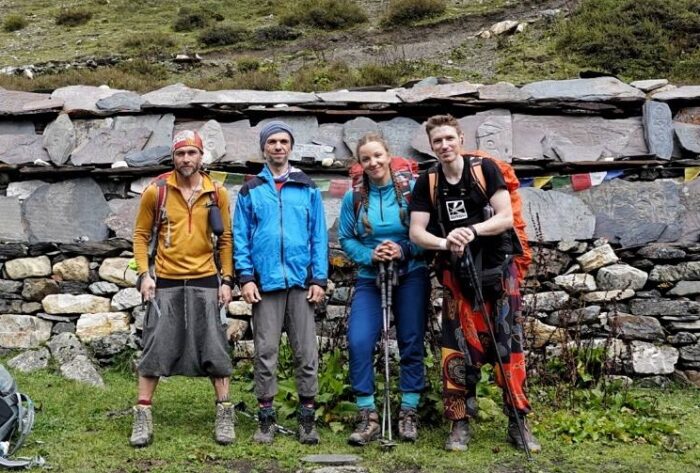
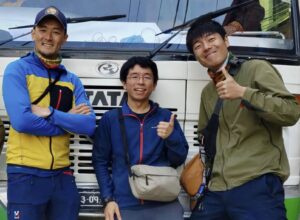
Andrey Vasilyev, second from the left, and his team on the trek to Manaslu’s normal route. Photo: Mountain.ru
The Cho Oyu team plus one
The plan was clear from the start: Vasilyev and his team wanted to open a new route on the Southwest Face in true alpine style. They would onsight the route once there, carrying all their equipment and relying solely on their own decision-making. Vasilyev knew they could make it because they had tested their skills and endurance in 2023 and 2024, on the wild south side of Cho Oyu.
“The Cho Oyu experience was essential to fully understand our capabilities during long periods at high altitude,” Vasilyev explained. “[It showed] our technical climbing skills above 7,500m, and all the health issues we might face. We prepared for Manaslu accordingly.”
With the hardships endured on Cho Oyu in mind, Vasilyev knew they needed another team member. They chose the young Natalia Belyankina, a mountain guide and the youngest woman to bag the prestigious Snow Leopard award (a distinction for summiting the highest peaks in the former Soviet Union).
Yet, what most impressed Vasilyev was Belyankina’s easy temperament, which made her a great team fit.
Normal route training
Previous experience suggested they needed to acclimatize for 10 days and reach at least 7,400m. There was no better place for this than the normal route on Manaslu’s northeast side. They trekked to Samagaon village, while hundreds of commercial climbers flew over their heads, chartering helicopters to Base Camp.
On a shoestring budget, the Russians set up in a village some 1,000m below Base Camp, starting from there every time they went up the mountain. Eventually, the team summited among hundreds of climbers, but with no oxygen or porters, proving they were ready for their real expedition goal.
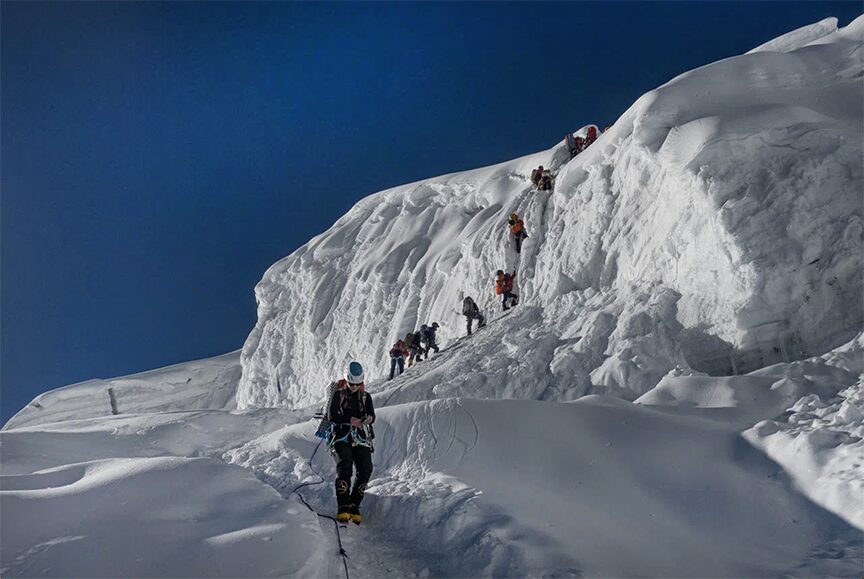
The busy normal route on Manaslu. Photo: Andrey Vasilyev
The team loaded their backpacks and set off on foot toward the Southwest side of the mountain. They left no base camp crew and carried only essential supplies and equipment, aiming to be fast and flexible. Each of them climbed with a 35kg backpack, grueling at those altitudes.
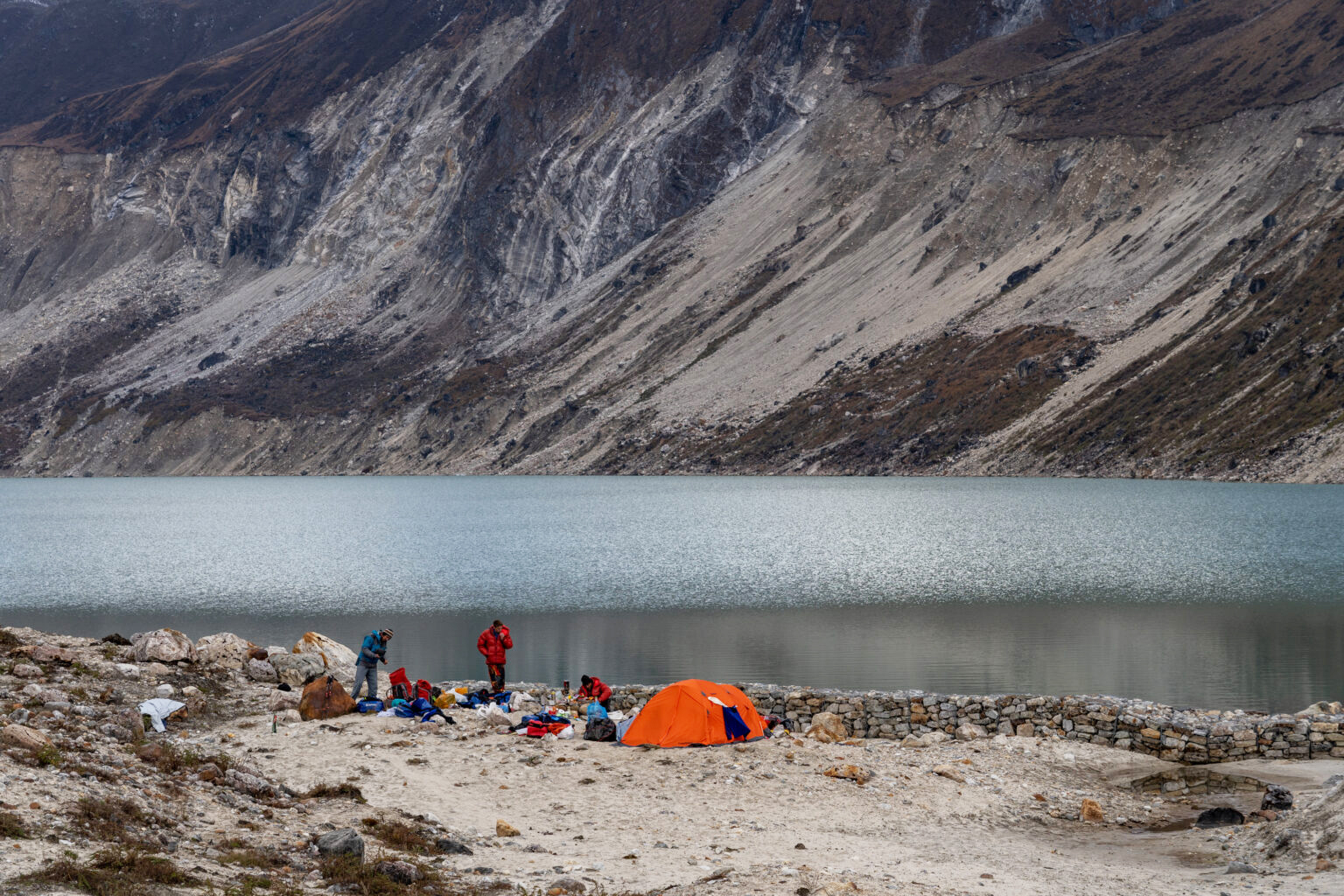
The team’s Base Camp. photo: Andrey Vasilyev
Vasilyev had dreamed of a direct line up the middle of the Southwest Face, but at the base of the face, it became clear to them that unstable snow and threatening seracs made a direct route too dangerous.
Instead, they chose safer-looking terrain to the left of the face, similar to the 1972 Tyrolean route opened by Reinhold Messner (but 1,000m to the right). Sections of the route remained uncertain.
“We tried to use a drone, but our lack of experience did not allow us to get any significant information,” Vasilyev said. “The drone fell before reaching the icefall.”
No obvious cruxes
“Our route didn’t have any clearly defined cruxes,” Vasilyev said. “But overall, it’s very demanding. One of the main challenges was to protect our progress. Except for some isolated spots, there was no reliable ice on the face, so the only protection was deadmen [snow anchors].”
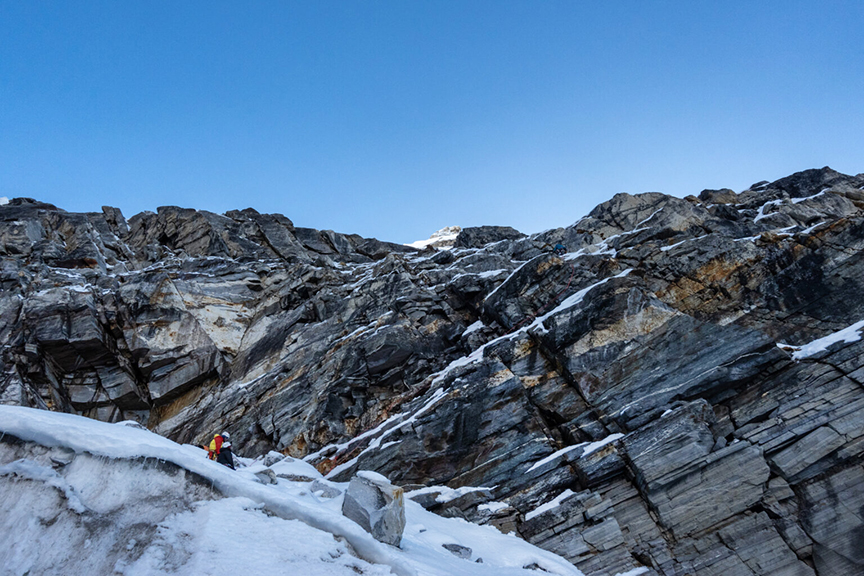
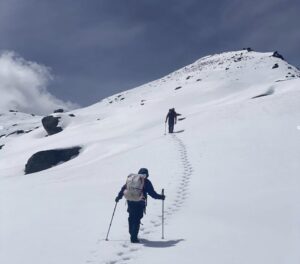
On a rock section at 5,600m. Photo: Andrey Vasilyev
Technically, the most difficult part was a mixed section at 7,500-7,700m, consisting of short rock steps and steeper snow and firm slopes.
The climb
The climb started on October 12, and it took them two days to cross a big icefall af the base of the face because they were not carrying ropes to fix. Once on steeper terrain, things looked better.
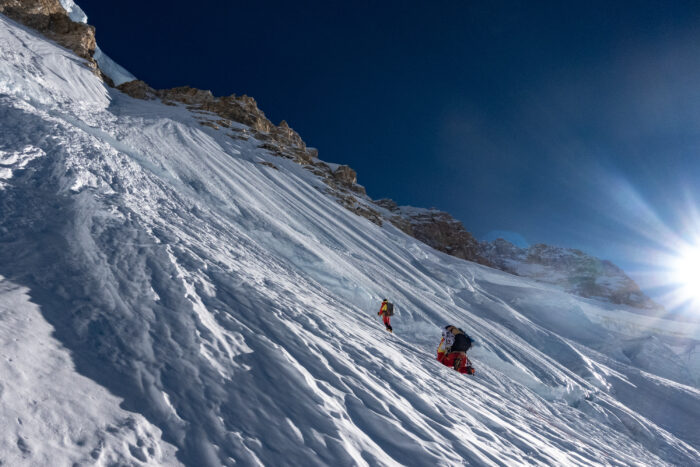
The snow slope before the bergschrund. Photo: Andrey Vasilyev
“We left Base Camp five days after the last precipitation, hoping there wouldn’t be too much snow on the face. Indeed, we found nearly perfect conditions,” Vasilyev explained.
They began climbing on October 16, moving up snow slopes of 30° to 55°, mainly simul-climbing. Two days later, they crossed a dangerous line of seracs, which involved climbing non-stop until 10 pm because there was nowhere safe to bivouac.
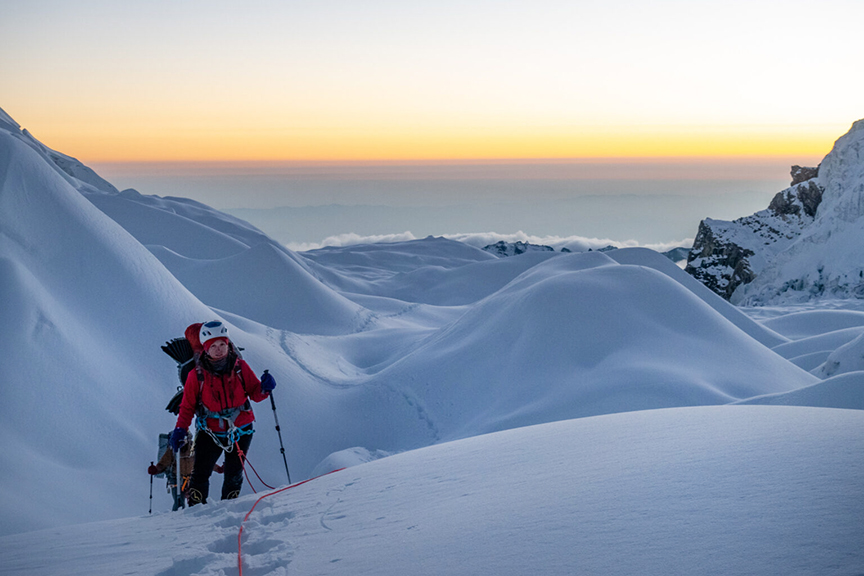
Natalia Belyankina on the flat section of Thugali Glacier. Photo: Andrey Vasilyev
“On October 19, we went further up a 60º snow slope. It was hard to protect, which made progress slow,” Vasilyev recalled.
That day, the wind increased, and they had a tough night on a platform cut into the slope. The following day, the wind was so strong that they only progressed four pitches. It was only on October 22 that they reached Manaslu’s summit ridge, and their route merged with the Messner route and then the normal route to the summit. This was supposed to be the easiest part, but high winds made them struggle for every meter.
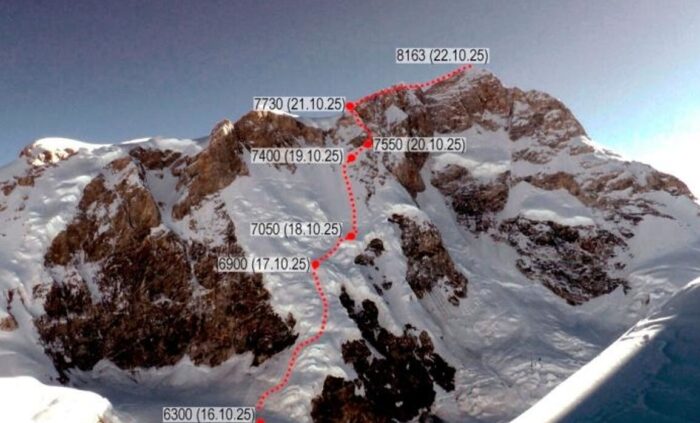
The new Russian route on the Southwest Face of Manaslu. Photo: Federation of Alpinism of Russia
The descent
Rather than descending their new line, the Russians chose to come down via the Tyrolean route because it was safer. However, they still had to find the route in low visibility.
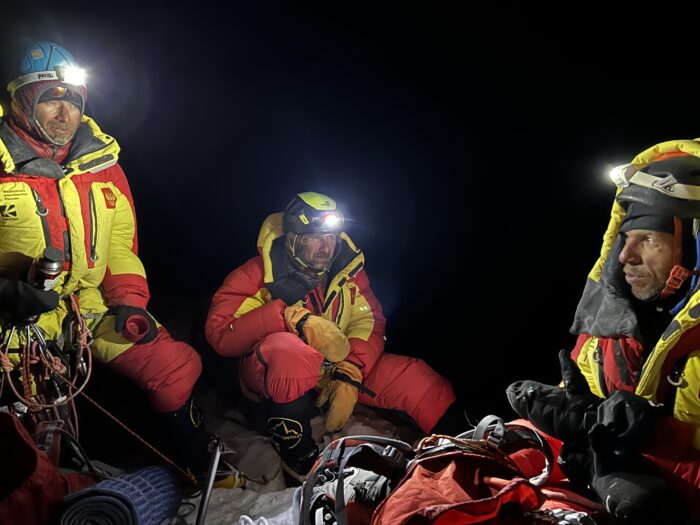
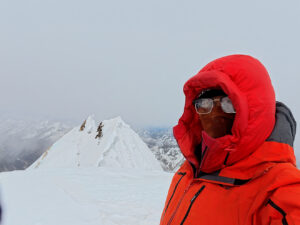
During the descent. Photo: Andrey Vasilyev
They descended in deteriorating weather, with the team fatigued after several days at altitude. Despite this, they managed a controlled return to lower camps and ultimately back to Base Camp, completing the expedition without serious incident.
Technical work
The climbing community has unanimously praised the climb. Yet, the climbers are modest about their achievement.
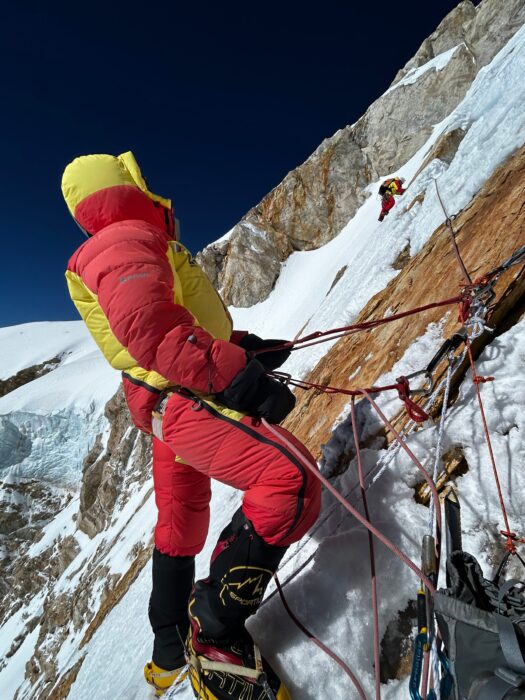
On a mixed section at 7,600m. Photo: Andrey Vasilyev
“Our ascent is not of great importance in the history of mountaineering in general,” Vitaly Shipilov told ExplorersWeb. “It is just another of many routes climbed on known mountains. We did not discover a new peak; we just climbed it from the other side.”
However, Shipilov admits that the climb was personally important to him.
“It is the result of long preparation, unsuccessful attempts, risks, and hard work,” he said. “I am satisfied with the result, but awards are not important. My most vivid memory is the incredible beauty during our time there, the way we interacted, had fun, and helped each other. Everything else is just technical work.”
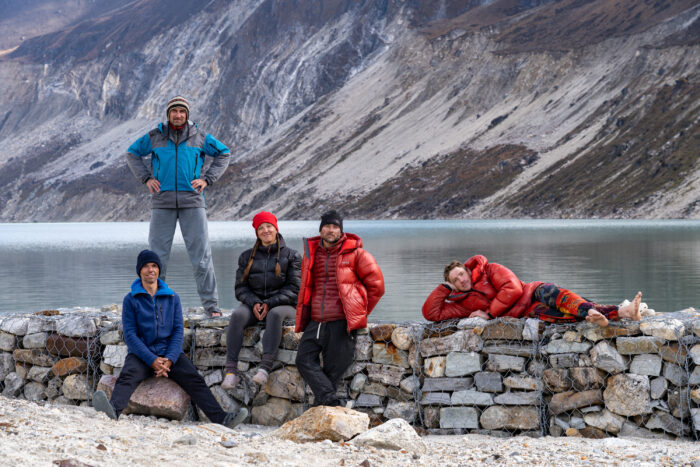
The Russian team during the approach trek to the Southwest Side of Manaslu. Photo: Andrey Vasilyev