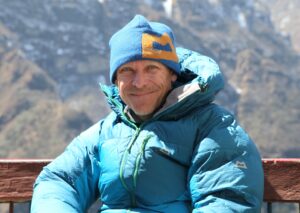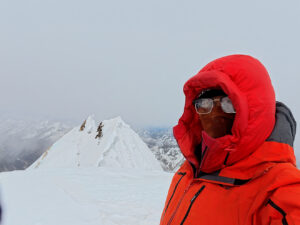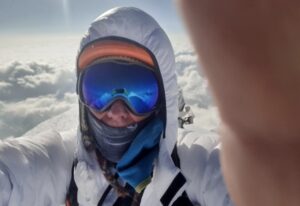
This year, a legendary high-altitude climber and his courageous life partner opened a new alpine-style route on Nanga Parbat, the so-called Killer Mountain of Pakistan’s Himalaya.
Denis Urubko, 52, of Russia, one of the best high-altitude climbers in history, had supposedly retired from the higher peaks some years ago. But a new goal prompted his return: He wanted to help his wife, Maria Cardell, 50, become the first woman to climb a new 8,000m route in alpine style.
However, no matter how much experience and support Urubko could provide, the effort was totally Cardell’s. And that is the most impressive aspect of this Nanga Parbat expedition — how the Spaniard rose to meet the challenge.
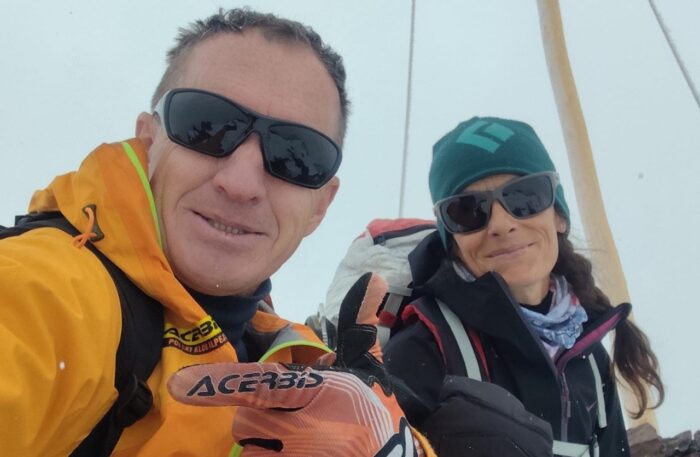
File image of Denis Urubko and Maria Cardell. Photo: Denis Urubko/Mountain.ru
Climbing Urubko-style
The humble, soft-spoken Maria Cardell not only climbed a new route in alpine style on 8,126m Nanga Parbat; she has climbed it in pure Denis Urubko style, without being Denis Urubko. Bear in mind that the Russian’s imprint through his seven new Himalayan routes all involved relentless endurance and stubborn progress in poor weather and difficult conditions. Rescue is never an option with him. Trying to climb Urubko-style is more than meritable. It is scary.
Cardell is more of a sport rock climber and a ski patroller than a high-altitude mountaineer, but Urubko introduced her to elite alpinism through brutal training in the Caucasus, where they climbed several peaks in rough weather. In 2023, they attempted a new, alpine-style route on Gasherbrum I, but high winds stopped them. Luckily for Cardell, they had already climbed the peak’s normal route for acclimatization; it gave Cardell her first 8,000m summit. It was Urubko’s 27th without bottled oxygen.

Maria Cardell looks toward Nanga Parbat and Rakaposhi from a tent pitched at 4,500m. Photo: Denis Urubko
The following winter, in January 2024, Urubko attempted Gasherbrum I again, but suffered frostbite after falling into a crevasse on the Gasherbrum Glacier. It required a long recovery, but the Russian was determined to get Cardell into mountaineering history, and she was willing.
Pakistan 2025
The couple chose the Diamir side of Nanga Parbat, the site of most climbing routes on the mountain, including the normal Kinshofer route. They traveled to Skardu early in the season, in June, and followed an innovative acclimatization program. It consisted of climbing 4,000m and 5,000m peaks in a day, moving very fast, and returning for the night to a camp at a lower altitude. Here, they recovered better and faster than they would have at the higher Base Camp of an 8,000’er.
“If Masha [Maria Cardell] can’t keep up, I’ll try it solo,” Urubko wrote in an email to Mountain.ru.
She could.
The couple moved to Nanga Parbat’s Base Camp, but kept a low profile. Meanwhile, commercial teams fixed the normal route and eventually summited at the beginning of July. One day later, Urubko broke his silence.
Dangerously old-fashioned
“The route is calling,” Urubko texted on July 4. “It’s time to turn the dream into reality.”
He told his home team they expected to be four or five days on the face. Climbers in the area reported very dry conditions and frequent, dangerous rockfall. Later, we learned that the pair carried no InReach, no satphone, no GPS, not even a radio to communicate with the base of the mountain. Urubko had made clear they wanted no rescue in case of trouble, so no one else had to risk their lives.
Cardell explained later that Urubko had made her promise that she wouldn’t try to help if he fell. She also admitted that she said yes but had no intention of keeping her word if something went wrong. She was also convinced that her husband would have done the impossible to help her if she’d been the one who needed help.
The weather seemed stable, although it wouldn’t last. And lacking communication devices, the climbers had no way to receive forecasts.
A low-key summit
On July 11, their expedition outfitter confirmed to ExplorersWeb that Urubko and Cardell had summited the day before. The news made waves across the climbing community. Everyone was eager for details, but none came. Urubko and Cardell decided to stay under the radar for several days. They only returned to Skardu and told about the climb 10 days later.
Even then, details were scarce. They said they climbed between July 6 and July 10 and said their route combined varied terrain, with ice, mixed rock, snow, and a crevassed glacier.
“The route is technically difficult and exposed to avalanches and rockfall in some sections,” the Russian climber told Mountain.ru.
The details of the climb were released progressively through interviews the couple gave back home and, most of all, Maria Cardell’s lectures across Spain. Denis Urubko has stepped back to let his partner take the limelight. Cardell also shared a complete report (in Spanish) with the Spanish Mountaineering Association. They spent six days on the ascent and one on the descent, down the fixed ropes of the normal route.
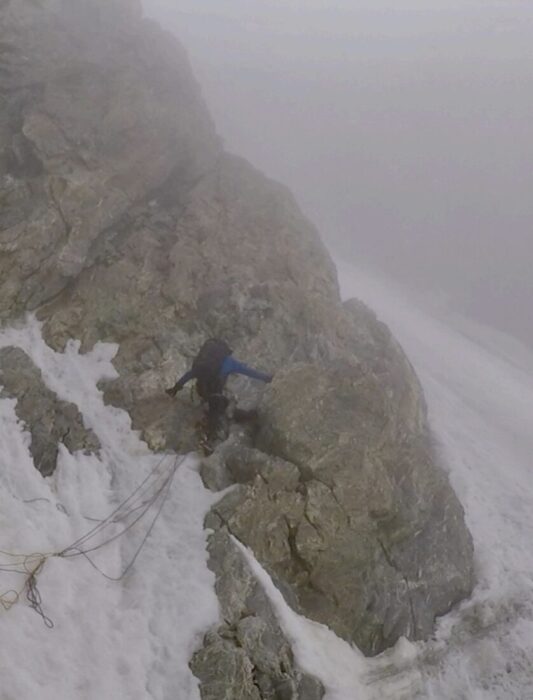
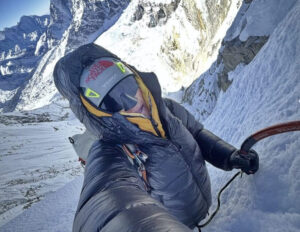
Maria Cardell climbs in low visibility. Photo: Denis Urubko/FEDME report
Brutal experience
It was then that we knew that the climbers progressed in bad weather and low visibility and that they had taken significant risks in some sections due to the constant rockfall. On the second day, they had to wait for seven hours at the edge of a corridor while rocks fell constantly, until the sun set. They then resumed the climb and continued nonstop all night long, doing 19 pitches.
Their strategy was to go as fast as possible, with minimal gear, no 8,000m clothing, rationed food and fuel. Every afternoon, they had to pause as violent storms wracked the mountain. Snow piled up, and the avalanche risk increased dramatically.
“There’s been tension, avalanches, rockfall, bad weather. I have surprised myself with my physical and mental endurance,” Cardell told Desnivel.
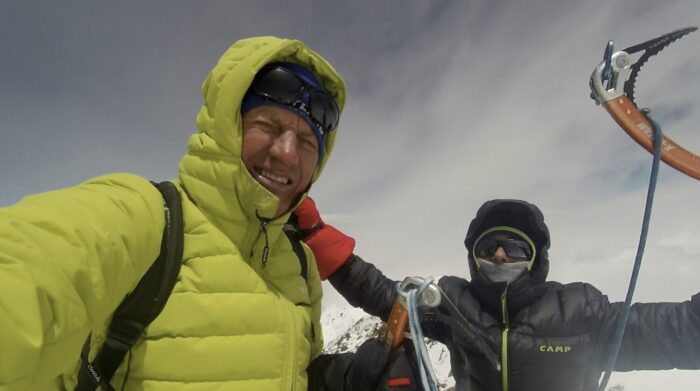
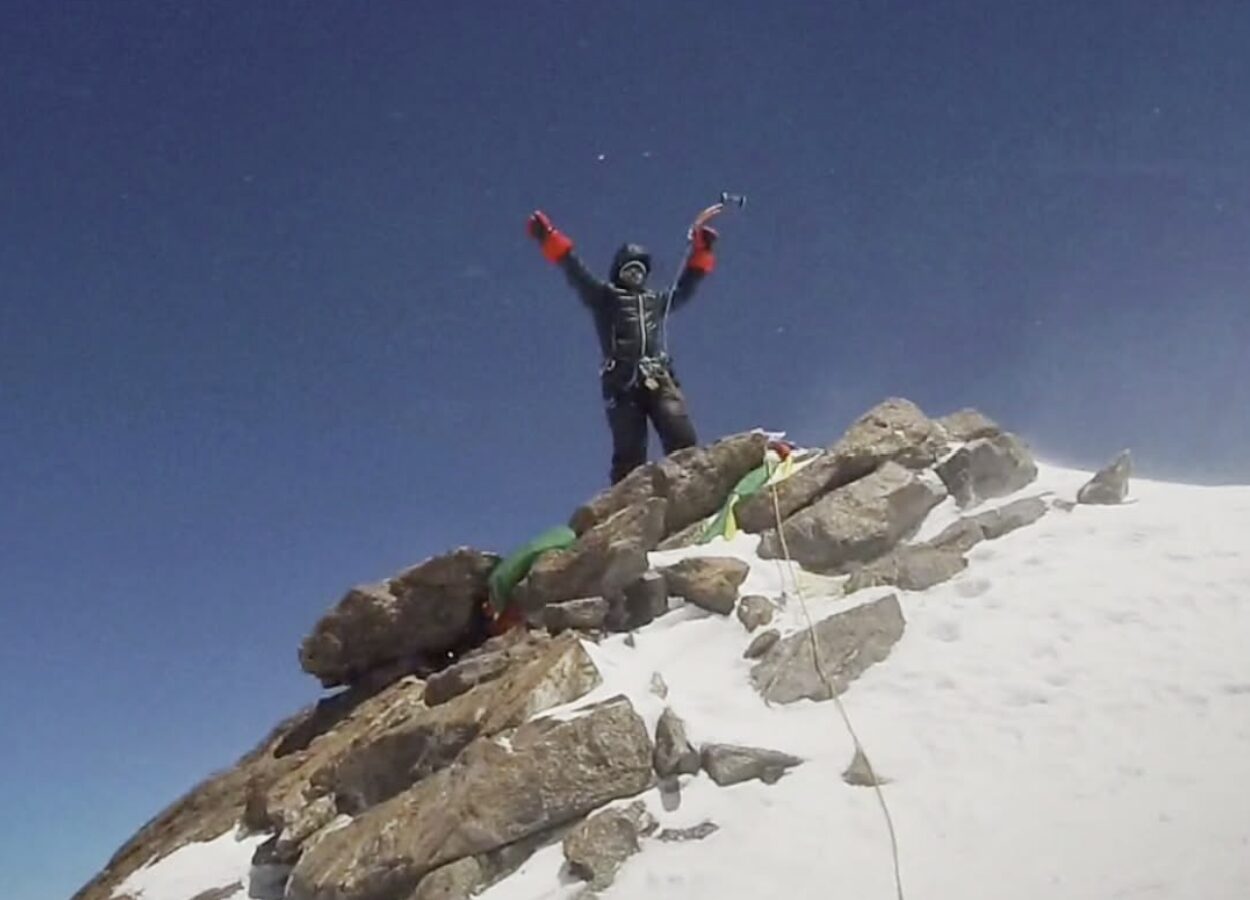
Urubko and Cardell on the summit of Nanga Parbat. Photo: Denis Urubko/FEDME report
Cardell admitted she had to assume the “extremely hard” methods and rules Urubko applies during his climbs. Among these, they didn’t drink during the entire day while climbing — very Russian. In order to go lighter, they didn’t even carry water.
She also explained how Urubko is always analyzing every possible danger at every moment, in order to anticipate and prevent it.
“That is how, after all the huge challenges he has assumed, he is still alive,” she explained. That also involves constant tension. “If Denis does not allow himself the least mistake, he will obviously be even more demanding with a partner, in whom he trusts his life.”
New route or variation?
While in Skardu, Urubko also sent a topo of their ascent route, which raised the attention of some followers of Himalayan history. They noted that their line on the Diamir Face was very similar to a previous route opened in 2009 by Gerfried Goeschl of Austria and Louis Rousseau of Canada.
Gerfried Goesch had perished on Gasherbrum I, but Urubko and Cardell were careful to speak to Louis Rousseau before their expedition, to make sure they climbed on different terrain.
After the expedition, both Urubko and Rousseau collaborated with Gorskie Mapy of Poland, whose exquisite cartographic work is a respected reference in mountaineering. Since there is no GPS track, Urubko gave his memories and photos of where they went. Gorskie Mapy shared with them the topo of the two routes and also the Kinshoffer route, for comparison:
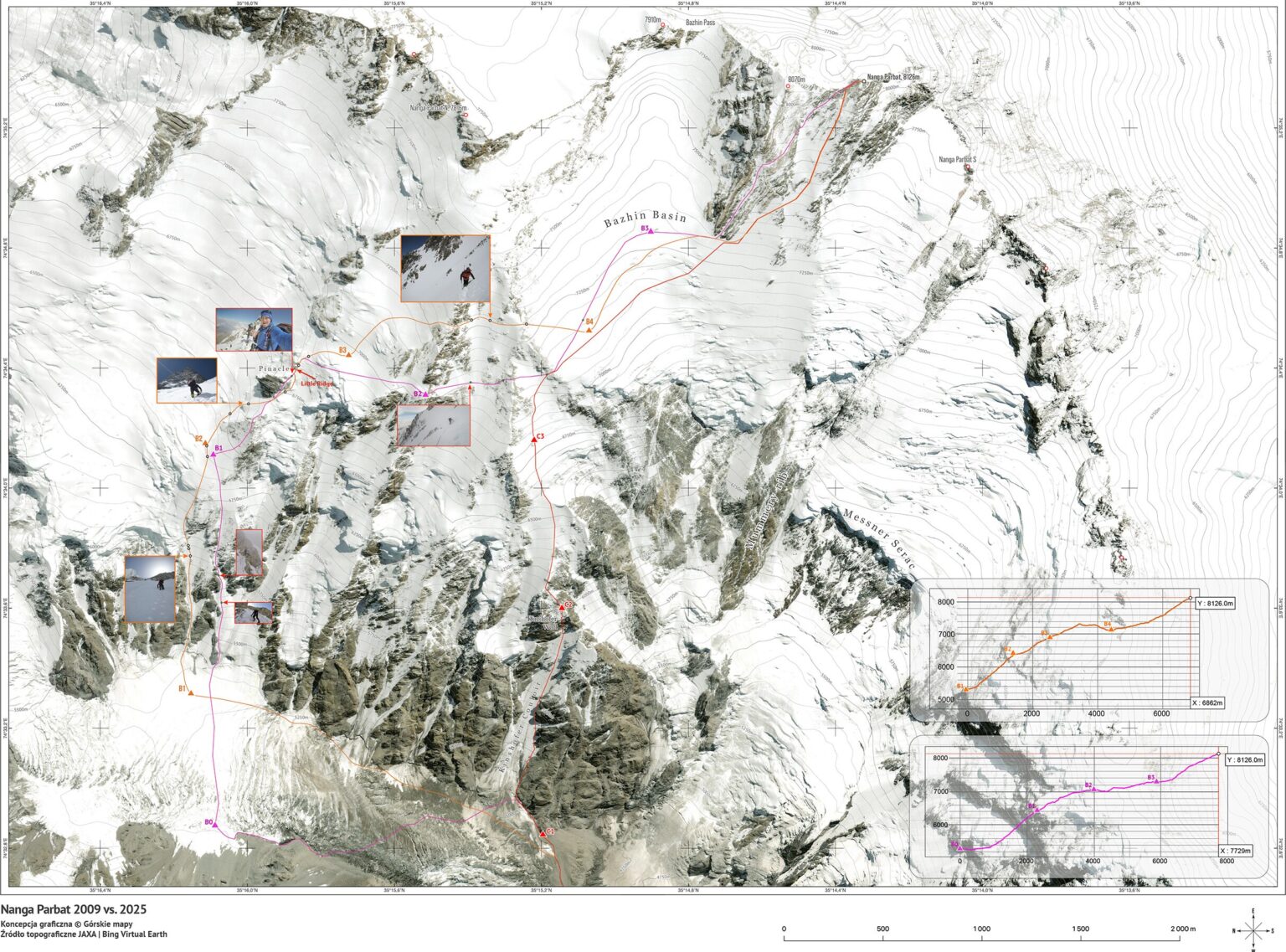
The 2009 Canadian-Austrian route and the 2025 Urubko-Cardell route on the Diamir face of Nanga Parbat, with data compiled and topo drawn by Gorskie Mapy
We recently published a long article about new routes, partial new routes, and variations, which attempted to explain the differences. However, as we noted, there are no accepted criteria in the mountaineering community about which is which. Urubko-Cardell’s route and Goeschl-Rousseau’s have different starting points. The closer areas are mid-mountain. Other sources told ExplorersWeb that the summit area is worth a careful look, since that is where most routes converge.
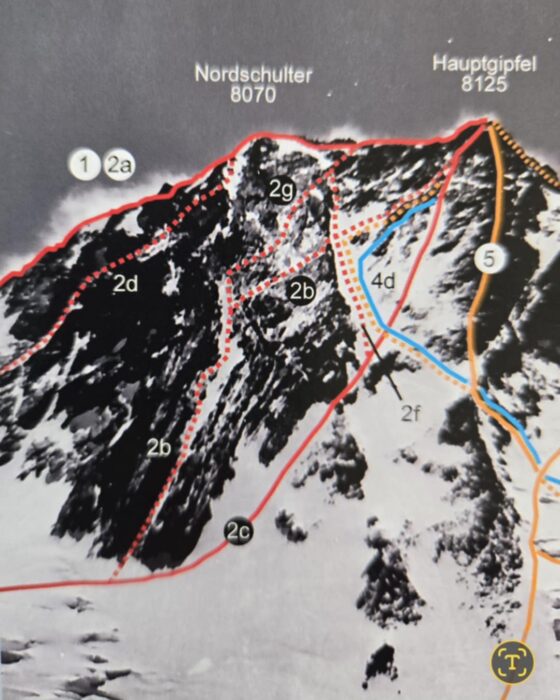
Picture shared on Facebook shows several routes merging on the summit of Nanga Parbat from the Diamir side.
Louis Rousseau declined to enter the debate about whether the Urubko/Cardell route, which they named Niezabudka (the Russian word for the forget-me-not flower), is new, partial, or a variation.
“I will leave it to specialists and historians to judge,” Rousseau said.
Instead, he highlights the significance of the climb itself, done as a two-person team, alone on a huge mountain, in excellent style and difficult conditions.
“For me, it’s just another incredible badass ascent made by Denis and Maria that embodied the true essence of alpinism,” he told ExplorersWeb.