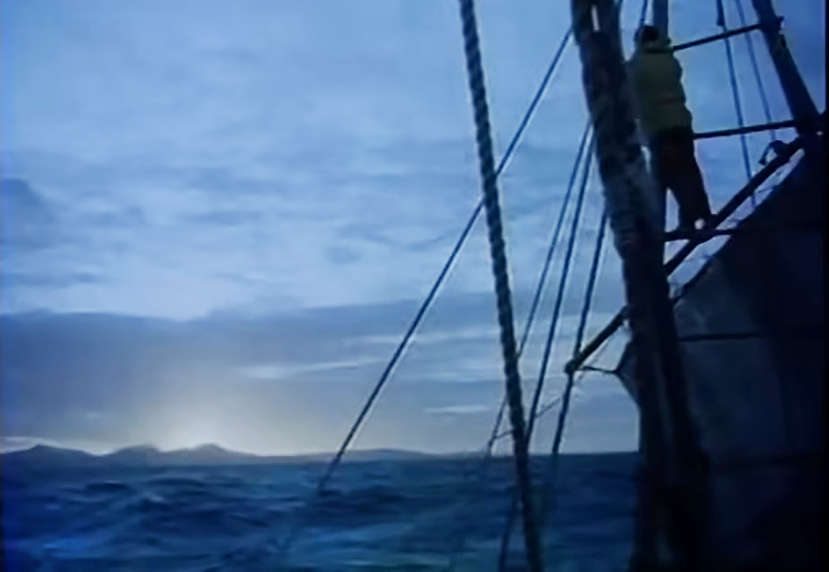
In 1986, Robert Hobman set out in a small dugout canoe with the goal of crossing the entire Indian Ocean. This week’s documentary, The Voyage of the Sarimanok, chronicles Hobman’s months-long expedition. An exercise in experimental archaeology, his goal was to prove that the ancient Indonesian peoples who settled Madagascar could have made the journey in one go, rather than island-hopping.
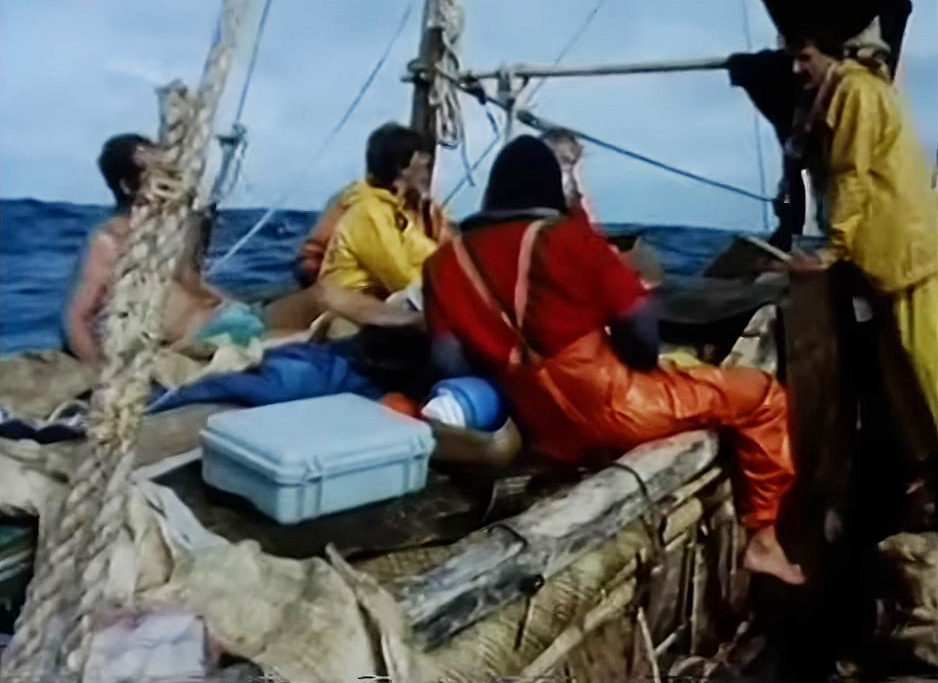
Hobman and crew aboard the ‘Sarimanok’. Photo: Screenshot
After ancient mariners
The documentary begins in media res, aboard the Sarimanok. Speaking to the camera, Hobman wonders who will give up first, the crew or the boat. A prim RP narrator, the sort they seemingly stopped manufacturing after 1990, takes us through the background and history of the voyage.
We meet Bob again in the Philippines. There, alongside his friend, the artist Charles “Chico” Hansen, he’s studying ancient boat-building. For thousands of years, Southeast Asian islanders have possessed incredibly successful maritime technology. In collaboration with Hobman, islanders on Tawi Tawi built a ship using these ancient techniques.
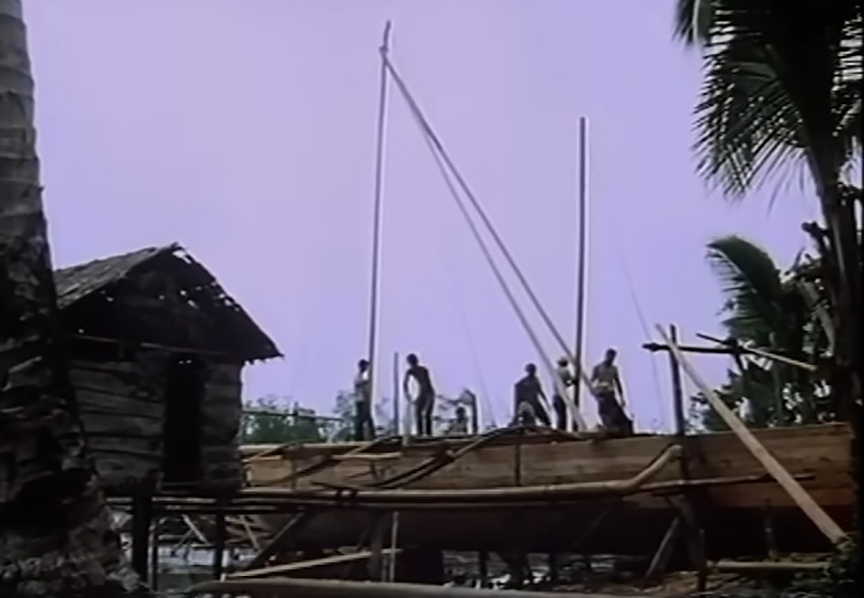
We watch them chop down a massive tree and carve it into the keel. They then craft outriggers for balance. Photo: Screenshot
Seven months later, the ship is ready to launch, and we meet the crew. Nutritionist Sally Crook gets off to a bad start by failing to break a bottle against the hull, while photographer Don King looks on. Yachtsman Steve Corrigan, meanwhile, admires the craft.
But before the journey can truly begin, tragedy strikes. Chico contracts hepatitis and has to be airlifted to a hospital, where he soon dies. For a year, the battered boat stays in Bali. With the trade winds, however, Hobman returns to finish what he and Hansen started.
Bill McGrath, navigator, Colin Putt, boat specialist, Robin Davy, diver, Albrecht Schaeffer, journalist, and videographer Peter Rogers join the crew. Modern technology sealed away for emergencies, loaded up with historically accurate foodstuffs — taro, dried fish, rice– they set sail.
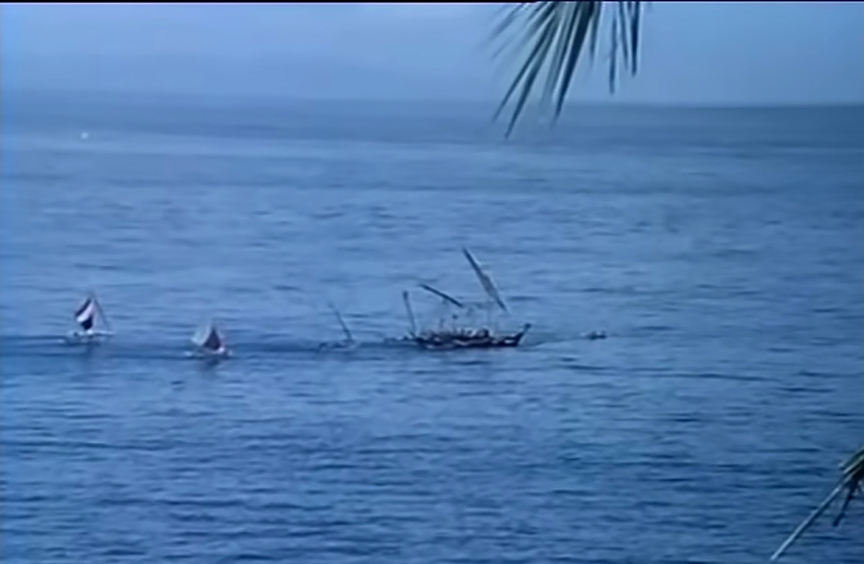
Small craft trail behind, duckling-like, as the ‘Sarimanok’ sets out. Photo: Screenshot
Across the Indian Ocean
We watch the sailors navigate by the sun and monitor the surprisingly hardy little vessel. Luck, however, is against them. The weather is unseasonably stormy, straining the critically important outriggers. Worse, Colin Putt becomes ill.
McGrath reluctantly changes their course, unable to take the winds head-on. Storms continue to batter, but it puts them closer to inhabited islands. As Putt’s illness continues, Sarimanok makes for the Cocos Islands using the modern navigation equipment, seeking help.
“She’s being pushed to extreme limits,” Hobman says. We have now caught up to the introduction, and context only makes things more dire.
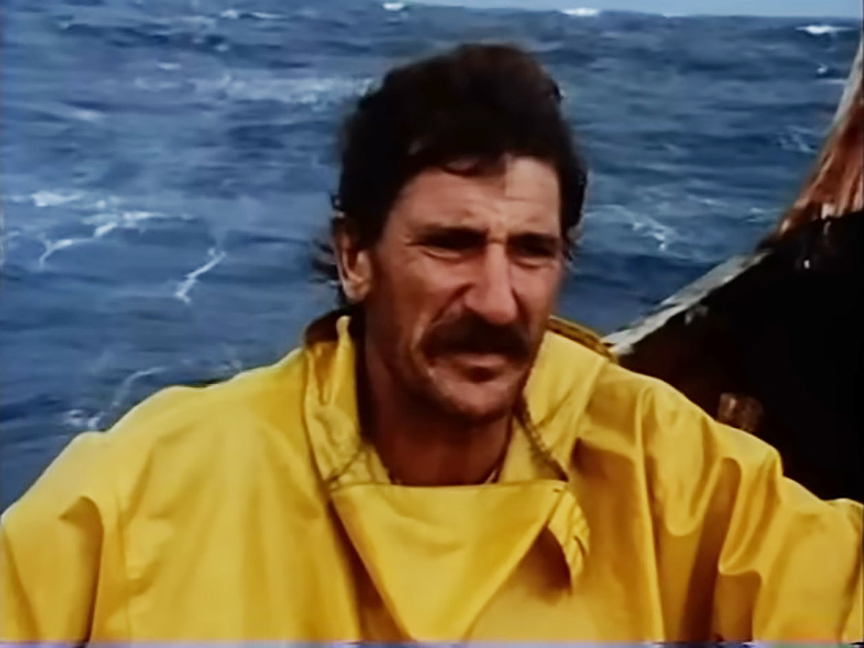
Hobman on the ‘Sarimanok’ amid powerful swells. Photo: Screenshot
They are bailing continuously. It seems they can hardly go on when, providentially, the Cocos Islands appear. Putt is packed off to the hospital, and the rest take the opportunity to beach the Sarimanok for repair and resupply.
They relaunch in good spirits, and the ocean seems to be in a better mood, too. A young finback whale follows them curiously for a few days. The weather isn’t good, but it’s less terrible. When, on the anniversary of Chico’s death, Hobman breaks out the champagne, a genuinely celebratory, if bittersweet, mood prevails.
Nearly 1,000 kilometers from Madagascar, the starboard outrigger fails. Hard work and ingenuity prevent them from capsizing immediately, but another storm would be the end. Putting their faith in the ship, the crew push on and are rewarded, after 65 days, with the sight of Madagascar.
–