Several teams had attempted Khurdopin Sar in the Karakoram, including this summer, but a French pair who arrived without fixed plans finally made the first ascent.
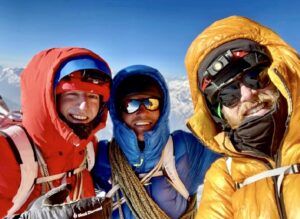
On October 14, Gaetan Navarrete and Julien Priour summited the 6,458m peak in the Shimshal Valley.
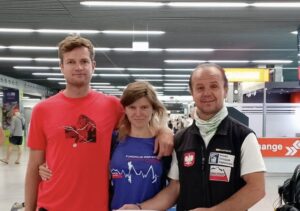
Philip de-Beger and Aleksi Mujirishvili attempted Khurdopin Sar in 2023. De-Beger also attempted the peak in 2015, with Peter Thompson and Aiden Laffey, but high avalanche risk pushed them back. Thomson also planned to try the peak this summer, but health issues forced him to cancel.

The route up Khurdopin Sar. Photo and topo: Gaetan Navarrete
The successful climbers went to Shimshal with no fixed plan, as they wanted to assess the conditions on the region’s peaks before deciding.
“The mountains were rather dry and the north faces showed too much hard black ice, so we went for a suitable south face,” Navarrete told ExplorersWeb.
Alone in the Karakoram
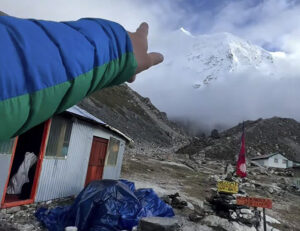
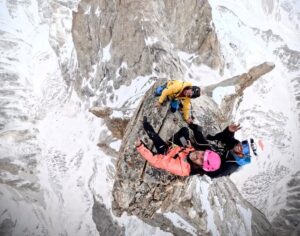
From the village of Shimshal, the climbers trekked to Halga, at the 3,400m junction of the Virjerab and Khurdopin Glaciers. During the next two days, two hired porters shlepped supplies to a settlement known as Shereenin, at 3,800m. From there, the two were completely alone in the Karakoram.

A lonely night during the approach trek. Photo: Gaetan Navarrete
This was the second time that Priour visited the Karakoram, and the first for Navarrete. Both have wide in the Alps, and Navarrete has climbed for three years in the Peruvian and Bolivian Andes. But he admits that the Karakoram is a different league.
“Everything is bigger: the valleys, the rivers, everything is more remote and exposed. Even the roads are dangerous, and the moraines are huge.”
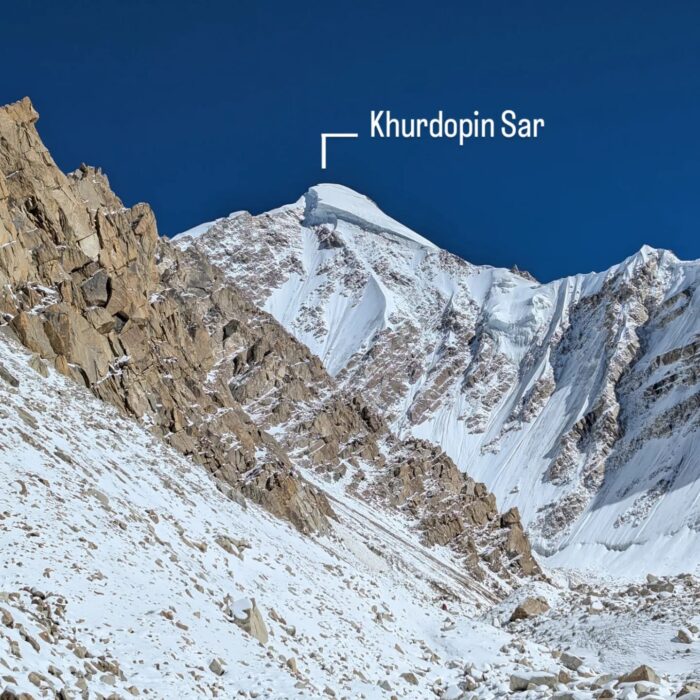
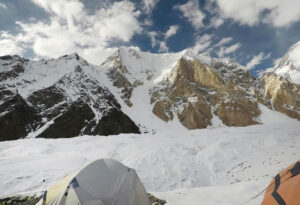
Khurdopin Sar, Pakistan. Photo: Gaetan Navarrete
Single summit push
On the third day, they pitched their tent on the glacier at 4,900m. They set up their high camp the following day at 5,300m, on the only suitable place between unstable seracs and the icy couloir leading to the summit ridge.
After resting for 24 hours, they climbed nonstop to the summit in a long day. They left camp at 6 am, summited at 4:40 pm, and were back in the tent at 1 am. The entire expedition lasted 10 days: 4 days on the approach from Shimshal, 1 rest day, 1 summit day, and 4 days trekking back to Shimshal.

The second camp on the glacier, and the start of the climbing route. Photo: Gaetan Navarrete
The route
“We climbed in alpine style via the south couloir to the west ridge, then followed the ridge to the summit,” Navarrete said. “The route included snow, ice, and mixed terrain up to 70 degrees.”
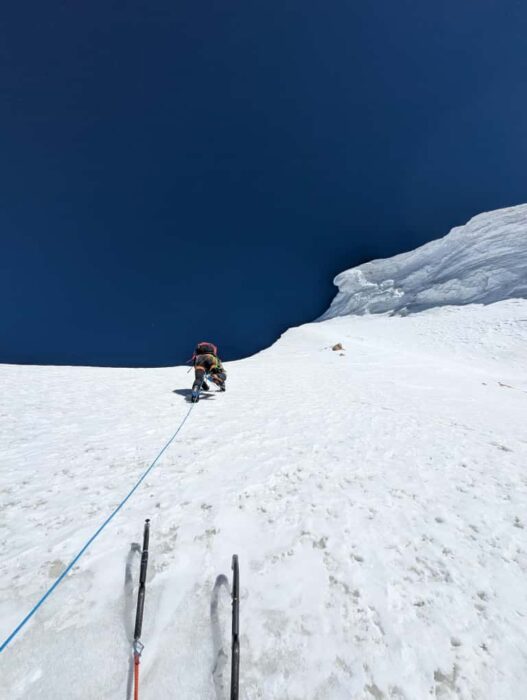
Icy ramps lead up to the summit ridge. Photo: Gaetan Navarrete
From their tent at 5,300m, the climbers headed to the bergschrund at the base of the face and started up the couloir.
“We followed the couloir…as far as we could, but at a certain point, it got steeper and the ice got harder, so we eventually abandoned it and looked for a passage on rocky/mixed terrain, which was easier,” said Navarrete.
Gaining the col that led to the ridge involved some 500 vertical meters of climbing.
The ridge
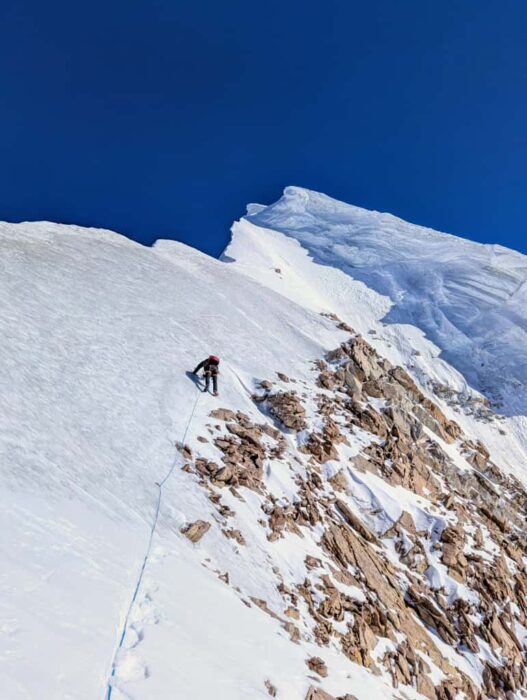
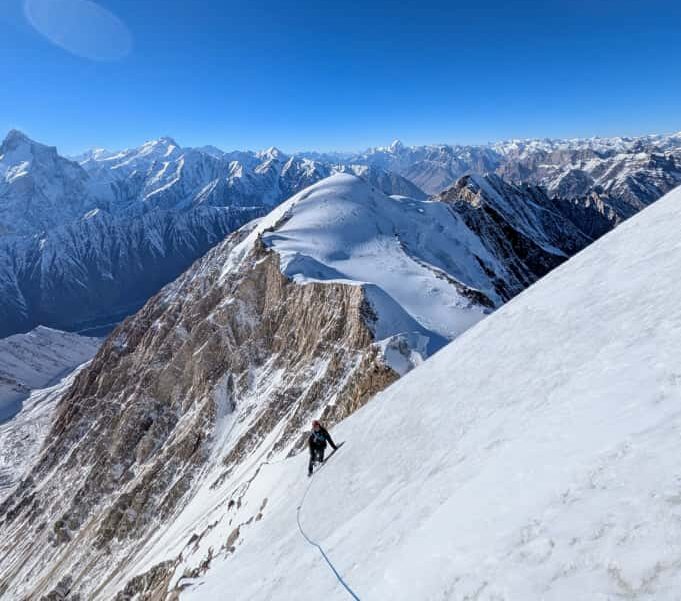
The summit ridge, before the rappel and the snow mushroom. Photo: Gaetan Navarrete
“When we got to the summit ridge, we had to progress on its south side, which was steep, hard ice,” Navarrete said. “The north side of the ridge was flatter, but we found it loaded with slabby snow and decided to avoid it.”
The climbers followed the ridge across several sections of 70º ice until they reached a gap that required a short rappel.
“Then we traversed a section of the ridge on mixed terrain, and finally mounted the final snow mushroom on sugary snow. Once on top of that, the summit was 10 minutes away.

The mixed section of the ridge and the snow mushroom. Photo: Gaetan Navarrete
Priour assessed D or D+, but Navarrete pointed out that the difficulty would decrease if the ridge were in better condition.
Fall season: Hard but safer
The climbers had to deal with wintry conditions: hard ice, –30 °C, and strong winds, especially during the descent.
On the other hand, they noted that the weather was pretty stable and the icy armor provided harder but safer conditions.
“The rocky sections were glued by ice; this peak was surely riskier this past summer, when there was a high risk of rockfall,” they said.
Indeed, mild temperatures and constant risk of rockfall were a constant in the summer Karakoram. Three people lost their lives to falling rocks, two on K2 and one on Leila Peak.
Priour and Navarrete are still in Pakistan with a new climbing project in mind. They will share details after they give it a try.