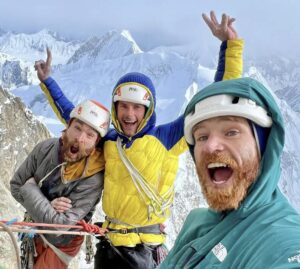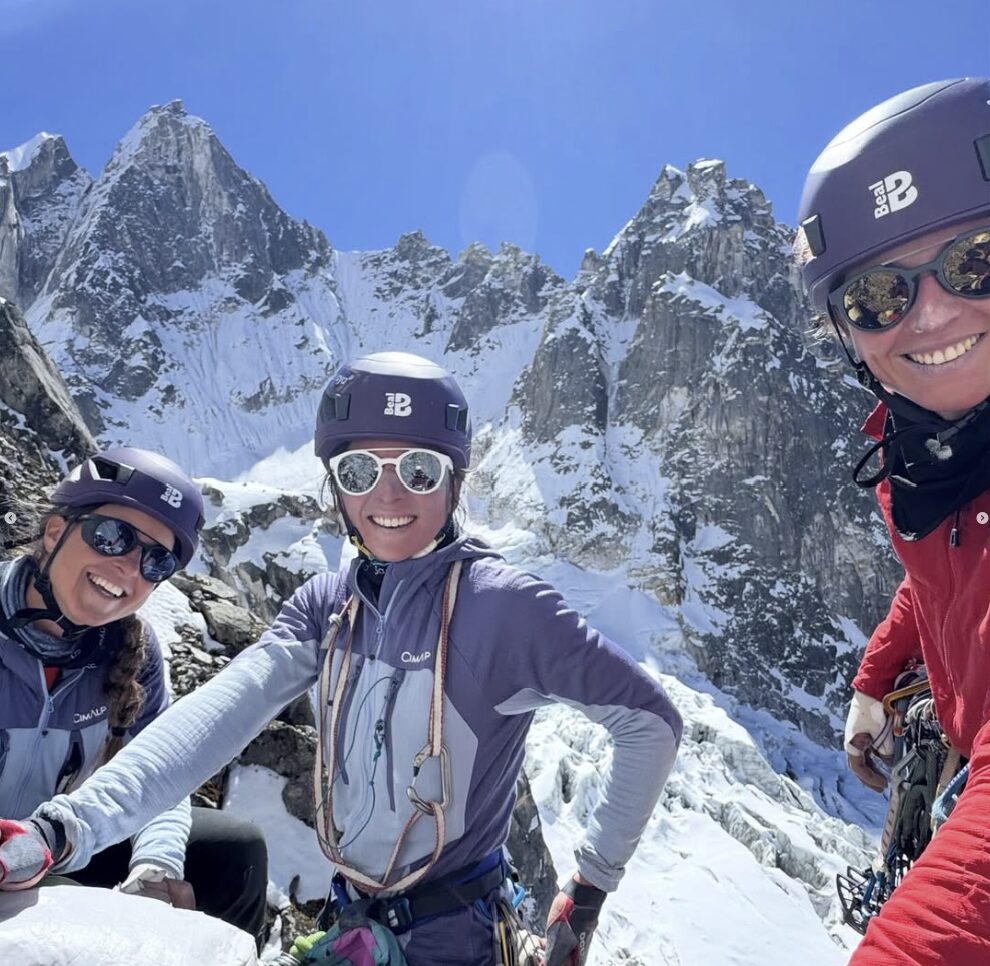
In October, Lise Billon and Maud Vanpoulle led a team of young women climbers to Uttarakhand in the Indian Himalaya. Conditions thwarted them on their main goal, but they forged a new route on a 5,200m granite spire.
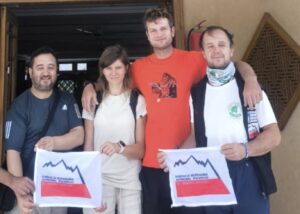
Sophie Jacob, Mathilde Badoual, and Isis Millerioux took part in this mentoring program organized by the French Mountaineering Association. The program recruits young, promising climbers and trains them for three years through several stages and mountain ranges, from the Alps to the Himalaya.
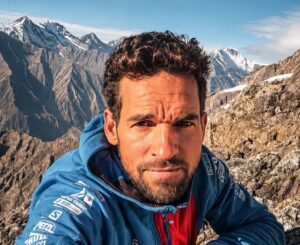
This was Billon’s second year as mentor but her first time leading the group to the Himalaya. Billon has climbed around the world, but this was quite a different experience than arranging an expedition with friends.
“[It was hard] trying to handle the expectations of everyone and feeling responsible for the outcome a little more than usual,” she wrote, “but I felt really great in this role.”
Harsh weather
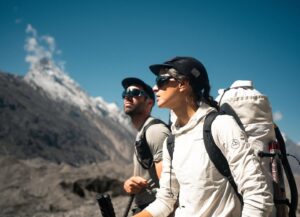
The team had to endure harsh weather during their approach to Base Camp, and then dealt with loads of fresh snow while acclimatizing.

During the approach trek. Photo: French Mountaineering Association
“Then something extraordinary happened, something I never had in Himalaya,” Billon said. “The weather forecast predicted infinite good weather. No clouds in the horizon, forever!”
Excited, they headed for their goal, the north pillar of 6,000m+ Brahmasar, lying between the Satling and Dudhganga Glaciers, south of the well-known 6,904m Thalay Sagar, one of the most challenging peaks in the Garhwal Himalaya.
No-go on Brahmasar
However, the attempt failed due to unstable snow on the face, which alternated with sections of loose rock. The climbers retreated after one day. According to the French Mountaineering Association (FFME), conditions were also worse than expected due to global warming. Some years ago, ice permanently covered these north faces, but now the ice has disappeared, exposing bare, frost-shattered rock.
The good news is, the southern and western faces offered good-quality granite and a suitable alternative.
Unknown terrain
“We spotted a western ridge leading to a summit right above our Advanced Base Camp and decided to make it our next objective,” Billon explained.
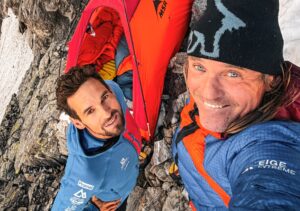
They took two days to complete the new route. As they moved across unknown terrain, the team had to discuss the next moves and the best way to deal with some vertical cracks, sections of brittle rock, and patches of snow on the upper section. A good exercise in teamwork.
“As a trainer for the last three years…I admit that I don’t have much more to teach the girls now,” Billon said.
.
The team did not reach the highest point.
“Night was falling, and a thick snow patch blocked our way to the last spire, five meters above us,” Billon explained.
They rappelled down in the dark, following a different line from their ascent route. “[This ] added a little bit of spice,” said Billon, “especially when my climbing shoes decided to slide off my foot in the middle of the descent, forcing me to walk barefoot through a snow patch at 5,000m.”