Since its rediscovery in the 18th century, the ash-covered Roman city of Pompeii has yielded tantalizing glimpses into the everyday lives of ancient people. One of the most valuable aspects of Pompeii is its graffiti. These 2,000-year-old scrawlings preserved the casual thoughts of its citizens before Vesuvius destroyed the town in an afternoon in 79 CE.
Until now, however, many doodles had worn away so badly they looked like random scratches. Researchers on a recent archaeological project used advanced computational photography on a single corridor to reveal secret messages hidden in plain sight.
This Pompeii graffiti includes nearly 100 newly discovered thoughts and drawings, including a gladiatorial battle scene and a declaration of love. A recent paper outlines the findings.
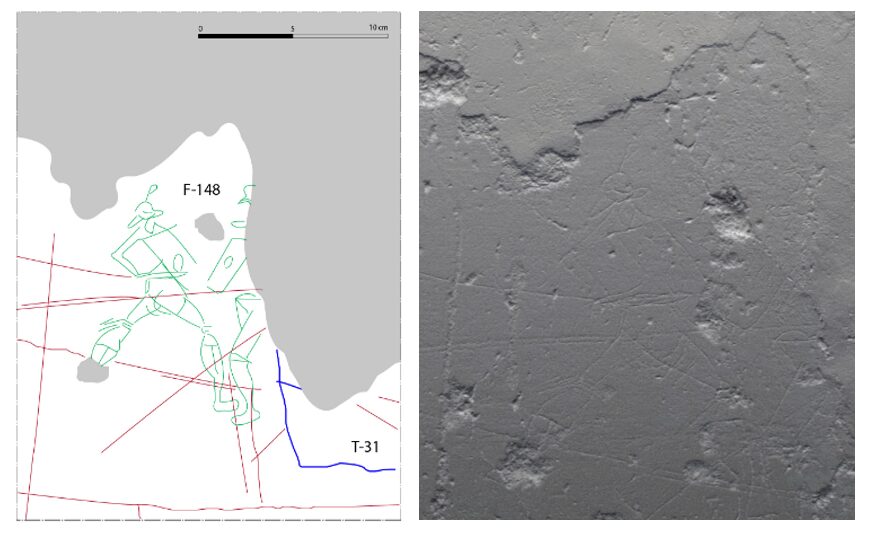
Can you find the gladiator drawing on the left, hidden on the stone wall at right? There’s no prize if you do. Photo: Autin et al
A corridor between two theaters
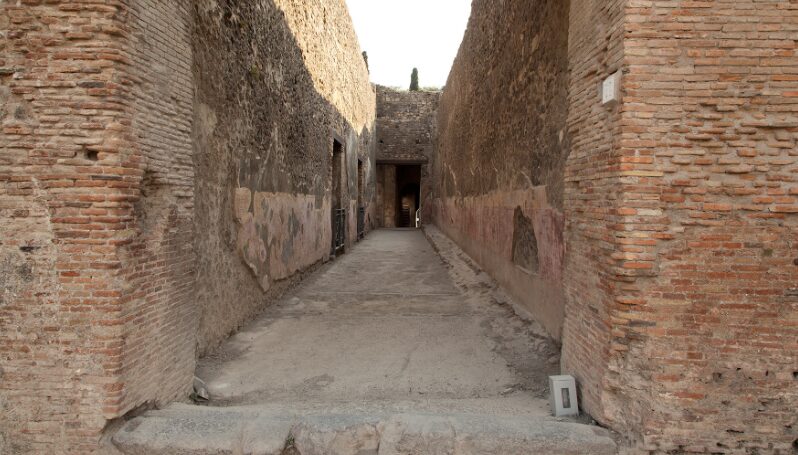
The city of Pompeii had two theaters joined by a long, narrow corridor. Measuring about 27 meters long and three meters wide, this corridor is particularly dense with graffiti. It was the perfect subject for detailed analysis.
Reflectance Transformation Imaging (RTI) reveals hidden details on surfaces. By taking multiple photographs of the same subject, from the same angle, with different lighting, computer analysis can use the interplay of light and shadow to create a detailed digital copy that makes faint or overlaying inscriptions readable.
Using this technique, the team identified 32 texts and 47 figures that had gone unnoticed before.
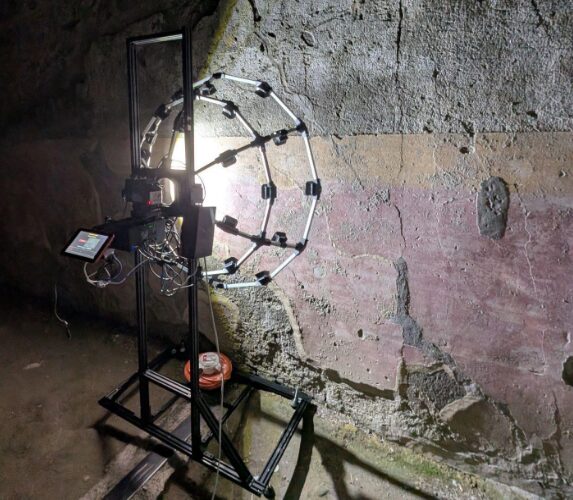
Using Reflectance Transformation Imaging on a section of the theater corridor. Photo: Autin et al
‘Beautiful Sabinus, Hermeros loves you!’
On the south wall, they found two short inscriptions, which they believe are actually two ends of one longer phrase. Working around the damaged central lacuna, it once read, “Erato loves [name missing].”
Declarations of love like this one are a common type of graffiti in Pompeii. Lovelorn graffiti bedecked these walls, and the villas themselves were decorated with erotic frescoes. Going through the corpus of Pompeii graffiti, an intrepid explorer soon discovers messages like “Methe, a slave of Cominia, from the town of Atella, loves Chrestus,” and “Beautiful Sabinus, Hermeros loves you!”
Scans also revealed a sketch of two gladiators fighting. Although this was not formal, professional art, the anonymous doodler showed a surprising command of perspective, anatomy, and movement. Thanks to the RTI scans, we’ve resurrected this 2,000-year-old sketch.