Today, Everest is making headlines around the world with scandalous stories of climbers poisoned or pushed unprepared into the death zone by nefarious guides. The stories aver that it’s part of a major scheme of fake rescues involving guides, companies, helicopter pilots, and hospital staff.
Much of the overall story is true enough, and there have been over 30 arrests around fake rescues so far. But the accusations have been out there for nearly a decade. What has changed to make publications large and small, serious and less serious, suddenly notice it? And what is really going on behind the scenes of the Everest industry?
Breaking news in 2018
Accusations of poor or even criminal practices by local trekking and expedition companies in the Himalaya have existed almost since tourism began in Nepal. However, in 2018, international media started digging into one particular issue. It seemed that trekkers on their way to Everest Base Camp, and some climbers higher up, were manipulated into being airlifted to private hospitals. This was done either by exaggerating their health issues or, allegedly, by making them sick with baking soda or prompting them to gain altitude so fast that they developed Acute Mountain Sickness.
Everyone from the guides to the helicopter companies to the hospital staff were in on this scam to make a supposedly sick tourist, or their insurance company, pay inflated bills.
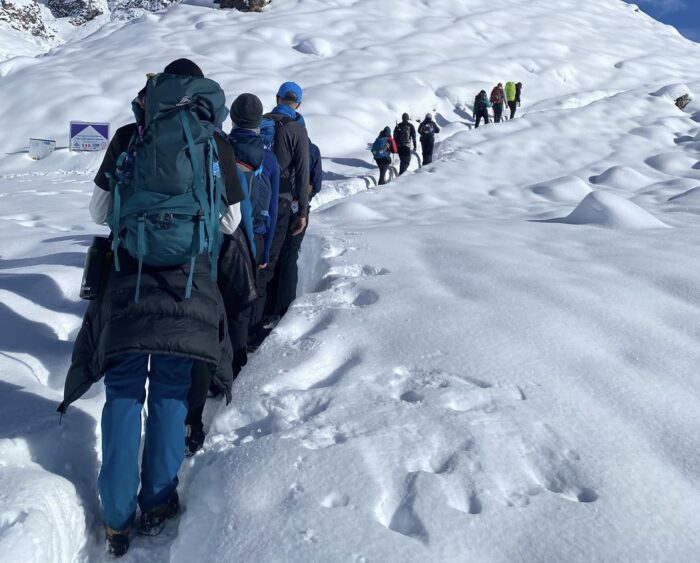
Trekkers in the snowy Khumbu. Photo: Dikesh Basnet
AFP’s Annabel Symington was among the first journalists to report on the scam, following a thorough investigation that included interviewing trekkers and climbers who shared their negative experiences on TripAdvisor. Big media, including The New York Times and The Guardian, picked up the story.
Minor measures
When some international insurers threatened to stop operating in Nepal, authorities launched inquiries that eventually led to minor corrective measures. However, these authorities were careful not to expose too much of the dark side of their promising industry.

Trekkers are essential to Nepal’s tourism industry. Photo: Shutterstock
Nepal’s Ministry of Tourism ordered helicopter companies, trekking operators, and hospitals to submit all rescue invoices to a new government committee within 10 days of the bill’s issuance.
“Unspecified legal action was also proposed against 15 Nepalese companies accused of unnecessary evacuations or hospitalizations, with more to be investigated in the coming months,” The Guardian reported at the time.
In the end, no further action or punishment was taken against the suspected companies and individuals. The thriving industry was left alone to take whatever measures individual stakeholders deemed best. The insurance companies took note and strengthened their protocols. But malpractice has persisted, as an exhaustive new investigation shared by the Nepal Police shows.
New government, new times
So, what happened to prompt Nepal authorities to address the 2018 issue and finally take action? The so-called Gen Z revolution last year overthrew the previous government and brought about big changes. The country’s newly elected leaders have the fight against corruption at the center of their agenda, a local guide told ExplorersWeb. As a result, the investigation into fake rescues was reopened in 2025.
Nepal Police’s CIB headquarters. Photo: Everest Chronicle
Nepal Police’s Central Investigation Bureau (CIB) reported the first arrests in January 2026. More outfitters, managers of helicopter companies and hospitals, and local insurers were detained as the investigations have advanced in recent weeks. On March 20, the CIB released the complete investigation dossier, in which prosecutors recommended criminal action against 33 individuals. Ten of those suspects were arrested, while 23 remain at large. Many are believed to be overseas, Everest Chronicle reported.
The CIB noted that fraud against insurers and individuals might total $6.4 million in damages, with additional claims of over $3 million linked to complaints, including those from foreign nationals.
The 1,243-page report provides hard evidence of an elaborate system in which false passenger manifests were prepared, unnecessary hospital admissions arranged, and inflated invoices generated for insurance reimbursement.
“In some instances, a single helicopter journey was billed as multiple emergency evacuations, with a routine Kathmandu–Lukla flight — typically costing around $2,500 — allegedly invoiced at up to $31,000,” Everest Chronicle noted.
Same facts
The reported facts are the same as those denounced in 2018. According to the police investigation, the systematic scheme has continued since then. Trekkers are forced to accept airlifts to private hospitals, either by scaring them when they present mild symptoms, or in some cases, purposely aggravating them.
“In at least one case cited in the investigation, baking powder was mixed into food to make tourists physically unwell,” reported The Kathmandu Post. Then, the bills were inflated, helicopters with several passengers faked manifests and charged as if they had done one flight per person, insurers and patients were both charged for the same hospital treatment, etc.
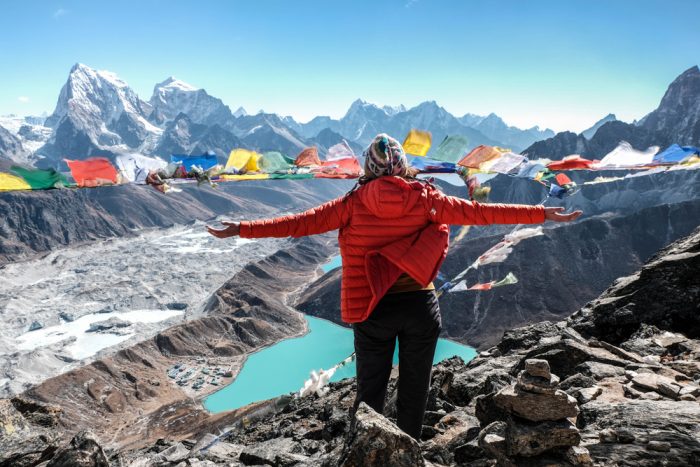
A trekker in Gokyo, Khumbu Valley. Photo: Shutterstock
Apparently, some who were just tired of walking were presented the option to simulate a medical condition in order to prompt a “rescue operation,” which was, in fact, an airlift to Kathmandu later billed to the insurance company. Likewise, the hospitals engaged in the scheme invoiced for unnecessary (or non-existent) treatments and gave percentages to helicopter and trekking companies.
“Investigators identified 4,782 foreign patients treated across the implicated hospitals,” The Kathmandu Post reported. “Of these, 171 cases were confirmed as fake rescues.
Poisoning: the new Everest trend?!
So, while the issue has long been denounced and rumored, the current investigation and the Nepal Police’s publicity have made it official. It is a hard blow to the country’s trekking industry and, by extension, to all branches of mountain tourism. But then here comes the confusion:
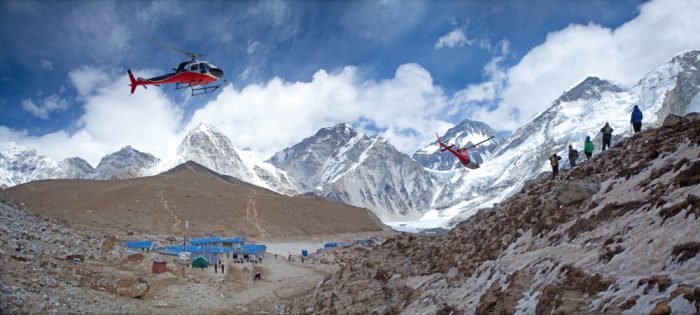
Helicopters fly over Gorak Shep towards Everest Base Camp. Photo: Shutterstock
The suspect operators are all travel and trekking companies. Most of the allegedly scammed clients were trekkers on their way to Everest Base Camp, the Annapurna Circuit, the Manaslu Circuit, or the Langtang region. There is virtually no mention of Everest or any climbers, except in a table that lists 2024 and 2025 aerial rescues.
Unfortunately, international media have again assigned this scam specifically to Everest. The nearly 5,000 patients involved turned into “Everest climbers” for many of those news sites, and the scamming agencies were identified as “Everest guides.” It even seems that poisoning clients is the new trend on the mountain:
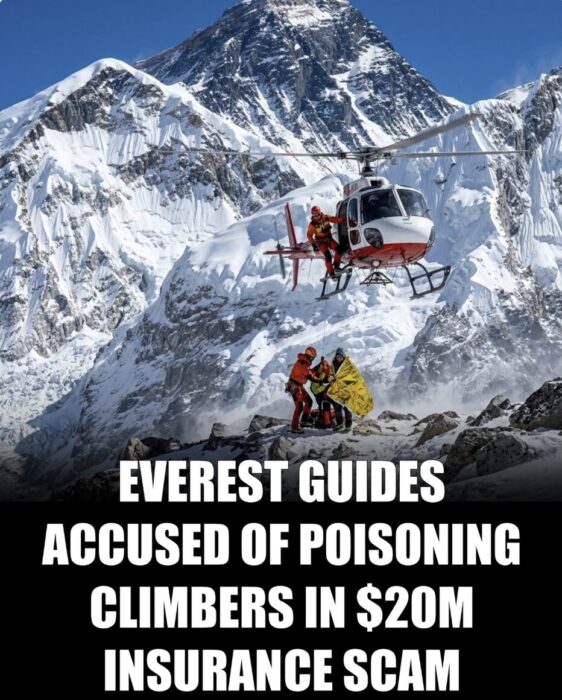
PMW TV’s story on Instagram today.
“Everest guides accused of poisoning foreign climbers to force fake rescues in $20m scam,” read The Independent. The New York Post, TV networks around the world, and even The Times have nearly identical headlines, but then Everest is barely mentioned in the text inside.
Everest just makes better headlines
Does that mean that Everest is free of scams and misbehavior? We can’t tell at present. The hospitals and helicopter companies in the report do receive climbers as well as trekkers, and the investigations are still ongoing. However, in the released report, there is no detailed case referring to Everest expeditions. It seems that Everest just makes better headlines.

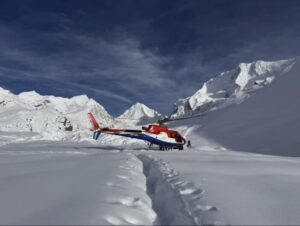
A helicopter lands at Everest Base Camp. Photo: Alpine Club of the Himalaya
Recent regulations by Nepal’s Department of Tourism and the Civil Aviation Authority have stressed the need to control any emergency airlift in order to prevent such scams. It is also to stop helicopters from being used as convenient taxis for tired climbers descending from the summit, and then to disguise those airlifts as rescues. This is forbidden on Everest. It is also true that whatever happens above Base Camps is hard to investigate due to the extreme conditions in such areas.
As for poisoning, we have not heard of any specific case of clients purposely poisoned to force their airlift from Everest Base Camp or above. Again, health issues in a Base Camp, no matter how luxurious, cannot be dismissed. But outfitters have improved logistics to ensure their clients’ well-being and, as a result, to improve their own reputation. Individual climbers need to research as thoroughly as possible to choose a trustworthy operator for their once-in-a-lifetime experience.
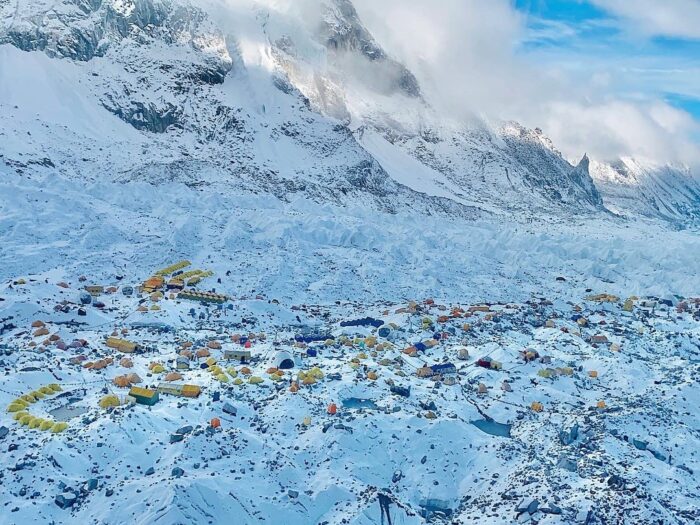
Everest Base Camp: big and getting bigger. Photo: Seven Summit Treks
While headlines may look alarming for trekkers planning to go to Nepal, the country is safe and enjoyable for most visitors, as long as they take basic precautions, such as going with reputable companies rather than just the least expensive ones. They should also make sure they have a reliable insurance policy.
In fact, the recent investigation and the arrests are positive signs, since they show the authorities’ interest in fighting abuse.
To summarize what we actually know:
Over the last few years, ExplorersWeb has reported about some unclear helicopter flights to or from higher camps on peaks such as Kangchenjunga, Manaslu, and especially Everest. We have had no news of clients poisoned.
As for acclimatization protocols, we have witnessed the massive use of oxygen, some extremely long summit pushes (well over 24 hours non-stop), and cases of climbers who went up too fast, with lethal consequences. However, it is extremely hard to assign blame to individual cases and to discern inexperienced or irresponsible decisions in guides from criminal behavior.