Tensions have increased among Everest expedition leaders as work on the Khumbu Icefall remains stalled. The clock is ticking, as climbers need to begin their rotations as soon as possible to acclimatize. The good news is that a new drone-based carrier service is ready to start operating once the way to Camp 1 is cleared.
As we reported last week, the work to find and fix a route through the treacherous Khumbu Icefall to Camp 1 — common to Everest, Lhotse, and Nuptse — is seriously delayed. In the spring of 2025, the route was open by April 10. This year, two weeks later, there is no tentative opening date.
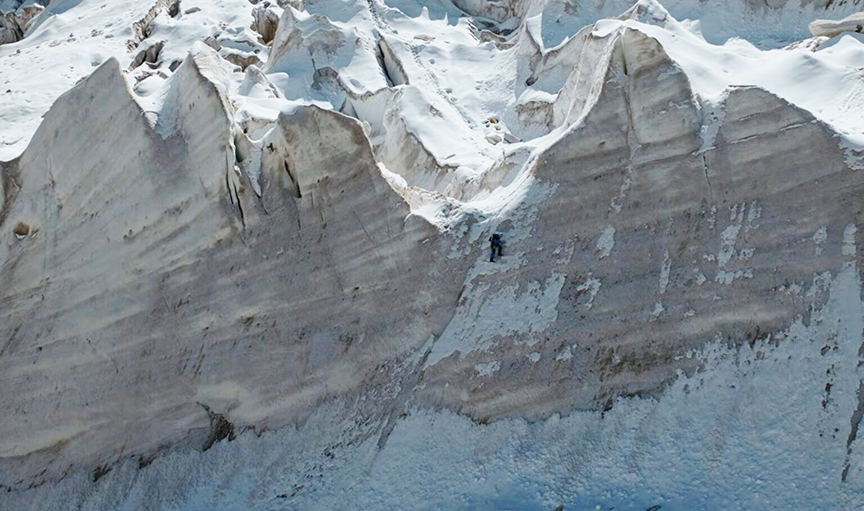
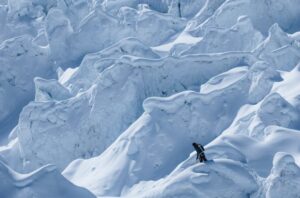
Maneuvering down a serac on the lower part of the Khumbu Icefall. Frame of a video by Bartek Bargiel/Red Bull
The problem is an unstable serac that threatens to collapse at any moment in the upper part of the Icefall. According to reports, the Icefall Doctors deployed by the Sagarmatha Pollution Control Committee were waiting for the huge chunk of ice to fall on its own. This has not yet happened, and there is no way to know when it will.
Slow approach
Meanwhile, teams are taking it easy on their approach to Everest Base Camp. Several groups are spending more time than planned around Namche Bazaar or climbing trekking peaks in the Khumbu for acclimatization and training. For example, Karl Egloff of Ecuador and climbing partner Nico Miranda summited Mera Peak yesterday:
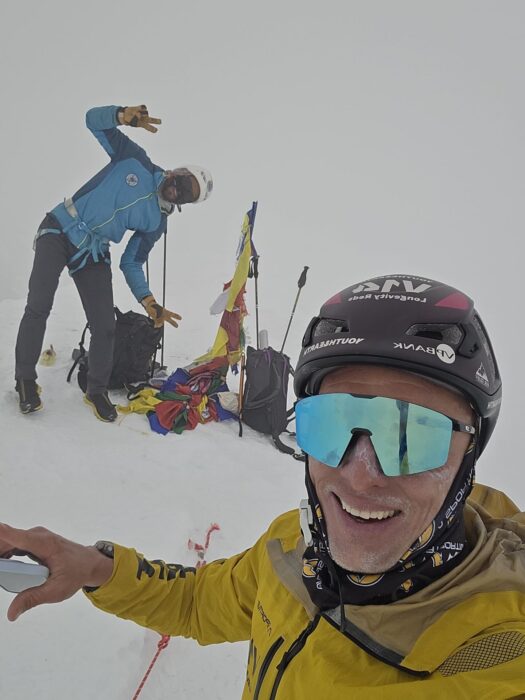
Nico Miranda, left, and Karl Egloff of Ecuador on the top of Mera Peak. Photo: Karl Egloff
Egloff intends to make the Fastest Known Time (FKT) up Everest and back down to Base Camp without supplementary oxygen. Other no-O2 Everest climbers include FKT runner Tyler Andrews of the U.S., American Justin Sackett, Saulius Damulevicius of Lithuania, and Marcelo Segovia of Ecuador. The current delay affects these no-O2 climbers more than others, because they need more rotations and a longer time at altitude to acclimatize.
Ryan Mitchell of the U.S. has definitely canceled his no-O2 Everest expedition after his bout of illness that required him to be put on bottled oxygen and airlifted temporarily from Base Camp. Mitchell got sick right after a short trip to Kathmandu from a throat infection and later, food poisoning. He said he will return to the Himalaya in the fall to attempt an 8,000’er.
Drone carrier
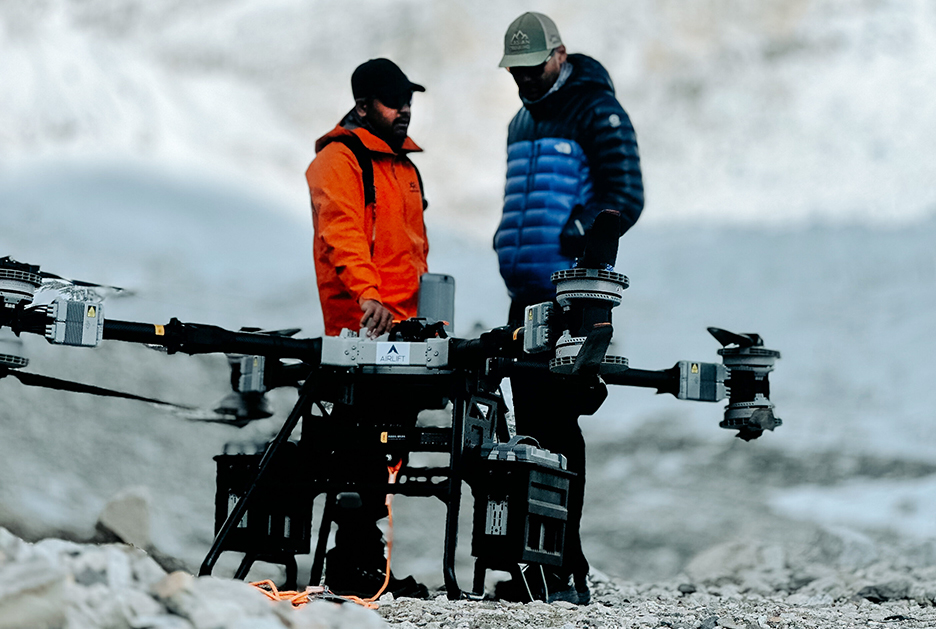
Expedition teams urgently need to set up their higher camps, and they worry about the traffic jams that will form at the Icefall once it opens. But a new drone-carrying service should help. It is a partnership between a local company, Airlift Technologies, and Dawa Steven Sherpa and Tenzing David Sherpa of Asian Trekking, supported by the Sagarmatha Pollution Control Committee and the Khumbu Pasang Lhamu Municipality.
The use of drones on Everest started last year and is a major advance in logistics and safety.
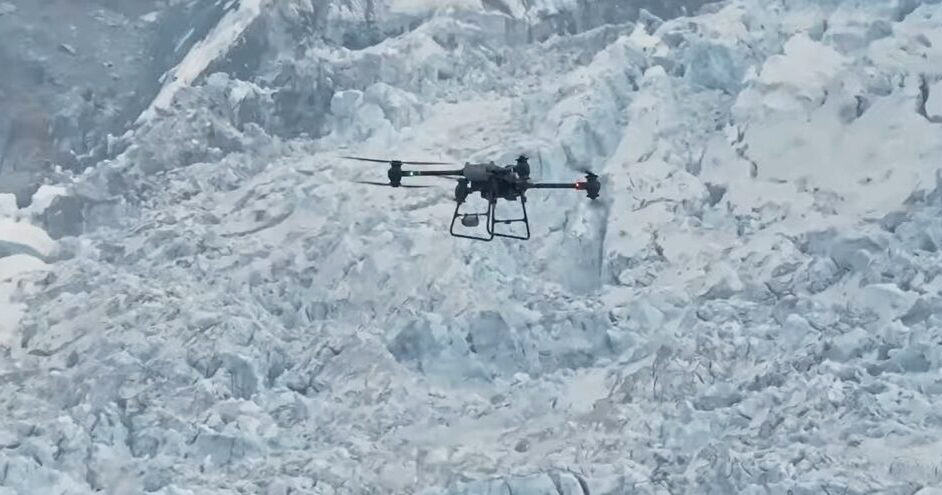
A DJI Flycart 30 cargo drone on Everest last spring. Photo: DJI
Currently, the drones are helping the Icefall Doctors with their work, carrying new equipment for the route and bringing down old ropes, gear, and litter from previous expeditions.
Once the way to Camp 1 is ready, the drones will diversify their services. First, they will shuttle gear to a second team of rope fixers, assigned by the Expedition Operators’ Association of Nepal, who will fix the rest of the route to the summit. Then, they will airlift supplies for commercial expeditions between Base Camp and Camp 1 at a very low fee. According to outfitter/guide Garrett Madison, it will be 1000 Nepalese rupees (less than $7) per kilo.
Last year’s drone could carry up to 30kg. The new one used this season can bear up to 100kg at sea level, but in the thin air at Everest, Airlift Technologies has set a maximum load of 50kg.
Reducing risk for Sherpas
The carry ups will prioritize toting up oxygen cylinders, tents, and bulky or heavy equipment, as well as bringing garbage down from Camp 1 to Base Camp, Tenzing David told ExplorersWeb. The expedition team will have to take the loads to the drone pad at Base Camp and ensure staff are ready to receive them at a similar drone landing pad near Camp 1.
This service will reduce the risks taken by local workers on Everest. They will now be able to remain in Camps 1 and 2, instead of having to go through the Icefall time after time all season long.
It will also help comply with the new, stricter regulations on waste management on Everest. This includes retrieving all garbage from the mountain, including litter, remaining supplies, and human waste.
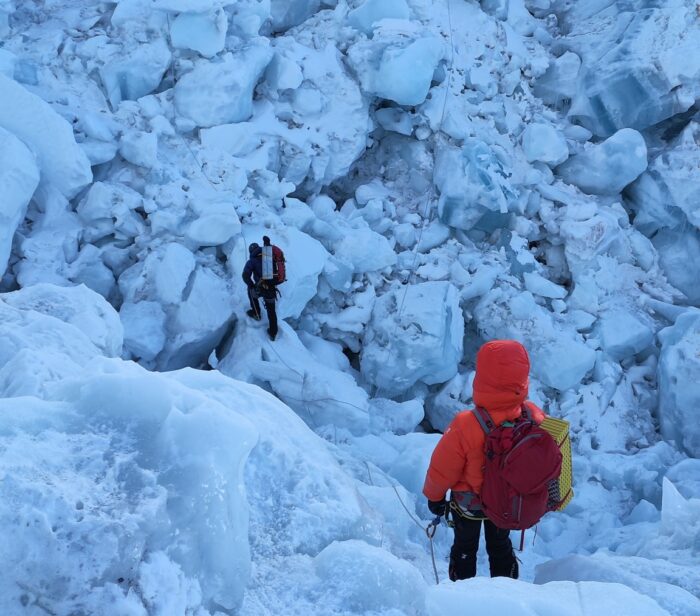
Climbers in the Khumbu Icefall. Photo: Hugo Ayaviri