In spring, Manaslu is a different mountain from the crowded fall season. Alex Moroz of Ukraine and Mark Ablovacky of Russia have sort of traveled back in time earlier this week and returned to an era of heavy backpacks, technical sections, an open bivouac at 7,500m, and a tricky descent on avalanche-prone slopes.
Moroz and Ablovacky had the only permits issued for Manaslu so far this year. They climbed the mountain with no oxygen, no Sherpa support, and no fixed ropes (except for some meters of old ropes Moroz clung to near the summit).
They didn’t even bother to set a base camp: When not on the mountain, they retreated to Samagaon village. They completed the no-O2 climb in only 15 days from Kathmandu. “It was an interesting experience,” they told ExplorersWeb after their return.
Alone on the mountain
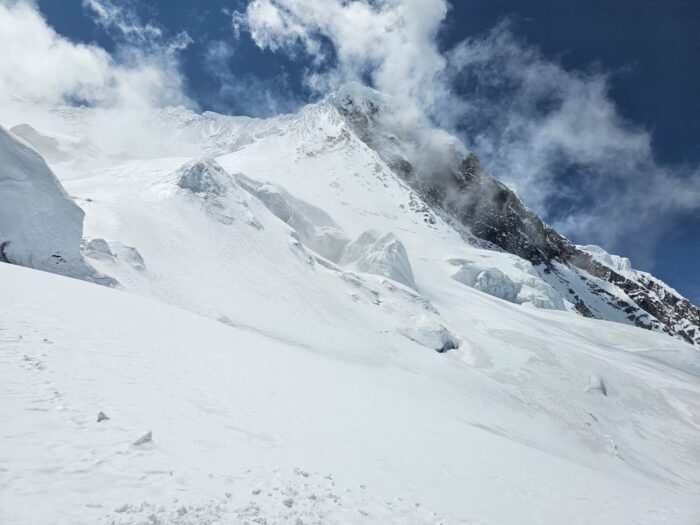
Pristine Manaslu earlier this week, from near what is usually Camp 1. Photo: Mark Ablovacky
Short of time and with an equally short weather window, the pair had to make a hard decision: to attempt a no-oxygen, self-sufficient summit push with only one previous rotation to 6,100m.
“The weather forecast was not great, so we skipped our planned second rotation and tried to use a short weather window for the summit push,” Ablovacky explained. Previously, their highest point was the Larke La (5,100m), as they trekked over the pass to Samagaon.
The team had left a small amount of gear stocked at Camp 1 (5,800m): down suits, some food, and fuel. They carried everything else, including tent and sleeping bags, all the way up and down the mountain.
Dry conditions
The climbers set off from Samagaon on April 24 with heavy backpacks and pitched one camp a day, in roughly the same locations as the camps used during peak season.
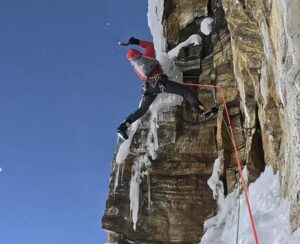
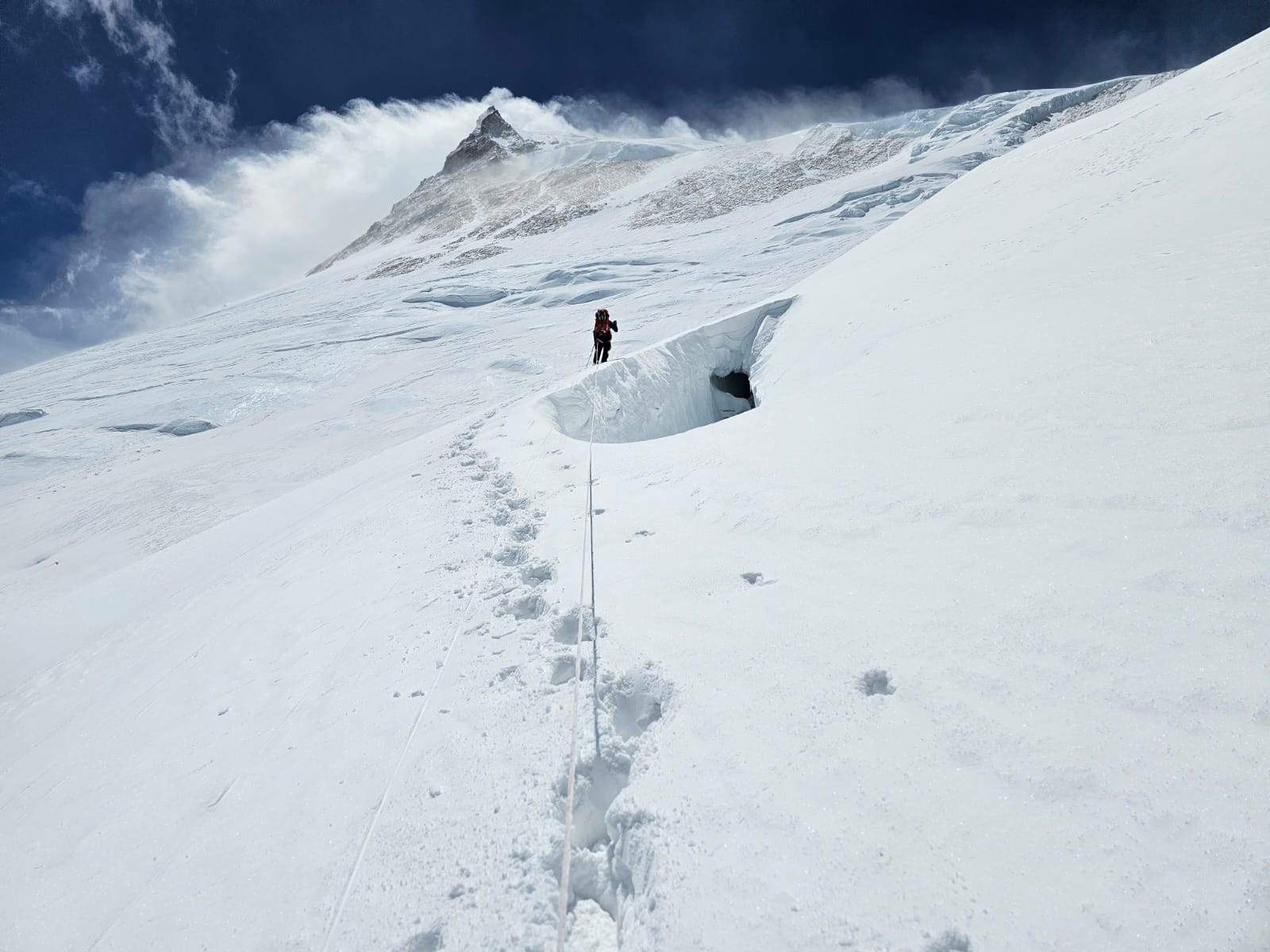
Otherwise, they found themselves on a different Manaslu. No crowds, camps, or post-monsoon snowy slopes. Dry and windswept, the route provided challenging conditions with large parts on bare ice. (Check the video below.) Approaching the summit, they experienced sections of frozen rock that required dry-tooling.
“It is not super hard from a technical point of view, but at 7500m+, it is really tricky terrain,” said Ablovacky.
One turns back
On April 27, the pair climbed from Camp 3 in rising winds up to 40 kph, which made the going harder, especially for Ablovacky. “I set off that day hoping to be able to reach the summit, but soon enough understood that I could get serious frostbite even in heavy mittens, so I decided not to risk it and retreated to Camp 3, while Alex [Moroz] continued,” he said.
That meant that Moroz proceeded without a tent, which resulted in enduring a short evening rest at an open bivy at 7,450m before the final push, which started at midnight.
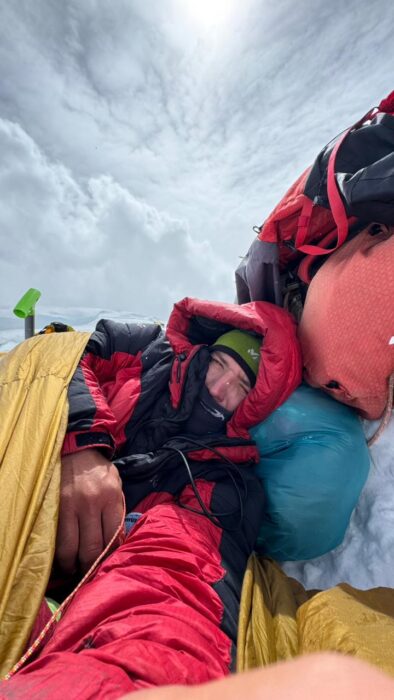
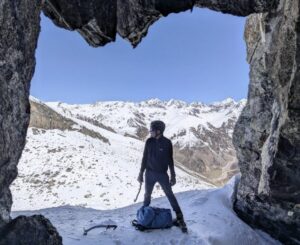
Alexandr Moroz takes a selfie during an open-air bivy at 7,450m on Manaslu.
The summit
Moroz reached the summit alone at around 8 am on April 28. Conditions were increasingly technical. Three short sections from the true summit, the Ukrainian used some old ropes from the previous season, which still looked in good condition. “I had to climb for a while on the front points of the crampons, using dry-tooling techniques,” Moroz told ExplorersWeb.
The climber shared several summit videos and photos, plus the GPS track, with ExplorersWeb. On top, there were remnants of prayer flags, ropes, and rags of fabric left by the fall 2025 expeditions.
The descent
During the ascent, the weather was clear and cold in the morning, but some snow fell in the afternoons. It was windy on the 27th, but conditions improved on the summit morning, but then worsened quickly with snowstorms on the afternoon of April 28 and, most of all, on April 29.
“On the way back, we had 60cm of fresh snow in one day, so we used one 30m rope and one of us went in front to act as an avalanche probe,” Ablovacky said.
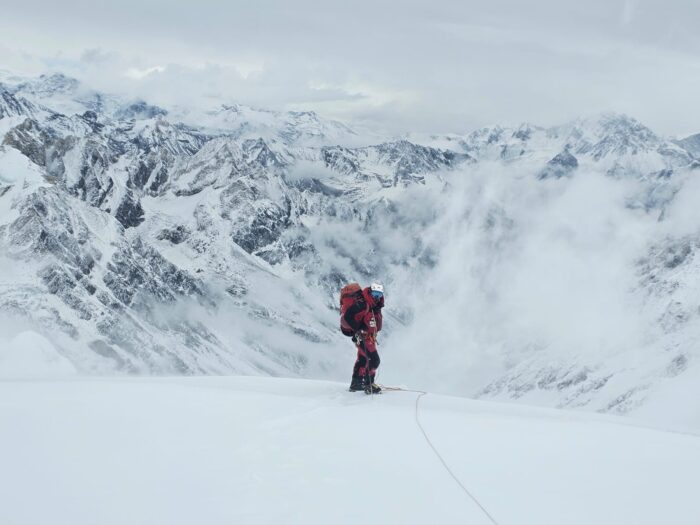
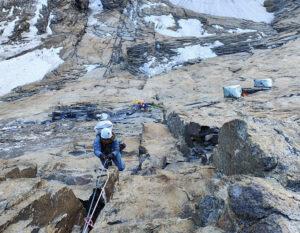
Alexandr Moroz during the descent on Manaslu. Photo: Mark Ablovacky
Alexandr Moroz and Mark Ablovacky have shown that an 8,000m peak can still be found in the wild and lonely state it was 20 years ago, even on the normal route — as long as one goes in the off-season.