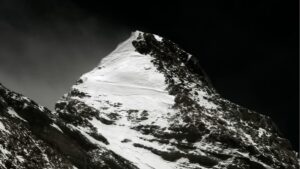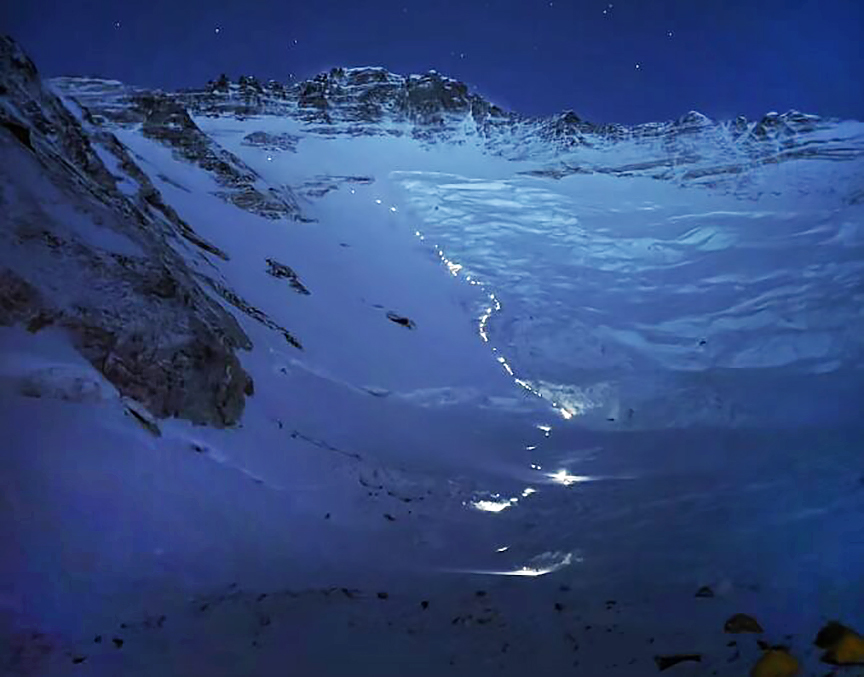
While jet stream winds are hitting the top thousand meters of Everest, making summits impossible, the lower slopes are still fine. With the high winds expected to subside next week, hundreds are starting to move up from Base Camp, one camp a day, positioning themselves for the next summit window. Meanwhile, Sherpa porters are feverishly shuttling supplies to the higher camps to support the massive number of climbers and guides expected.
Until now, the only summits reported were those by the large group of Sherpas who fixed ropes to the summit, plus six clients from Imagine Nepal — some 20 summits in all. Since then, the jet stream has kept climbers away. There are reports of high winds hitting Everest from 7,600m. Nevertheless, Sherpas continue to carry supplies to Camp 4 at 7,900m, according to the photos from the mountain.
Crowds everywhere
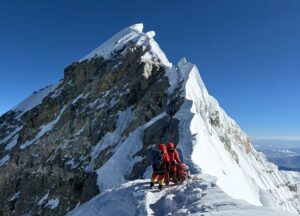
Every year, worldwide audiences frown at images of endless lines of climbers on the summit ridge of Everest. However, traffic jams are a potential problem not only on the upper section but at any point on the mountain. Everyone follows the same trail and clips to the same fixed ropes. This includes not only climbers but also heavily loaded porters.
Two videos taken by Ram Bahadur Gurung earlier this week on the way to Camp 3 illustrate these lower-altitude traffic jams:
Coordination is key
The climbers and their summit support teams have waited until the route was fixed and all tents were pitched. Now that that is complete, there is no time to waste if they want to take advantage of the good weather expected to begin on May 18.
The question is, how many people will try to summit on those first days and how they are going to distribute this in a season characterized by many delays and a record number of climbers.
A significant number plan to set off from Base Camp this weekend, although teams tend to keep their plans to themselves. Among the few who have confirmed they are on their way up are Xavier Ladoucer of Canada; Kami Rita Sherpa, hoping to summit Everest for a record 32nd time, and his group. The detailed summit schedule of Laura Gonzalez of Mexico is: Camp 2 tomorrow with a rest night there, Camp 3 on May 18, Camp 4 on May 19, and final summit push that night, aiming for the summit on the morning of May 20.
Gonzalez has summited Everest twice and climbed several other Himalayan 8,000’ers with her husband, Yuri Contreras. Contreras (summited eight 8,000’ers, including Everest four times) died last year of a heart attack during a cycling race in Cancun. His wife now wants to scatter his ashes on the summit of Everest.
A few others are still finishing their acclimatization and will schedule their summit day after the first waves of climbers subside.
No-O2 climbers
Climbers going without oxygen need to move more slowly and be stricter with their acclimatization. American Justin Sackett is just back from his second acclimatization round after spending a night at 7,700m, the site of a higher Camp 3 on the mountain.
Kristin Harila of Norway has spent at least one night at Camp 3. Earlier this season, she climbed Lobuche East. Saulius Damulevicius summited Mera Peak and tried Baruntse. He also spent 10 days on Everest/Lhotse, with one night at Lhotse Camp 4 (7,700m) and three nights at Camp 3 (7,070m).
Sabrina Filzmoser of Austria is back at Base Camp after spending two nights at Camp 3 and trying to reach Camp 4. She turned around at 7,600m (before the Yellow Band) due to high winds.
State of the Icefall
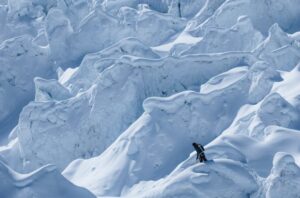
As always, the Khumbu Icefall — the first obstacle beyond Base Camp — remains a key section. Everyone needs to traverse this labyrinthine maze of ice on their way both up and down. Note that airlifts to avoid the Icefall are forbidden, and helicopters from Camp 2 can only carry passengers who need urgent rescue. The passage is usually slow at vertical sections or where ladders span crevasses. Safety concerns are always present, especially this year, due to the unstable serac at the top of the Icefall.
Despite the search for alternative passages, the route to Camp 1 still passes close to that unstable area on the upper part of the Icefall, known as Section Four. Happily, most of the giant blocks of ice have fallen down by now.
Ben Jones, guiding for Alpine Ascents International, wrote yesterday: “I can’t remember the Icefall and route to C2 ever in better condition in the last 15 years.”
Valik Sypavin of Ukraine posted a cool drone video of the Icefall, noting that the section is fun, not dangerous: