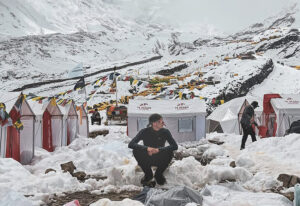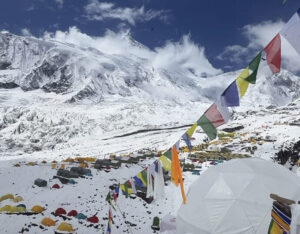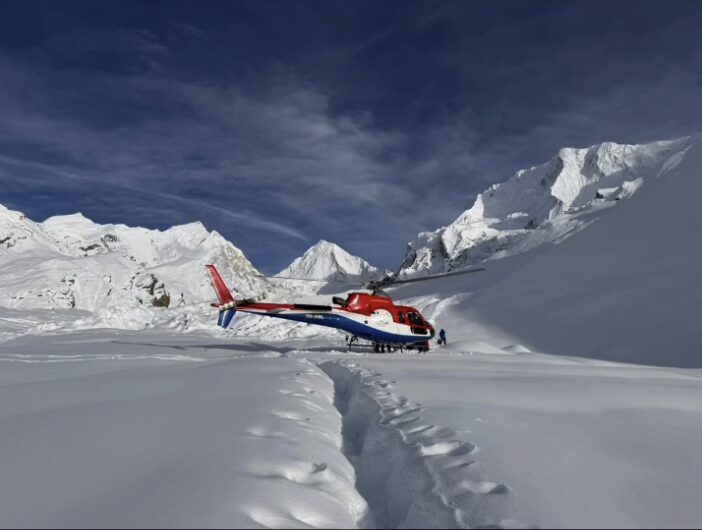
Mingma G, leader of the rescue team on Himlung, has given up any hope of finding survivors among the 12 base camp workers still missing. He suspended search efforts for the bodies until the snow melts. But a key question remains: Why keep crews at peril in base camp during storms while clients are told to leave?
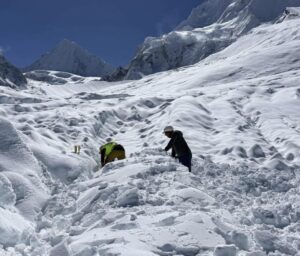
“We recovered four bodies, making it clear that no one survived,” Mingma G wrote yesterday. He added that the 12 missing kitchen staff are buried under more than four meters of snow. With only shovels, the rescue team cannot dig that deep. “We will…retrieve the bodies as soon as the snow melts a bit more,” he said.
Himlung expeditions uncertain
Several outfitters were planning expeditions on Himlung. Will they now cancel their climbs, or will they set up new tents and base camp kitchens while the corpses of the deceased lie below them? In a new update published yesterday, Nepal’s Ministry of Tourism says that no permits have been granted for Himlung yet. However, there are also no permits yet for Ama Dablam, Nepal’s most popular peak in October and November. On these peaks, permits are often issued at the last minute, so their absence does not in itself reveal anything.
The tragedy raises questions about safety protocols for local base camp teams. Several institutions in Nepal warned climbers, trekkers, and residents of the country’s mountain areas to stay in safe areas. There were no foreign climbers on Himlung at the time of the incident.
Safety comes first — or does it?
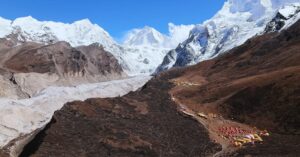
Obviously, the local operators never considered that a relatively safe base camp like Himlung’s would be buried completely. “The avalanche was enormous — no one had believed that Himlung Base Camp could experience something on that scale,” Mingma G wrote yesterday.
However, the weather front that hit Nepal last weekend had been forecast days in advance. Alerts were issued in plenty of time. Local outfitters always insist that “safety comes first” as the reason for canceling expeditions and bringing foreign climbers down to safer ground. However, this does not seem to apply to their base camp staff. Whatever safety protocol was in place, it was clearly inadequate after 14 people died in a supposedly safe camp.
Manaslu
Local staff also remained in camp on Manaslu during the storm, even after outfitters canceled their expeditions for the rest of the season. Foreign climbers were airlifted or guided down the valley, while high-altitude Sherpas reportedly dismantled the upper camps and brought down the materiel. However, dismantling Manaslu’s huge Base Camp, which can accommodate 1,000 people, is not easy. Most tents remained, together with an undetermined number of local workers.
Alexander Abramov, leader of the Seven Summits Club team, filmed a significant number of these workers as they finally retreated to Samagaon village over the weekend, while the gale raged. As seen in the video, they were poorly equipped, had no crampons, and tried to help each other as they dragged themselves down on frozen ground toward Samagaon.
Abramov also posted some photos of his base camp tents, totally buried under snow:
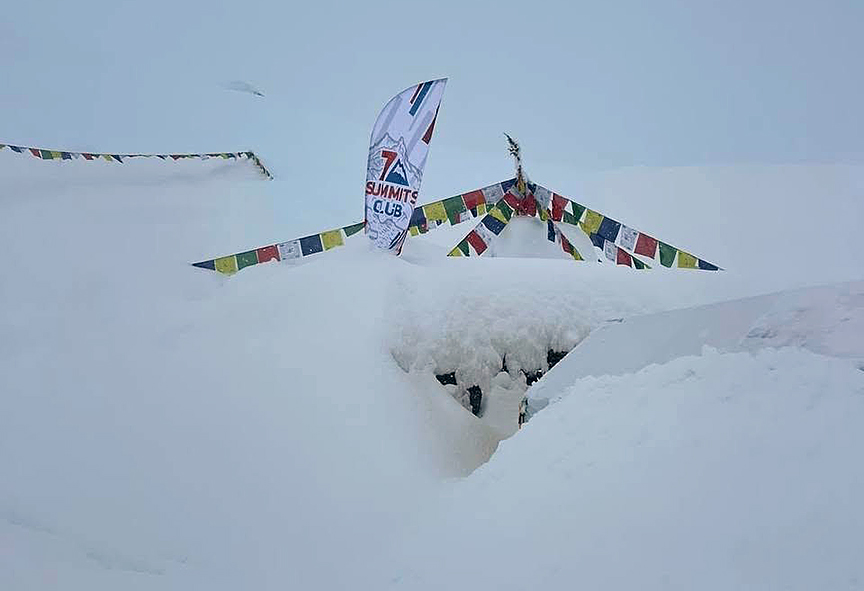
Meters of snow on Manaslu. Photo: Alex Abramov/7 Summits Club