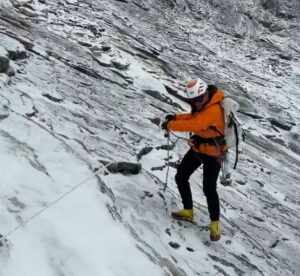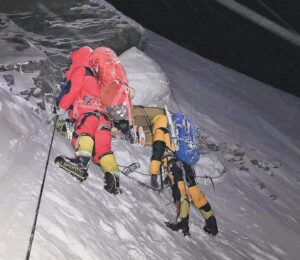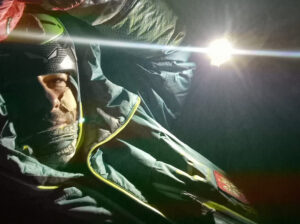
With the failure of commercial climbs on Manaslu and Dhaulagiri this fall, all eyes now turn to the most popular commercial peak in the second half of autumn — 6,812m Ama Dablam. A Sherpa team already opened the route to the summit last Tuesday.
Unlike those two 8,000m peaks, where bad conditions prompted outfitters to abort the season prematurely, the seven rope fixers on Ama Dablam experienced light winds, sunshine, and good snow, which allowed them to fix 800m of rope in just five hours. Siddhi Bahadur Tamang, Lal Kumar Tamang, Dawa Paljor Sherpa, Lakpa Sangay Sherpa, Pasang Tenji Sherpa, and Namgel Dorje Tamang stood on top of Ama Dablam on October 13 shortly before noon:
Since then, workers have been hurrying to set up and stock three higher camps, while many climbers flock to Base Camp or acclimatize on nearby peaks before their summit push.
The stats
According to the October 13 update from Nepal’s Department of Tourism, 178 permits for foreign climbers have been issued for Ama Dablam. That will increase greatly over the coming weeks, since the high season continues until the end of November. In recent years, improved logistics and increased popularity have led to many more summits. Success rates are also far better than just a few years ago.
Last fall, according to the Himalayan Database (HDB), 273 foreigners attempted to climb — and all succeeded! They were supported by 399 Sherpas, including guides, high-altitude porters, and their helpers. The final summit numbers included the 273 foreigners plus 227 locals, totaling 500 summits, with a 100% summit rate. Two clients died: a Brazilian climber hit by falling ice on his way down, and a South Korean man who suffered cardiac arrest.
By comparison, in 2015, 76 foreigners and 47 locals summited — nearly five times fewer — and the summit rate was 71%. Certain things have not changed: Back then, the normal route was also fixed, and teams had Sherpa support. It’s the scale and the tactics that are different.
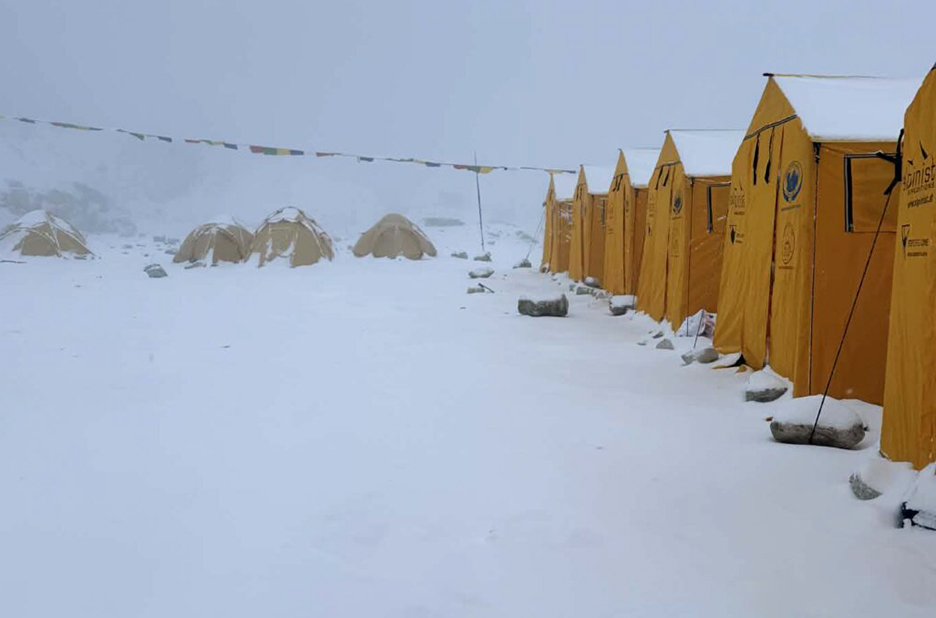
Ama Dablam Base Camp. Photo: Dominic Asselin
Why a favorite
If Everest is to Himalayan climbing history what Mont Blanc was to the Alps, Ama Dablam is the Nepalese equivalent of the Matterhorn: a favorite of both climbers and outfitters, for different reasons.
Climbers appreciate its beauty — it’s usually considered one of the most aesthetic peaks in the world, despite its commercialization, with ropes, abundant Sherpa support, and helicopter transfers. Moreover, the views of Everest, Lhotse, and the surrounding peaks from its flat, snowy summit are breathtaking:
Its relatively low altitude means shorter acclimatization. Climbers usually do a trekking peak and/or hypoxic training at home as preparation. An Ama Dablam climb rarely requires supplemental oxygen — although it is available if needed.
Handy location
Its convenient location in the Khumbu Valley on the way to Everest is a great asset, thanks to its many year-round accommodations, good infrastructure, an easy peak to acclimatize for, and a straightforward approach trek.
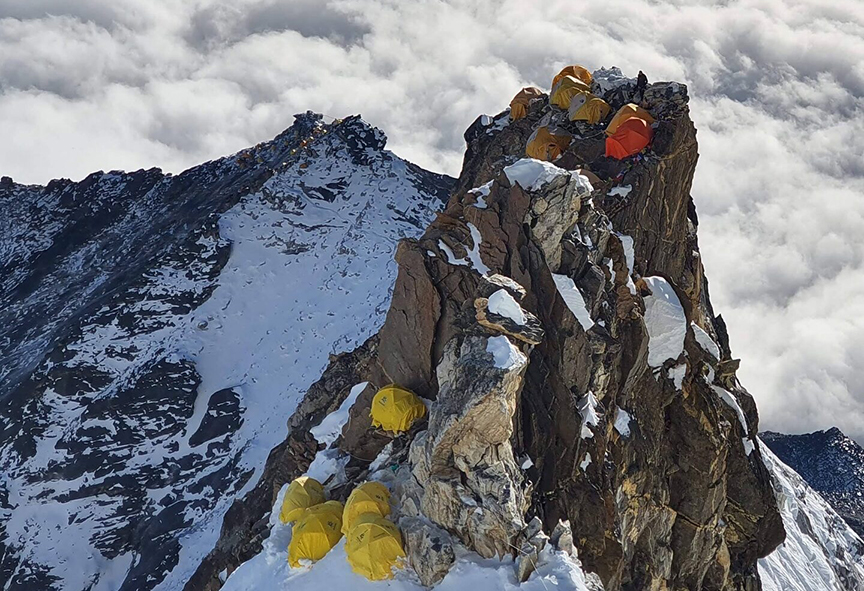
A crowded camp on Ama Dablam. Photo: Lakpa Sherpa/8K Expeditions
For outfitters, Ama Dablam is a natural moneymaker. Its wide Base Camp on a dry, flat plain allows a large number of tents, a helipad, and the constant flow of supplies from the Khumbu’s main trail nearby. Yet the key to accommodating many climbers lies in fast expeditions. Once acclimatized, climbers can summit Ama Dablam and return down in three or four days — even less for the frequent speed climbers. That allows companies to reuse the tents and equipment many times through the season. Camp staff and guides are constantly working, with little downtime.
As for the climb itself, double ropes allow climbers to ascend and descend at the same time, maintaining a steady flow of people every day while the weather holds. Last year, there were 10 to 30 summits a day between October 12 and October 27, and nearly every day in November.

File image of climbers on Ama Dablam, progressing on fixed ropes. Photo: Explore-Share
Also in winter
Even during winter, which in Nepal officially starts on December 1, it is common for some teams to attempt Ama Dablam, especially before the end of the year. Expert winter climbers such as Simone Moro often mention the cold but stable and sunny days in Nepal in December. In recent winter attempts on Manaslu, Moro has acclimatized on Ama Dablam.
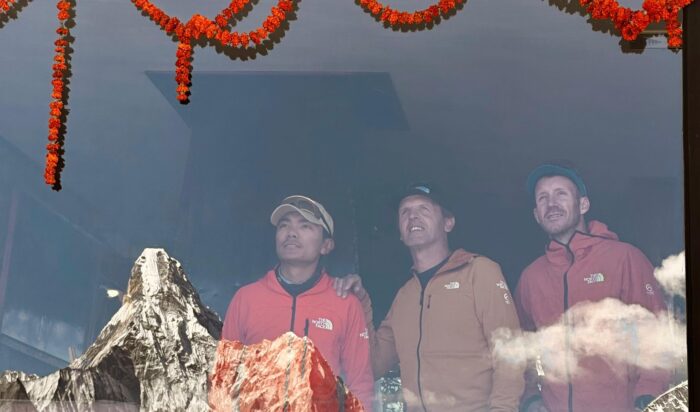
Nima Rinji, Simone Moro, and Oswald Pereira acclimatized on Ama Dablam in December 2024 before attempting Manaslu in winter. Photo: Manish Maharjan
Last year, the HDB only registered a three-member expedition that summited the mountain in winter. However, during the 2024-25 cold season, 12 foreign climbers and six Sherpas summited that December.
Ama Dablam was first climbed in March 1961 by Mike Gill and Wally Romanes of New Zealand, Mike Ward of the UK, and Barry Bishop of the U.S. via the Southwest Ridge.
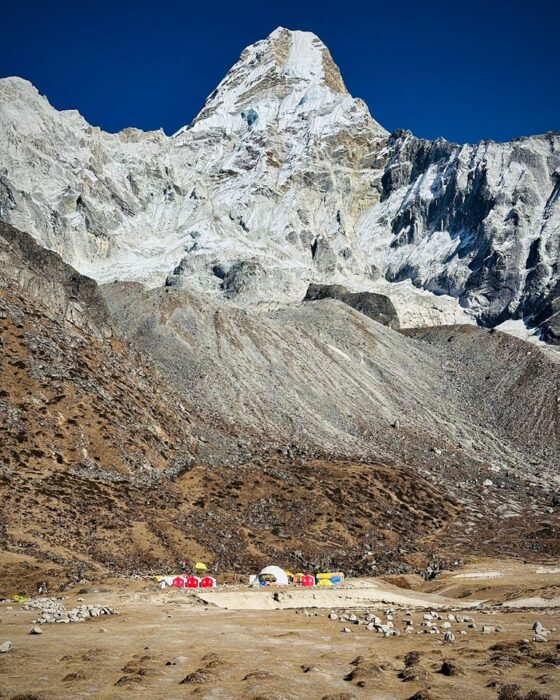
Some local operators keep a functioning Base Camp and maintained route on Ama Dablam throughout December. Photo: Seven Summit Treks
Do not underestimate
With all this latter-day success and improved logistics, the biggest risk may be underestimating Ama Dablam. A high number of rescues have occurred in the last few years. Helicopters can perform long-line airlifts from Camp 3, but such options are not available in bad weather. The prospect of a rescue helicopter on standby in case of trouble, especially on the way down, may produce a false sense of security for those who find themselves at their limits but still decide to continue to the summit.
While the death rates on Ama Dablam are relatively low, it is not a peak to be trifled with, as the many cases of frostbite, AMS, and injuries from falling rock and ice attest.
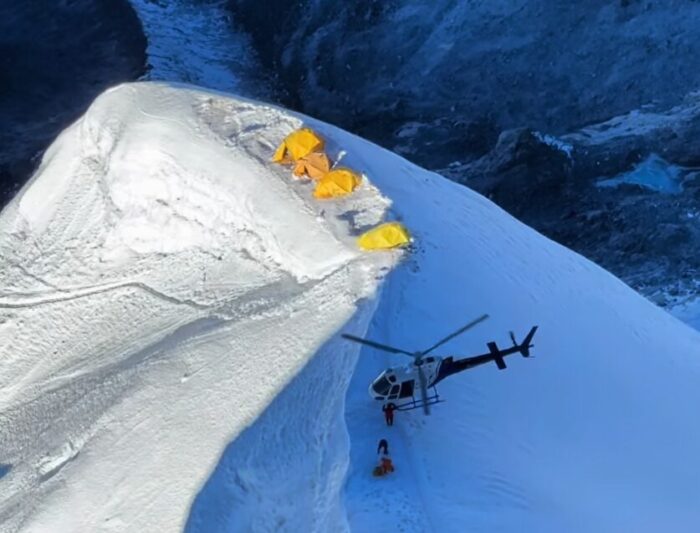
A helicopter performs a rescue at Camp 3 on Ama Dablam. Photo: Nga Tenji Sherpa