Planets, both our own and others, were born in violence. Their hellish beginnings included thousands of meteor impacts and, of course, volcanic eruptions. From the towering shield volcanoes of Mars to the ice-spewing cryovolcanoes of distant moons, vulcanism gives us an extraordinary glimpse into the chaos of planetary formation. Here are some of those Lords of Chaos, both here on Earth and beyond.
Ol Doinyo Lengai
Despite the otherworldly name, this one lies on Earth. Located in northern Tanzania, Ol Doinyo Lengai, or “Mountain of God,” is where the supreme being of the Maasai people, Engai, lives. Though the creator of everything, Engai took permanent refuge on this mountain after he was hunted and injured by an arrow.
The Massai came to its flanks to offer sacrifices, as Engai supposedly cured everything from infertility to curses. In particular, they prayed for him to bless couples with children and for animals to reproduce.
Ol Doinyo Lengai is an active stratovolcano over 2,960m high with some odd properties. It is the only volcano on Earth to expel natrocarbonatite lava, which consists mostly of sodium, calcium carbonates, and potassium. Its low silica content causes it to be very runny. It is also much cooler than most lava, with a ceiling temperature of just 600°C.
The lava is black rather than bright orange and red. When exposed to the air, it quickly turns an ashy white.
Ol Doinyo Lengai lies on the East African Rift, where the Somali Plate diverges from the Nubian Plate and created this unusual volcano eons ago.
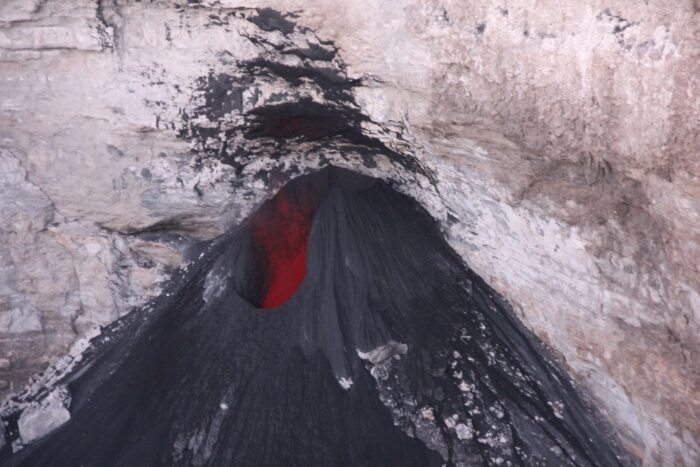
Eruption at Ol Doinyo Lengai. Photo: Shutterstock
Theia Mons and Maat Mons
Welcome to hell. Or rather, welcome to Venus, where temperatures soar past 462°C. Though further from the sun than Mercury, its thick, toxic atmosphere of mainly carbon dioxide and sulfuric acid makes it the hottest planet in the Solar System. Vulcanism created this poisonous atmosphere.
The volcanoes on Venus are mainly shield volcanoes with gentle slopes. Lava fields in the form of basaltic rock cover 90% of the surface of Venus. Repeated major eruptions and lava flows built it up over the ages. There are an estimated 80,000 volcanoes on this hellish planet.
Though the volcanoes’ formation is hypothetical for now, it is likely similar to that of volcanoes on Earth — magma surfacing from deep below, in the planet’s mantle.
The constant volcanic activity has made the surface of Venus renew itself again and again, as eruptions of lava cover older terrain, filling in impact craters and other features.
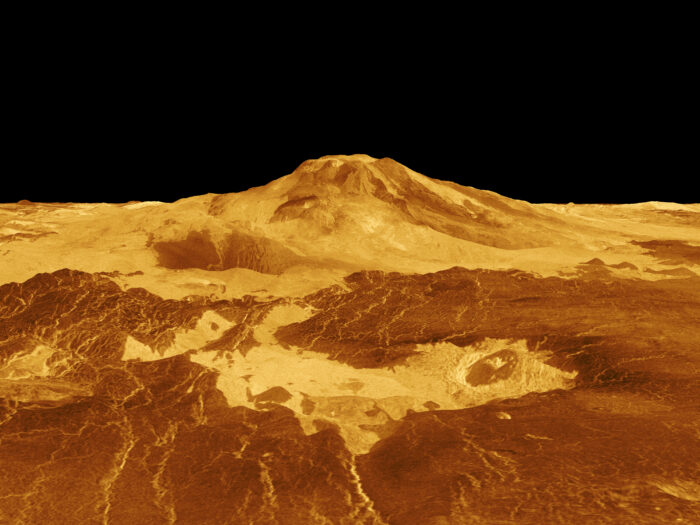
Venus’s Maat Mons. Photo: NASA/JPL
Two of Venus’s more prominent volcanoes are Maat Mons and Theia Mons. Maat Mons rises about 8,000m high and has steep slopes and a summit caldera 28km in diameter.
Appropriately named after the Titan Theia in Greek mythology, Theia Mons towers 4,000m above the surface in the Beta Regio region, a highland 3,000km wide. Theia Mons features a complex summit with multiple calderas and displays evidence of an explosive type of vulcanism, more so than Maat Mons.
Olympus Mons
The largest volcano (and mountain) in our solar system, Olympus Mons straddles the ruddy desertscape of Mars. At 25km high, it is three times taller than Mount Everest. It is also 601km across.
The main caldera is 85km in diameter, and it is accompanied by a few other collapsed calderas. It is really nothing like the comparatively puny volcanoes of Earth. Olympus Mons is a shield volcano, with a large but gentle slope that in the past, has conveyed flowing lava great distances. Although it is the youngest volcano on Mars, its last eruption was over 25 million years ago. It’s considered dormant or possibly extinct.
Olympus Mons consists of basalt rock, calcium, iron oxide, aluminum, magnesium, silicate, and sulfur dioxide.
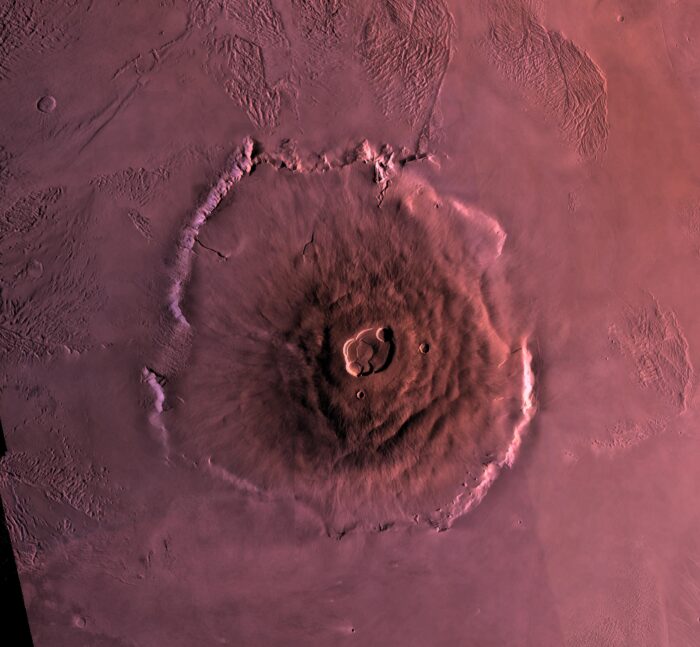
The 600km sprawl of Olympus Mons, seen from space. Photo: NASA/JPL
The underworld of Mars is not like Earth’s. Earth’s tectonic plates are constantly moving due to the convection currents in the mantle. Mars does not have active tectonic plates. It has a thicker lithosphere, so less heat travels from the interior to the surface.
Because the slope is very gentle, and Mars’s gravity is much lighter than Earth’s, climbing Olympus Mons would not be as arduous as climbing Everest. But any future summiter needs to be aware of unpredictable clouds and violent dust storms.
Triton
In the outer reaches of the Solar System exist moons with ice volcanoes. One of the most famous examples of this cryovolcanism is Triton, Neptune’s largest moon. In 1989, the Voyager 2 space probe picked up signs of volcanic activity and detected vast amounts of nitrogen gas erupting from the surface.
A cryovolcano is an ice volcano that erupts water, ammonia, methane, or other gases instead of molten lava. These materials, called volatiles, are typically in a frozen or icy state because of low temperatures. Cryovolcanoes do not exist on Earth. However, they can create features similar to Earth’s volcanoes, including mountains and calderas. These simply form by the deposition of icy materials rather than molten rock.
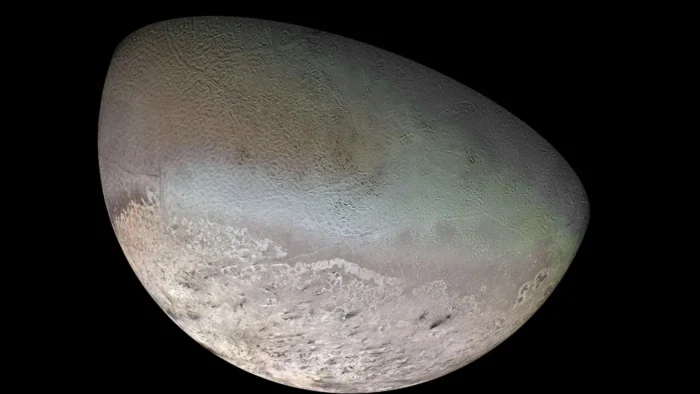
Triton. Photo: NASA/JPL
Like the volcanoes here on Earth, cryovolcanoes have a magma chamber. However, the cryo-magma consists of a bizarre cocktail of water, ammonia, magnesium, sodium sulfate, methanol, methane, and nitrogen. Leviathan Patera, the largest caldera on Triton, spews this unique cryo-lava. Its 80km-wide caldera is one of the largest volcanic structures in the Solar System.
Although these eruptions do not spray out rock, they still shape the terrain of the moons.
Exoplanet TOI-6713.01
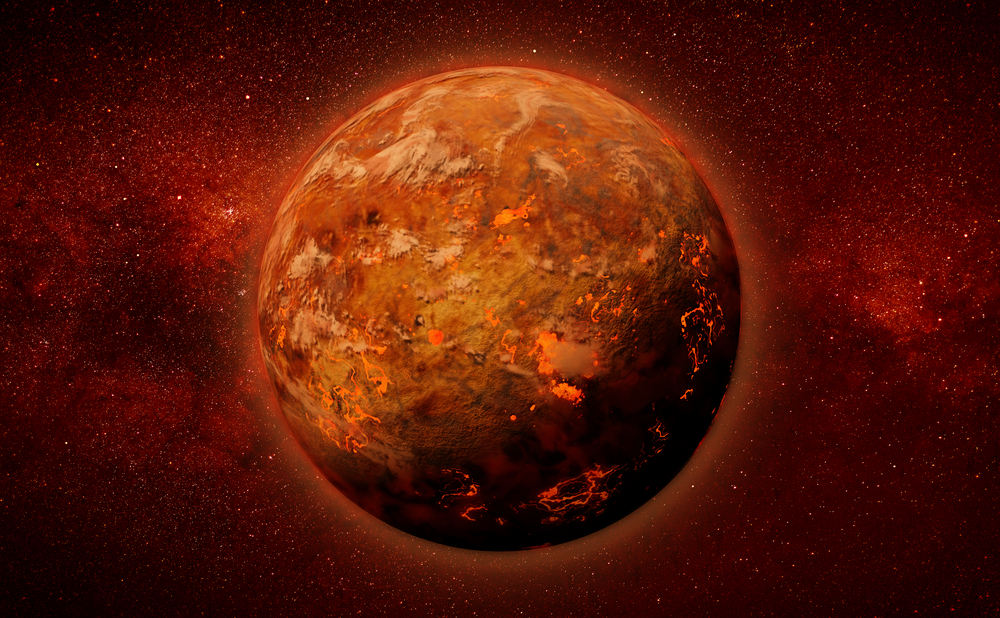
Imagine an entire planet covered in volcanoes. If we thought Venus or Mercury were bad, exoplanet TOI-6713.01 is even worse. Many writers compared this burning planet to that battlefield on which the fight between Anakin Skywalker and Obi-Wan Kenobi took place. This planet glows with the same angry, bright red and wall-to-wall volcanoes.
Thankfully, it is 66 light-years away from us. Why and how is this exoplanet so extreme? Its wild volcanic environment comes from powerful tidal forces.
TOI-6713.01 circles its star a little too closely, completing its journey every 2.2 days. Its elliptical orbit creates extreme gravitational pulls. This planet cannot escape the constant reshaping of its surface and molten malleable interior. A never-ending eruption cycle adds its planetary-sized brushstrokes. Suffice it to say, this one is not viable for life.
Io
We cannot speak about vulcanism without mentioning Jupiter’s tumultuous moon Io. Pockmarked and with over 400 active volcanoes, Io spits out plumes of sulfur and other materials hundreds of kilometers into the ether.
Io is not a result of forces from within but rather from without. Giant Jupiter’s outsized influence and the gravitational forces of its sister moons cause non-stop chaos. Little Io has silicate lava lakes, an irregular elliptical orbit, crazy electrical currents, and a consistently resurfacing surface, much like Venus’s, due to lava flows.
The surface is a blend of yellows, blacks, reds, and browns because of reactions of sulfuric compounds. Io itself is one big ticking volcanic bomb.
“Io’s volcanoes are at times so powerful that they are seen with large telescopes on Earth,” according to NASA.
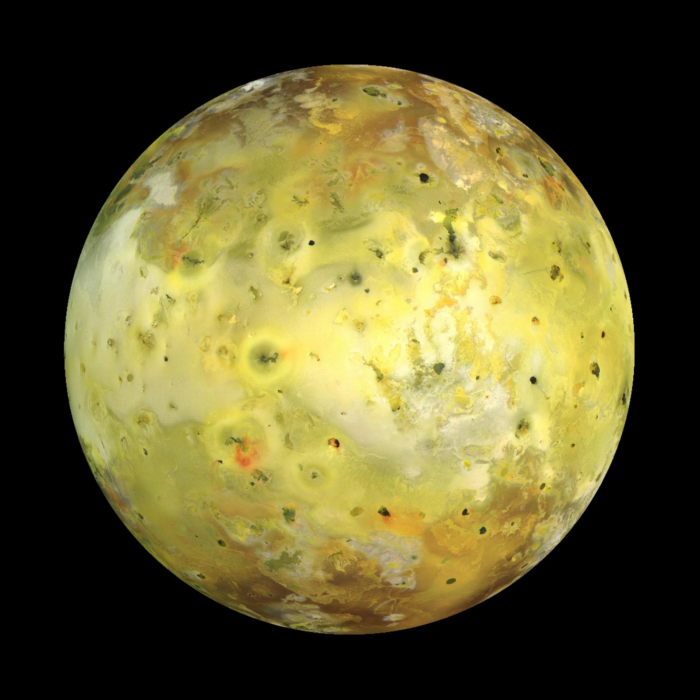
Io, Jupiter’s mottled moon. Photo: NASA/JPL