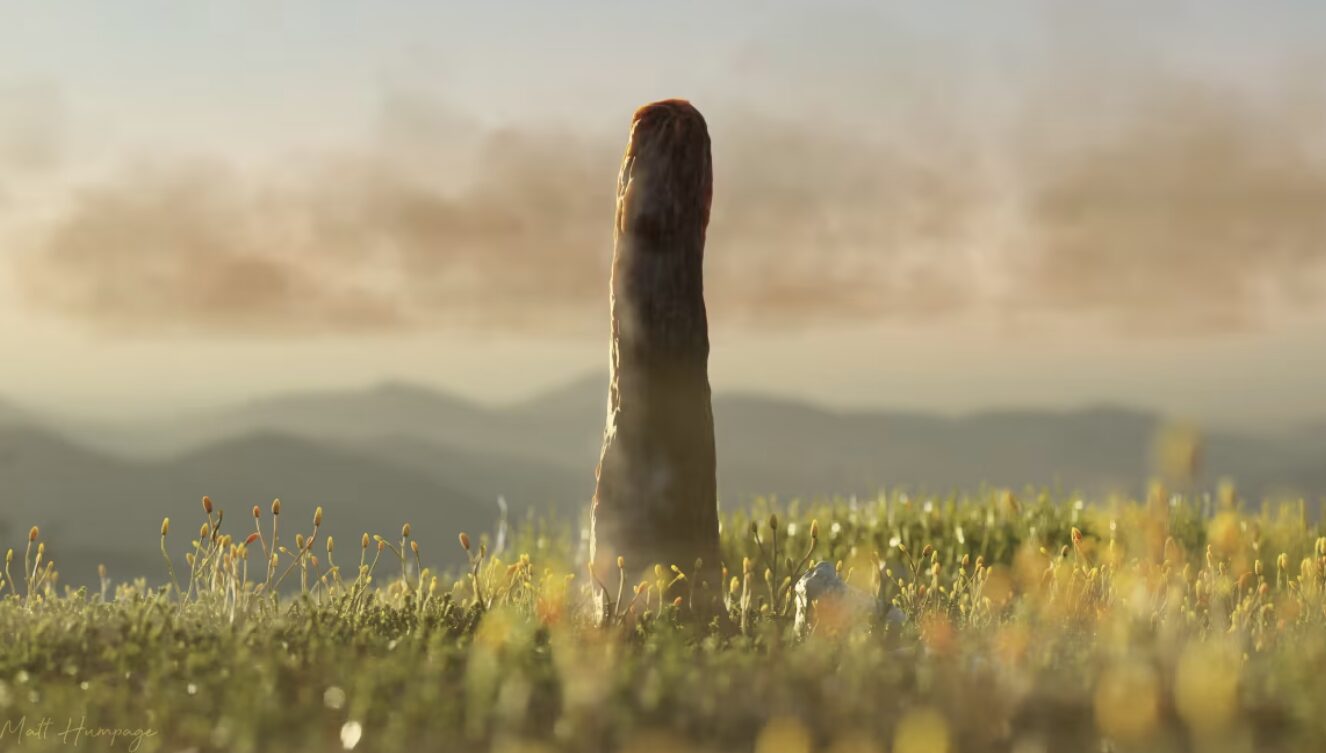
For over 180 years, what appear to be ancient giant tree trunks in Scotland have baffled paleontologists. Geologist William Edmond Logan (who later gave his name to Mount Logan, Canada’s highest peak) discovered the column-shaped fossils in 1843. Ever since, scientists have struggled to classify the colossal organisms. No one is really sure what they are. New research suggests that they are a completely unknown branch of life with no living descendants.
The weird structures, lumped into their own Prototaxites genus, date back to between 375 and 420 million years ago. The fossils can measure up to nine meters high. They look like branchless tree trunks from a primeval forest, but trees didn’t exist then. Whatever they are, they would have towered over other life forms in the Devonian period, where the largest plants were around one meter tall.
Initially, the Prototaxites were first mistaken for conifer trees, but analysis showed they were not plant cells but rather tube-like structures. Researchers pivoted, suggesting they might be a form of algae or lichen. Then, in 2007, a study based on chemical analysis of the fossils suggested that they were ancient giant fungi, as they fed on decaying organic matter rather than producing their own food through photosynthesis.
Its own category
Now, fresh research is challenging all of these hypotheses. Its authors think it might be a completely new life form, one that does not fit into any category.
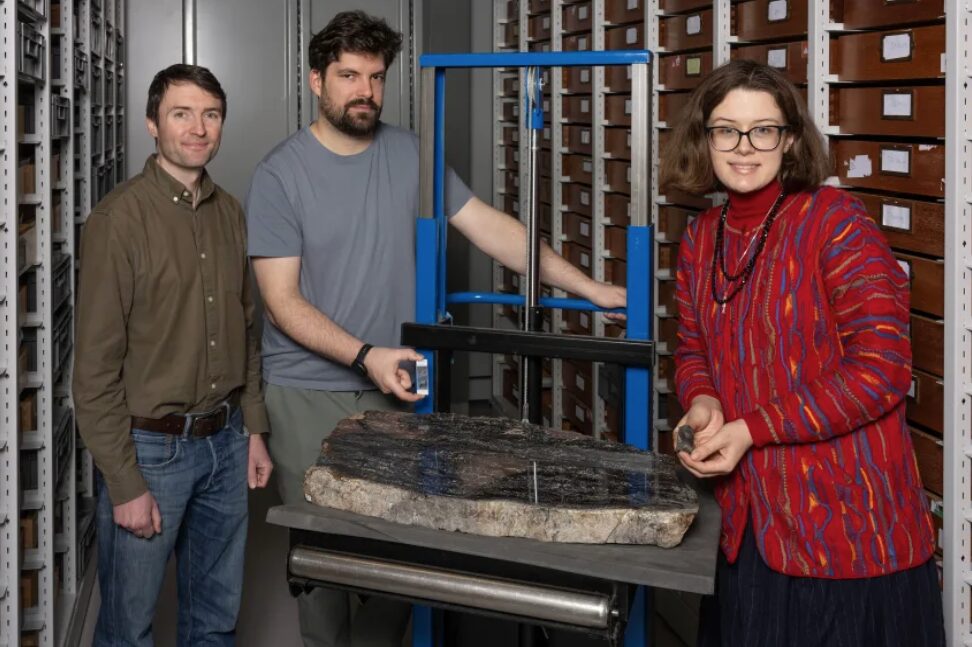
Researchers Sandy Hetherington, Corentin Loron and Laura Cooper, with a Prototaxite fossil. Photo: Neil Hanna
The new study, published in the journal Science Advances, examines exceptionally well-preserved fossils from Scotland’s Rhynie chert. Rhynie chert was once a hot spring and is now an early Devonian sedimentary deposit in Aberdeenshire. It holds some of the best-preserved fossils of ancient plants, fungi, and fauna on the planet.
Using high-resolution imaging, the team examined the internal structure of Prototaxites more closely than ever before. What they found did not resemble any known fungus. Instead of simple, repeating filaments, the fossils contained several different types of tubes woven into dense, complex networks. Modern fungi do not build themselves this way, and neither do plants or animals.
Chemical analysis only deepened the mystery. The team compared the molecular fingerprints of Prototaxites with modern and ancient organisms preserved in the same rock. Fossils of known fungi in the Rhynie chert contain biomarkers associated with chitin and glucan, which are key structural molecules in fungi. Prototaxites lacked these biomarkers entirely.
“If Prototaxites were fungi, we would have expected it to follow the same trend as the fungi because they are next to each other in the same burial conditions,” co-author Corentin Loron commented.
Based on this, the researchers reached a radical conclusion: Prototaxites might be an entirely unknown and now-extinct life form. With no match to known kingdoms, the researchers think that Prototaxites belongs to a previously unknown eukaryotic lineage, an extinct branch of multicellular life that wasn’t fungi, plants, or animals.