Americans Dane Steadman and Cody Winckler, awarded with a Piolet d’Or in 2025 after the first ascent of Yashkuk Sar, have done a similar monster 1,800m-long new route on the north face of Sosbun Brakk (6,414m). This time, Grant Stewart joined them for this off-season climb in the Karakoram.
This first ascent of the peak’s north face included difficulties up to M7, WI5. The climbers had to overcome several obstacles before even setting foot on the face. Like many other alpine-style teams this season, they were originally planning to climb another peak. But instead of adapting because of washed-out trails, they had bureaucratic issues. Their permit, obtained 10 months earlier, was revoked some weeks before their departure. They had to quickly find a different goal.
Meanwhile, the airline misplaced Winckler’s baggage — every adventurer’s nightmare. Somehow, the outfitter sent it to base camp some days later. Then, Steadman had to overcome serious Acute Mountain Sickness in base camp. Their acclimatization was hampered by freak spells of bad weather. Finally, the line on Sosbun Brakk they initially chose was too hard and risky because of a hanging serac they only spotted after they began.
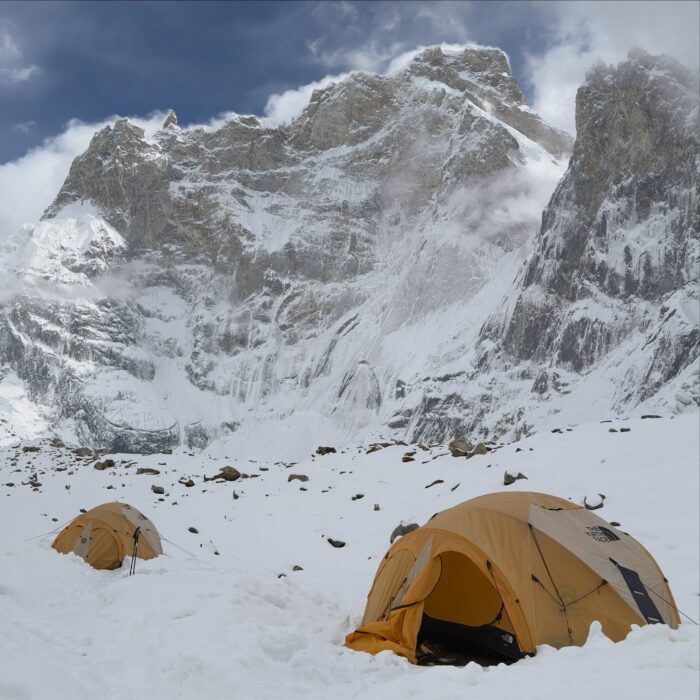
The team’s lonely base camp. Photo: Dane Steadman
“Back at BC, it was time to rest, regroup, and contemplate a totally different line that we’d seen from on the wall, which gave us new hope,” Steadman recalled.
The push
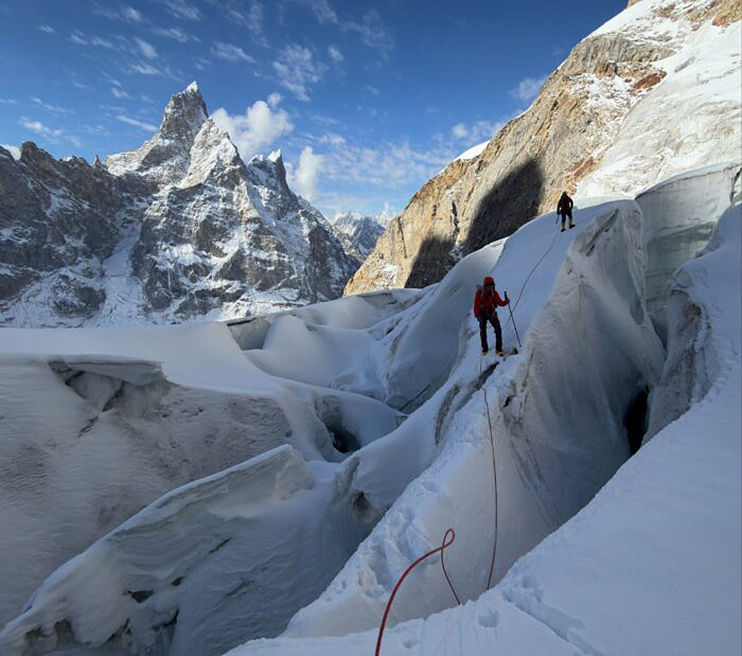
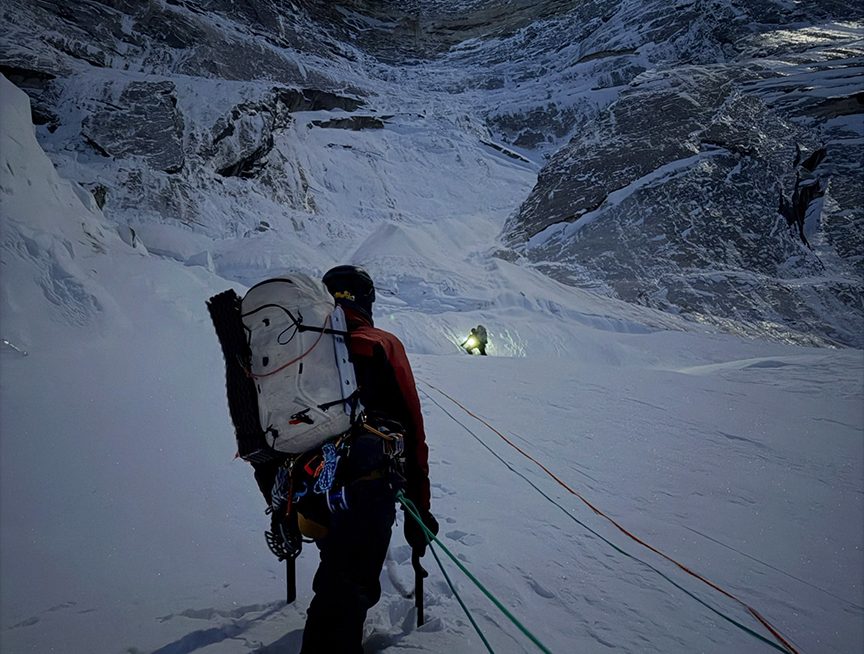
Off to the north face. Photo: Dane Steadman
On October 1, the three climbers set off on that potential new line. “Instead of angling left up hard mixed ground above the cone as before, we made an arcing traverse right, across an ice apron, to gain runnels on the right side of the face,” Steadman explained.
The team gained 800m on that first day and set their first bivouac on a snowy arete, just in time to be slammed by a violent storm that kept them in their tent the whole next day.
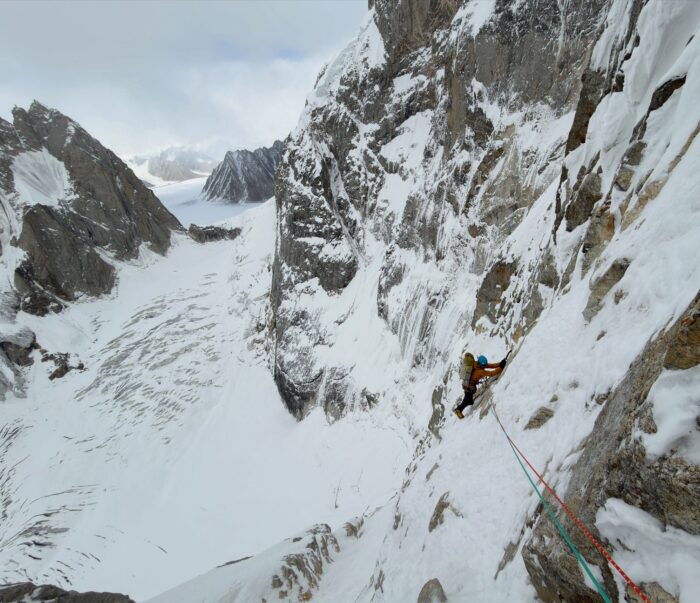
Steep mixed terrain. Photo: Dane Steadman
Climbing through cracks
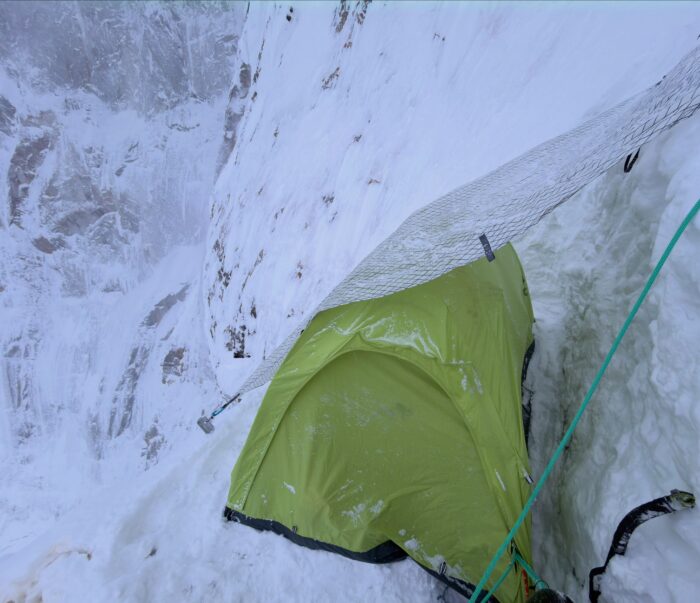
A tarp to protect the team’s bivouac from falling spindrift. Photo: Dane Steadman
“In the morning, we made a gamble for the top by leaving the tent and starting up a massive gully system,” Steward wrote. “At its top, we reached another dead end in a huge serac barrier. To escape this, Dane committed to a visionary pitch, casting off up a blank slab to eventually reach an ice smear.”
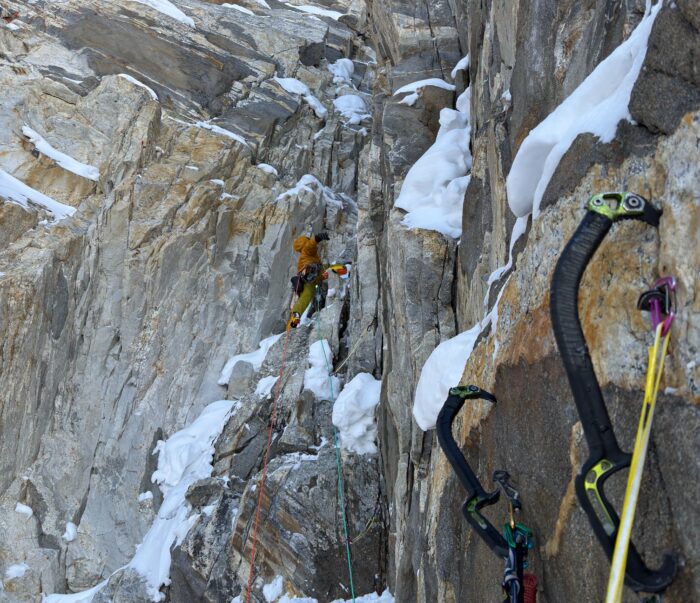
Chaotic, difficult rocky sections. Photo: Dane Steadman
“A huge serac to our right and smooth slabs out left posed a serious question; eight meters of sideways teetering on tiny gneissic edges and a miraculous rock thread were the answer,” said Steadman.
“We continued up the massive hanging glacier to reach the hallucinatory final headwall of steep ice/mixed climbing and mushroom-weaving lunacy,” Stewart continued. “One final traverse with 1,800m of exposure under our feet and a magically appearing, dead-vertical ice tongue led us to the summit ridge.”
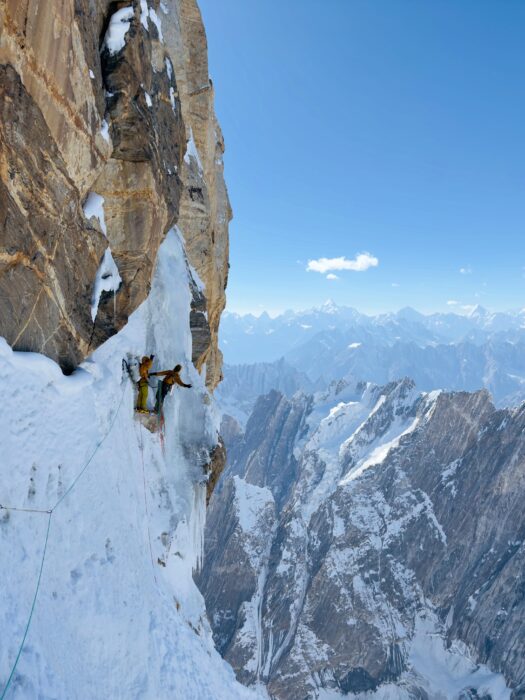
A totally vertical section. Photo: Grant Stewart
Afternoon summit
“The wild terrain on the upper mountain took longer than we wanted,” Steadman admitted. By the time they finally reached the summit, it was 4 pm, the storm was coming the following day, and they still had a long way (and many rappels) down.
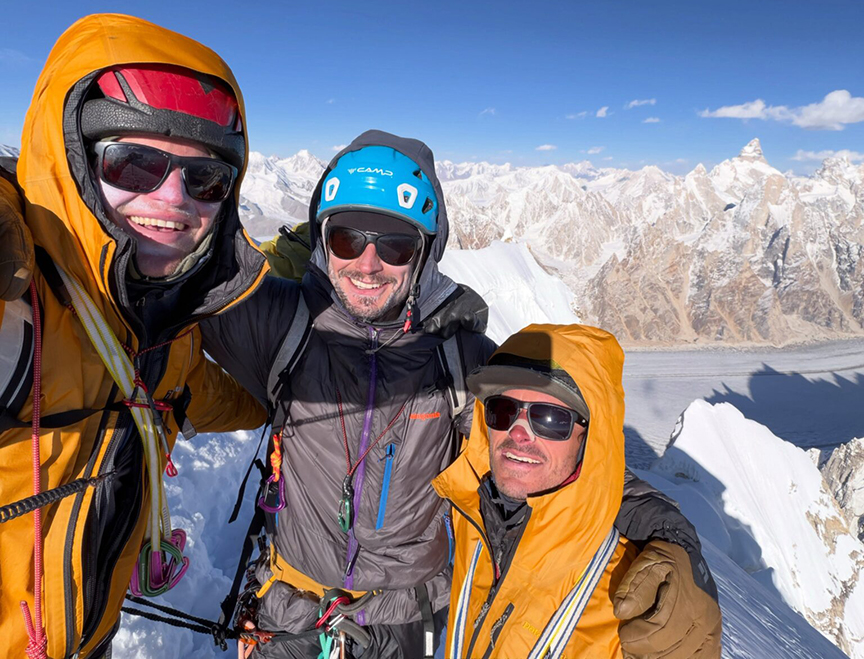
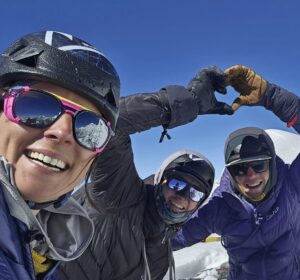
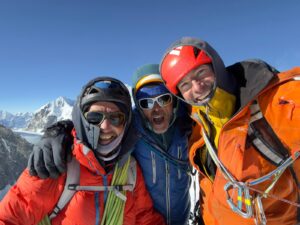
Summit picture on Sosbun Brakk. Left to right, Dane Steadman, Grant Stewart, and Cody Wrincker. Photo: Dane Steadman
The descent
“The sun would set around 6 pm, so we threaded the first of 35 rappels and started down. Long after dark, we finally arrived back at our bivy ledge at around 5,800m,” Steadman recalled.
The storm was not supposed to start until noon the following day, but it was already snowing at 8 am, with still 1,200 vertical meters of descent to go.
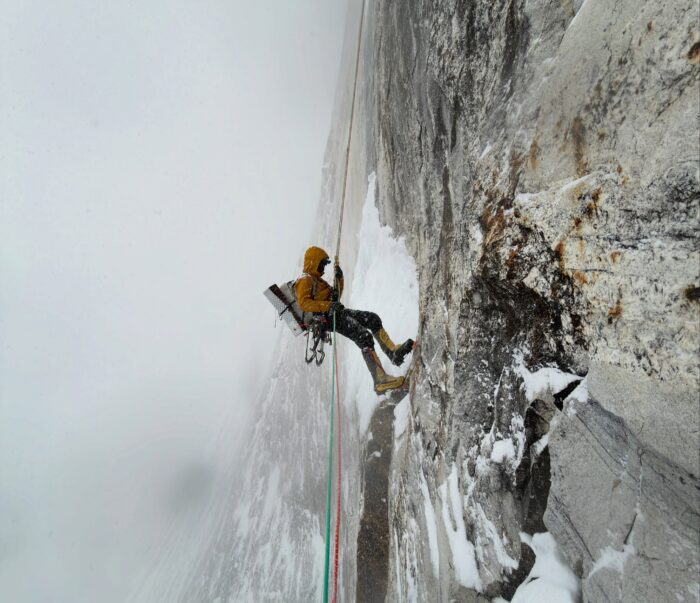
Rappelling down the route. Photo: Dane Steadman
“Before long, we were caught in a proper storm,” Stewart explained. “We committed to a faster and hopefully safer descent by rappelling down the west rib to the Sokha/Sosbun col. By the time we reached the col, we could barely communicate over the screaming southwest wind.”
After some scary rappels in high winds down the serac band, the climbers finally reached a sheltered section of the face. They still had to deal with heavy spindrift coming from above until finally, at around 4 pm, they touched down on the glacier. And yet, the adventure was not over — especially for Grant Stewart:
Following Dane, I took maybe 10 steps when I felt the ground under me crack. Instinctively, I jumped and landed on my stomach as a huge crevasse swallowed the ground behind me. Soaking wet, we began postholing into the wan light of a mesmerizing white out.
[We stuck] to the center of the glacier as avalanches rumbled down all around in the whirling snow. After a strange eternity, the ragged colors of a tent appeared and we were greeted by ecstatic dancing, big hugs, and endless cups of chai from (our BC crew) Ibrahim and Idrees.
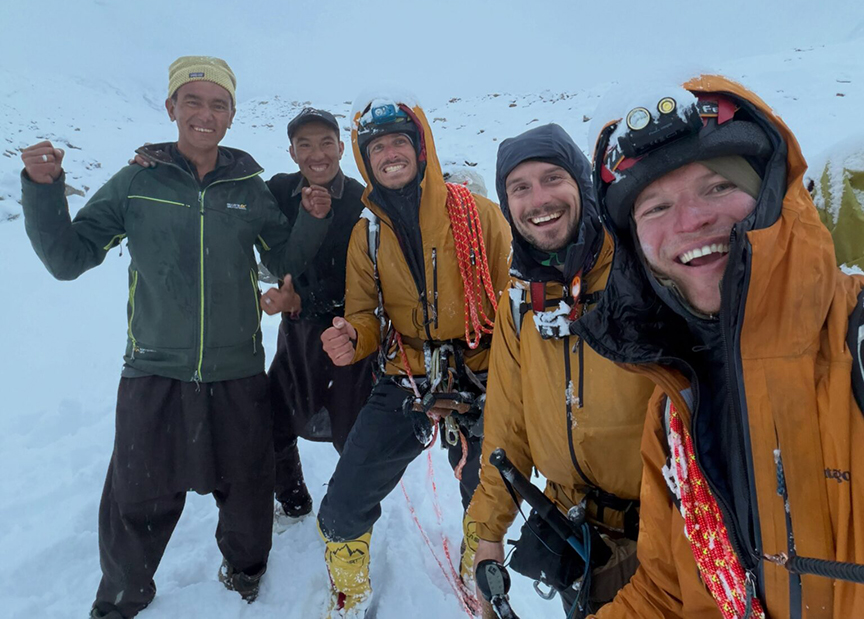
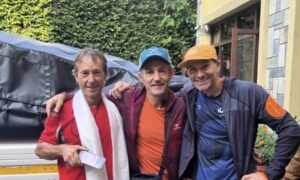
Happy climbers and base camp crew after a safe return from the summit. Photo: Dane Steadman
Love for place and people
The team didn’t report their success and the details of the climb until they returned home. And then, the first words of appraisal were not for the route itself, but for the mountains and people of Gilgit-Baltistan.
“It’s a unique place…where continents and cultures collide. Trips there, while often difficult, are rewarding in ways hard to describe simply,” Steadman said. This was his third trip to the Karakoram, a place he has fallen in love with.