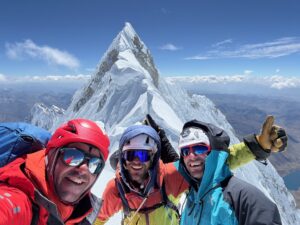
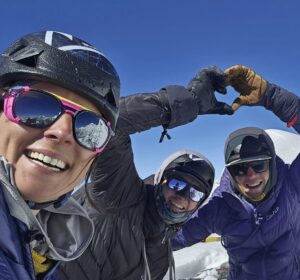
Benjamin Bosshard and Philippo Sala will never forget their first experience above 6,000m and the new route they opened with Stefan Siegrist on India’s Bahai Jar, commonly known as Mount Shiva (6,142m).
Expeditions in the Indian Himalaya are usually quiet while they take place, because satellite phones and InReach devices are prohibited. After returning home, however, Stefan Siegrist reported the details, and the team’s cameraman, Christoph Detschmann, posted a video summary of the expedition:
Siegrist had already visited the Chenab River Valley area in 2018 and climbed Shiva with Jonas Schild, but he still had designs on its unclimbed northwest ridge. At the end of September, he, Sala, and Bosshard reached base camp in the Kishtwar massif.
The three Swiss climbers were prepared to endure a long period of bad weather while acclimatizing. To their surprise, a good weather window opened right away. It was too good to let go, despite not being properly acclimatized and Sala and Bosshard’s lack of altitude experience. The window was expected to last just three days. After many “discussions and doubts,” they left base camp on October 3.
Now or never
Sala had a headache during the first night, but the following morning, they were all totally focused on the climb, and the tension disappeared. “We assumed that we were unlikely to reach the summit on this attempt, and that we would therefore be wasting our only chance before a major storm [brought] the season to an end,” Siegrist explained. “So from then on, the idea was simply to climb higher and acclimatize, without any pressure.”

A moment of the climb, filmed from a drone by Christoph Detschmann
Along the way, they discovered they had left their stove at base camp. No problem in 2026: The expedition photographer used his drone to carry the stove up to them. The use of drones was a hot topic during the recent Piolets d’Or: To what extent are they compatible with alpine-style criteria? While most accepted that drones could scout routes or sections out of view of base camp, many considered using them to carry equipment up a face to be a red line.
On Shiva, Siegrist says the delivery of the missing stove “proved essential to the success of the climb.”
Climb on
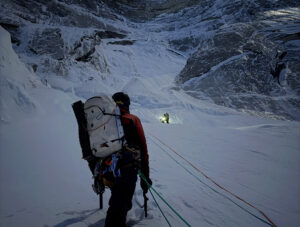
The climbers spent their second night at 5,250m at the base of the northwest ridge. On the following morning, they had to decide whether to continue or retreat. They all felt well, but starting the highly technical ridge was a point of no return. At the same time, Siegrist recalls, they realized they really had a chance to summit. And so on they went.
That night, they stopped at 5,700m in what Siegrist describes as a crucial moment. His partners had not been at that altitude before, and the latest forecast announced a storm the following day. They decided to wait and see what the morning looked like. No one slept at all that night.

The last meters before the summit. Drone image by Christoph Detschmann
The sky was still clear when the team set off again at 4am, so they chose to keep going. “After a while, we finally reached the final slope, just 300m below the summit,” Siegrist wrote. By now, they knew they were going to make it. They reached the top at 7:44am, six days after arriving in Base Camp, and just in time to hurry down as the storm approached.
The climbers descended via the 1985 Japanese route (see topo below), and reached their base camp tents as it started to snow.