Thousands of years ago, the kangaroos roaming Australia were more than double the size of the modern ones. How these gigantic marsupials moved has long puzzled paleontologists. The assumption was that they didn’t hop like our familiar kangaroos but ambled along on their hind legs.
Now, new research suggests these ancient giant kangaroos could and did jump around.
The idea that these jumbo kangaroos were unable to hop came from simply scaling up what we know of modern-day ones. The Australian red kangaroo can reach up to two meters tall and weigh 90kg. Paleontologists estimate that the largest ancient kangaroo species, Procoptodon goliath, tipped the scales at 250 kilos. If the modern kangaroo weighed that much, its Achilles tendons and ankle bones would snap under the stress of repeated jumps.
However, a recent study took a new approach. Instead of just scaling up the skeleton of a modern ‘roo, they examined the fossils of giant kangaroos themselves. They then compared these to a range of living and extinct kangaroos and wallabies.
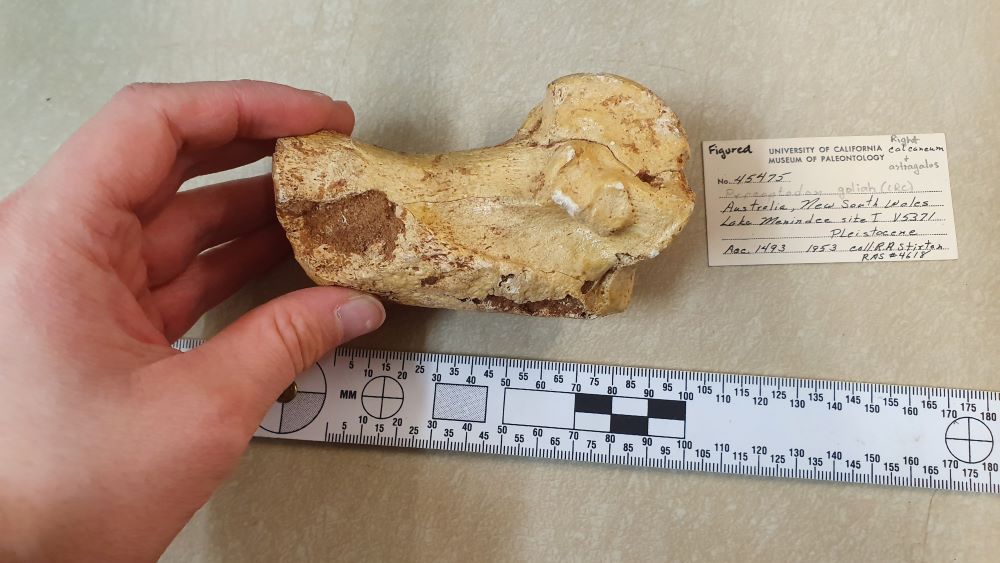
The heelbone of Procoptodon goliah. Photo: Pat Holroyd/UCMP
They weren’t just supersized modern kangaroos
What the researchers found was surprising. By measuring the hindlimbs of 94 modern specimens and 40 fossil specimens of different kangaroos and wallabies, they noted that modern kangaroos have an elongated foot bone that helps them hop, and a large heel that supports the tendons needed to withstand the jumping force.
But the giant ancestors of red kangaroos were not just oversized versions of modern specimens. They often had shorter, thicker foot bones capable of handling landing forces, and heel bones broad enough to accommodate robust Achilles tendons. These anatomical features suggest a capacity for hopping that earlier studies had overlooked.
“Previous estimates were based on simply scaling up modern kangaroos, which may mean we miss crucial anatomical differences,” said lead researcher Megan Jones. “Our findings show that these animals weren’t just larger versions of today’s kangaroos; they were built differently, in ways that helped them manage their enormous size.”
This doesn’t mean ancient kangaroos bounded across Australia as energetically as modern red ones. But it does mean they were capable of jumping, at least sometimes.
“Thicker tendons are safer, but they store less elastic energy,” explained co-author Katrina Jones. “This likely made giant kangaroos slower and less efficient hoppers, better suited to short bursts of movement to cross rough ground quickly or to escape danger rather than long-distance travel.“