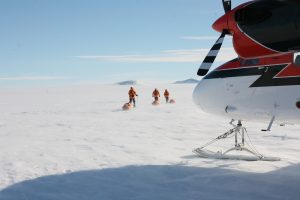
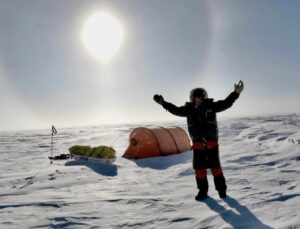
After 56 days on the Ross Ice Shelf, Colin O’Brady celebrated reaching the Antarctic landmass this week. He had struggled with soft snow and whiteouts early on and had to do double hauls to move his heavy sleds forward. More recently, he has picked up the pace and is inside 85°.
It remains tricky to calculate exactly how much time O’Brady has left for his attempted crossing. Polar guide Lars Ebbesen suggests the crossing could still be possible if Antarctica Logistics & Expeditions (ALE) is prepared to stay open long enough to support O’Brady for another 65 days or so.
“A few hard days will do away with most of the altitude, so if he uses 30 days to the South Pole, he will have 35 days going out, which equals 40km per day. That is absolutely doable,” Ebbesen explained.
O’Brady’s/ALE’s decision to start at the Bay of Whales rather than on the other side of the continent, on Berkner Island, may also allow a later finish. A late-season pickup from the Bay of Whales is more difficult than an extraction from Berkner Island.
Kite skiers
On January 2, Matthieu Tordeur and Heidi Sevestre had 150km remaining to the South Pole. With “the strongest winds of the entire expedition” forecast, they planned to knock it over in a day. However, conditions in the morning were challenging.
“Kiting at full speed while seeing no more than three meters ahead became a pure balancing act. Skis wide apart, a few scares, a few falls — but more fear than harm,” they wrote.
Later, after one of Sevestre’s sleds repeatedly flipped, the pair lost each other in the whiteout.
“[We were] only a few hundred meters apart, but in this endless white landscape, it was enough to lose sight of one another entirely,” they explained on their website. “Tracks vanished instantly under blowing snow, with no visibility and no reference points. For over an hour, we were separated. Thankfully, using our inReach devices, we were able to exchange our positions and reunite via GPS, with great relief.”
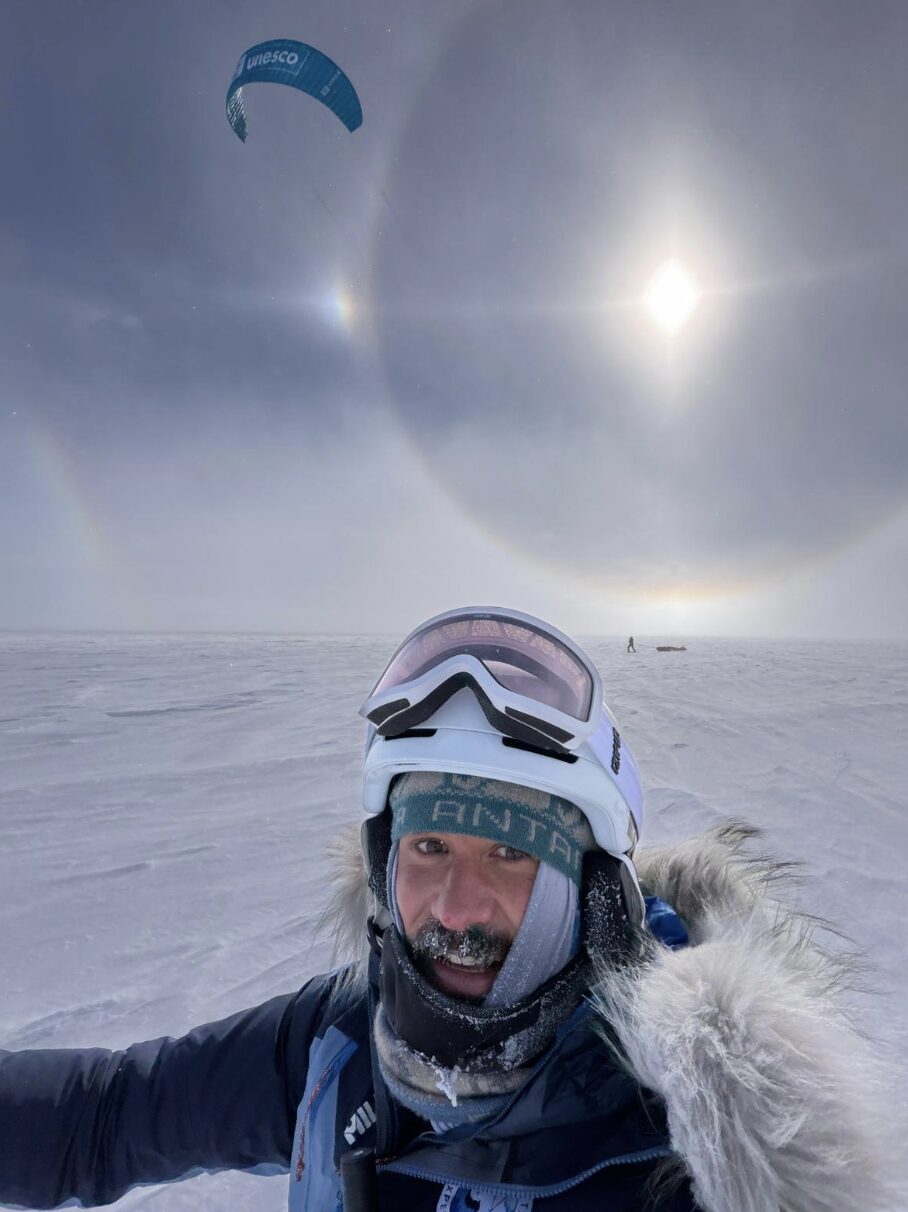
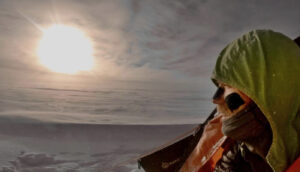
Matthieu Tordeur, with Heidi Sevestre in the background under a sundog. Photo: Under Antarctica Expedition
The weather had improved by the time they reached the Pole, marking the completion of the second phase of their expedition after 61 days and 2,700km of kite-skiing. They stopped at the South Pole camp for two and a half days to repair equipment, replace their damaged sleds, and enjoy a heated tent.
The pair is now on the move again and has covered a further 265km with just over 1,000km remaining to Union Glacier.
Hoddi Tryggvason
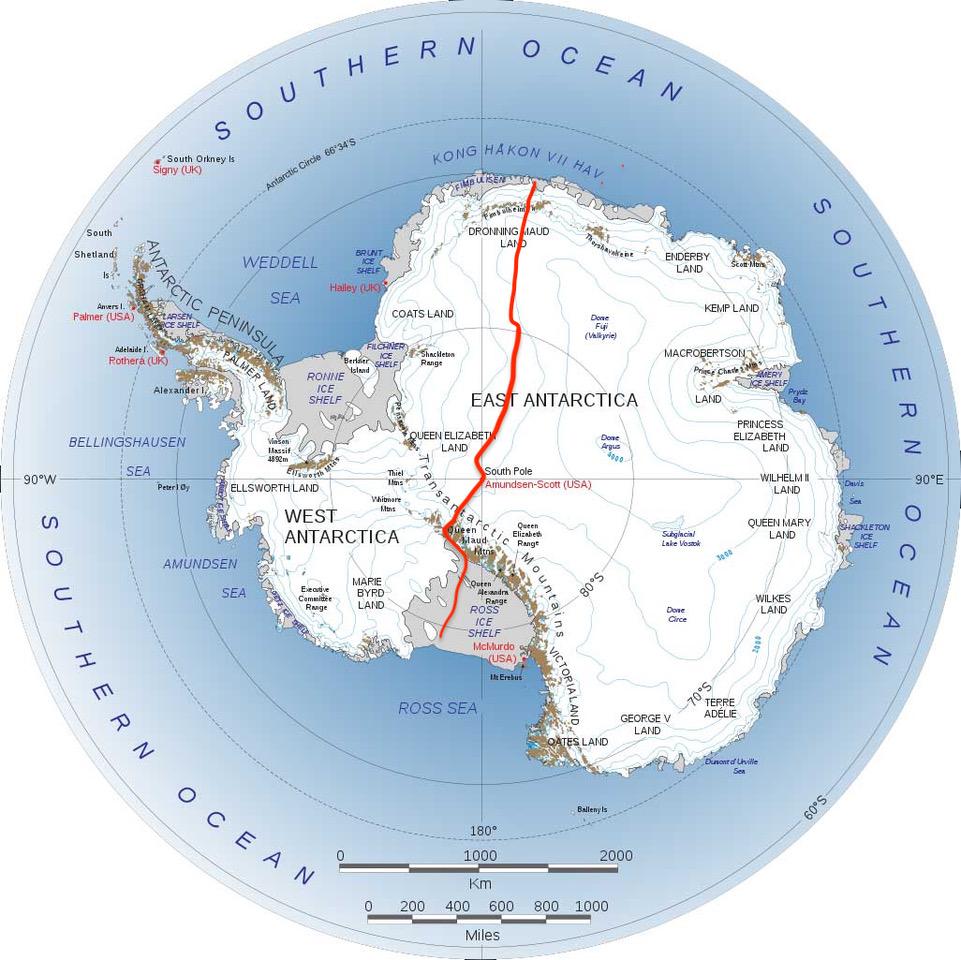
Hoddi Tryggvason’s approximate route across Antarctica.
Now back in Iceland, Hoddi Tryggvason provided some interesting information about the end of his mammoth 3,770km solo kite-ski expedition from Novo Station on the north coast to the edge of the Ross Ice Shelf in the south (via the South Pole).
“My sled was severely damaged arriving at the South Pole, as the sastrugi in East Antarctica was quite extreme and relentless,” Tryggvason told ExplorersWeb. “I had ALE fly a sled in from Punta Arenas that I had used on an expedition in 2022. I had also lost some fuel and had to get a few more liters.”
Heidi Sevestre and Matthieu Tordeur were having similar problems and had arranged for two new sleds to be sent to the Pole before their arrival on January 2.
Tryggvason’s final run to the Bay of Whales sounded a little hairy: “Reedy Glacier was heavily crevassed, with extreme wind gusts, so there was some involuntary flying, a few death runs on the very rough Reedy caused some more damage to my sled, so I was not sure if it could finish the remaining 800km to the Bay of Whales, but the soft snow Colin O’Brady has reported helped in that regard.”
He made it, and after “almost 8,000km in eight months (between Greenland and Antarctica).” Tryggvason will now take some well-earned time off.
Hercules Inlet to the South Pole
Monet Izabeth crossed from 86° to 87° yesterday, on day 44 of her expedition. Izabeth has around 300km remaining.
Andrea Dorantes remains a bit further ahead and reports mixed conditions: “These stretches have been a little bit of everything: whiteouts, cloudy days that slow you down, and at the end, some feel-good sunshine. Moving forward without references is more exhausting than it seems.”
Dorantes could finish in around 10 days.
Tom Hunt
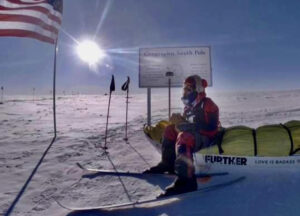
After missing out on the Hercules Inlet to South Pole speed record, Tom Hunt’s final run to the finish line was touch-and-go, with the possibility of a medical evacuation suddenly on the table. Struggling with a pulled hamstring and a calorie deficit, he limped to the Pole on January 6.
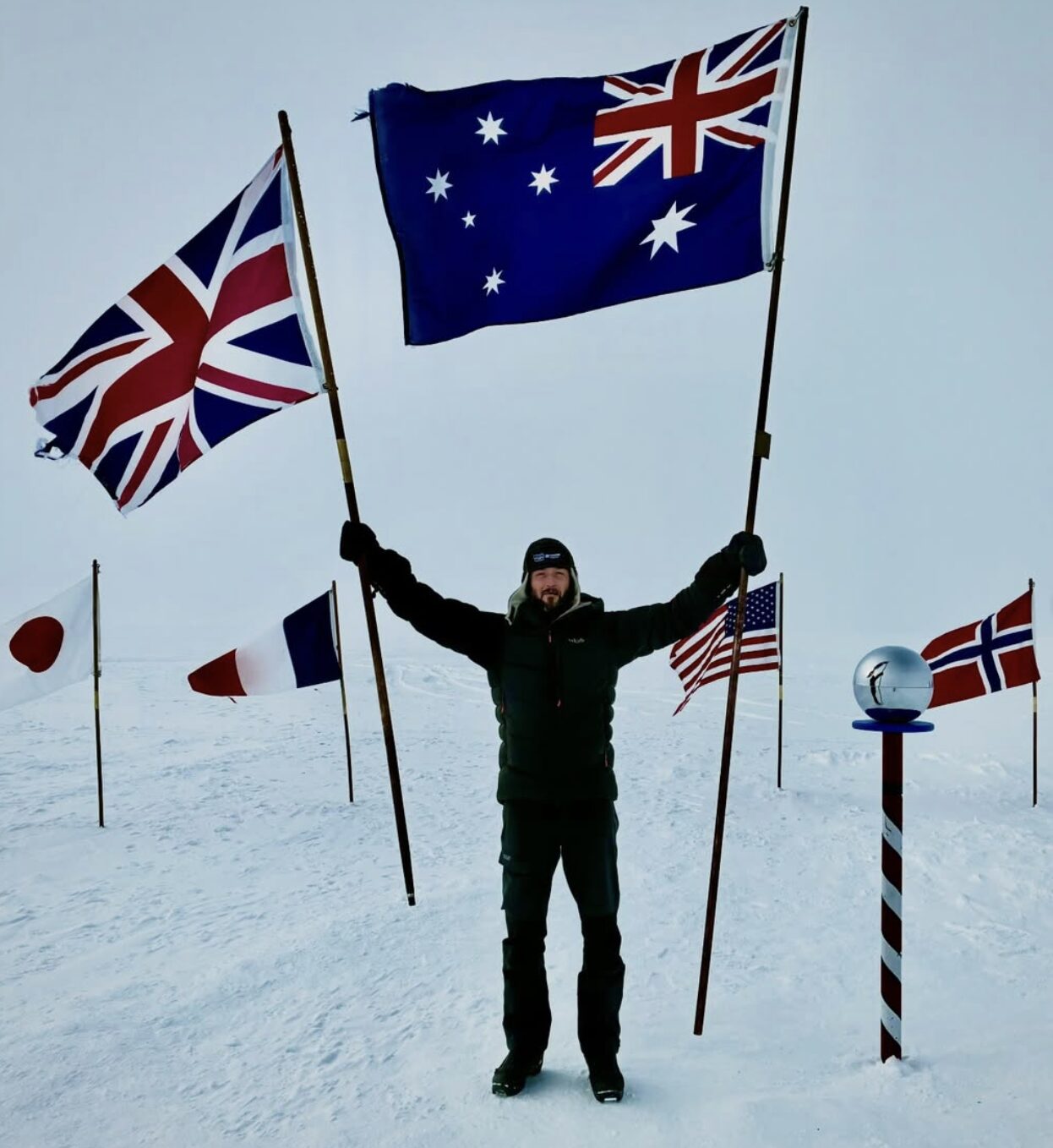
Hunt at the South Pole. Photo: Tom Hunt
“The amount of pain I’ve been in over the last couple of weeks has been overwhelming,” he said in an audio update shortly after arriving. He finished his expedition from Hercules Inlet in 34 days.
Hunt expressed pride, gratitude, and relief, and summed up his expedition.
This expedition was well and truly a game of two halves. In the first, I saw myself keeping pace, almost all was going to plan, challenges were environmental and mostly familiar. The objective was to break the speed record.
In the second, things started to break down. Various health issues combined with an attributable absence of sleep, subsequently led to implacable pain, timeline blowout, and insufficient rations, causing a self-perpetuating downward spiral. The objective became completion.
One of the beauties of being a human is that I don’t have to think in binaries and can entertain complexity. And, whilst on one hand it is obvious to me that I failed (and this is something for me to confront, navigate, and learn from), on the other, I have never been more proud of seeing something through.
Other expeditions
Kite-skiing Norwegian duo Kathinka and Emma Gyllenhammar made it to the South Pole on January 7 after 55 days of skiing 1,265km from Union Glacier.
“Antarctica has been our home for nearly two months, and we can both wholeheartedly say that these have been two of the best months of our lives,” they wrote from the Pole.
They haven’t updated since arriving, but the pair may need a quick turnaround. The wind may die before the weekend, and after picking up their kites at the South Pole, they still plan to kite-ski back to Union Glacier, making their journey 1,500km in all — half skiing, half kite-skiing.