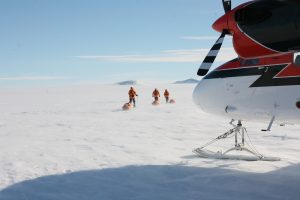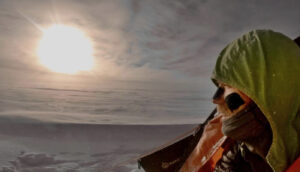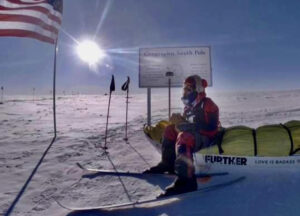
It was an eventful end to the Antarctic season for the kite-skiers. After struggling to find enough wind near the South Pole, duos Matthieu Tordeur and Heidi Sevestre and Norwegian mother and daughter Kathinka and Emma Gyllenhammar found that conditions improved after Thiels Corner.
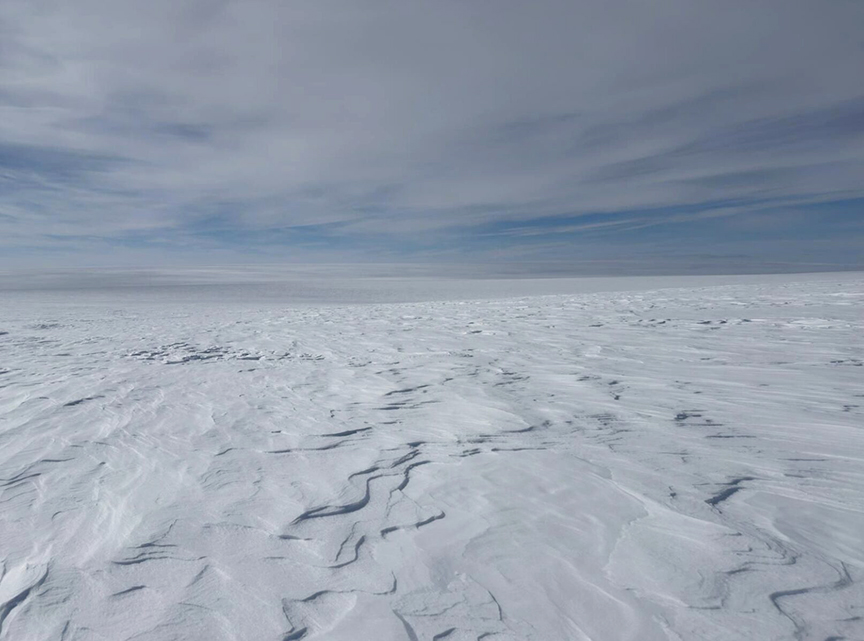
But while strong winds accelerate progress, they are also hazardous. Tordeur and Sevestre described the wind as the strongest they had experienced during their expedition, so powerful that they dropped down to their smallest kites (7 and 4m², respectively). Eventually, they even had to take a windbound day inside their tent. The surface also hardened to the point it was “solid as concrete and carved with countless sastrugi.”
On January 21, after 80 days and 4,000km, Tordeur and Sevestre arrived at Hercules Inlet.
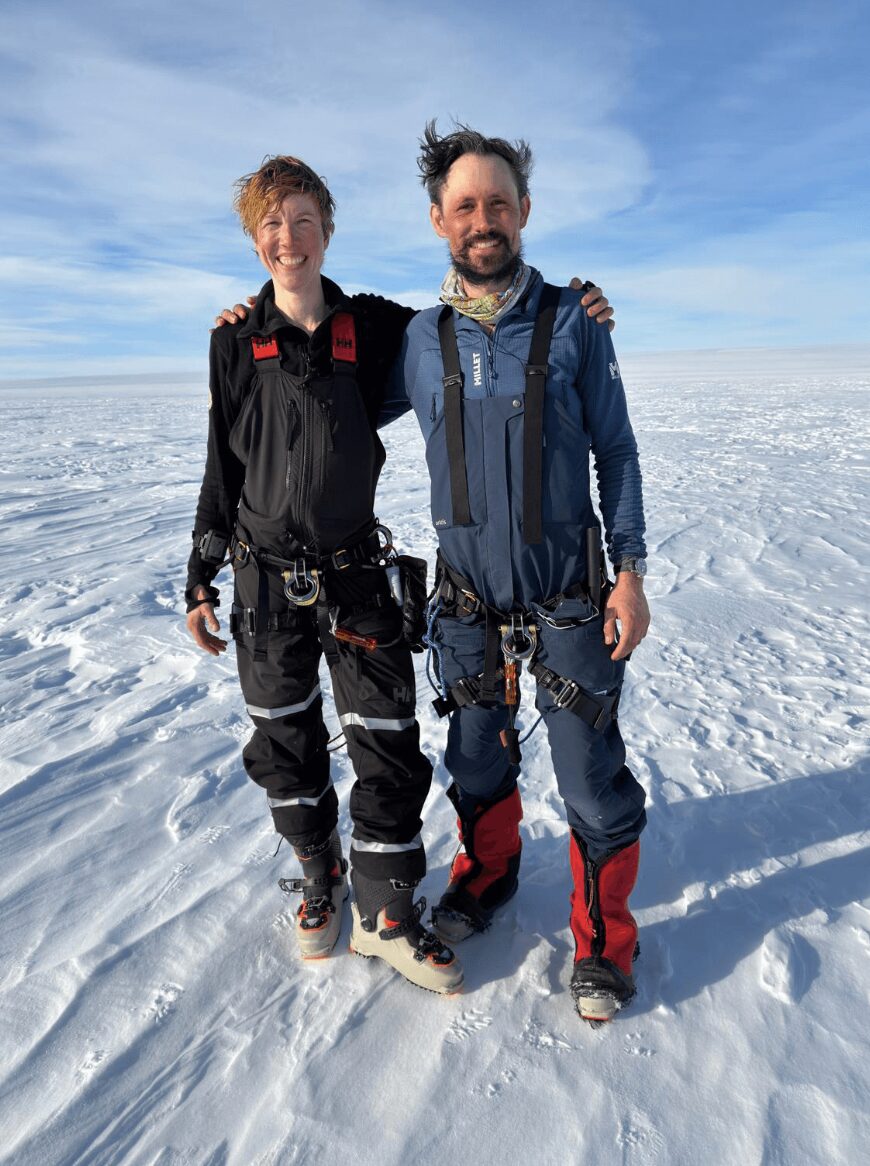
Matthieu Tordeur and Heidi Sevestre at the end of their journey. Photo: Under Antarctica Expedition
Meanwhile, struggling with the same conditions, the Gyllenhammars suffered a brutal accident just a couple of hours from the finish line. After kiting all day, they were just 40km from their pickup point and were skiing down a long slope. About halfway down, Kathinka’s sled caught between sastrugi, which stopped it dead, while the kite pulled her forward. She suffered three pelvic fractures and a fractured rib.
A medical team evacuated the Gyllenhammars from Antarctica a few hours later. Kathinka is recovering in Chile.
Antarctic crossing
Last week, we noted that Colin O’Brady had slowed around 87°. He recently provided some context: “87°S kicked my ass, with shoulder-high sastrugi [an exaggeration] for 70 miles, and damn it got cold,” he wrote on his Instagram.
Yet conditions on the polar plateau should improve, certainly when compared with the Reedy Glacier. “The Reedy glacier was by far the scariest and most dangerous section of the route. A few [times] my feet punched through into crevasses…I really feared for my life,” O’Brady wrote.
Antarctica Logistics & Expeditions (ALE) has confirmed that O’Brady completed “the first solo ascent of the Reedy Glacier,” according to their records. O’Brady’s other claim, that he is the “first person to cross the Ross Ice Shelf solo and unsupported,” is more complex. Here is what ALE had to say:
“According to our records, Colin [O’Brady] is the third solo unsupported crossing of the Ross Ice Shelf that ALE has provided logistics for, after Borge Ousland in 1996 and Hoddi Tryggvason in 2025. All three have had different travel styles. Ousland completed the first solo crossing of Antarctica from Berkner Island via the South Pole to Ross Island with a mix of manhauling and assistance using parawings. Tryggvason has recently completed an unsupported solo snow-kiting expedition.”
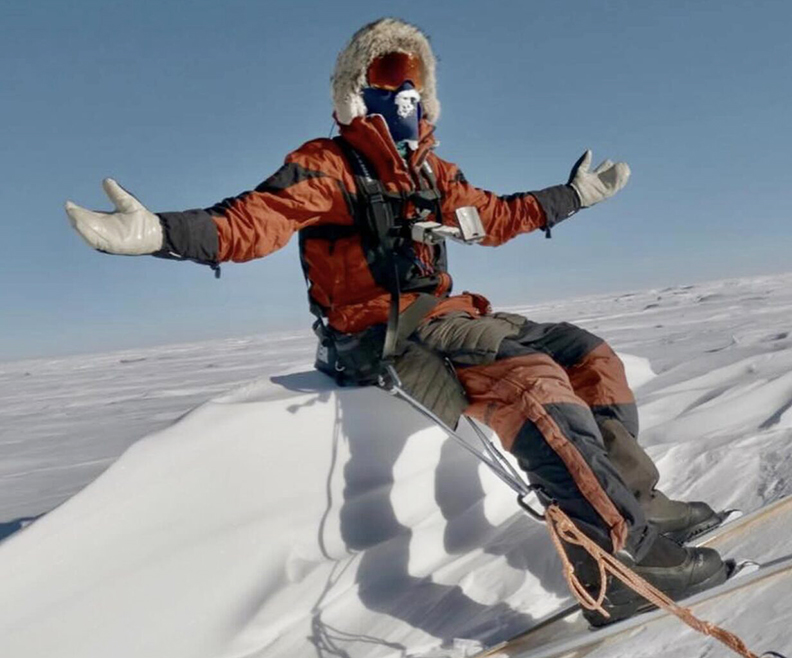
O’Brady takes a break on a convenient sastrugi wave. Photo: Colin O’Brady
O’Brady is now 78 days into his expedition and is well into degree 88. He took a rest day on January 28 but reports feeling healthy, bar a few minor complaints: “The biggest pains I have in my body are my fingers, which are now super cracked from the cold, dry air. My right thumb, especially. I put Super Glue in all the cracks every night.”
Other expeditions
Scott Pallett and Bill Kwok have climbed a new route on the western face of Mount Erebus (3,792m). The pair skied from Ross Island before climbing Mount Erebus, the world’s southernmost active volcano.