Since our last update, a wave of Arctic expeditions has either launched or continued across Greenland, Svalbard, the Canadian Arctic, and beyond. Conditions have proven challenging for some, forcing route changes and slow progress. Meanwhile, an 81-year-old polar legend will shortly begin a 1,300km trek.
Greenland
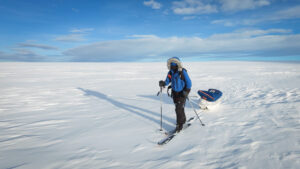
Last week, Australian glaciologist Marcus Arnold started his 400km solo, unsupported ski circumnavigation of Milne Island, Greenland’s third-largest island. However, Arnold’s tracker shows very little movement.
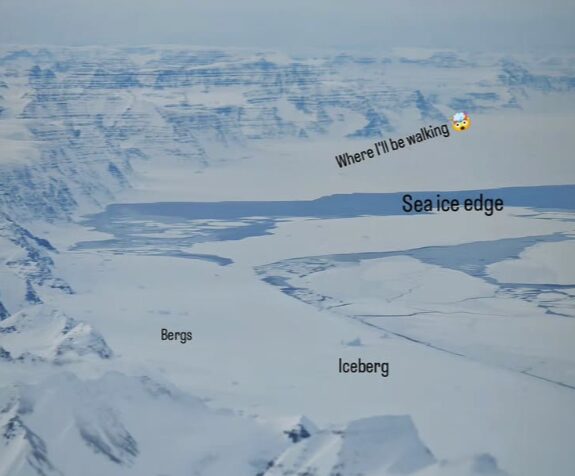
Photo: Marcus Arnold
His sister has been posting on Instagram on Arnold’s behalf, and recently shared a few updates. On March 25, she stated, “He’s had a challenging few days with the conditions, his health, and his dog, Atlas. But he is okay, still on the ice, and staying positive.”
The Australian has taken a local sled dog called Atlas to warn against approaching polar bears.
On March 22, his first day on the ice, Arnold reported, “The dog is a challenge. He ran off when one of the shackles broke.” Thankfully for Arnold, his owner drove Atlas back out to Arnold via snowmobile.

Photo: Marcus Arnold
“He pulls in the complete opposite direction or just sits and refuses to move and pulls against me. It has been next to impossible to move with him,” the Australian lamented.
In the coming weeks, elsewhere in Greenland, Mike Keen will start a manhauling trek across Melville Bay, and an international team of four will kite from Kangerlussuaq to Qaanaaq.
Svalbard kiting
Norwegian and Danish snow kite guides Thomas Sorensen and Morten Rejkjaer are 11 days into what now seems to be an aborted unsupported snow-kite circumnavigation of Svalbard.
On March 23, day seven of the expedition, Sorensen reported that “due to safety precautions,” the pair had decided not to kite to the most northerly point on Spitsbergen, Verlegenhugen. “The first week,” they reported, “has brought extreme weather and conditions that have led to equipment damage…and frostbites that heavily decrease the active time on skis.”
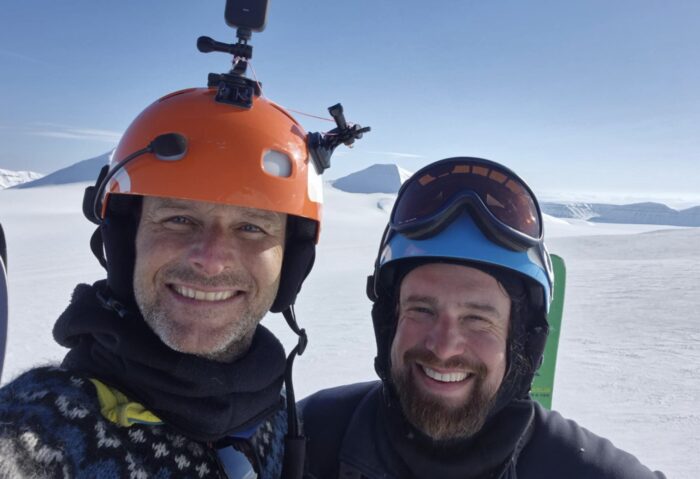
A shortened trip: Thomas Sorensen, left, and Morten Rejkjaer. Photo: Thomas Sorensen and Morten Rejkjaer
By March 26, Sorensen shared a more optimistic update after they adjusted their objective. “The moment after we let go of the goal of reaching Verlegenhuken, we were able to charge across the glaciers with the wind,” he wrote.
Moving at 50kph, they quickly left behind their old tracks where they had fought for every meter gained. “Several days of work passed in just a couple of hours,” they wrote.
The change in route has also allowed them to prioritize recovery. “We’ve spent time treating frostbite and taking precautions we wouldn’t have been able to if we had kept fighting against the wind,” Sorensen noted, adding that “our feet still need monitoring, but they’re recovering.”
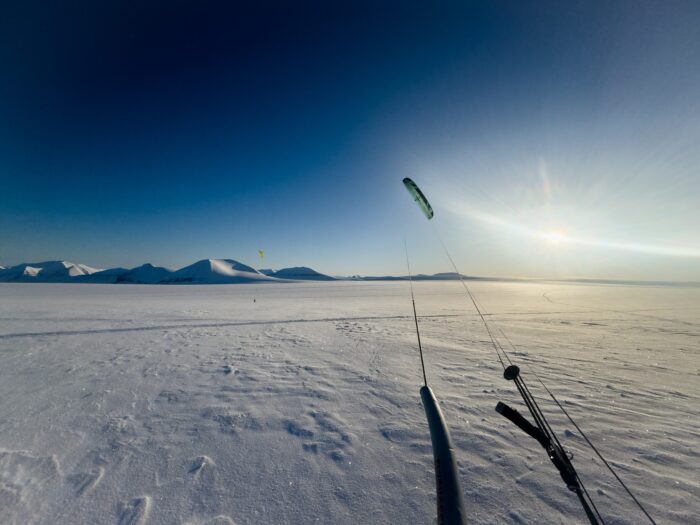
On a previous journey. Photo: Thomas Sorensen and Morten Rejkjaer
Conditions have remained highly variable for them. “We’ve had all kinds of weather: strong winds with heavy snow showers, extremely low temperatures, whiteouts where you can’t see more than a few meters,” Sorensen wrote.
At the same time, the expedition has also experienced “the beloved and notorious Svalbard high pressure — postcard-beautiful landscapes and no wind — so we’ve also been able to do some skiing.”
Sorensen’s latest update suggests that the expedition will be aborted early. “We can feel that the trip is nearing its end.”
Svalbard skiing
Yesterday, Norwegian Alexander Read and his 10-year-old daughter Mina began their 600km sled journey south to north across Spitsbergen. Although not publicized by Read, Norwegian polar guide Are Johansen will guide them.
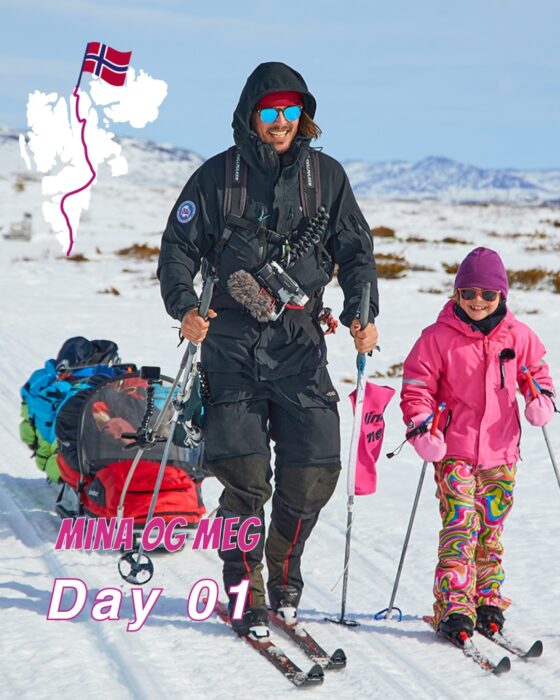
Photo: Mina Og Meg
The six-woman Norwegian team of Christine and Veronica Fore, Cecilie Rydberg, Ellen Burchard, Ingvild Ferangen, and Karen Kylleso are one day into a 35-day, 650km sled expedition from southernmost Svalbard to Verlegenhuken in the north.
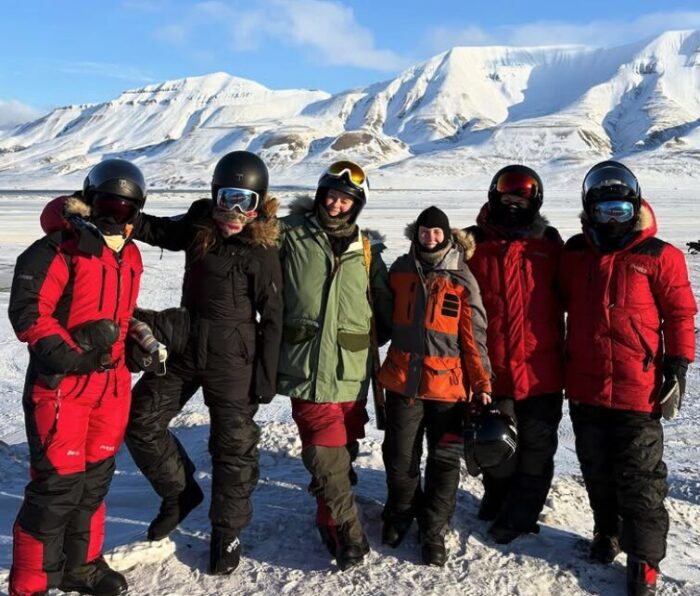
The all-female Norwegian team. Photo: Karen Kylleso
Merlin Cerise, 29, of Belgium will set out on March 27 with a four-man team of fellow Belgians Gael Loicq, 39, and Jean-Simon Gerard, 37, as well as French photographer Fabrice Yencko, 40, and Nicolas Sanchez, 35.
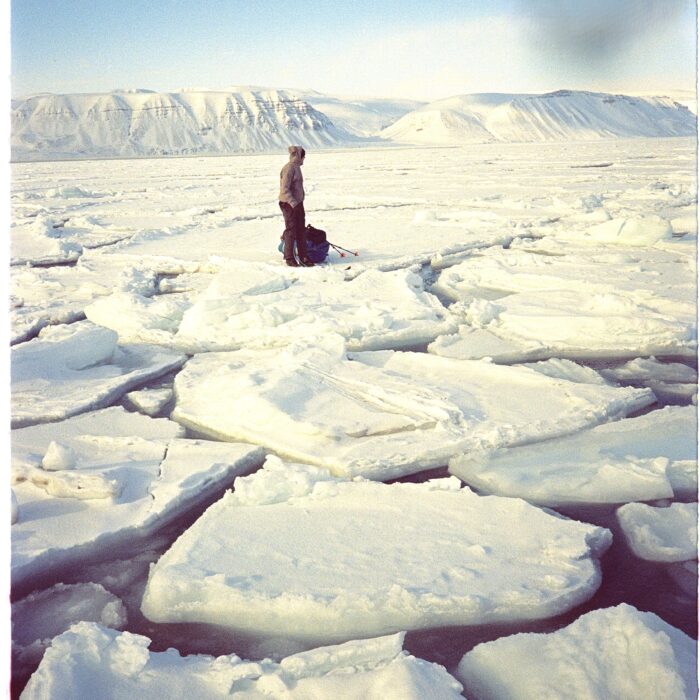
A past expedition. Photo: Merlin Cerise
The team plans a 35-day, unsupported ski journey from Longyearbyen to the northern tip of Spitsbergen and back, adapting their route as needed depending on glacier conditions. At present, they note that the fiords are not well frozen, which may influence their plans.
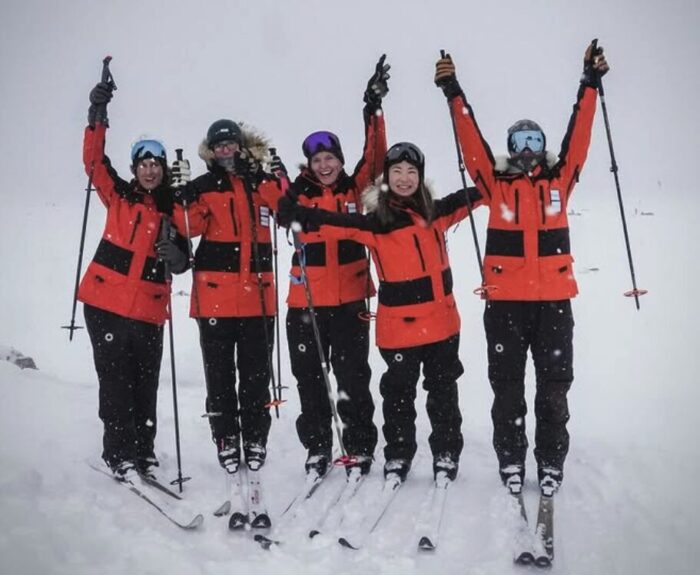
The ‘Girls Trip’ team while training in Norway. The group includes two Arctic guides.
In April, in northwestern Spitsbergen, an international team of five women known as Girls Trip plans to ski 200km over glaciers from Ekmanfjorden to Magdalenefjorden.
Finland
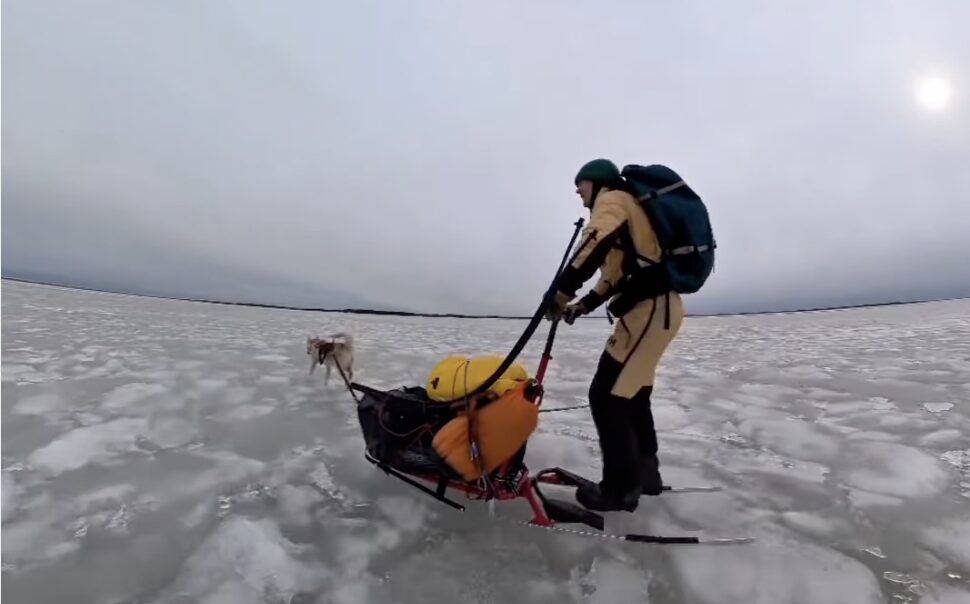
Finnish adventurer Juho Kara is now within 40km of completing a 700km snow-kiting journey along Finland’s west coast.
Canadian Arctic
Preet Chandi of the UK is now 16 days into a 1,000km-plus sled journey in the Canadian High Arctic from Resolute on Cornwallis Island to Ellef Ringnes Island and back.
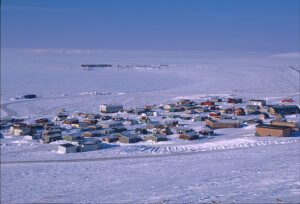
She set off on March 12 from Resolute, one of Canada’s northernmost communities, and the last stop of jets from the south. Chandi is hauling two sleds loaded with 60 days’ worth of food and fuel. Her route rounds Cornwallis Island before heading north along the frozen east coast of Bathurst Island and across sea ice to Ellef Ringnes Island.
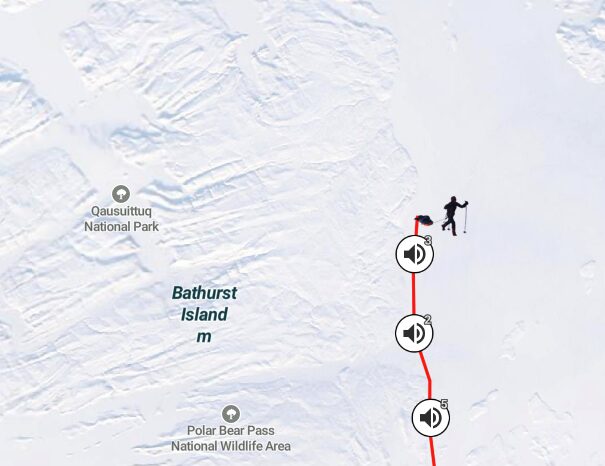
Chandi’s current location. It all looks white, but the textured area on the left is Bathurst Island. The right-hand quarter of the image is sea ice.
Heavy sleds made initial progress slow, and by day eight, she had covered 89km. Chandi has posted no further mileage updates, but her tracker indicates she is currently along eastern Bathurst Island.
A veteran returns
Time seems to stand still for legendary American polar traveler Will Steger as he gets ready to set out on another long sled journey at age 81. Steger has led some of the most influential modern expeditions in the Arctic and Antarctica.
In 1986, he spearheaded the first confirmed dogsled journey to the North Pole without resupplies. Steger later co-led the 1989–90 Trans-Antarctica Expedition, the first dogsled crossing of Antarctica.
At the start of April, Steger will fly to the northeast corner of Great Bear Lake in the Northwest Territories. Here, he will begin a 1,300km, 60-day solo journey north to the Arctic hamlet of Paulatuk.
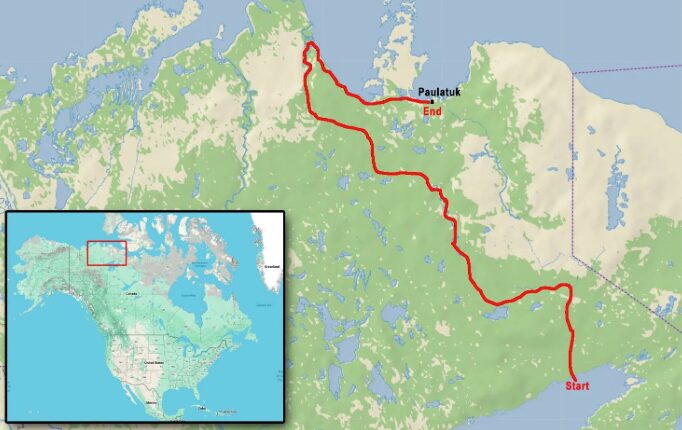
Steger’s route.
Steger will haul three sleds totaling 120kg. He will ski the first 500km on the Bloody River before switching to the Horton River during breakup season. On reaching the Arctic Ocean, he will continue east, either in a packraft or on land.
Although ancient now by expedition standards, Steger completed a 1,300km solo journey in 2023 along a similar route.
Lake Baikal
Irish adventurers Stafford Tyrrell, 31, and Mark McInerney, 32, are now 24 days into their expedition on Lake Baikal. As noted last week, once they hit the southern tip of the lake, the pair began to retrace their route. They are currently heading north along the western shore rather than continuing on the opposite coastline, indicating they have dropped their circumnavigation plans.
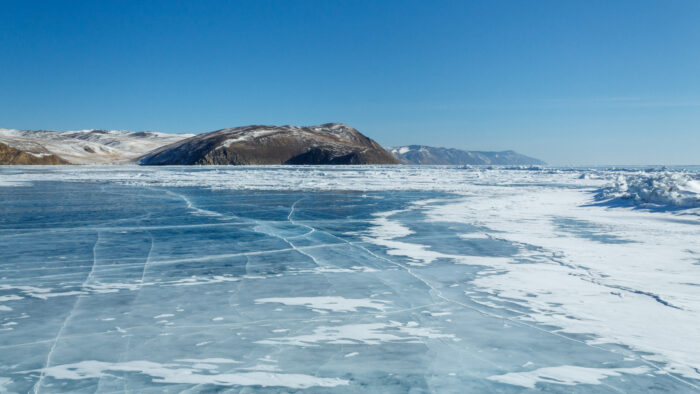
Olkhon Island ahead. Photo: Ash Routen
Their progress has been relatively slow, with around 380km covered so far, according to their tracker. This places them on the eastern side of Olkhon Island.
Alaska
No further word from young American adventurer Kyle Sprenger. On March 9, his sister posted on Instagram that Sprenger had fallen ill on the first day of the expedition, possibly from food poisoning. Sprenger was intending to ski a roughly 600km solo sled journey across a remote region of northwest Alaska.