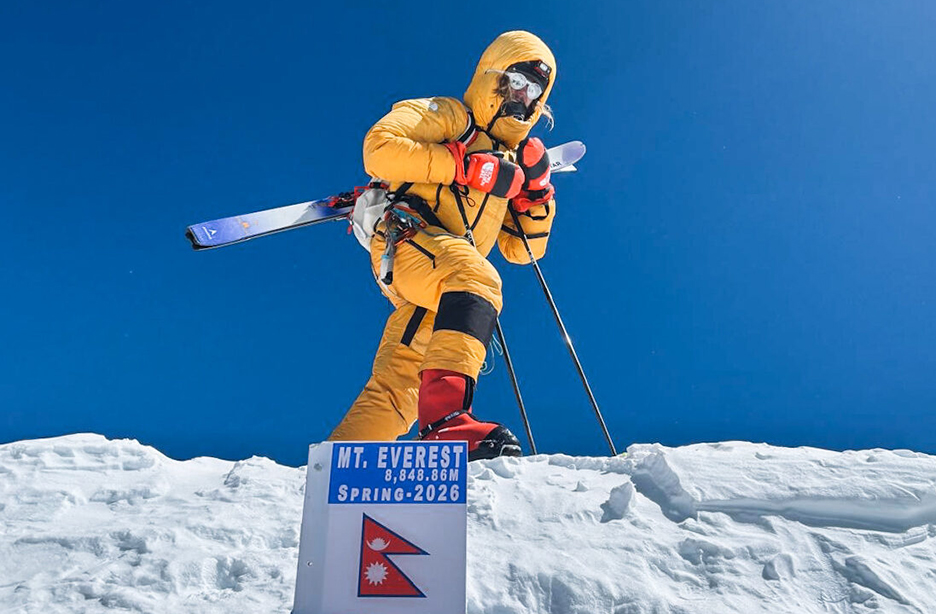
Bartek Ziemski of Poland has made it. Today, he summited Everest without bottled oxygen or Sherpa support. Then, despite the crowds, the ropes, the wind, and the tracks, he skied nonstop all the way back to Base Camp, just seven days after achieving the same feat on Lhotse.
Ziemski has just texted Explorersweb to confirm his success. He left Camp 4 at 11 pm, summited at 9:30 am, and was back in Base Camp around 2:50 pm. It took him just under five-and-a-half hours to ski the 3,485m down Everest.
We expect to speak to him later, but in the meantime, here’s a brief overview to understand the magnitude of the achievement.
While not strictly an alpine-style ascent, as he climbed on the roped and well-trodden normal route of Everest, far from alone, Ziemski’s ascent was impressive in its self-sufficiency. He carried up and retrieved (on the way down) his gear, tent, and supplies, and didn’t rely on supplemental oxygen or anyone accompanying him at any point.
Several firsts in a week
Ziemski’s descent is the first double ski descent of Lhotse and Everest in the same season. His is also the first complete no-O2 descent of Everest done in that self-sufficient style. He has done the first no-O2 ascent of Everest this season — a mere week after doing the first ascent of the season on Lhotse, also no-O2. Last but not least, Ziemski’s ski descent of Lhotse was the first complete one, from summit to Base Camp across the Khumbu Icefall, and the first without oxygen.
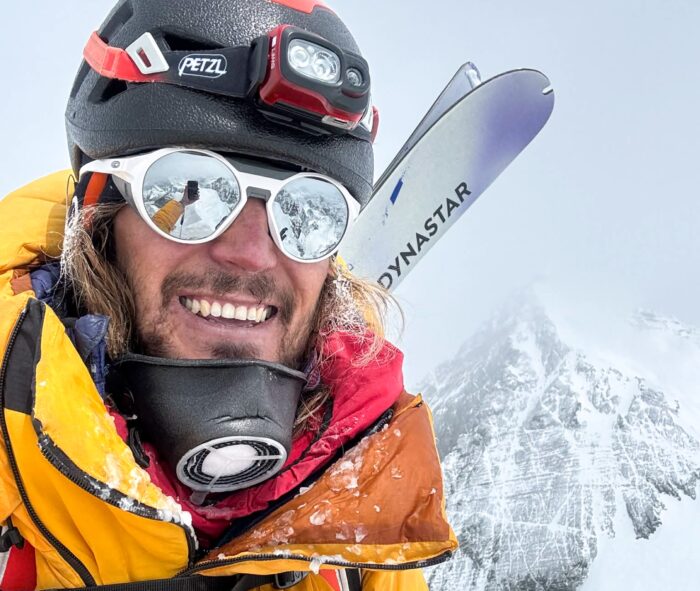
Bartek Ziemski on the summit of Lhotse, with Everest in the background, on May 12, 2026. Photo: Bartek Ziemski
Nine 8,000’ers skied
Everest is the ninth 8,000’er Bartek Ziemski has climbed and skied down without oxygen in just five years. He has done:
- Broad Peak and Gasherbrum II in 2022
- Annapurna and Dhaulagiri in 2023 (he then went up again to rescue an injured Carlos Soria from above Camp 3)
- Kangchenjunga (first complete ski descent), Makalu, and Manaslu in 2024
- This year, Everest and Lhotse
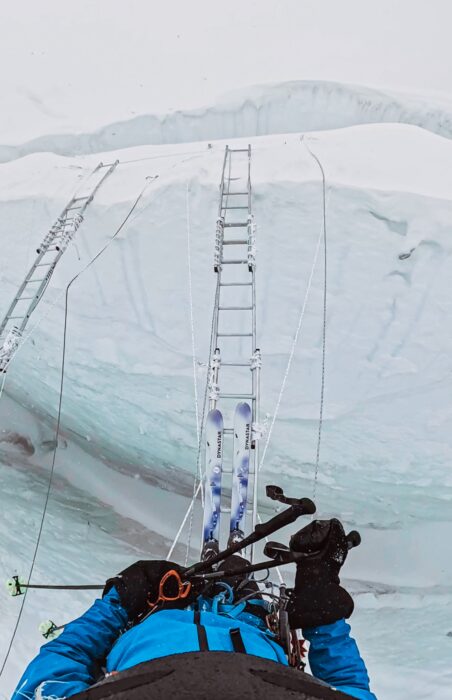
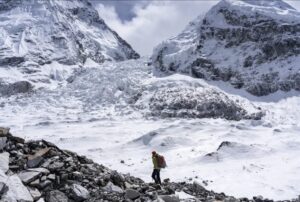
Ziemski crosses a ladder at the Khumbu Icefall after descending from the summit of Lhotse last week. Photo: Bartek Ziemski
There remains for Ziemski the two Tibetan 8,000’ers (Shisha Pangma and Cho Oyu), which are historically the easiest ones to ski down, and the three Pakistani giants: Gasherbrum I, Nanga Parbat, and K2, the second-highest peak on Earth at 8,611m, which has been skied only once, by fellow Pole Andrzej Bargiel.
Why it is historic
Everest was climbed without oxygen and skied down completely once before, also by Andrzej Bargiel in the fall of 2025. Both were historic in their own way.
Bargiel had a huge team fixing the route, setting the camps, breaking trail, filming the climb and the descent, and supporting him at all times. Otherwise, there was no one else on the mountain.
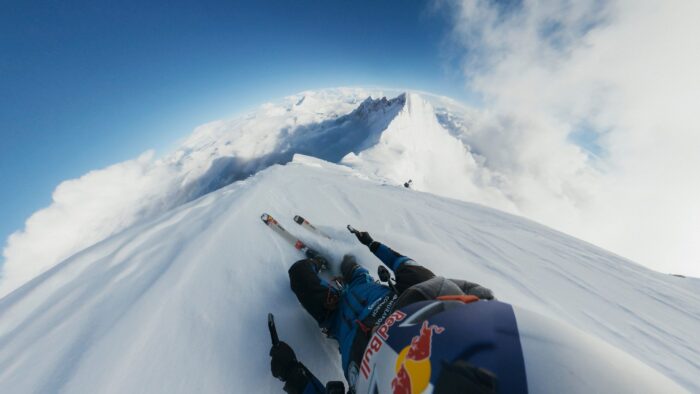
Andrzej Bargiel while skiing down Everest in the fall of 2025. Photo: Red Bull Content Pool
Everest also had a thick blanket of snow post-monsoon, which facilitated skiing the summit ridge and crossing the Khumbu Icefall. In that last section, Bargiel counted on the guidance of his brother’s drone. It was, nevertheless, an amazing feat.
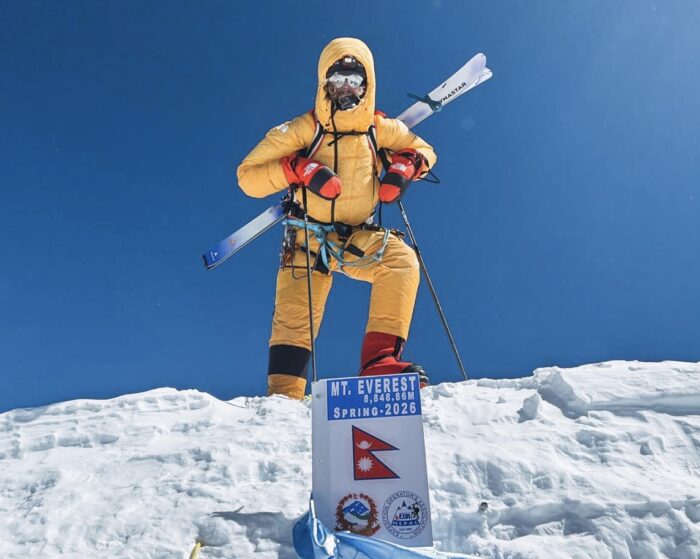
Ziemski on the summit of Everest today. He wears an air-warming mask after his no-O2 ascent. Photo: Bartek Ziemski
However, Ziemski had no support except for the fixed ropes and packed trail. He carried his own stuff — tent, gear, skis, food — up and down the mountain, had no drones, and no support team. He had to ask a nearby climber to take a photo of him on top of Everest.
At the same time, he had to contend with heavy traffic on the route, plus ropes and tracks in narrow passages that should be hard to ski. Last but not least, by luck or by boldness, Ziemski has skied Everest (and as far as we know, most of the 8,000ers he has skied) on his first attempt.
Overall, the 31-year-old Polish climber and skier has proven that there is room for unique adventure even on a crowded Everest. It’s just extremely hard.