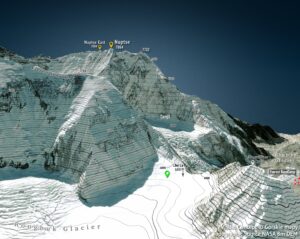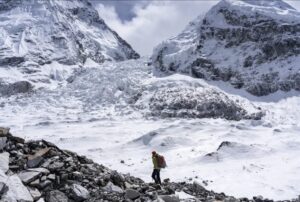
Since the first attempts in the 1970s, high-altitude skiing on Everest has evolved from pure media spectacle to either highly technical efforts or heavily funded corporate descents.
The purists’ ideal would be a fully unsupported alpine-style ascent combined with an unsupported and continuous summit-to-base ski or snowboard descent. This feat, the “Holy Grail” of high-altitude snowsports, remains a dream. But who has come closest to this ideal? Let’s look at the notable descents.
Starting on the southern flank
During the 1970s and 1980s, style was secondary to proving that controlled turns were physically possible in the death zone.
In 1970, there were only two expeditions on Everest, both in the spring, and both Japanese. A large team led by Hiromi Ohtsuka attempted the Southwest Face, reaching 8,050m before finally succeeding on the standard route (South Col-Southeast Ridge) with the use of bottled oxygen. Icecfall killed a Sherpa, and a Japanese climber died of a heart attack.
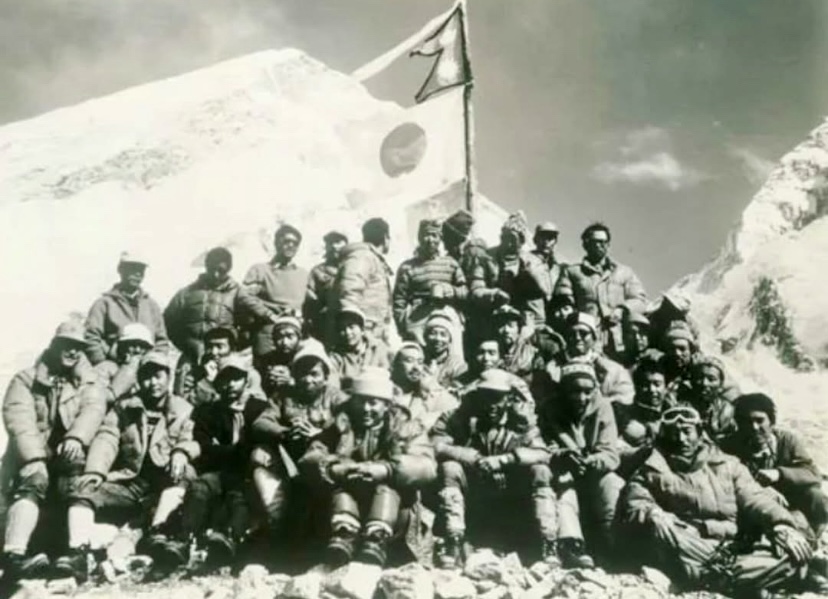
Members of the Japanese expedition led by Yuichiro Miura. Photo: Akira Kotani
The other team was a massive, well-funded Japanese expedition led by Yuichiro Miura. Rather than attempting the summit, Miura targeted a high-altitude ski descent. On May 6, after climbing 250m above the South Col without using oxygen to conserve his supply, he reached his starting altitude of 8,150m. There, he prepared for a high-stakes, technology-driven ski descent.
According to the Himalayan Database, before dropping in, extreme mountain winds forced Miura to spend an hour inside his tent meticulously filing his ski edges. He then transmitted an hour-long technical checklist via a specialized helmet to a control center at 6,800m to verify his oxygen valves, communication systems, and gear.
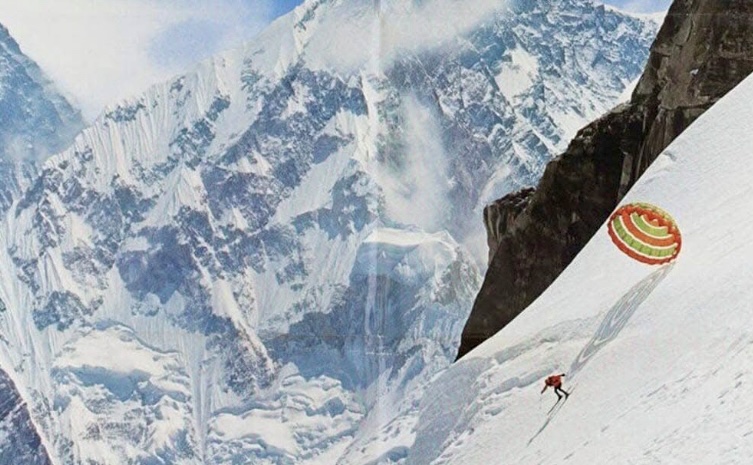
At 1:07 pm, after waiting for the wind to die down, Miura hooked into his breathing apparatus and began his run using supplemental oxygen. The Japanese skier threw himself down the Lhotse Face and reached an astonishing 160km/h within seconds. Soon after, he deployed a custom drag parachute to cut his speed in half.
The crash
As he entered a narrow section near the Geneva Spur, conflicting winds from the South Face and Lhotse tangled his parachute into a kind of violent vortex. After skiing for 2 minutes and 10 seconds, he struck a small stone on the wavy ice. He lost control and suffered a terrifying 300m tumbling slide down the Lhotse Face toward a 10m-wide crevasse. Stripped of his right ski, he miraculously came to a stop just 150m before the abyss, saved by a heavily padded jacket and his fiberglass helmet.
Ultimately, Miura’s spectacular feat was a high-risk stunt rather than a complete line, and this expedition was marred by tragedy. Six Sherpas lost their lives in the Khumbu Icefall in an icefall collapse.
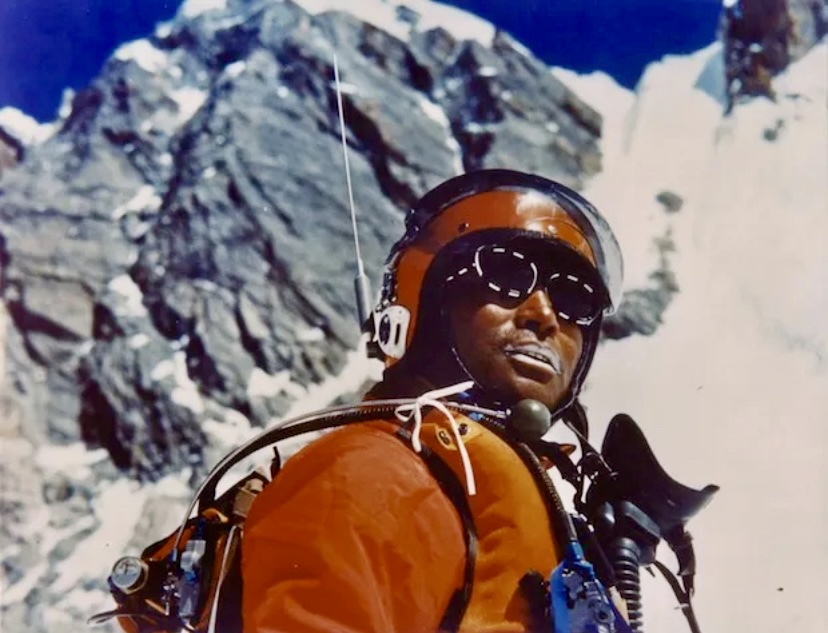
Yuichiro Miura at Everest in 1970. Photo: Snowbrains
Partial ski descent on Everest’s northern slopes
On May 24, 1996, Italian climber Hans Kammerlander achieved a major milestone by climbing Everest via the standard northern route (North Col – Northeast Ridge) in a record-breaking 16 hours and 45 minutes from Advanced Base Camp. He made his final summit push alone from the upper mountain, without supplemental oxygen, without relying on fixed ropes, and carrying his own skis and gear on his back.
Upon reaching the summit, Kammerlander began his descent. Because of bare rock and ice on the uppermost sections, he downclimbed before starting to ski.
Around 300m below the top, he encountered a highly exposed bare rock band. To bypass these impassable rocky sections safely, Kammerlander was forced to take off his skis and downclimb another 250 vertical meters on foot before clicking back into his bindings. He then resumed skiing to the lower camps, completing the round-trip from Advanced Base Camp to the summit and back in an astonishing 23 hours and 30 minutes, but leaving the physical continuity of the line broken.
Kammerlander’s no-oxygen, high-speed push on the upper mountain without Sherpa support or fixed ropes was outstanding. However, from a skiing perspective, it was not a continuous descent.
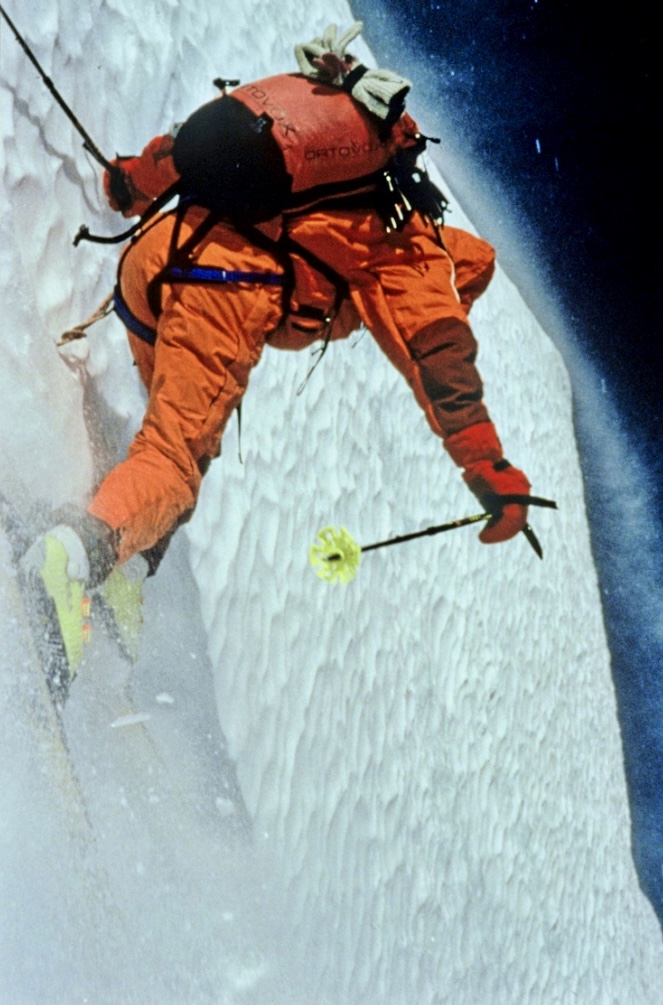
Hans Kammerlander skiing down Everest. Photo: Hans Kammerlander
The first continuous ski descent
The turn of the millennium marked a polarized era. Some athletes prioritized the continuity of a ski line down the standard southern route; others brought snowboarding to the hyper-technical terrain of the North Face, accepting style compromises on the ascent to achieve unprecedented riding feats.
On October 7, 2000, Slovenian skier Davo Karnicar achieved the first fully continuous ski descent from the summit of Everest to Base Camp on the south side. Over a grueling five-hour descent, Karnicar never removed his skis. He successfully navigated the Hillary Step and the treacherous Khumbu Icefall. However, absolute continuity on the descent came at a cost to his ascent style because he climbed using supplemental oxygen and relied heavily on the established infrastructure, fixed ropes, and the support of a commercial expedition.
Gatt, the snowboarder
Seeking a more purist approach on the Tibetan side, Austrian snowboarder Stefan Gatt climbed Everest without supplemental oxygen and without personal Sherpa support. He climbed via the North Col-Northeast Ridge (standard) route.
On May 22, 2001, Gatt strapped into his snowboard at the summit, originally intending to ride the extreme Norton Couloir. However, exhausted and facing dangerously hard ice, Gatt abandoned his plan.
After a brief ride below the Third Step to 8,650m, he diverted to the standard northern ascent route. He was forced to unstrap his snowboard and down-climb nearly 1,000 vertical meters on foot. He only clicked back into his bindings at 7,600m to complete the ride to Advanced Base Camp, leaving his line heavily fractured but his independent alpine style intact.
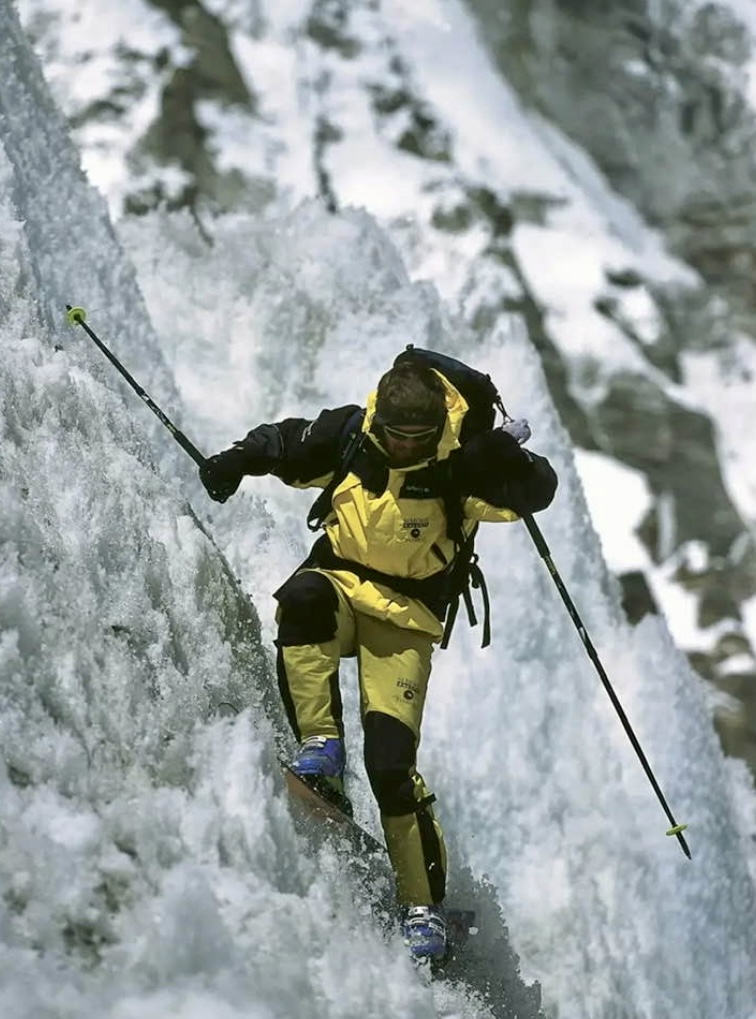
Davo Karnicar skiing down Everest. Photo: Davo Karnicar
The first complete snowboard descent
Just one day after Gatt’s fragmented attempt, 22-year-old French snowboarding prodigy Marco Siffredi completed the first continuous snowboard descent from the summit. Unlike Gatt, Siffredi used supplemental oxygen on the ascent and was guided by Sherpas who carried his gear on the standard route. He dropped into the couloir proper, carving turns on slopes around 40°, threading his way past seracs near the base before cutting right toward the North Col. After a brief rest there, he linked the final 600m down to Advanced Base Camp on the Rongbuk Glacier. The whole descent took about two and a half hours.
A year later, in September 2002, obsessed with an even steeper and more aesthetic line, Siffredi returned during the autumn season to attempt the Hornbein Couloir. He aimed to snowboard the Super Direct line (Hornbein Couloir – Japanese Couloir) but reached the summit late. Exhausted and under heavy cloud cover, he dropped into the face and was never seen again.
The modern era took high-altitude ski mountaineering from an era of fragmented success into a period of surgical execution. Driven by advances in lightweight carbon gear and physiological preparation, athletes began targeting complete, aesthetic lines, without sacrificing ascent style or the continuity of their descent.
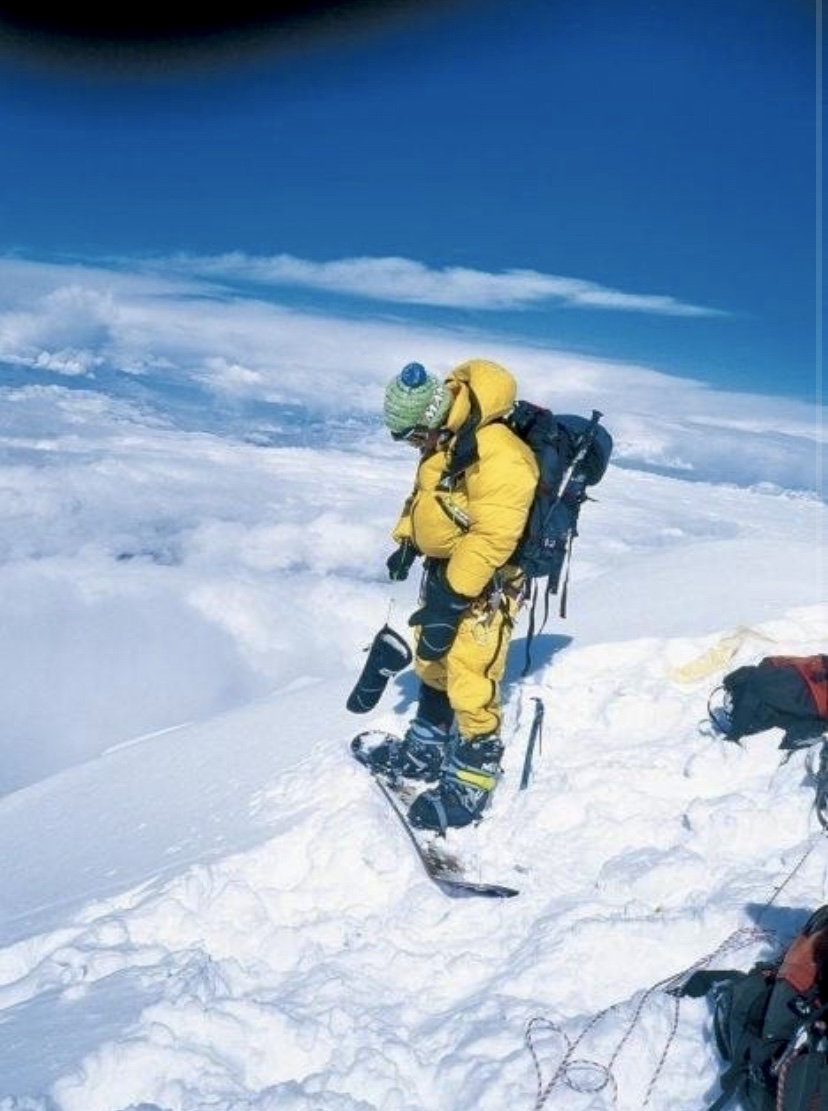
One of the last photos of Marco Siffredi, right before starting a snowboard descent toward the Hornbein Couloir. Photo: Marco Siffredi Archives
The Norton Couloir tragedy
In the spring of 2006, Norwegian skier Tormod Granheim and Swedish skier Tomas Olsson set their sights on a bold objective from the Tibetan side. They planned to summit via the standard northern route and then ski the Norton Couloir, aiming to complete the first full ski descent of Everest’s North Face from the summit to the glacier below.
After a demanding summit day (Granheim had pushed hard from Advanced Base Camp in roughly 24 hours, while Olsson took longer), the pair dropped into the face around midday on May 16.
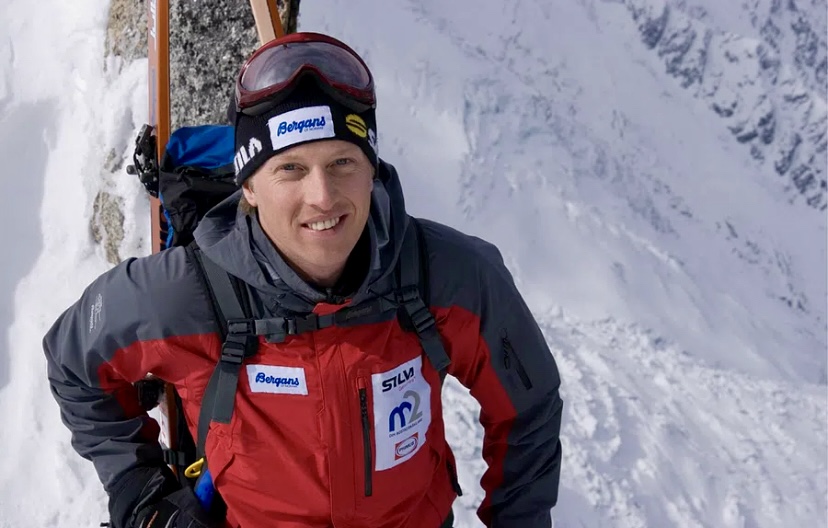
Tomas Olsson. Photo: Fredrik Schenholm
They began skiing the upper sections of the couloir, but conditions were unforgiving. Soon, one of Olsson’s skis broke near the binding, forcing a hasty repair with tape and adding stress to an already exhausting effort.
At approximately 8,500m, a rock band intersected the couloir. The two were forced to remove their skis and set up a rappel. A snow anchor failed during the abseil, and Olsson fell 2,500m down the face. Granheim, unable to locate his partner, continued alone, eventually reaching the North Col and lower camps. Olsson’s body was later recovered by Sherpas.
Granheim thus achieved the first ski descent of the North Face via the Norton Couloir with the use of supplemental oxygen. However, the descent was incomplete because of the forced rappel and the tragedy that cut the expedition short. Granheim later reflected on the day in his book (Pa ski fra Everest), calling it one of the most harrowing experiences of his life.
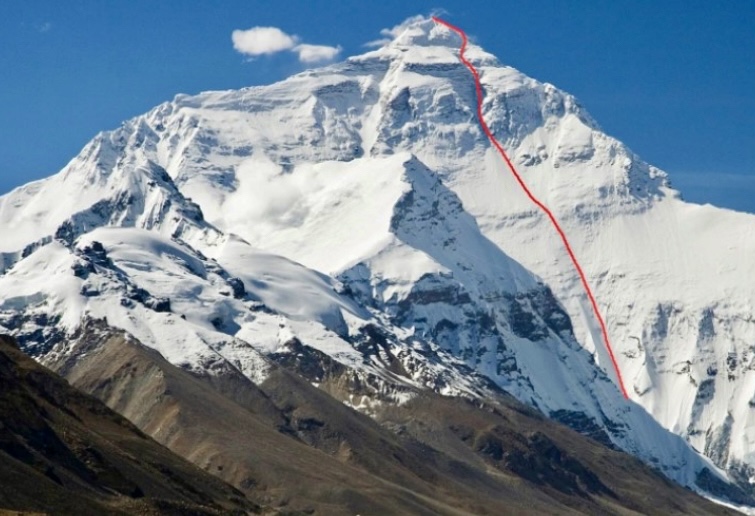
The Super Direct route. Photo: Animal de Ruta
The first ski descent of the Super Direct
On October 15, 2025, American ski mountaineer Jim Morrison carried out the first ski descent of the Super Direct route on Everest’s North Face.
Dropping from the summit, Morrison executed a four-hour, five-minute descent down a menacing 50° ribbon of snow and hard water-ice. However, for purists, it was a heavily assisted style. Far from an independent alpine effort, the expedition was a massive corporate and logistical undertaking organized by Alpenglow Expeditions and documented by National Geographic.
Morrison was supported by world-class climbers such as Esteban “Topo” Mena and Tico Morales, alongside a large team of Sherpas who broke trail, carried gear, and meticulously fixed the route. Furthermore, the team used supplemental oxygen during the summit push. From a skiing perspective, critics also pointed out that Morrison’s descent lacked physical continuity: he encountered a bare rock band that forced him to take off his skis and rappel 200m before resuming his descent.
Yet Morrison’s primary focus was mastering the skiing (precise, high-consequence turns on a very difficult line), rather than a pure lightweight alpine-style ascent and descent in the classic sense. He achieved exactly what he set out to do: the first complete ski descent of this legendary line. It is widely regarded as one of the most audacious ski descents in history.
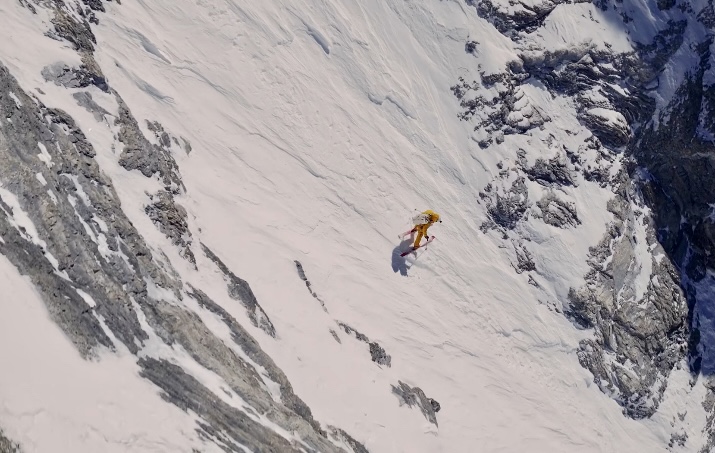
Frame of a video. Jim Morrison skiing down the Super Direct route. Source: NatGeo/Jim Morrison
Bargiel’s complete ski descent without bottled O2
In September 2025, Polish extreme skier Andrzej Bargiel completed the first complete ski descent from the summit down the standard route on the Nepalese side without the use of supplemental oxygen.
In the quiet post-monsoon autumn season, Bargiel’s team was alone on the mountain. He skied the entire standard route, including the highly fractured blocks of the Khumbu Icefall, completely on his skis. The critical compromise lay in his use of 16 Sherpas who actively broke trail through deep snow and fixed safety lines during the ascent. His team also used drones to scout the route.
“Carnival mountaineering” vs. unbroken lines
The collision between modern corporate sponsorships and traditional alpine ethics caused some media debate. Following Bargiel’s heavily publicized Everest descent, Kammerlander voiced his frustration in a 2025 Der Standard interview. Kammerlander said that his 1996 descent was unfairly penalized by purists for a single bare patch of ground. Kammerlander defended his choice of survival over an impossible, unbroken line, calling the strict definition of continuous descents absurd.
“If I’d known what a fuss it would cause, I would have left the skis on, of course, even though it would have been stupid,” Kammerlander said.
Kammerlander was also annoyed by Red Bull’s marketing campaign that framed the feat as unprecedented. He criticized the modern direction of Himalayan records, labeling the current trend as “pure carnival mountaineering.”
Kammerlander pointed to the independence of his 1996 push to illustrate the dilution of style. “It’s simply not fair. I had no Sherpas, carried everything myself, and the whole thing was over in less than 24 hours.” He argued that a ski descent should be evaluated by the integrity of the entire expedition, rather than penalizing an athlete for a single bare rock patch while ignoring massive logistical assistance on the ascent.
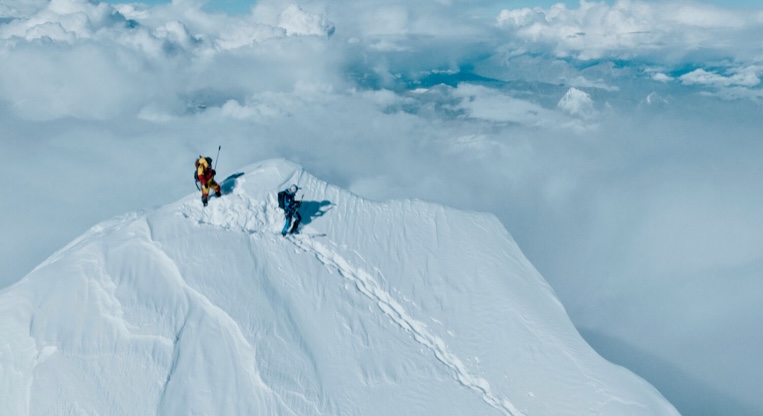
Andrzej Bargiel and Dawa Sherpa on the summit of Everest. Photo: Bartek Bargiel
Fully unsupported?
However, critics point to a problem with Kammerlander’s argument. Kammerlander’s ascent was not fully unsupported, because two Sherpas had gone ahead to pre-position a tent with food and supplies at 7,700m. He used the tent to rest and make tea on both the way up and the way down, while a small film crew accompanied him as far as the North Col area. These logistical compromises stand out given his condemnation of “carnival mountaineering” and Sherpa support in modern expeditions.
Bargiel’s response focused strictly on environmental and historical realities. In an interview with ExplorersWeb, he paid direct homage to Kammerlander, recognizing his 1996 effort as a masterpiece executed under much harsher conditions.
“It was a partial descent, but I believe the season just didn’t allow for a full one,” Bargiel noted. He explained that Kammerlander climbed in May when Everest is often stripped dry of snow by winter winds, whereas autumn provided the deep post-monsoon snowpack required for a continuous line.
Ziemski’s recent ski descent
Last month, Bartek Ziemski achieved a staggering back-to-back, skiing down both Lhotse and Everest without supplemental oxygen within a single spring window.
He skied completely unclipped from ropes, picking steep, untracked powder variations down the Lhotse Face to avoid the crowds. He completed his Everest descent without taking off his skis. Yet, his independence on the upper mountain was dependent on the valley below. His line relied on ladders installed across the Khumbu Icefall crevasses by commercial agencies. Ziemski came closest to the purist ethos, yet his success remained tethered to seasonal infrastructure.
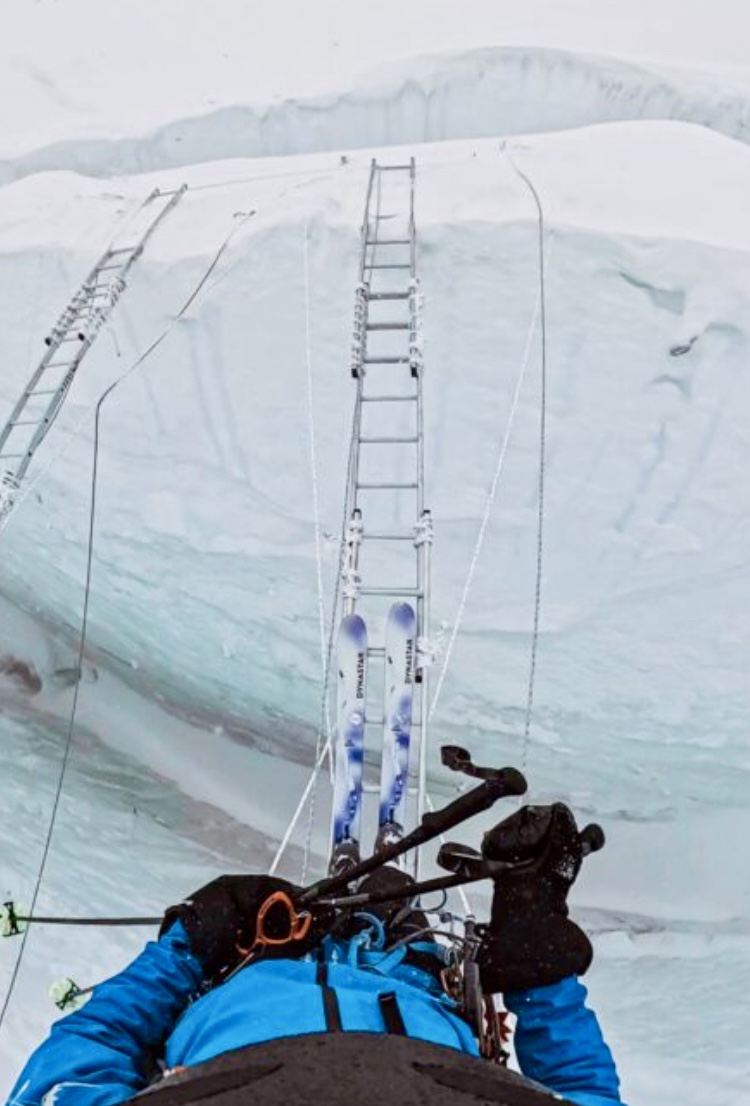
Bartek Ziemski crossing a ladder on skis in the Khumbu Icefall. Photo: Bartek Ziemski
Evolution and dilemmas
The evolution of Everest skiing divides opinion.
Can a descent truly be called “independent” if the skier crosses the Khumbu Icefall via ladders installed by the Icefall Doctors? For purists, using a pre-placed ladder or skiing down a trail packed by hundreds of commercial clients fundamentally changes the equation.
The use of drones allows skiers to analyze snow bridges, hidden crevasses, and blue ice layers from the safety of a tent. While a brilliant safety advancement, it removes the blind commitment that characterized early extreme skiing.
Furthermore, the terrain is changing. Classic lines, like the Hornbein and Norton Couloirs, are increasingly stripped to bare rock and hard water-ice. Achieving a 100% continuous snow line from the summit to the base is becoming an environmental impossibility, forcing a philosophical shift: Is a brief, tactical rappel more offensive to style than using commercial tracks?
Enduring quest
Although all these descents were outstanding, every effort has required a trade-off between ascent style and descent continuity, and because the standard routes are inevitably equipped with seasonal infrastructure, true purity remains elusive.
A flawless, 100% unsupported alpine ascent blazed entirely off the commercial tracks, combined with an unbroken summit-to-base ski or snowboard descent on Everest, has never been accomplished.
The perfect line on Everest has not yet been drawn.