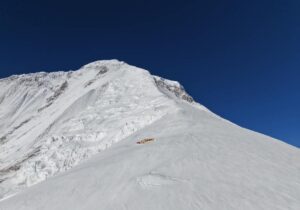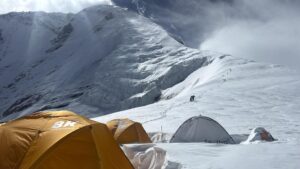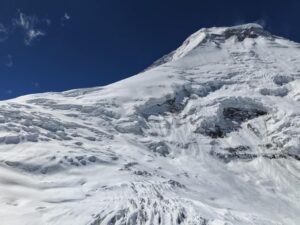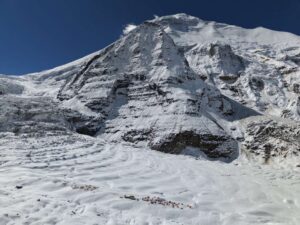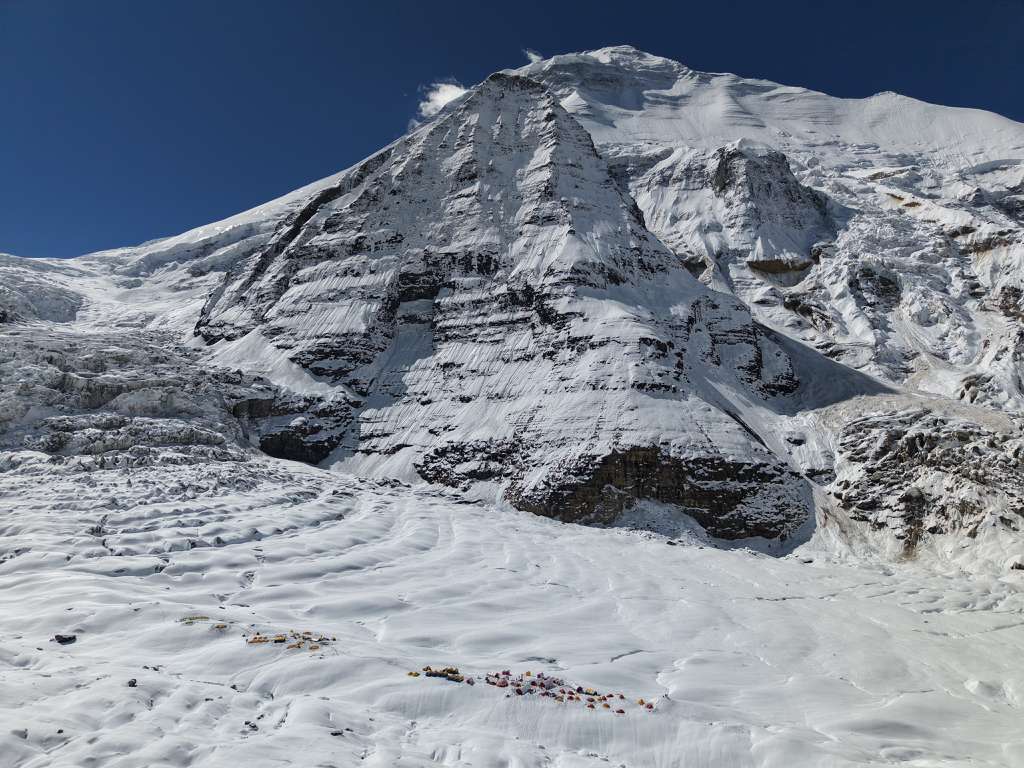
After Manaslu, Dhaulagiri is the second 8,000’er this season with no summits. The rope-fixing team says they stopped working for safety reasons, but some climbers suspect other motivations and describe a tense atmosphere.
Paul Clarke of Australia — who had been waiting at Camp 2 for five days — shared his frustrations with ExplorersWeb. Clarke had just learned that the rope fixers had stopped working above Camp 3 and was retreating. He described a lack of motivation among the Sherpa rope fixers after VIP clients with Seven Summit Treks, the company in charge of fixing the route, had called off their summit attempt. Soon after, all 20 climbers waiting at Camp 2 were told to return to Base Camp.
“Makalu Lakpa came through the lower camp this morning after the decision had been made,” Clarke said. “It was a pretty uncomfortable atmosphere, and I think everyone understands just how badly this has affected the rest of the teams on the mountain.”
Clarke’s outfitter, 8K Expeditions, sent a Sherpa team to retrieve their gear and tents from Camp 3 at 7,100m.
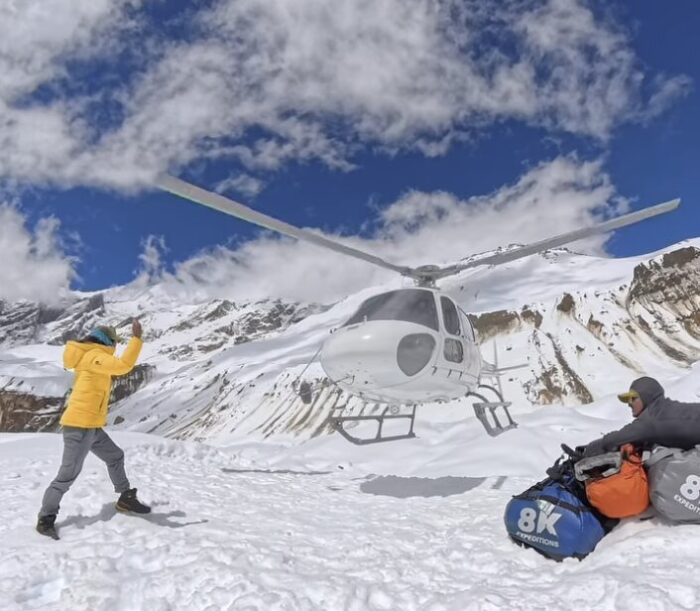
A helicopter lands at Dhaulagiri Base Camp. Photo: Paul Clarke/@outdoorpirate
Sherpa leader’s take
Makalu Lakpa Sherpa is leading the 14 Peaks Dhaulagiri Expedition, one of the two largest teams, together with its sister company, Seven Summit Treks. Today, he posted a message explaining that increasing winds on October 10 resulted in a higher risk of slab avalanches on October 11, when his team was due to attempt the summit. He says that is the only reason his team returned to Base Camp.
In an unusual remark, Lakpa stated that he looks after his own group and cannot be held responsible for “other teams’ summit ambitions, climbing strategies, or rope-fixing arrangements.” He also noted that the rope-fixing work was assigned to Seven Summit Treks, not his team.
Finally, he spoke out against climbers who had expressed their disagreement yesterday:
To those criticizing our decision from a distance, I ask you to understand the actual mountain conditions before passing judgment. Assessing risks firsthand and making decisions that determine whether a team returns home safely is very different from commenting on social media.
Supporting statements
Guides working for Lakpa’s company and for Seven Summit Treks have posted messages on social media supporting his decision. Benny Lieber, an American guide working for 14 Peaks, posted his assessment of avalanche risks on the mountain:
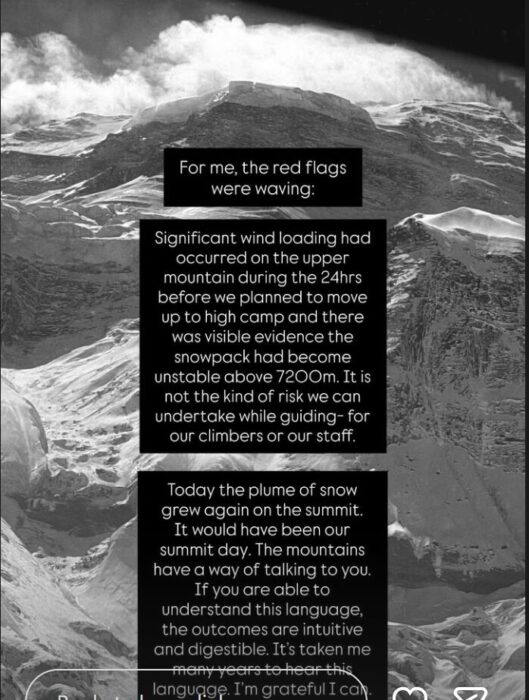
A post on Dhaulagiri conditions by Benny Lieber on Instagram. Photo: Benny Lieber/Instagram
Chhang Dawa Sherpa, leader of Seven Summit Treks, argued that the weather window was too short, given that a summit push would take “several days.” The plan was to move up to Camp 3 on October 11, reach the summit on the morning of October 12 (with October 13 as a buffer day), and return to Base Camp the following day.
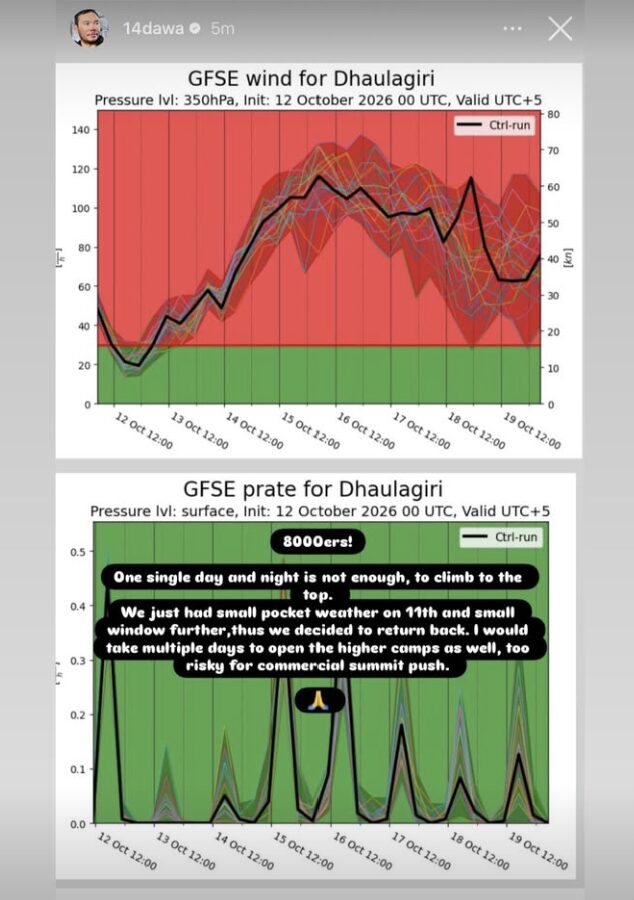
Chhang Dawa, a director at Seven Summit Treks, posted about Dhaulagiri’s weather forecasts. Photo: Chhang Dawa/Instagram
One person decides for everyone
Still, these explanations have not satisfied some climbers. Their biggest frustration came from watching the mountain in perfect, windless weather (though a wind plume eventually grew on the summit, according to Benny Lieber).
“From my perspective, one of the biggest frustrations is how badly the weather window appears to have been misread by Makalu Sherpa,” Paul Clarke said. “The strong winds and poor climbing conditions yesterday were not a surprise, since we had all been watching the forecasts for days, and winds in the 40–50kph range had been clearly visible well in advance.
“Despite that, Makalu Sherpa sent the rope-fixing team and his VIP clients higher on the mountain yesterday in conditions that were obviously going to be difficult. That has left climbers from multiple other operators stranded by a decision they had no control over. The consequence is that the rope-fixing team has now come back down, the VIP clients are no longer continuing [a helicopter was waiting for them as they arrived in Base Camp], and we have just been told that all our expeditions are over.”
Plenty of time
Vincere Zeng of Singapore also shared her pòint of view with ExplorersWeb. Zeng has summited seven 8,000’ers, and was the first Singaporean woman to summit K2 and Annapurna. “I attempted it [Dhaulagiri] last autumn as well, so I was fully aware of the risks involved, which is why I had been monitoring the weather closely every day,” she said.
Zeng explained that her group was aware of high winds on October 9 and 10, and therefore waited at Camp 2. They planned to attempt the summit today, on October 12, in the morning. “We also considered Oct 12-13 as a possible buffer, as the next strong wind cycle was forecast to arrive around the afternoon of Oct 14,” Zeng explained.
“What I did not understand was why the 14 Peaks team chose to move toward Camp 3 (~7,000m) on Oct 10, which was the windiest day in the forecast, and then cancelled the rope fixing based on the conditions they encountered that day,” Zeng said. “From our side, we hoped we would at least have the opportunity to assess conditions during the originally planned Oct 11-12 window.”
No chance to check conditions
Both Clarke and Zeng said that the 8K Sherpas who went to Camp 3 yesterday to retrieve equipment reported good conditions to that point.
“Of course, that does not mean conditions higher up, particularly around the traverse and summit slopes, were necessarily safe,” Zeng noted. “But it was one reason I hoped conditions could be reassessed once the forecasted wind had passed, especially as we still had time to do so. Instead, we were informed that the expedition was cancelled before we had that opportunity.”
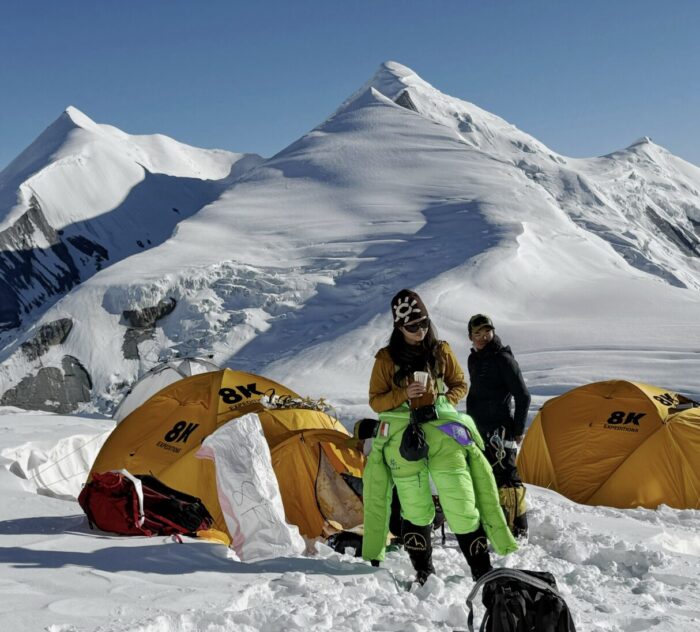
Vincere Zeng (with green down suit) waits at Camp 2 in good weather last weekend. Photo: Vincere Zeng
Zeng explained she was “absolutely prepared to turn around if an assessment showed that conditions were unsafe.”
Everyone home, except Bargiel
Clarke confirmed that all commercial expeditions on Dhaulagiri have called off their attempts. With the big teams pulling out, there is no manpower to launch another commercial-style attempt.
“At this point, nearly all of the teams have already packed up their Base Camp operations, and almost all of the climbers have flown out by helicopter, either yesterday afternoon or this morning,” Clarke said.
One team, however, has no intention of leaving. Andrzej Bargiel’s expedition, which includes a significant support team and film crew, is still hoping to summit and ski down the mountain, as he explained to fellow climber Xenia Santha of Hungary today.
“We wish Andrzej [Bargiel] the best of luck,” Clarke said. “If he can continue and summit, it will obviously provide another very clear picture of what the conditions on the mountain were actually like during this window.”
Cooperation needed
Risk assessment is always a tricky issue on commercial expeditions. Climbers pay large sums of money and expect every possible summit chance. It is often hard to explain when conditions are too risky, considering that factors include avalanche risks and wind, but also group sizes, the skills and endurance of guided climbers, complex logistics, and the disastrous consequences of a wrong decision.
However, in this instance, it is the lack of choices rather than the conditions that has frustrated climbers. Ironically, commercial expeditions on big mountains are more interdependent that ever, but communication between them, and sometimes with their clients, can be poor.
“As a client, I have no exact knowledge of the rope-fixing arrangement or collaboration agreed between the different outfitters,” Zeng said. “As we were a relatively small team with less manpower [8K Expeditions], we were to some extent dependent on the main rope-fixing team and whatever cooperation had been agreed between the operators. So, once the main fixing effort stopped, in practical terms it also affected our ability to continue.”
Don’t shoot the messenger?
“Seven Summit Treks and Makalu Lakpa are now, from our perspective, trying to justify the decisions that were made by saying the weather was the reason they stopped,” Clarke concluded after reading the posts by Makalu Lakpa and Chhang Dawa today. “Based on the forecasts we had been watching for days, what we saw ourselves, and now the reports from climbers and Sherpas who were actually higher on the mountain, I simply don’t agree with that explanation.”
Large expedition operators sometimes react only when climbers openly share their experiences and thoughts, and their reaction is often to try to stop the dissemination of news from the mountains.
Clarke and his climbing partner, Xenia Santha, said media coverage had caused tension. Santha received a text message asking why she and Clarke had been speaking to the press. “I found that quite surprising; we have only spoken publicly about what we experienced firsthand and about decisions that directly affected our expedition,” Clarke said.