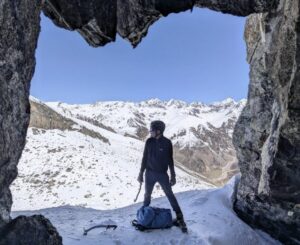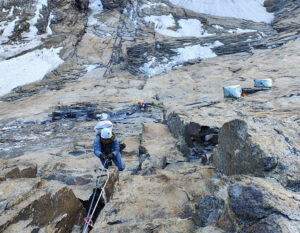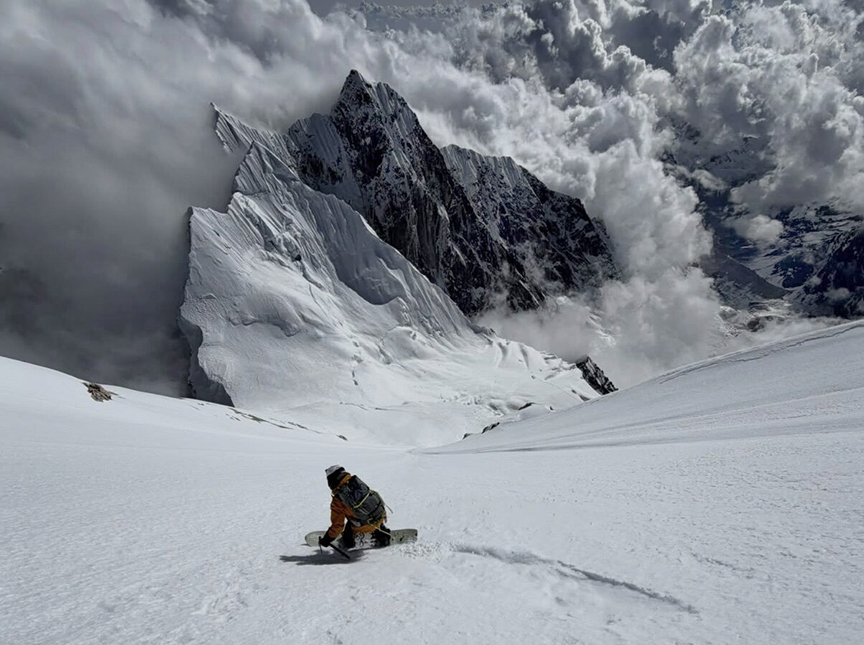
American snowboarder Nick Russell and skiers Adam Fabrikant and Billy Haas have just returned from Langtang with a first snowboard and ski descent of the south face of the formidable Dorje Lhakpa (6,966m).
The team climbed the peak, often known as the Langtang Pyramid, in two days in alpine style. They summited on October 20 and rode/skied down via the same line on the south face, while American photographer Blake Gordon and Canadian cinematographer Leo Hoorn filmed from a high camp.
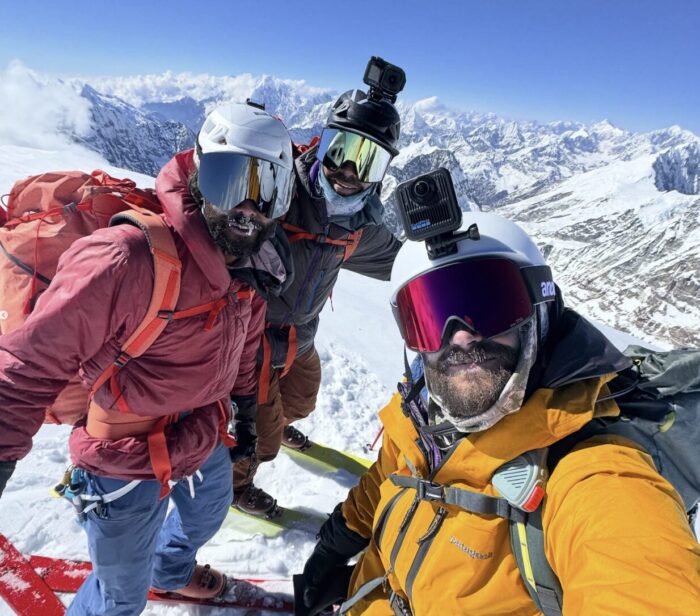
On the summit of Dorje Lhakpa, October 30, 2026. Photo: Nick Russell
Long-time dream
“The south face of Dorje was always the goal, and I’d been planning/dreaming of it for over two years,” Nick Russell told ExplorersWeb while on his way to the airport.
The expedition reached base camp on October 6, shortly after an intense storm blanketed Nepal’s mountains with heavy snow. For them, however, the snow was a blessing rather than a curse.
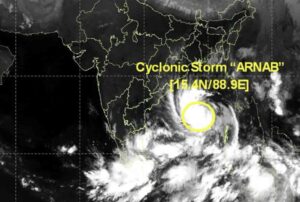
“The cyclone gave our zone some much-needed snow down low, and on the face, it allowed a clean descent (no down climbing, no rappels),” Russell said.
Sickness slowed the beginning of the expedition. “Three out of five of us, myself included, caught COVID,” Russell said. Luckily, the climbers recovered just as the weather cleared and winds dropped, followed by a string of perfect days.
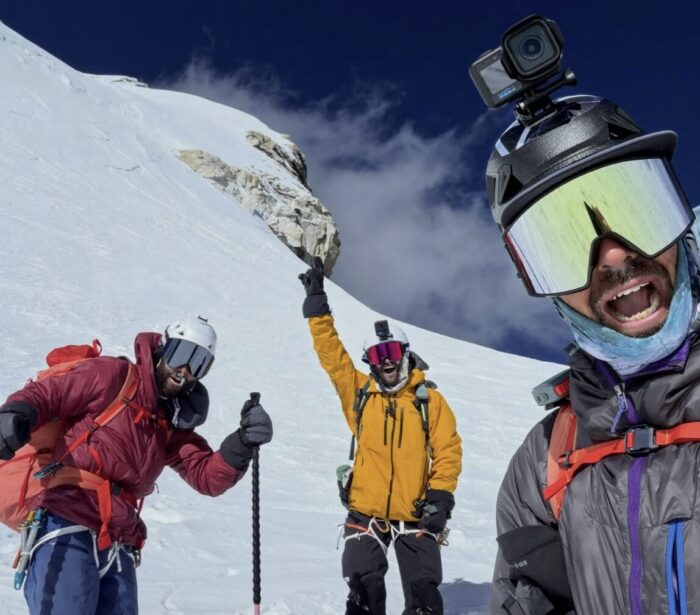
After the descent. Photo: Nick Russell/Instgram
Alpine style
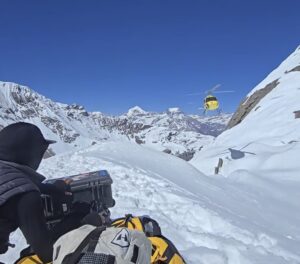
“Adam, Billy, and I all carried our own gear, set the tracks, and climbed in alpine style on the face,” Nick Russell said. The team had hired three Sherpa climbers (Dawa Geljee Sherpa, Kami Sherpa, and Nuri Sherpa) who helped the camera crew get their gear to a high camp, plus a base camp crew, outfitted by Shangri-La Nepal Trek.
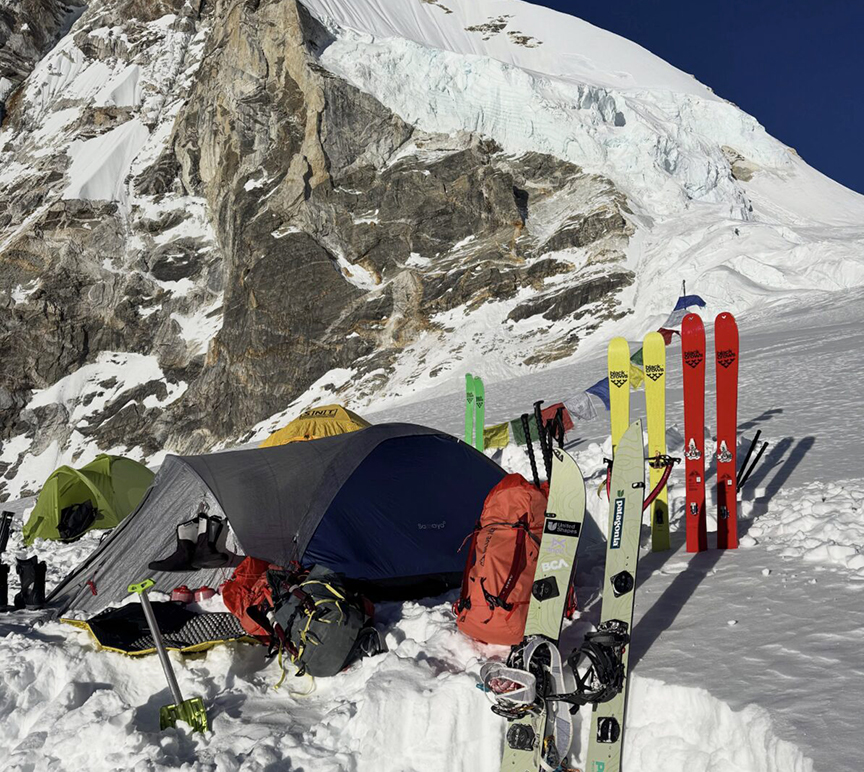
High camp at 6,000m on the south face of Dorje Lhakpa. Photo: Nick Russell/Instagram
The line of ascent/descent followed the snow from below 4,500m to Camp 1 (4,900m) by crossing an icefall. According to the team, this was the only real crux of the ascent, due to overhead serac hazard. At least, the exposed section was short — less than an hour.
On the first day of the summit push, the team continued to their high camp at 6,000m, below the col and at the base of the snowy face. Russell recalls the details of the climb as follows:
The south face is quite steep and sustained above the bergshrund, with sustained 45-50˚ and pockets of 55º, we estimate. The face had seen so much sun [over] the past two weeks that the rising conditions were the biggest unknown of the entire project.
We didn’t know whether or not it would be too icy to ride/ski until we got on the face. The snow was mostly firm, pretty much on the brink of being edge-able. It was two tool and crampon climbing the entire way, with no proper rests to take the pack off.
It took about 7.5 hours to climb the face, and we topped out around 1:30 pm. It took roughly 1.5 hours to descend, with breaks for the cameras to reset.
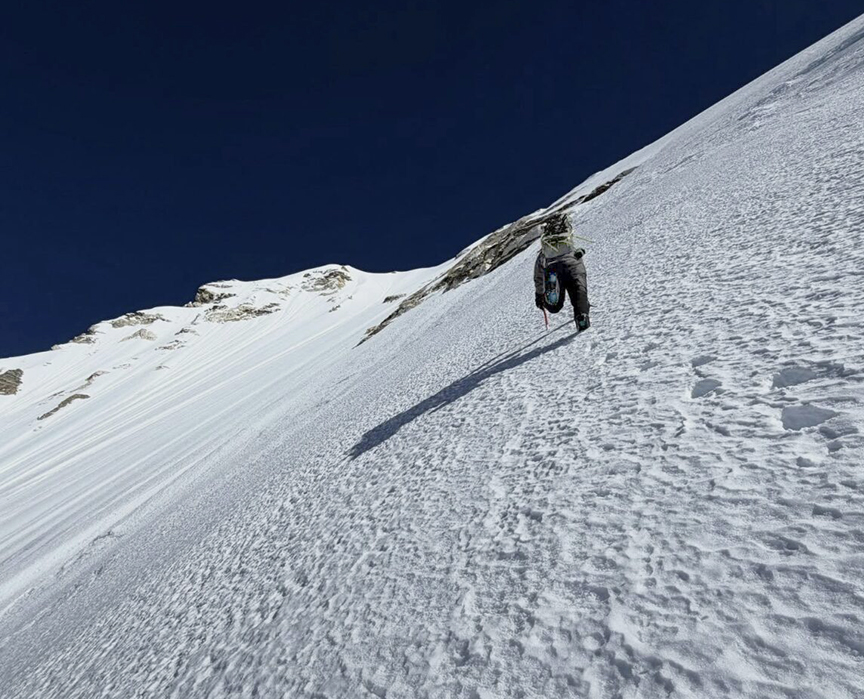
A climber leaves almost no tracks in the hard snow on Dorje Lhakpa. Photo: Nick Russell/Instagram
No falls allowed
The three summiters started down from the top at the same time, Russell on snowboard and his partners on skis. It was anything but easy.
“The snow was more firm than I would have liked, but just edgeable enough to hold an edge,” Russell recalls. “Between the altitude, exposure below, steepness, and how firm it was, it was by far the heaviest line I’ve ever ridden.” He added that if the snow had been a little harder, they would have had to rappel down.
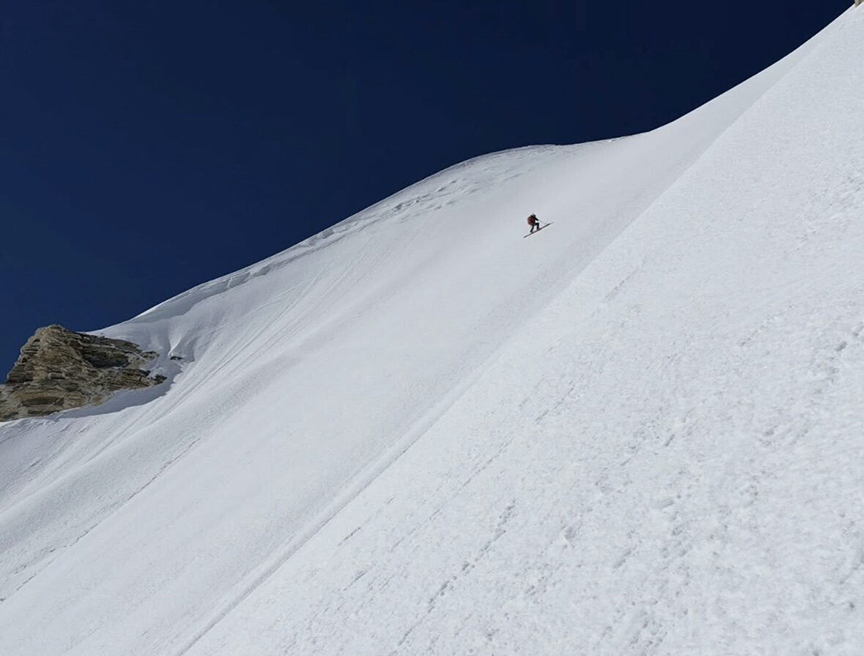
The hard snow on the upper sections. Photo: Nick Russell/Instagram
“You always hope for stable, boot-top powder, but that’s rarely the case at high altitude,” Russell explained. “Instead, you make the most of the conditions presented and try to do it as safely as possible.”
He added: “The entire line was a no-fall zone; one lost edge, and it’d be over. Regardless of conditions, it was a dream for all of us to ride off the top of a peak in Nepal.”
After a partial descent, the team spent the night at high camp, hoping to ride some interesting slopes they had spotted earlier, but finally decided to bail the next morning. “We were satisfied,” Russell said. They continued on skis/snowboard all the way down to the moraines below Camp 1 around 4,500m.
The team
Childhood friends Fabrikant and Haas often partner up on major ski expeditions, mainly in Alaska but also in the Himalaya. They climbed and skied both Gasherbrums 1 and 2 without oxygen after climbing them in the same style in 2024, together with Brendan O’Neill.
“They are the strongest partners I’ve ever been in the mountains with,” said Russell, who has also climbed and snowboarded twice in the Indian Himalaya and twice in Nepal.
“I tried Dhaulagiri in 2022 with Blake Gordon and Dan Corn, but the difficult conditions that year coupled with the loss of Hilaree Nelson [who fell to her death while trying to ski down Manaslu] didn’t allow us to make very much progress,” Russell said.
“I’ve always dreamed of riding lines in the Himalaya, and this felt like a major step forward in my personal journey,” he concluded.
Snowboard pioneers and future goals
While this is the first ski and snowboard descent of Dorje Lhakpa’s south face, the legendary Marco Siffredi snowboarded the west ridge of the mountain in 1999, with Bertrand Delapierre. Siffredi perished shortly afterward on the Hornbein Couloir on Mount Everest. “Dorje Lhakpa first entered my psyche from Marco and Bertrand’s descent,” the rider recalled.
The south face of Dorje Lhakpa was only climbed for the first time in 2021, by Spaniards Mikel Inoriza, Iker Madoz, and Mikel Zabalza.
“I came across a photo of the south face and the American Alpine Journal article from the Spanish team’s first ascent in 2021,” Russell said. “The massive south face is visible from the Kathmandu Valley on a clear day, and it is honestly crazy to me that no one had skied it before.”
“Today,” he went on, “people are so hyper-focused on the 8,000m peaks (for good reason, I get it), but there are still virgin lines waiting for a snowboard/ski descent in the 6,000-7,000m range. It just takes a shit ton of work to make it happen.”