On a gloomy Sunday morning in 1978, a little boy was riding home on his bike. Little did he know that his calm, serene morning was to be violently interrupted by an flash of light and a boom that would shake his small island home to the core. Since then, Bell Island in Newfoundland, Canada, has become a hotbed of mysteries and theories for a boom that defies all logic and explanation.
Background
Bell Island is only nine kilometers long by three kilometers wide, with a rugged maritime coastline. Its interior, rich in iron, phosphate, and pyrite, became famous for its mining in the late 1800s. Iron, in the form of hematite, is the dominant mineral on the island, and Bell Island contains some of the highest concentrations in the world.
However, the island’s mining heyday did not last long. Impurities riddled the ore. Companies found cheaper, superior material overseas, and production on Bell Island slowed until it stopped altogether. After the mines closed, many families left. As of 2021, only about 2,000 residents still live there.
It seemed that Bell Island was not going to see any excitement for quite a while. That all changed on April 2, 1978, at 11 am on the dot.
The incident
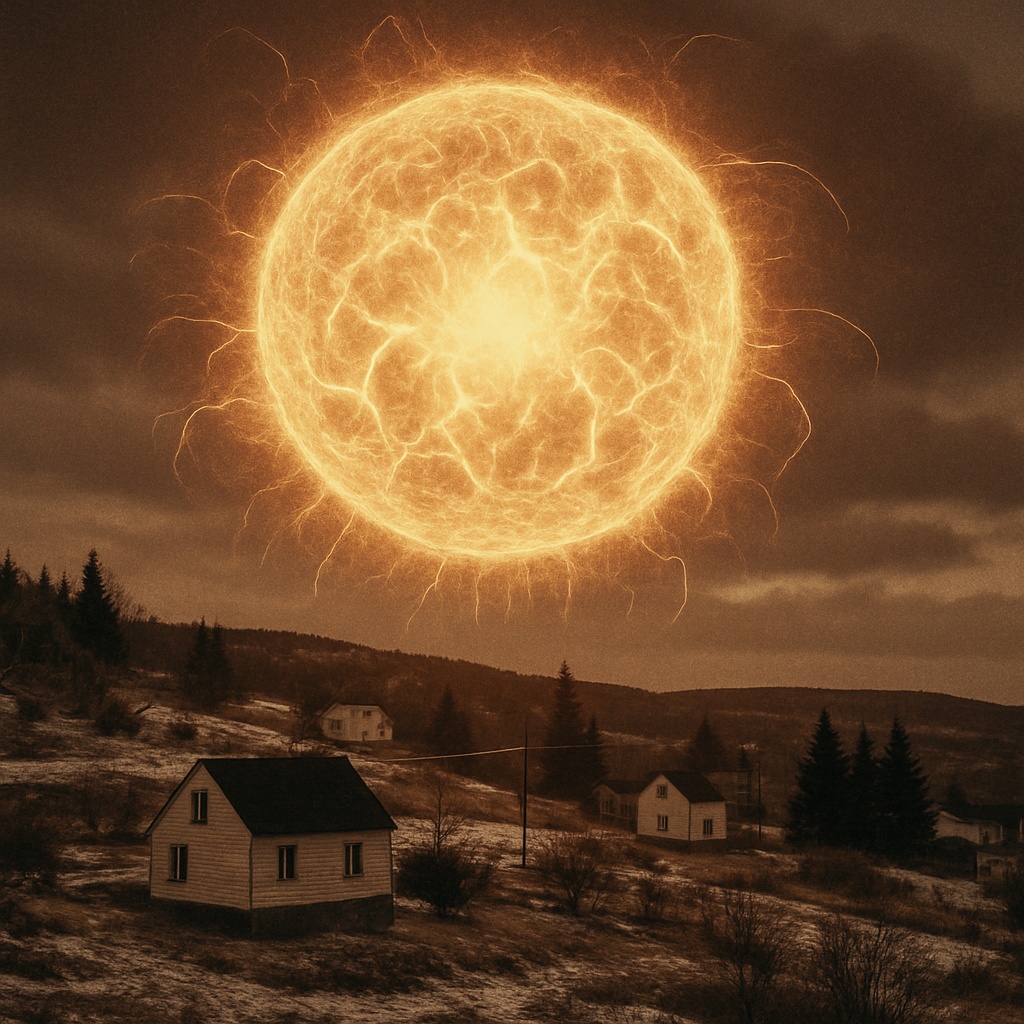
That Sunday morning was like any other. Families were preparing for the day. Some were cooking breakfast, some watched television, and some were outside tending the fields. Suddenly, a blinding glow was followed by an earth-shattering boom which shattered windows, blew fuse boxes, and destroyed electronics. Blood oozed from the eyes, beaks, or mouths of animals.
While no one died, some residents received superficial injuries and a couple of concussions. The shock wave was felt several kilometers away, and the residents had no idea what had happened or where the light or the boom came from.
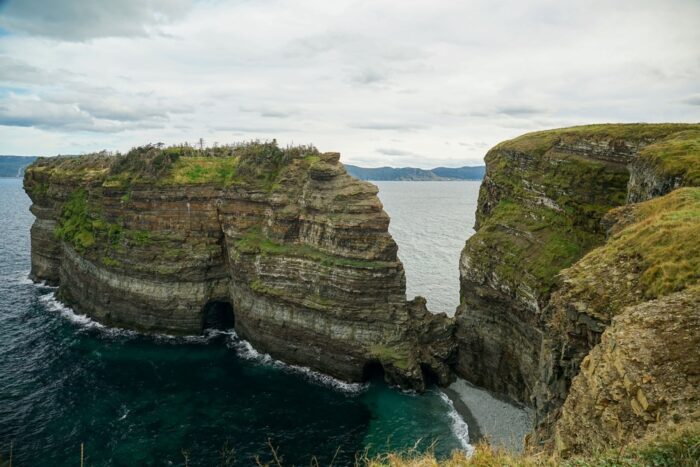
Cliffs on Bell Island. Photo: Shutterstock
Investigations started the day after, when first responders began looking for the source. Eventually, they came to a farm belonging to Jim Bickford, who was inside his house when the boom happened. He was watching TV when his screen began to glow an eerie blue, and then everything around him erupted in a fury of sparks and glass. In an article by journalist Russell Bowers for the Newfoundland Herald, Bickford described how the fuses in his fuse box came out “like bullets…and buried themselves in the wall.” The rubber in his house also melted, leaving behind a foul odor.
An eyewitness speaks
Bickford’s 12-year-old son, Darren, was outside when the hairs on his body prickled up, and he saw the light with his own eyes. Bowers quotes the boy:
“As I approached the end of the driveway, all the birds stopped chirping, all the dogs stopped barking. It just went so still. And then it was…like a shotgun blast, followed by a ball of light, and then the second ball followed immediately after. The ground shook underneath me. It was the biggest noise I ever heard in my life.”
The ball appeared out of thin air and hovered above the ground. Beautiful blue colors made up most of the center of the ball. “Outside of the blue,” said Darren, “there was orange and yellow.”
Investigators expected to find immense destruction and large craters associated with a bomb, but there was nothing of the sort except for three holes in the ground on the farm.
Theories
This was not the first time Bell Island experienced such an odd, destructive event. A report from a newspaper called the Daily News from November 11, 1896, states:
“At about 9:30 pm on Monday, the inhabitants of Belle Isle witnessed an extraordinary flash of lightning. It lasted for five seconds and was the most powerful ever experienced. Its attraction is attributed to the immense bed of ore on the island.”
Sources say that minor booms have occurred off the island for years. This had led scientists to suggest that it might simply have been lightning. But not just any lightning. What Darren described sounds a lot like ball lightning, a rare weather phenomenon so rarely seen that it borders on science fiction.
However, there have been thousands of sightings; it does exist. I saw it myself when I was a kid. Within a span of a few seconds, which felt like an eternity, I witnessed a glowing blue ball of sizzling light the size of a basketball descend into my grandparents’ front yard before exploding with a resounding boom. It knocked the lights out briefly. It’s important to note that ball lightning does not leave little craters in the ground.
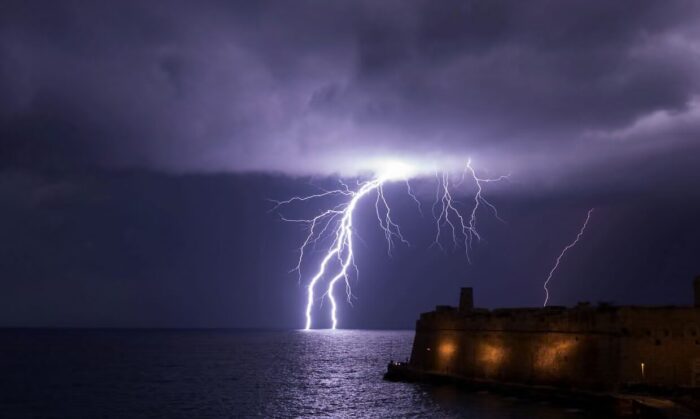
Superbolt captured in Malta in 2019. Darrin Zammit Lupi
The investigation
American scientists traveled to Bell Island to investigate. They thought there may have been another cause: a super lightning bolt. They’re very rare, but they do happen. A superbolt can be up to 1,000 times stronger than an average lightning bolt. Scientists remain baffled as to why they are so powerful. They also occur more around the sea than on land, they are positively charged, and they fry nearby electronics.
Other natural explanations for the light/boom include a gas deposit exploding, but there was no fire afterward.
The flash was so bright that the United States’ Vela Satellites detected it. These satellites were designed to detect flashes of light on Earth associated with nuclear tests. Scientists also came discreetly to examine whether secret weapons tests were being conducted here.
Some theorists pointed to the Soviet Union’s experimentation with radio waves, particularly Extremely Low Frequency waves (ELF). The interaction between these radio waves and iron ore may be to blame. Others also suggest an electromagnetic pulse. Nevertheless, the evidence collected shows nothing of a man-made origin.
A similar incident occurred a year after this boom. Somewhere in the subantarctic, between the Prince Edward Islands and the Crozet Islands, the Vela Satellites detected an exceptionally powerful double flash. In this case, there was evidence of nuclear fallout, but no nation came forward to claim responsibility. Some believe that the boom was a nuclear test or at least an experimental weapons test.
Conclusion
Though we have no clear answers, perhaps there is a type of lightning or atmospheric phenomenon we have yet to classify. It is safe to say that this boom was not man-made.