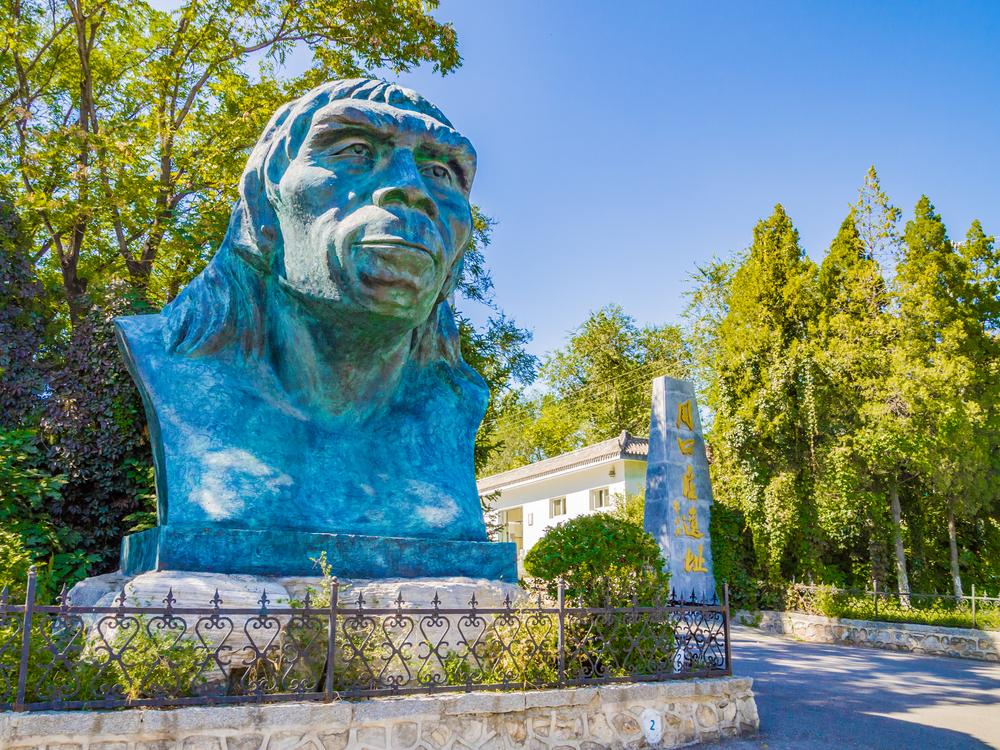
A few kilometers southwest of Beijing, a bust of a man greets visitors when they enter the Fangshan District. The man has shoulder-length hair, very bushy eyebrows, a large nose, a protruding jaw, and a friendly expression.
Over 200,000 years ago, this man dwelt in a cave nearby. He lived, learned to harness fire, to hunt, and use tools. In this simple existence, he had no idea that in the distant future, he would be hailed as the first ancestor of a nation. Peking Man is one of the greatest archaeological finds and is often cited as evidence that humanity began not in Africa, but in Asia. However, during a period of turmoil, Peking Man’s fossils vanished without a trace. Governments and anthropologists still search for him today.
Who was he?
Peking Man was a subspecies of Homo erectus, an ancient type of human known for first inventing tools like spears and hand axes, using fire, and cooking meat. Homo erectus had a short, robust frame with thicker bones, a smaller brain, and much larger teeth and incisors than Homo sapiens. They were primarily hunter-gatherers with rudimentary conceptions of art and religion. Peking Man, in particular, was described as possessing:
… a skull that was flat in profile, with a small forehead, a keel along the top of the head for attachment of powerful jaw muscles, very thick skull bones, heavy brow ridges, an occipital torus, a large palate, and a large, chinless jaw.
You might be wondering why ancient humans matter at all. Homo erectus was not just any species of human but the main “missing link” between humans and apes.
The discovery
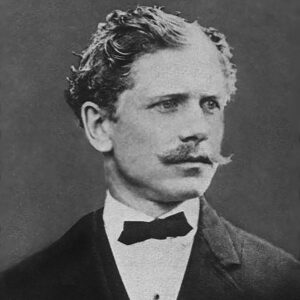
Peking Man’s modern journey began when Swedish archaeologist Johan Gunnar Andersson was invited to China in 1914. Renowned for his participation in the Swedish Antarctic Expedition and for geological research, he came at the invitation of the Chinese government to establish a geology training program. Apart from his scientific duties, Andersson was interested in Chinese culture, mythology, and traditions. During his time in China, locals regaled him with stories about finding dragon bones at sites like Chicken Bone Hill and Dragon Bone Hill.
These so-called dragon bones, or long gu, were petrified or fossilized fragments of wood or of animals such as bears and orangutans. For thousands of years, the Chinese believed these fragments were dragon bones and so contained magic and healing properties. The bits were ground up and consumed in rice wine to treat ailments such as constipation and fevers.
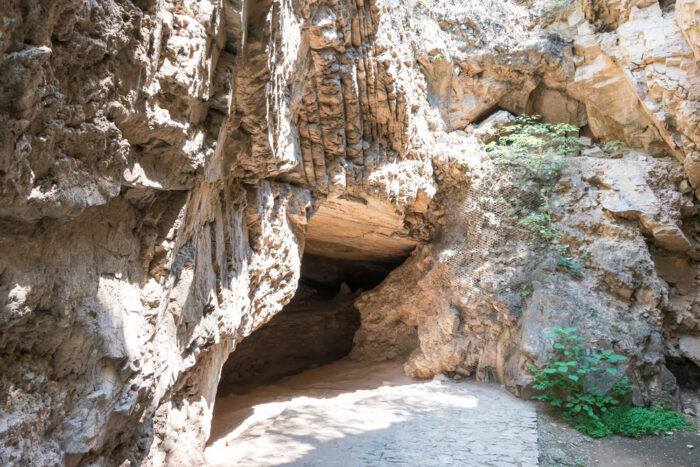
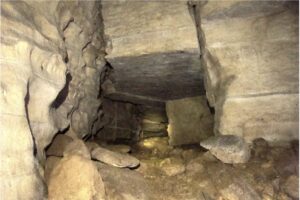
Peking Man cave. Photo: beibaoke/Shutterstock
A few years later, in 1921, Andersson and his assistant Otto Zdansky visited an area in Fangshan called Zhoukoudian, home to a vast cave network. On Dragon Bone Hill, they found white quartz pieces that resembled tools. With these instances in mind, Andersson was optimistic that finding human fossils would soon come.
In 1923, Zdansky returned to the site without Anderson and discovered a human tooth. He kept the discovery a secret for three years for some unknown reason, but eventually released his findings during a fancy reception in China for his financial backer, Sweden’s Crown Prince Gustaf VI Adolf. The media erupted into a frenzy at the news.
There was no time to lose. The site with those ancient human remains needed to be secured as soon as possible. On top of that, researchers needed funding and facilities to house and study any further remains. The Rockefeller Foundation stepped in to collaborate with the Peking Medical College and the China Geological Survey to provide the scientists with equipment and a laboratory. Anthropologists Jai Lanpo and Pei Wenzhong were key figures in developing anthropology as a field of study in China.
A sensation
Decades earlier, in 1891, a Homo erectus fossil found in Java had already caused a stir. Anatomist Eugene Dubois declared this Java Man to be a missing link between apes and humans. The Chinese Communists did not hesitate to claim Peking Man as a national symbol. The government used Peking Man to push the theory that humanity emerged from Asia instead of Africa. It famously stated:
We pioneered in human evolution and made human civilization bloom. Our ancestor lit up the fire so we could be illuminated. How can the Chinese today not be awakened and inspired!
This discovery of Peking Man prompted Chinese archaeologists to believe the Chinese were the oldest people on the planet.
War breaks out
Geologists from various countries excavating at Zhoukoudian found several teeth, layers of ash, animal bones, and rudimentary tools. In 1929, a skull cap emerged. They also found other skull caps belonging to several individuals who dwelt in the same cave as Peking Man.
Davidson Black, a Canadian palaeontologist on the team, called it Sinanthropus pekinensis, a new species. When he died, a Jewish scientist who had fled Nazi Germany took over the project. His name was Franz Weidenreich, who hoped to escape war and study human anatomy. However, war followed him to China.
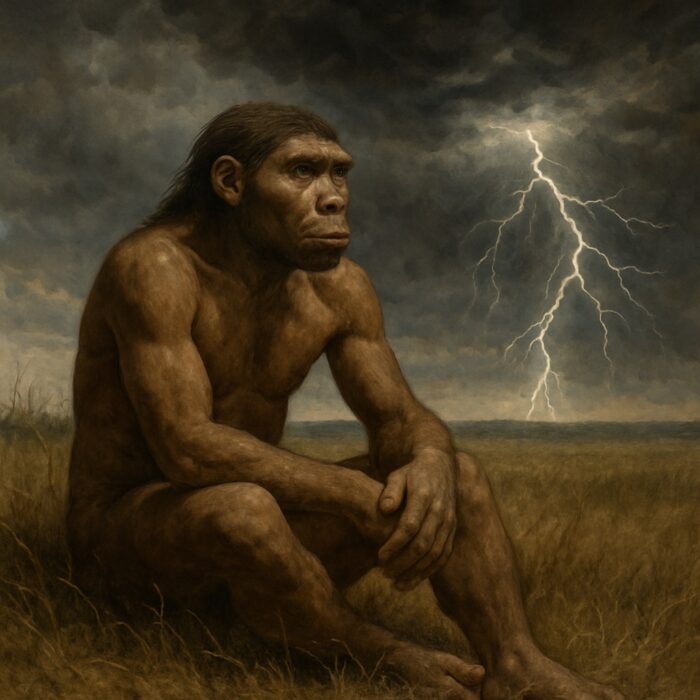
What the Peking Man could have looked like. Photo: Shutterstock AI
When the Second Sino-Japanese War broke out in 1937, the remains of Peking Man were at risk of being seized or destroyed by the Japanese. Hastily, Weidenreich made casts of the fossils and took extensive notes and audio recordings. He fought hard to get the remains transferred to the United States. In the 1940s, it was finally authorized.
A worker at the Peking Medical College named Hu Chegzhi assisted in the transfer, saying:
We wrapped each skull in layers of lens paper, thick cotton, and medical gauze, then placed each one into a small box. Then we packed the small boxes into two wooden crates.
The plan was for these crates guarded by U.S. Marines and conveyed to the SS President Harrison, docked at Qinhuangdao Port. From here, they would sail for New York City. When the crates were heading to the port on December 4, 1941, Japanese forces attacked. The fossils never reached the ship.
The search
According to writer Jake Hooker for Archaeology magazine, the Americans, Chinese, and Japanese searched “the Imperial Palace in Tokyo, the American Museum of Natural History and several sites around Beijing…nothing turned up.”
Philanthropic individuals in America, eager to support science, offered to pay for information, especially for the location of the remains. A man named Christopher Janus offered a $5,000 reward for anyone who could tell him where the Peking Man fossils were.
A mysterious woman contacted him and told him her husband knew about them during his time in China as a soldier. They met at the top of the Empire State Building, where she showed him a promising photo of Homo erectus remains. She claimed to have had them in her possession. However, she demanded more money and disappeared when Janus was unable to provide it. This lead did not go anywhere.
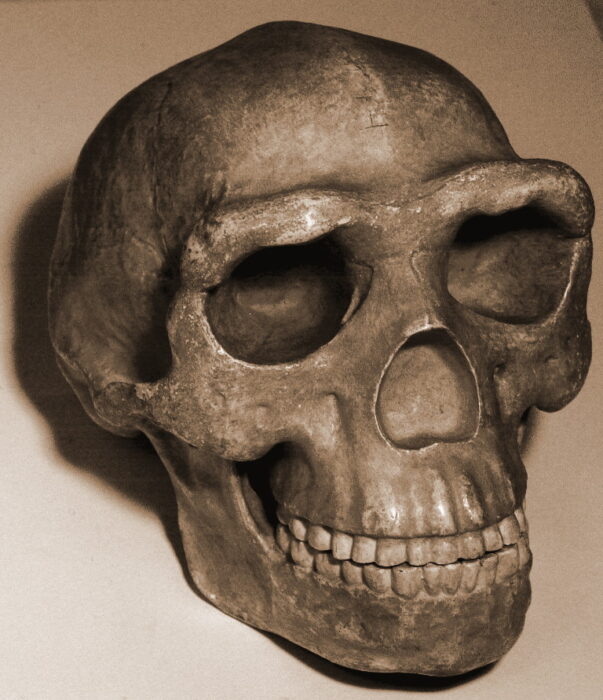
Peking Man skull cast. Photo: kevinzim/Wikimedia Commons
Perhaps the most intriguing lead came during the Chinese Civil War. During a violent clash between the Communists and nationalists in 1947 in Qinhuangdao, a U.S. Marine named Richard Bowen was quickly digging a hole to shelter from all the gunfire. He then hit a solid object, which turned out to be a box of human remains.
Bowen described:
I had a 30-caliber machine gun and our lieutenant would, from time to time, change our crossfire. In this nightly digging process, we dug a lot of holes. In one of them, we found a box that was full of bones. At night, it gave us a little scare, and we filled in that hole and dug another.
Bowen survived and moved on when the conflict ended. When he heard about the missing Peking Man fossils years later, he wondered if that’s what he’d unearthed. A palaeoanthropologist named Lee Berger connected with Bowen’s son, and Berger went to China to try to locate the field where the Marines dug. However, the field is now an asphalt parking lot, surrounded by warehouses.
Conclusion
Judging by Bowen’s story, there is a faint chance the Peking Man fossils are under a parking lot in Qinhuangdao. This was close to where the fossils were originally headed and could have been buried by the Marines who were escorting them. In the chaos of war, they likely forgot the precise location. Until there is a permit to excavate the parking lot, we can only wonder.
Though the main set of fossils has disappeared, four teeth reside at Uppsala University’s Palaeontological Museum. And thanks to Weidenreich’s quick thinking in making casts and taking notes, researchers today can still study Peking Man.