By October 12, 1892, the situation was desperate for young Swedish explorer Johan Alfred Bjorling and the four other members of his expedition. The trouble had started two months earlier in mid-August, when their ship, the Ripple, a 37-ton fore-and-after, had been wrecked off the shore of a small island between Greenland and Ellesmere Island. Bjorling and his party were able to salvage their supplies but faced the grim prospect of spending the Arctic winter on this barren island. This in itself was not disastrous. They had enough food to last till the following June. A whaling ship would likely stop by the island eventually to look for them. So they built a camp in a small ravine on the south side of the island and settled in for the wait.
The last days of summer ticked away. By now, there was evening frost, despite the midnight sun, and days hovered around freezing. Even the dovekies and murres were flying south to their wintering grounds on the Grand Banks.
Map: Alexandra Kobalenko
Impatience
Experienced Arctic travelers know not only when to move but also when to sit still. But Bjorling was not good at sitting. Though the forced overwintering would have been an impressive feat in itself, Bjorling was apparently determined to salvage something of his original expedition. On August 27, the five castaways set out in the Ripple’s rowboat to push two hundred kilometers further north to an area where earlier expeditions had overwintered. It was their first big mistake.
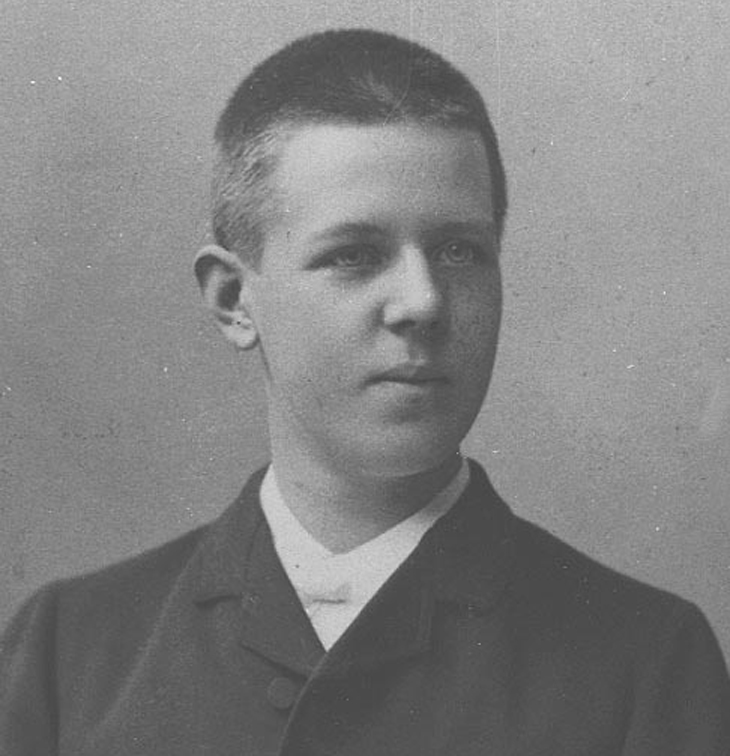
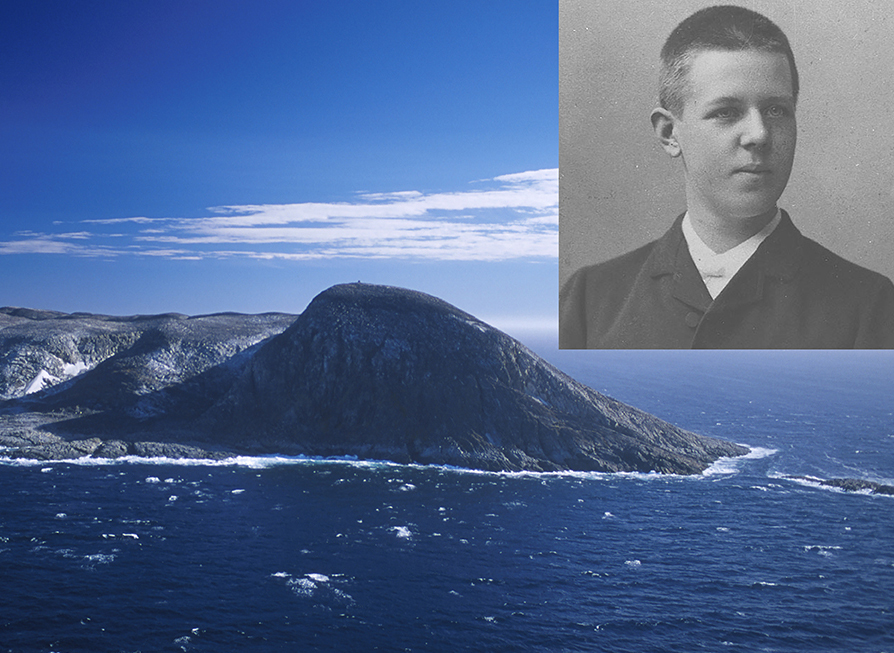
Twenty-one-year-old Johan Alfred Bjorling.
Loaded to the gunwales with all their supplies, they rowed north across stormy Baffin Bay. Their first day out, a ship carrying American explorer Robert Peary home from northern Greenland passed within a few kilometers, but they did not see it. Rough seas threatened to swamp the rowboat, forcing them to dump most of their food to lighten the load. Against all odds, they managed to reach Northumberland Island, not quite halfway to their goal. Here, for what Bjorling called “various reasons,” they decided to retreat to the Carey Islands.
They made it back to their original base in late September. Bjorling’s last message, on October 12, omits much but still gives a clear picture of their situation. They now had enough food only until January 1. And they had other problems, too. The cryptic last line of his entry reads, “We are now five men, one of whom is dying.”
By the time that message was found, Bjorling and his crew had vanished without a trace.
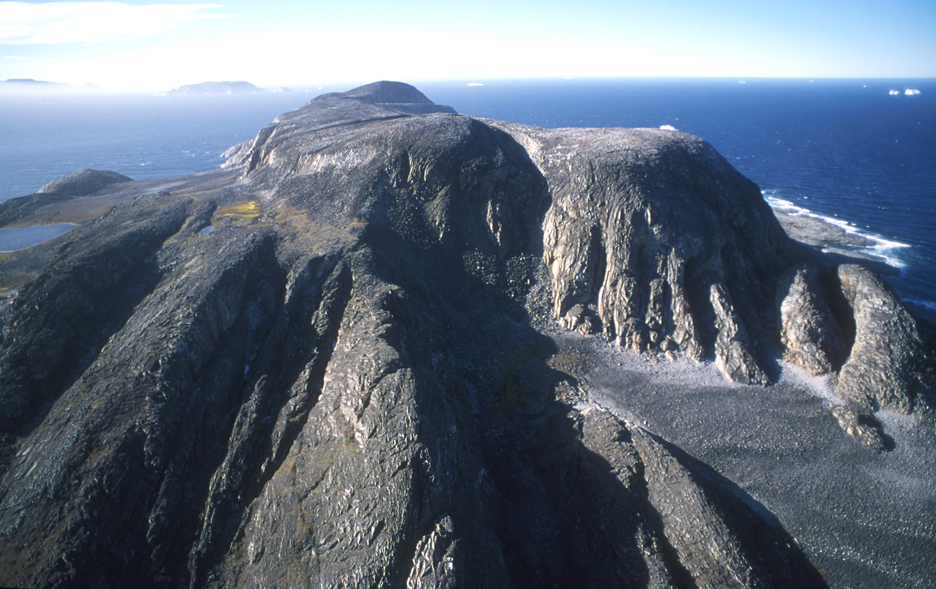
The rugged northern end of Bjorling Island, the easternmost of the Carey Islands off Northwest Greenland. Photo: Jerry Kobalenko
Bjorling Island
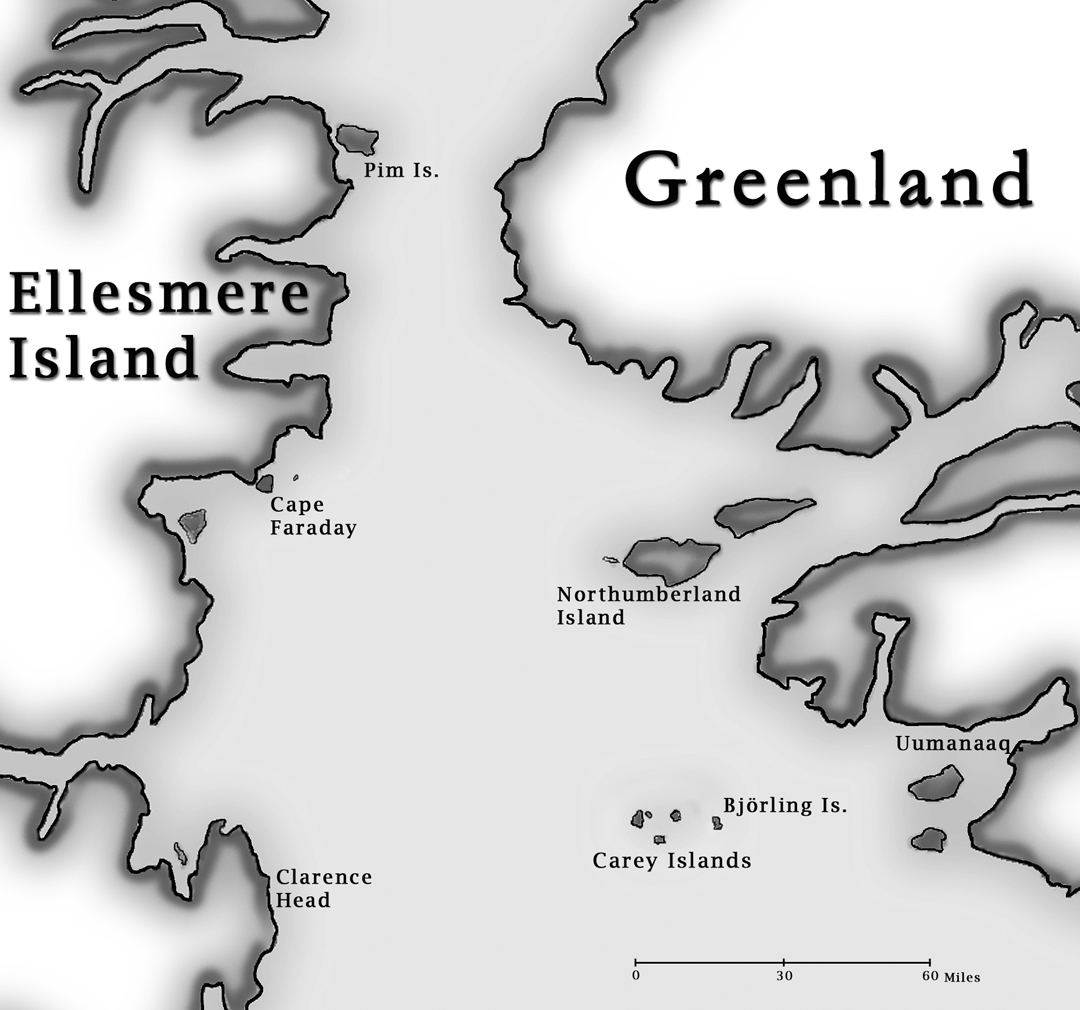
The island where Bjorling’s ship came to grief now bears his name. It’s one of the Carey Islands, six small outcroppings in the High Arctic, and one of the most isolated places on earth. These wind-blasted, treeless specks of rock sit in the throat of Baffin Bay, between northern Greenland and Ellesmere Island, some 3,200 kilometers due north of Quebec City.
Bjorling is the easternmost island of the Carey group, measuring less than a kilometer across by one-and-a-half kilometers long. Only a handful of people have ever stood on what one early explorer called “this bleak and desolate island, which a wealth of bright sunshine could not relieve of its aspect of dreariness.”
Getting to the Carey Islands these days may be easier than it was a hundred years ago, but it’s still no simple matter. I flew north on a Canadian C-130 Hercules cargo plane to Thule, now known as Pituffik, the U.S. base on the west coast of Greenland. The Thule area has been occupied more or less continuously since the twelfth century –- an important fact not known in Bjorling’s day -– and has yielded more ruins than anywhere else in the High Arctic. Thule was home to an Inuit settlement in 1952 when the U.S. Air Force picked the site for a strategic base. Its peak Cold War population of 10,000 has now shrunk to a few hundred people, mostly Danish support staff.
In Thule, our hired Greenlandair helicopter was ready to make the trip to Bjorling Island, about a half-hour flight away. From the helicopter, a wind-whipped sea spray made the Carey Islands ghostly and insubstantial, but we could make out Bjorling Island immediately, a long dark line with a distinctive bump on the north end.
I wasn’t sure what I was looking for. I only knew that I wanted to look.
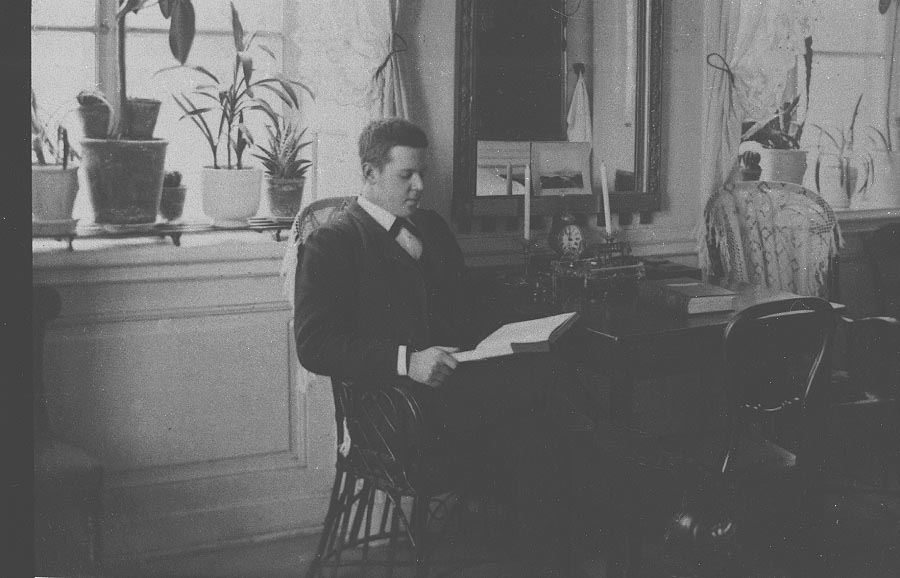
Bjorling at home.
Bjorling’s early years
Johan Alfred Bjorling came from an old, intellectual –- but not rich –- Stockholm family. His father died in 1871, a week after Bjorling was born, and he was raised by his mother. Johan was one of those kids who seemed always to have been miniature versions of their adult selves. At two years old, Bjorling had the same chunky face, outsized head, and blonde brush cut as when he put to sea at twenty-one. Behind the childish proportions, his gaze already looked mature. Bjorling reminded me of the kid brother of one of my emigré European friends back in high school. This eight-year-old seemed decades older than I was. The only hint that he was also a normal kid was the poster of a hockey player in his bedroom, just above the bust of Mozart.
At twenty-one, Bjorling had had only limited experience in the Arctic. Yet his goal was ambitious: to sail up the eastern side of Ellesmere Island, to cross to the unexplored west coast (the size of the island was not yet known), and then to retrace his route back south before the polar winter set in.
The crew
The other members of Bjorling’s expedition were even less experienced than he was. His partner, Evald Kallstenius, was 24 and had never been to the Arctic. Their ship’s captain, a baby-faced Dane named Karl Kann, whom they enlisted in St. John’s, Newfoundland, was Bjorling’s age. Never before had so young a group attempted so much in the Arctic. Those who preceded Bjorling, and those who followed, were all much older. Robert Peary was 35 when he commanded his first expedition; George Nares was 44; Adolphus Greely, 37; Otto Sverdrup, 40. Polar exploration was a game for the middle-aged, yet Bjorling had launched a children’s crusade. What’s more, most of the expeditions of the time were large, well-financed, and well-equipped. But Bjorling set out with a ragtag crew of only four others.
Few have ever heard of Bjorling, though if he had reached western Ellesmere, he would undoubtedly be ranked as one of the great polar explorers. Seven years later, Sverdrup would accomplish Bjorling’s dream of crossing Ellesmere and, with the discovery of Axel Heiberg Island, step into the front ranks of Arctic explorers. While other disastrous expeditions have gone on to receive a twenty-one gun salute in polar literature, Bjorling earned little more than a brief obituary in a Swedish journal.
I’d stumbled upon occasional references to Bjorling in my reading and eventually turned to Swedish sources for more information. I was fascinated not only by his disappearance and obscurity, but also because any twenty-one-year-old’s death by misadventure hits close to home. Rare is the adventurer who has not done stupid things in his youth. My most reckless summer came when I was a year younger than he was. I was knocking about Europe, and in a three-week span, I rappelled off a cliff on a clothesline, free soloed a thirty-meter cliff in France with no experience, and kamikazied down a mountain highway near Gruyère, Switzerland, on a one-speed bike with no brakes. I wasn’t suicidal, just overconfident and giddy with the freedom of my first big trip away from home. Of course, I was also lucky. Bjorling wasn’t.
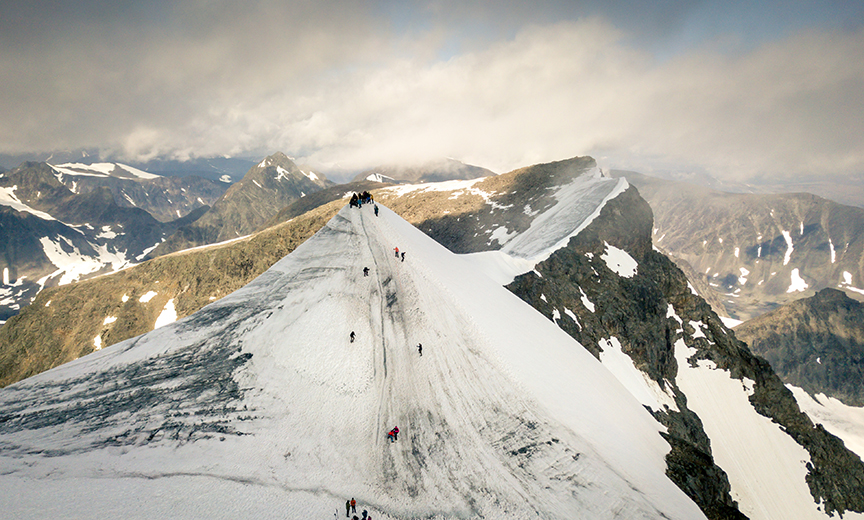
Kebnekaise today. Photo: Shutterstock
Arctic obsession begins
Bjorling’s obsession with the north began in 1889 when, as a seventeen-year-old student from Stockholm, he went to northern Sweden with two schoolmates to make what they believed was the first ascent of Kebnekaise, the highest peak in the country. (Unknown to them, a French climber had topped out six years earlier.) By today’s standards, the 2,123m peak presents no great challenge. Guidebooks describe the route as “safe, toilsome, and rather unexciting,” and the summit register includes seven-year-olds and families of five. But in 1889, the 110km trek in, plus a glacier that has since shrunk back, taxed the young adventurers. An unroped Bjorling even fell into a crevasse but landed on a ledge of ice. Fueled on the twenty-three-hour push by just a little chocolate and coffee -– a shortage of food and sleep would mark all Bjorling’s trips –- they reached the summit.
For his two friends, it was the trip of a lifetime, but for Bjorling, it was just the beginning. He was already, in the words of a companion, “afflicted with the most absolute polar craziness, ‘bitten by a mad Eskimo,’ as they say in Copenhagen.”
Later that year, in search of a mentor, Bjorling approached Sweden’s most famous polar explorer, Baron A. E. Nordenskiold, who was impressed by the intense young botany student. The following summer, Nordenskiold managed to place Bjorling on a landmark four-month expedition to Spitsbergen, a wild Scandinavian island of fiords and ice caps and sawtooth peaks. A zoologist on the expedition was surprised when the teenager showed up at the dock. “In our eyes [he was] little better than a schoolboy,” the zoologist wrote, “a fat and flourishing sixth-former, beaming with well-being, and with round innocent eyes.”
A close call
On a Spitsbergen glacier, Bjorling had a close call even more serious than his fall into the crevasse on Kebnekaise. Ill-equipped as usual, he was the only one of the skiers without climbing skins. Wet snow balled up under his wooden slats, and eventually Bjorling removed the skis and tried to keep up with the others by postholing through the snow. The trek went on longer than anticipated; fog added to the confusion. Eventually, Bjorling could go no further. The team had almost run out of food. In desperation, they left Bjorling in a tent with their remaining supplies and hurried back to the ship.
Before they could return for him, a storm swept over the glacier. When it lifted a day later, Bjorling tried to reach the ship himself, but headed in the wrong direction. The relief party caught up to him by following his tracks. They found him confused, possibly hypothermic. He tried to hide from them behind a rock.
Rather than deter him, Bjorling’s early misadventures seemed to galvanize his will to explore ever deeper into the North. Within a year, he had set his eyes toward the northernmost inhabited corner of the globe, the mythic place the ancients called Thule. Greenland.
First foray
As the nineteenth century was drawing to a close, the pace of Arctic exploration was accelerating, but only a daring few had penetrated the waters of far northwest Greenland. In 1891, Bjorling set out for that terra incognita. His plans were modest –- to explore part of the west coast –- but this was still a place in which explorers could lose themselves forever.
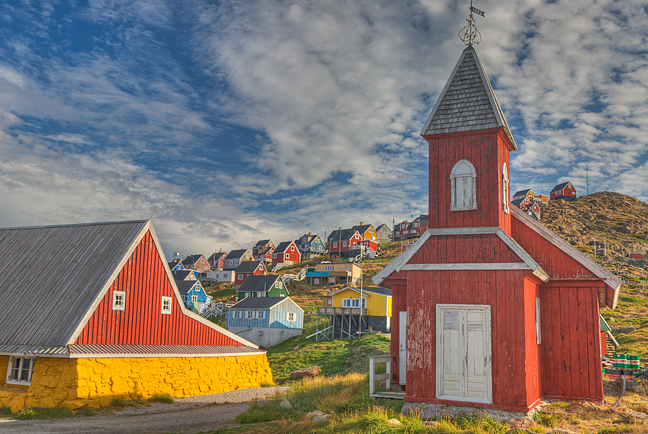
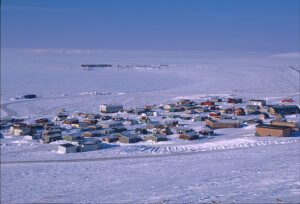
Modern Upernavik. Photo: Jerry Kobalenko
After a Danish trade ship deposited Bjorling at Upernavik, halfway up western Greenland, he and four hired native oarsmen embarked on a furious journey northward. His time was extremely limited, as he had to return to Upernavik in time to catch the ship home. The hyperactive Bjorling pushed the hired crew and himself mercilessly, all the while collecting plants and taking a series of ocean temperatures that provided the first evidence of warm upwellings. Within six days, despite contrary winds and ice, they had maneuvered two hundred and fifty kilometers north. No one ate or slept much; Bjorling took only brief catnaps. His men were so exhausted that they fell asleep while rowing in a snowstorm. The bad weather persisted, but Bjorling, tenaciously botanizing till the end, managed to return to Upernavik in time for his rendezvous with the ship. He had covered an impressive five hundred kilometers in just over two weeks.
In 1892, Bjorling was ready to attempt the expedition that he hoped would make his name: a crossing of Ellesmere Island. One source I’ve read claimed that Bjorling’s real goal was to scoop the North Pole, but that’s unlikely. Bjorling’s long-range ambitions may have involved the Pole –- what young explorer of that era wouldn’t have had lurking designs on the ultimate polar prize? -– but his expeditions show a mature progression toward acquiring ever more experience.
Bjorling’s correspondence reveals how markedly different he was from such well-known young modern romantics as Everett Ruess and Chris McCandless, who also perished in the wilderness. The twenty-year-old Ruess was an artist who disappeared in 1934 near Escalante, Utah –- murdered, some say –- and who has been the subject of numerous articles and short films. McCandless was the twenty-four-year-old who died of starvation in Alaska in 1992 and became the subject of Jon Krakauer’s bestseller, Into the Wild. Both these young men were mystics who rhapsodized about nature as they groped for an artistic voice. Bjorling’s voice was much more business-like. He sounds a lot older.
On this expedition, Bjorling planned to travel to St. John’s, Newfoundland, and buy a ship to enable him to stick to his own timetable. Impressively practical, he raised money from private sponsors and scientific societies. He also sought out a zoologist to complement his botany work. A professor he knew recommended Evald Kallstenius.
Bjorling and Kallstenius left Sweden and made their way to Liverpool, living in fleabag hotels and traveling third class. They crossed the Atlantic on a tramp steamer and arrived in St. John’s on June 1. Both spoke English well, and letters of introduction from the influential Nordenskiold gave the students a certain profile in town, despite their hardscrabble budget. They dined with the governor of Newfoundland and met with the Swedish consul, Robert Prowse, who offered to sell them his boat. When the students purchased a cheaper one, Prowse became their secret enemy. He spread word around town that their little schooner, Ripple, was a floating coffin.
The Arctic summer is brief, and Bjorling and Kallstenius had counted on a quick start. But Prowse’s quiet sabotage made it difficult for them to find a captain and crew. It took until the third week of June for Bjorling to enlist three local knockabouts. Karl Kann, a Dane, was twenty-one but had been at sea for seven years. Herbert McDonald of Prince Edward Island joined as cook, while a “wandering waif” named Gilbert Dunn, originally from England, signed on as crew.
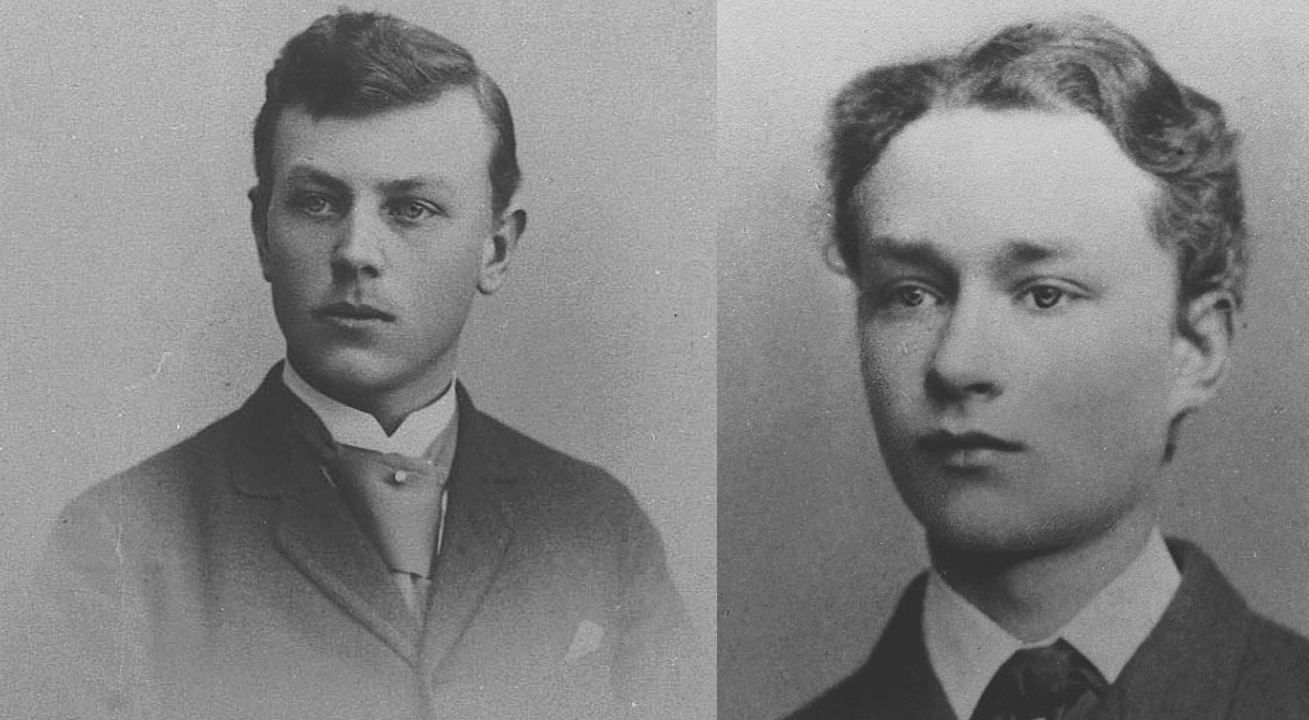
Evald Kallstenius, left, and Karl Kann. No photos exist of the other two members of the expedition.
Lost time in St. John’s
Bjorling’s three weeks in St. John’s are well-documented, thanks to a series of newspaper articles by a local fixture named Reverend Dr. Moses Harvey, who befriended the young adventurers. “Bjorling,” he gushed, “was a young Norse giant, 6 feet 2 or 3 inches in height, with a broad chest, muscular arms, and fine carriage. I have seldom seen a handsomer face –- fair complexion, finely sculptured mouth and nose and large blue eyes. People here used to stop in the streets and look after him in admiration.” According to Harvey, the frailer Kallstenius “almost worshipped Bjorling,” despite being three years older.
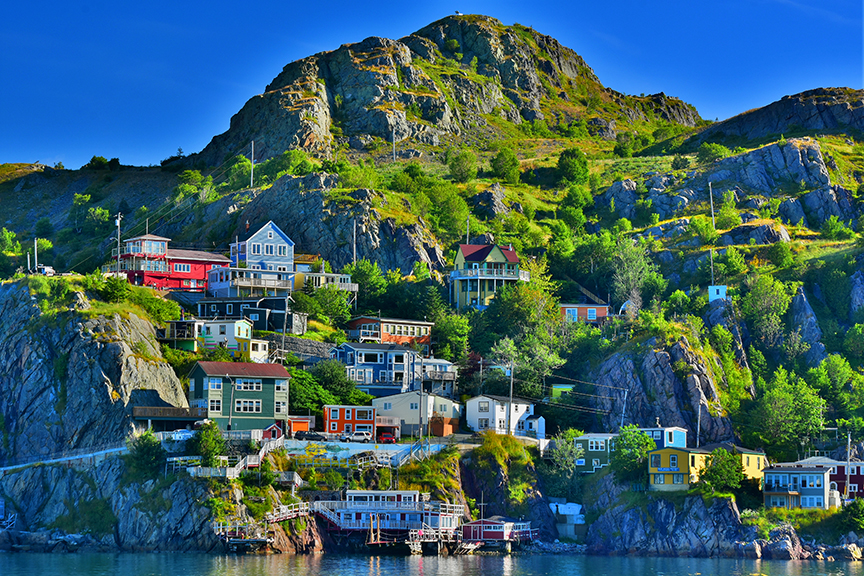
St John’s, Newfoundland — greener than Greenland but with the same rugged coastline and colorful houses. Photo: Shutterstock
Bjorling used the delay in St. John’s to make a series of inland treks for plant specimens, all of which would be destroyed in the great fire of St. John’s later that year. They also gathered provisions and made the social rounds. Bjorling and Kallstenius finally put to sea on June 22, dismissing with brave smiles the concerns of the small group of St. John’s well-wishers who had come to see them off. Wrote the effusive Reverend Harvey, “As he stood on the deck that day, with his beautiful face lighted up with smiles and radiant with hope, [Bjorling waved] his cap in farewell as the vessel glided from the wharf. I had but a faint hope that I should ever see them again.”
From here, the story of the expedition relies mostly on letters home and sketchy notes left in rock cairns. Although Bjorling’s minimalist style leaves many questions unanswered, we can reconstruct the main events of the 1892 expedition. Herbert McDonald, the cook, was drunk when he came aboard and apparently went insane after a week at sea. Although he partly recovered later, he seems to have remained dead weight, because Kallstenius writes how they all did their own cooking on a small camp stove.
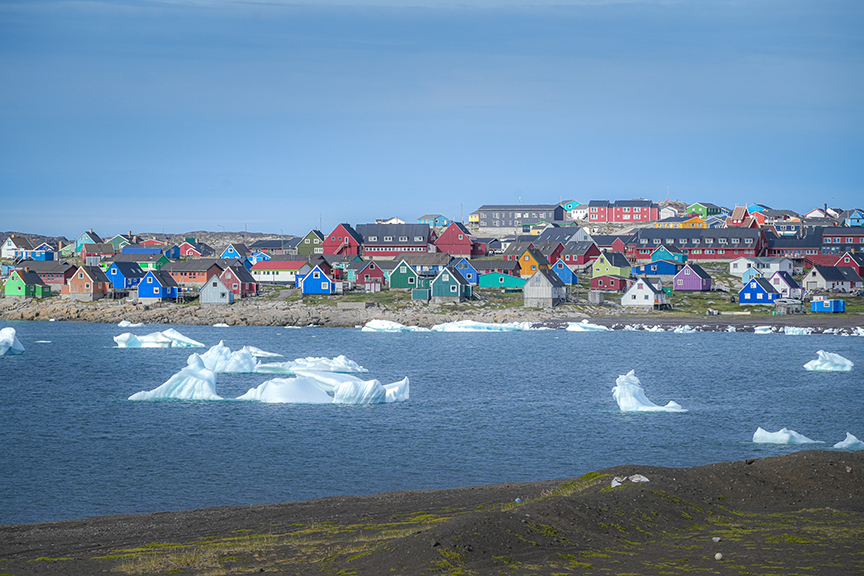
Qeqertarsuaq, formerly Godhavn, where Bjorling and his crew provisioned. Photo: Shutterstock
Behind schedule
For three weeks, the Ripple groped northward in a fog without seeing land. Fighting ice and gales, it took them nearly five weeks to reach Godhavn (now Qeqertarsuaq), then the largest town in Greenland. It was already late July, and they were still in central Greenland, drastically behind schedule. The Arctic summer was now almost over. August has good ice conditions for sailing, but winter can set in any time after mid-month.
Bjorling and Kallstenius spent five days in Godhavn provisioning themselves for a possible overwintering. They didn’t have enough money to buy everything they needed, so they planned on supplementing their stores from the food cache that George Nares had left on the Carey Islands in 1875. Thanks to the Arctic deep freeze, most of the food would still be edible.
Despite the floating-coffin rumors spread by the Swedish consul in St. John’s, the little Ripple proved perfectly seaworthy. The Ripple even crossed treacherous Melville Bay –- an ice-choked gauntlet that had sunk many a stout whaling ship –- in one day. Nevertheless, Greenland is the largest island in the world, and they didn’t reach the easternmost Carey Island, site of the Nares depot, until August 16.
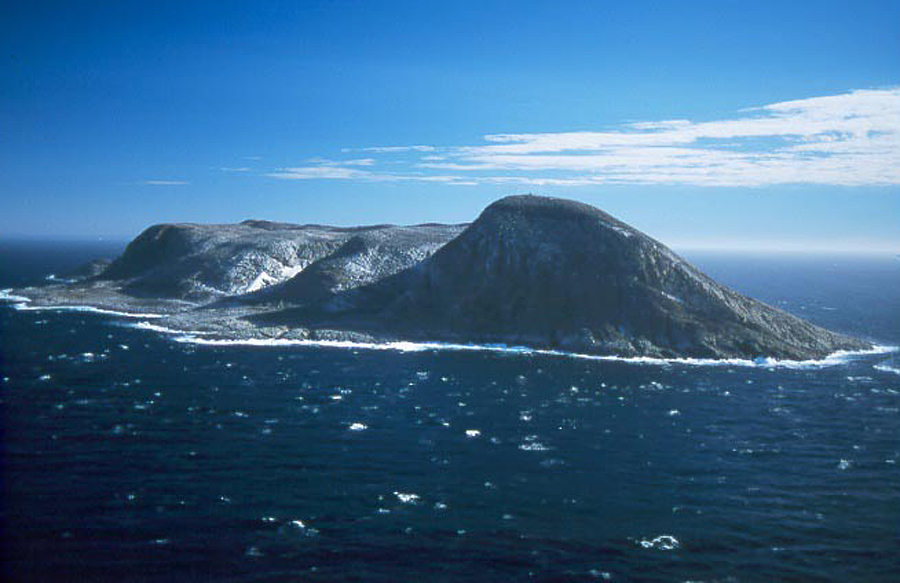
Bjorling Island. Photo: Jerry Kobalenko
The ‘Ripple’ founders
Bjorling had originally hoped to begin his Ellesmere crossing two months earlier, but either he did not realize how late in the season it was or the idea of failure was alien to him. He still hoped to follow a condensed version of his plan, and he was no doubt pushing himself and his crew with the same relentless energy he had successfully used on his rowing marathon the previous year. He’d been in tough spots before, and his determination had carried him through.
Probably working day and night, he and the others used their rowboat to shuttle Nares’s 3,600 rations onto the Ripple. They had just shifted the Ripple to the south end of the island when a storm came up. Maybe they were exhausted and were sleeping on shore. Maybe there was nothing they could have done. But during the night, waves drove the Ripple onto the shallows, wrecking it.
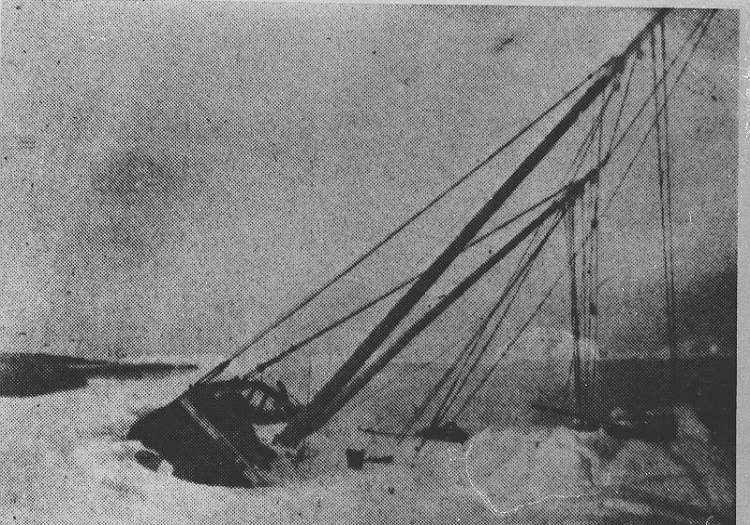
One year later, a Scottish whaler found the ‘Ripple,’ wrecked but still afloat.
Visiting Bjorling Island
The helicopter’s blades thumped loudly as the aircraft slowed, flared, and landed on the rocky hide of Bjorling Island. It was 7 pm on a lovely, bright but windy August evening. Dazzling white icebergs drifted south with the Greenland current, like an armada of tall ships. The sun blazed out of a cloudless sky as it angled northwest. It would not set for another month, but just circle the horizon endlessly, dipping a little lower at midnight, rising a little higher at noon. Crashing surf ringed the entire island like a reef. There were no harbors and many cliffs, but sailors would have been able to beach a rowboat on one of several rocky aprons. The pilot set the helicopter down on the west side, next to the only freshwater pond on the island.
Glaucous gulls cawed over our heads, constantly fine-tuning their wing angles to hold place in the roaring wind. The meadow around the pond, an ideal campsite, yielded little but the remains of a silk tent probably left by geologists who came here thirty years ago.
I was using a topo map plus a reference sketch drawn by a Swedish zoologist who had visited the island two years after Bjorling. But the island was much bigger and more rugged than the poorly detailed charts suggested. Ravines and small cliffs made progress more a sporting challenge than a hike. The terrain seemed to be mocking my desire to sniff out any traces of Bjorling.
After a fruitless search of the area, we piled back into the helicopter and did a slow, low tour of the island. I panned for artifacts while trying to make sense of the increasingly frustrating sketch. Finally, we spotted a scattering of wood and put down. It was not all old, but some ancient timbers, bully beef cans, and a wooden barrel top suggested that this was the spot on the east side where Nares had left his cache.
The Ripple had foundered on the south side of the island, and the crew had camped nearby in what Bjorling called a “cut.” Sure enough, flying south, a series of finger gullies replaced the cliffs and aprons of the east side. The rocky fingers reached a long way into the shallow sea. It would have been easy for a storm-tossed ship to sink on these petrified reefs.
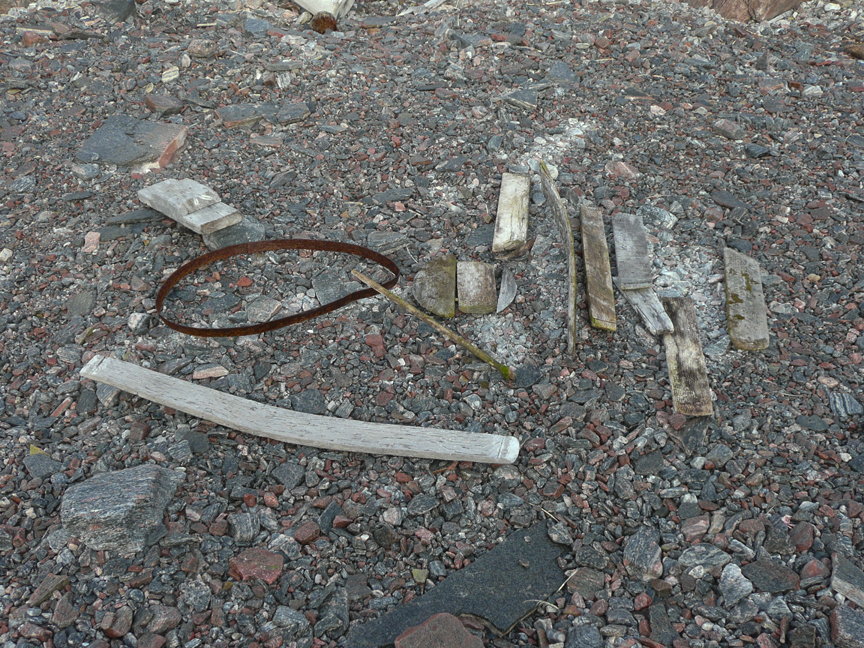
An old, broken-down barrel that Bjorling took from the cache of a British explorer who’d visited the island 17 years earlier. Photo: Jerry Kobalenko
Signs of Bjorling
One of the gullies looked full of junk. The big Bell 212 banked and jockeyed in the wind like the gulls, as it settled down nearby. Unlike the compromised Nares site, which had left me wondering whether that truly was his depot, this gully was undoubtedly where Bjorling and his four companions had huddled after the sinking of the Ripple. Hand-blown bottles, hemp ropes, broken crockery, and the remains of a linen shirt with pearly buttons lay amid the lichen-coated rocks. Two of Bjorling’s botanical specimen bottles were intact. Even after the loss of his ship, Bjorling had carefully preserved the tools of his trade, by which he expected to make his reputation.
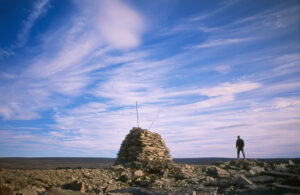
As hoped, I found the cairn in which Bjorling had left his four curt notes –- written in English –- still standing at the highest point of the island, 150 meters above the sea. The cairn has changed little since George Nares built it for his own notes back in 1875. The original canister for messages has disappeared, but Nares’s broken flagpole still protrudes from the top.
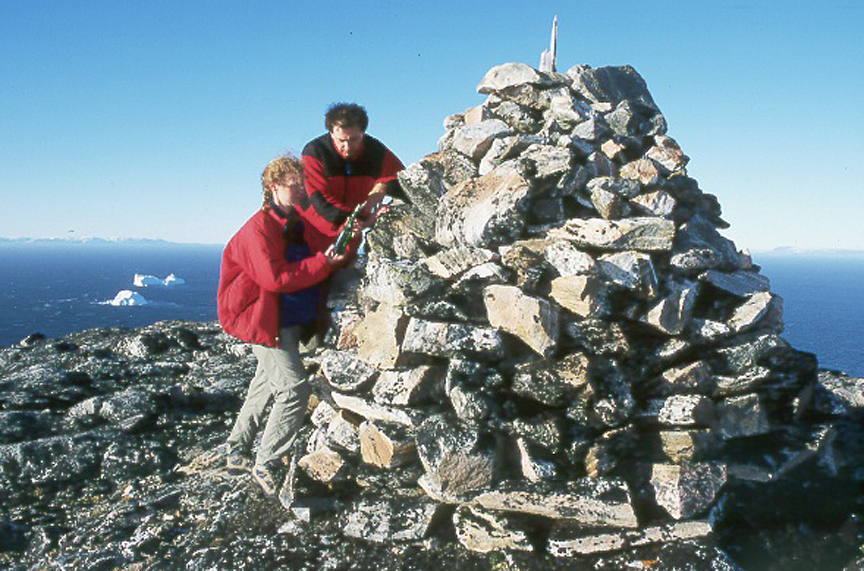
The 1875 Nares cairn atop Bjorling Island, where the young Swede left his notes. Photo: Jerry Kobalenko
In dire straits
By the time Bjorling left his last note on October 12, 1892, the expedition had collapsed. Their ship was a wreck. They had lost half their supplies on the unnecessary journey to Northumberland Island. They had been storm-bound on the island for some time, and by now, the snow lay knee-deep. In another week, the sun would disappear for the winter. And one of them was dying.
Bjorling does not mention who this was or why he was dying, but two years later, in 1894, searchers found a skeleton, “mistreated by gulls,” somewhere on the island. From stains on the teeth, they concluded that the victim had been a pipe-smoker who held his pipe in the left side of his mouth. Kallstenius did not smoke; it is unlikely that Kann, their fresh-faced captain, had been smoking long enough to discolor his teeth. It had to have been either the wandering waif or the crazy cook.
According to his last message, Bjorling decided to head to Ellesmere Island. “I now set out to the Eskimos at Clarence Head or Cape Faraday,” he wrote, addressing some whaler who might find the message the following summer. “I would be most obliged to you if you would go to Clarence Head (75 kilometers from here), where I will leave a message in a cairn on the easternmost cape concerning our life during the winter.”
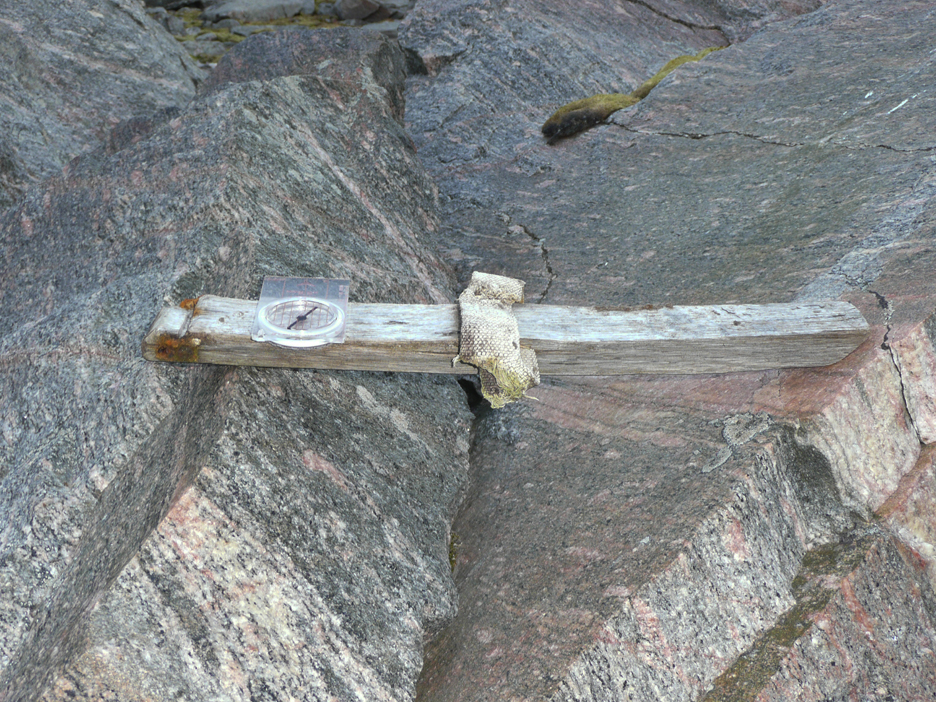
A homemade ski from the Bjorling expedition — just a short piece of wood with a canvas strap for the instep. By mid-October, when they left to row to Ellesmere, deep snow covered Bjorling Island. Photo: Jerry Kobalenko
Clarence Head
Bjorling wouldn’t have known it, but Clarence Head is the most austere part of Ellesmere; in most spots here, the ice cap meets the sea. Though the history of the Inuit in the High Arctic dates back over 4,000 years, no one has ever lived at Clarence Head. It would be like living on the Antarctic plateau. Except for an occasional passing polar bear, the region is wholly barren.
Cape Faraday has good whale, seal, and bear hunting, but these are difficult prey for inexperienced explorers. While the Inuit have migrated through the area on occasion, no one usually lived on Ellesmere’s southeast coast. Bjorling and his reduced party might have survived at Cape Faraday despite the loss of most of their rations, but it would have been hard.
Nonetheless, the lack of bodies and boat on Bjorling Island suggests that Bjorling did set out for the distant shore. But no further trace was ever found of the young explorer or his party.
Wreck discovered
Since Bjorling went north prepared to overwinter, his disappearance did not raise immediate concern. But the following summer, in 1893, a Scottish whaler found his cairn notes and the wreck of the Ripple. It was clear that the young Swede’s expedition had come to grief.
The public obsession with the disappearance of Sir John Franklin thirty-five years earlier had financed many search expeditions, but Bjorling’s fate did not get the same response. Only two search parties made brief stops at the Carey Islands in 1894, on their way to fry bigger fish. One of the expeditions also quickly checked Clarence Head on Ellesmere Island for signs of Bjorling, but found none. Subsequent visitors to Clarence Head and Cape Faraday have never reported any signs of white explorers. A friend and I skied past Clarence Head one spring, when the sea was frozen, and it was really just a big ice wall.
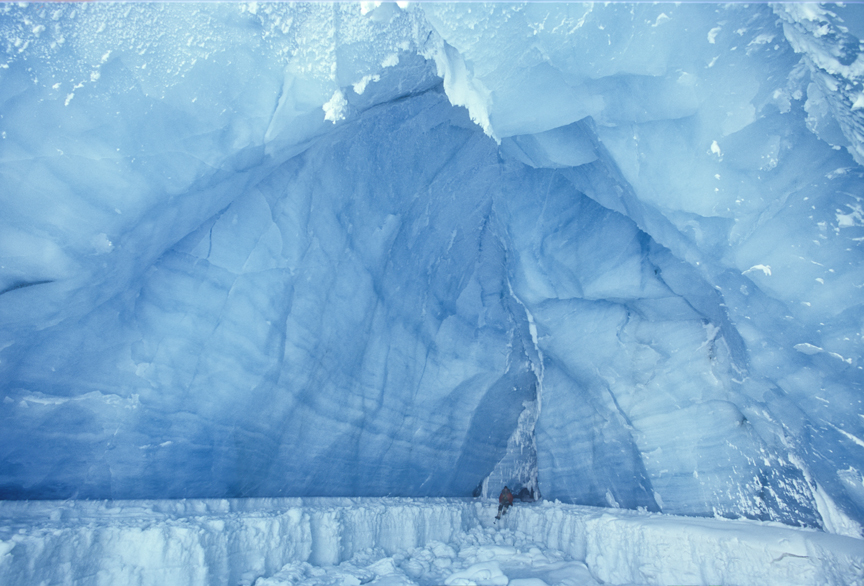
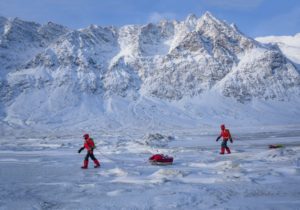
No people here: A huge tidewater glacier dominates Clarence Head. Photo: Jerry Kobalenko
In 1916, Peter Freuchen, a writer who began his career managing a trading post at Thule, made a thorough inventory of the expedition’s artifacts on Bjorling Island, removing a few for museums. After that, the world forgot about Johan Alfred Bjorling.
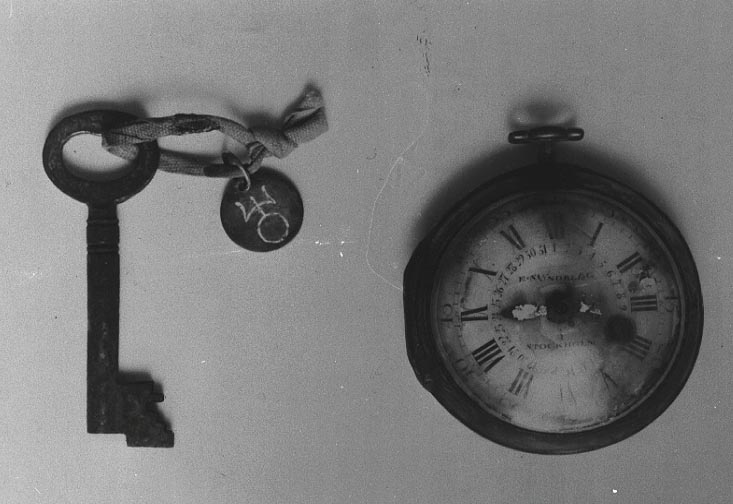
A key and pocket watch found on Bjorling Island by later searchers.
Their likely fate
On her deathbed, Bjorling’s mother claimed she could feel that her son was still alive. But while the absence of bodies always leaves open far-fetched possibilities, there is only one conclusion: Somewhere between the Carey Islands and Clarence Head, their boat swamped, and they died in the icy waters of Baffin Bay. Seventy-five kilometers to Clarence Head, Bjorling had said in his last note. At the pace he had managed the year before, that was a day and a half. A quick run in good weather. But in fact, it’s almost one hundred and fifty kilometers from Bjorling Island to Clarence Head, and over a hundred and sixty kilometers to Cape Faraday. A hundred and sixty kilometers over one of the stormiest seas on earth. Ernest Shackleton overcame worse in the Antarctic, but he was an experienced sailor with a veteran crew. Bjorling still made a practice of surviving everything by the skin of his teeth. Despite his European old-soul maturity, he was still twenty-one.
As I stood on the island, looking across the water at the brown cliffs of Greenland fifty kilometers away, I found it hard to understand why Bjorling had so persistently ignored that nearby haven. The Thule/Uumanaaq area would have been occupied. So would one of several small communities north of it. At Northumberland Island, during their September push, they were a mere fifty kilometers from Peary’s Greenland base, where supplies and local people might still be gathered. Even if they hadn’t known about these settlements, a beeline to Greenland was the obvious choice. It looked so close, while even from our helicopter, the high ice caps of Ellesmere were too far away to see.
Still, they’d had luck on their side and dodged the final bullet several times. Salvation may have been close, but Bjorling knew only one direction: forward. The loss of his ship, the death of a man, and the disappearance of the summer could not suppress his optimism.
As it turned out, one of his companions on his earlier trip to Spitsbergen had him dead to rights: “When it came to his all-absorbing interest, [Bjorling] proved able to manifest an utterly unbelievable will-power, an iron energy capable of overcoming any obstacle. Except death.”
This excerpt from The Horizontal Everest is partly a teaser for the book but mainly it’s an opportunity to include relevant photos with the narrative for the first time.
(c) 2010 The Horizontal Everest/Jerry Kobalenko