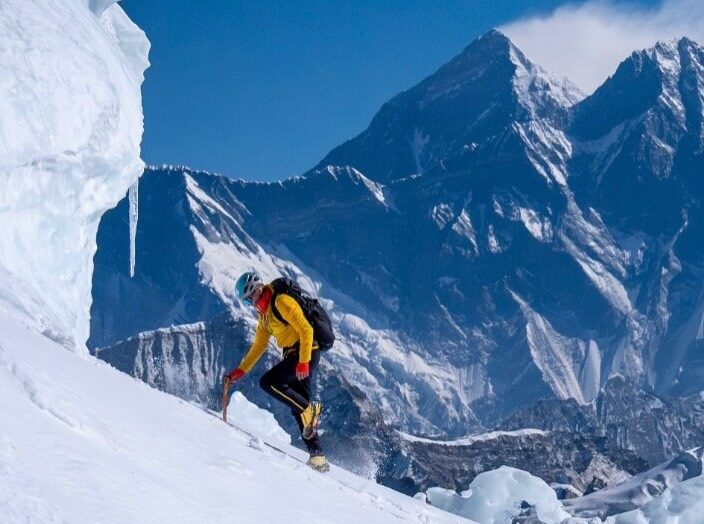
Karl Egloff of Ecuador will return to Everest this coming spring to again attempt the Fastest Known Time (FKT) for an unsupported return trip.
Egloff, who now lives in Switzerland, set speed records on Denali, Elbrus, Kilimanjaro, and Aconcagua. He wants to do the same with the remaining three Seven Summits, most of all Everest.
In 2026, besides Everest, he will also speed up Carstensz Pyramid (Punkak Jaya) in New Guinea. He will then target Antarctica’s Vinson in January 2027.
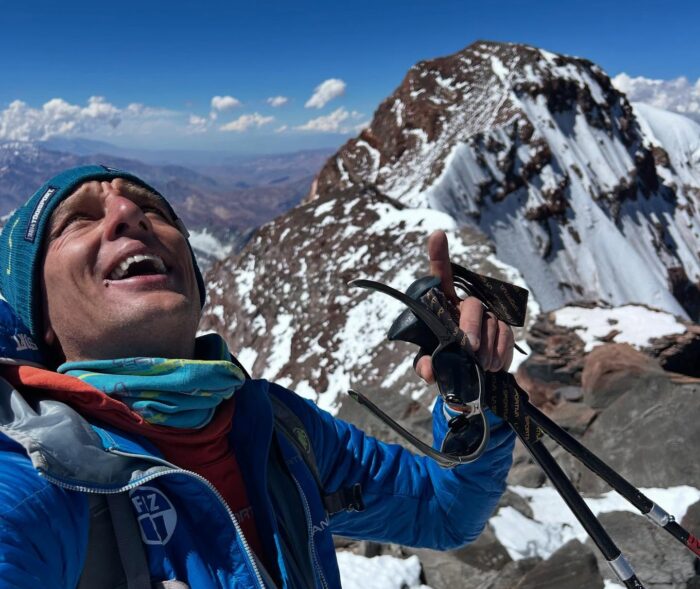
Egloff on the south summit of Aconcagua, with the main summit behind him. Photo: Karl Egloff
Return trip vs uphill only
For Everest, the most remarkable detail is Egloff’s determination to go without oxygen on a full return trip, running from Base Camp to the summit and back down to Base Camp.
“That’s how I understand a mountaineering FKT must be, no matter what the peak,” he told ExplorersWeb.
He achieved the speed record on Makalu in 2022 with fellow Ecuadorian Nico Miranda in the same round-trip, unsupported style. They went up and down Makalu in 25 hours and 48 minutes. He intends to complete his entire Seven Summits that way.
On Everest earlier this year, Egloff used the fixed ropes but not bottled oxygen. Nor did he ever stop his chronometer for rest breaks or to spend a few relaxed minutes on the summit.
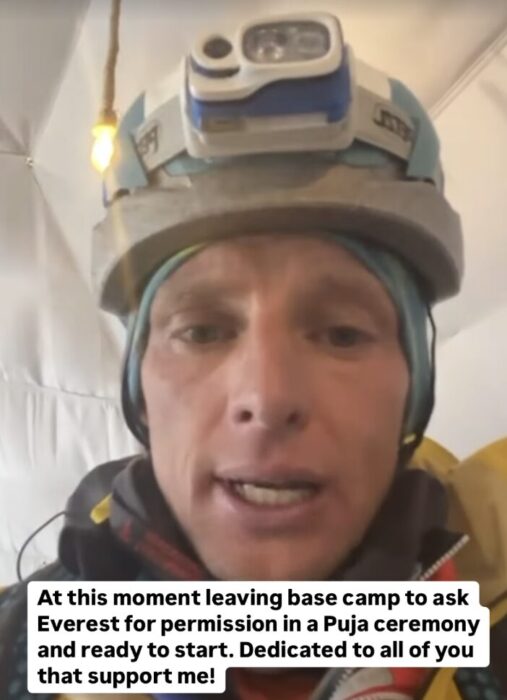
Egloff’s farewell before his attempt earlier this year. Photo: Instagram
In that sense, Egloff differs from American Tyler Andrews, who is also aiming for an Everest FKT, but just one way.
“I focus more on the uphill because that is historically what the records have been on 8,000’ers,” Andrews explained.
However, the American also mentioned that he will descend without supplementary oxygen except for health or safety reasons.
Previous attempts
Even though their approaches are different, the two runners enacted a kind of sporting duel last spring. Who would set the FKT? You could argue about round-trip versus one-way later.
Andrews had already made a previous FKT attempt on Everest in 2024, then launched three attempts last spring, one of them with supplementary oxygen and the other two without. Andrews even returned to Everest in the fall, taking advantage of the presence of skier Andrzej Bargiel’s large team, which fixed ropes and broke trail.
Andrews was trying to beat the previous uphill mark of 20 hours and 24 minutes from Base Camp to summit, set in 1998 by Kazi Sherpa. However, Andrews again had to abort his fall ascent at 8,000m, shortly after Camp 4.
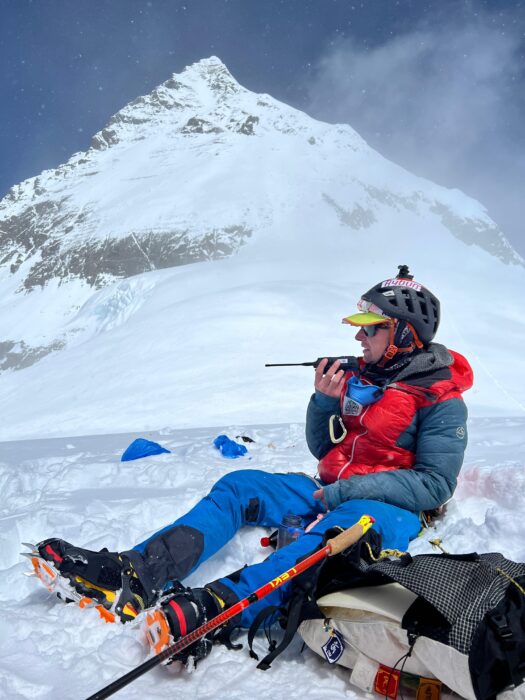
Tyler Andrews at the south Col of Everest, with the summit behind him. Photo: Asian Trekking Sherpa team
Andrews has not yet confirmed if he will return to Everest again in the spring. But as he says, the best way to achieve a goal is to keep plugging away at it as many times as needed.
“In marathon running, we say, ‘Keep showing up,’ meaning that if you just get fit and you get to the start line of every race, eventually you’re going to have a really good day, and your competitors are not going to have their best day, and you’re going to win,” he told ExplorersWeb at the time.
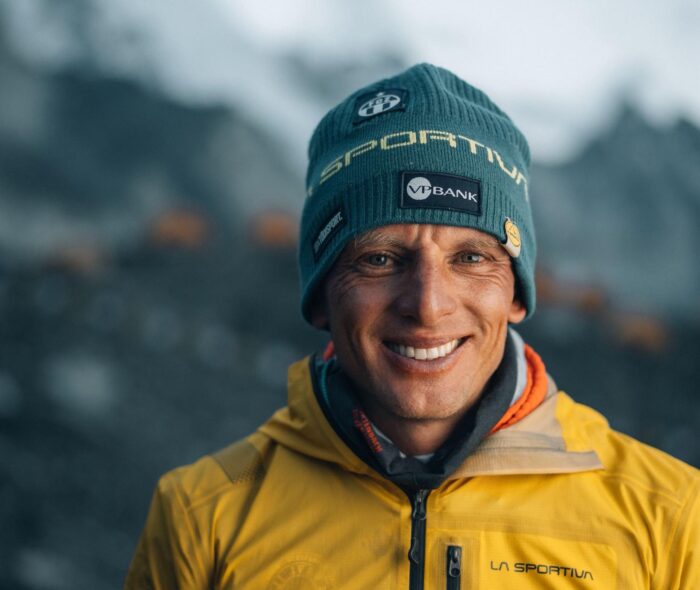
Karl Egloff during his previous attempt to break the Everest speed record. Photo: Karl Egloff’s social media
‘Here we go again’
Retreating from Everest in 2025 was tough on Egloff. He never considered a second attempt later in the season. After the huge effort, Egloff returned to face “a strange silence, emptiness, and many questions.” Egloff described his state as what some call athlete’s burnout.
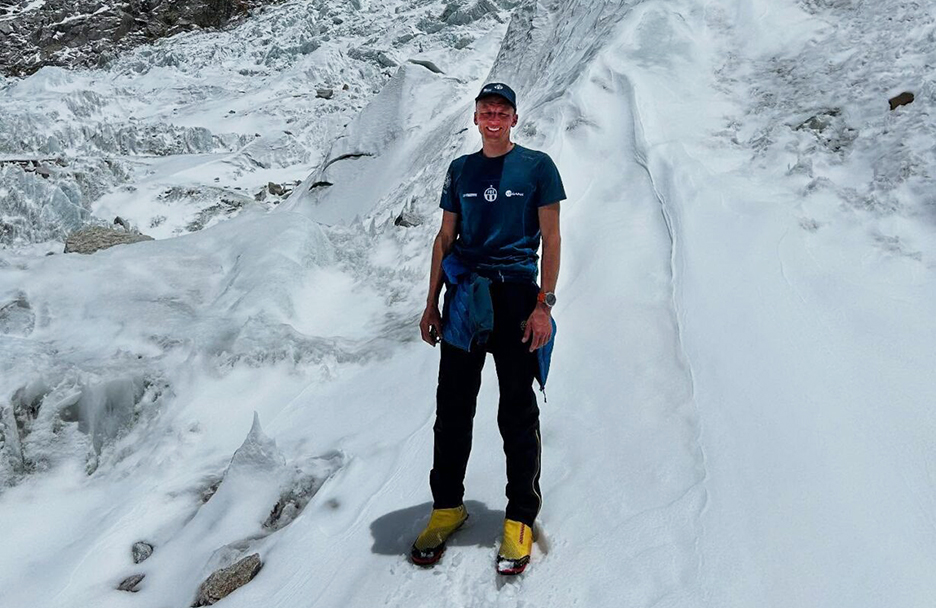
Karl Egloff on Everest. Photo: Karl Egloff/Facebook
“What’s next? Was it worth it? What did I learn? How can I improve? What circumstances were out of my hands? Shall I do it again?” he wondered, while dealing with a lack of motivation and even depression. But after three months of rest, all the positive feelings returned.
“Reaching this point has taken me more than 10 to 15 years of hard training, countless hours in the mountains, failures, lessons, and small steps forward…Now, here we go again.”
Training plan

Karl Egloff, left, and Nico Miranda on the summit of Makalu. Photo: Karl Egloff
Egloff has been training for months now. The first hurdle is that, since he moved to Switzerland, he lives at 400m above sea level, compared to the 2,500m he lived at in Ecuador.
For that reason, he will move his training abroad in January, although he has not said exactly where.
“I will also do two months of hypoxic training before moving to Nepal with Nico Miranda,” he said.
The plan is to acclimatize somewhere in the Khumbu and only move to Everest Base Camp when he is ready for the FKT. As in 2025, Egloff will be outfitted by Furtenbach Adventures.