Manaslu is facing a difficult start to the season after an avalanche buried the ropes hours before the rope-fixing team planned to use them to reach the summit. Concerns are growing over severe crowding as hundreds of climbers acclimatize at the same time. A second climber has died of altitude sickness on the mountain.
The first summits on Manaslu, the most popular peak in Nepal’s fall season, were expected today, but an avalanche buried part of the route yesterday, just hours before the rope fixers traversed that area. Conditions on the mountain remain unstable after over a week of precipitation.
Avalanche
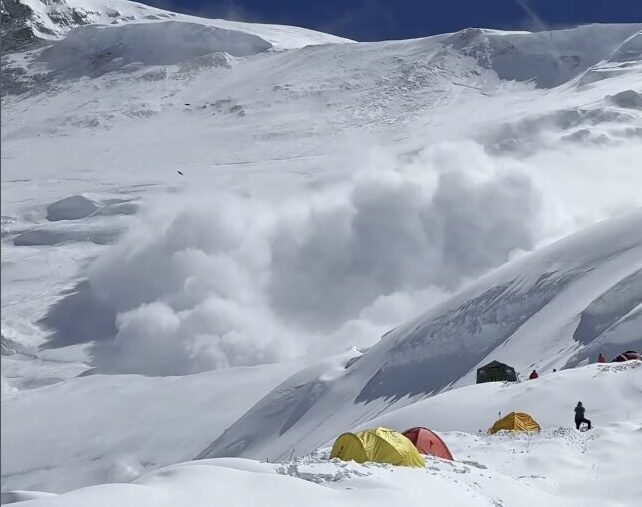
Dandu Sherpa was filming at Camp 4 yesterday at around 1:30 pm local time when an avalanche fell down a snow slope right below the camp, which is located in a safe place on the shoulder of the summit ridge. No one was injured, but the slide buried a section of recently fixed ropes right below Camp 4.
The rope-fixing team assigned by the Expedition Operators’ Association of Nepal, and possibly some other climbers behind them, had to postpone their plans and instead ask for assistance. Another team of Sherpas moved up to Camp 3 today, carrying 1,300m of rope to replace the buried ones. They are about to leave for the summit, hoping to top out tomorrow, as we post this story.
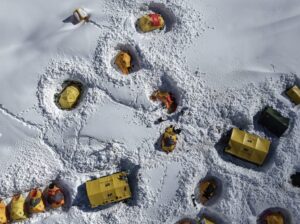
Once they succeed, it will trigger a massive wave of summits and growing concerns among the expedition leaders. With a record 480 foreign climbers listed so far and over 500 local guides and supporters on the mountain, crowding is guaranteed.
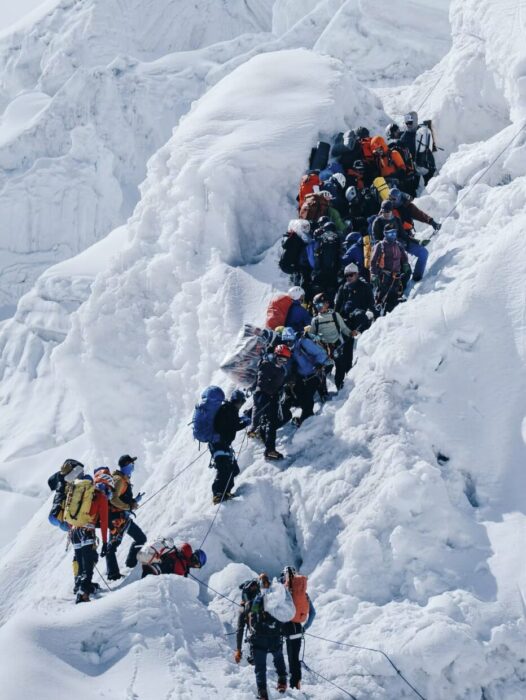
Traffic jam on Manaslu earlier this week. Photo: Halung Dorchi Sherpa
Crowding
In fact, the first traffic jams of the season occurred in the last few days, as all the expeditions had their clients rotating to Camp 3 in preparation for their summit pushes. Long lines on the ropes were especially noticeable at the serac area between Camp 1 and Camp 2, as shown in a video shot on Wednesday by Miles Sherpa.
Halung Dorchi Sherpa of Summit Force also shared images of crowded ropes and expressed concerns about the danger of crowding once the route to the summit is ready.
“Every year, the mountain has its own characteristics, and according to our information, the number of Manaslu permits issued this year may already exceed 500,” he said. “For the narrow true summit of Manaslu, this is undoubtedly enormous pressure.”
Lines to the true top?
Halung Dorchi wonders whether authorities should require climbers to stop at the false summit, which is not as narrow or as steep. “A more realistic short-term measure may still be to continue coordinating summit-attempt dates among teams to disperse the flow of people, although this has a limited effect when the weather window is narrow,” Dorchi wrote.
Seven Summit Treks and 14 Peaks Expeditions, the sister companies comprising the largest groups on the mountain, expect to have everyone heading for the top during a weather window expected on September 21-23. That means that the lines of climbers will start moving from Base Camp between today and tomorrow. Surely, many others will have the same idea.
In recent years, the outfitters have optimized costs by shortening the expeditions as much as possible, and conditions seem ideal at the beginning of next week — as long as their clients don’t mind queuing on the vertiginous final passage to the true summit.
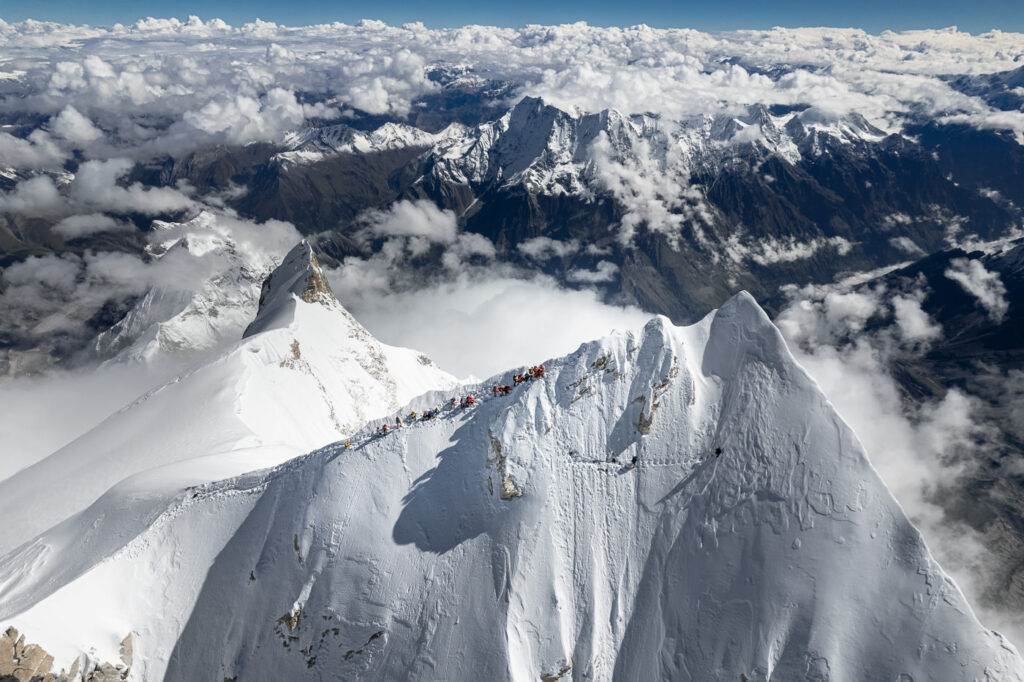
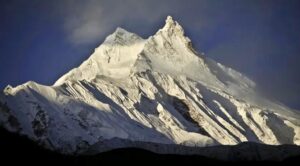
Not suitable for crowds: Manaslu’s sharp summit ridge in a previous year. Photo: Jackson Groves
Climber dead
A 50-year-old Singaporean climber, Lau Wee Seng, died near 6,000m on Manaslu yesterday, while he was acclimatizing. “He felt uncomfortable while descending from Camp 2 and breathed his last while resting,” outfitter 8K Expeditions told The Tourism Times. This is the second reported death on the mountain this autumn, after Tashi Sherpa, a 20-year-old porter, was found dead in a tent in Base Camp last week.