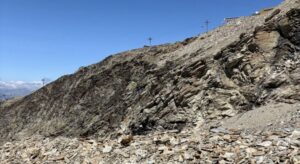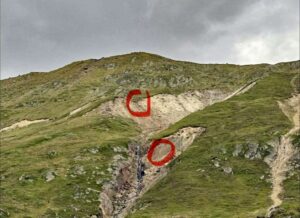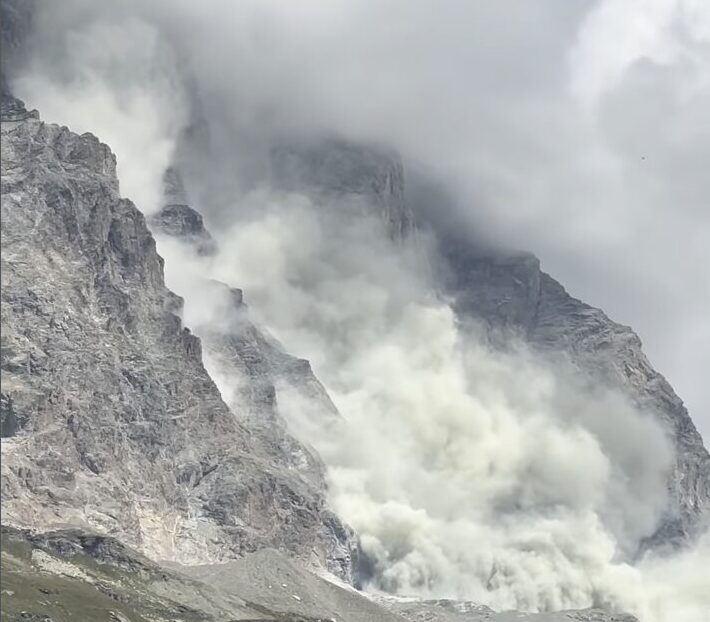
After a rockfall two weeks ago near the normal route on the Swiss side of the Matterhorn, a new video shows an even more massive slide on its Italian side.
Yesterday, the weather service in the Aosta Valley shared a video of the Matterhorn (called Cervino in Italy) wrapped in dust as tons of rocks slid down toward the ski resort of Cervinia.
Luckily, no one was harmed, and the Lion’s Ridge — the normal climbing route on that side of the mountain — was unaffected. However, to be safe, local guides have canceled all guided ascents of the Matterhorn. Private climbs are discouraged but not outlawed.
“Due to the current weather and terrain conditions, extreme caution is advised,” the Cervino Guides’ Society noted in a press release. “Ascents are therefore strongly discouraged for the entire mountaineering community until the situation stabilizes and safety conditions improve.”
The Carrel Hut, often used for climbs on the south side of the Matterhorn, remains accessible as a bivouac, but it is currently unstaffed, according to the guides.
Here’s another perspective on the crumbling mass of rock:
Permafrost thawing
“The slide is a consequence of the current heat, which melts the permafrost,” explained meteorologists in the Aosta Valley. They note that permafrost has been the natural glue that keeps the rocks stable. In the high mountains of the Alps, water and snow naturally permeate the rock through tiny fractures. They freeze and stay solid, thus keeping the fragmented rock together. However, rising summer temperatures have melted the permafrost, triggering unprecedented rockfalls.
Despite the conditions, the Matterhorn witnessed a new FKT (Fastest Known Time) last week. Jenni Jalonen of Sweden completed a solo ascent from Cervinia in a day.
“Cervinia at 8:30 am, summited 4h 19 min later, and eventually got back to the same spot, clocking 7h 29 min on my watch,” she reported.
Swiss side open
Currently, the Swiss side of the mountain remains open to climbers, and the Hörnlihütte is working at full capacity. However, previous rockslides and accidents that occurred during the second half of July discouraged some local guides from leading clients on the mountain. Those planning a Matterhorn climb are advised to get the latest information before heading to Switzerland.
The Zermatt Ski area on the Matterhorn Glacier is closed for the second consecutive year due to extreme heat. Climbers in the area warn that conditions may be tricky on the Breithorn and Castor-Polux ascents (very popular peaks on the other side of the glacier).
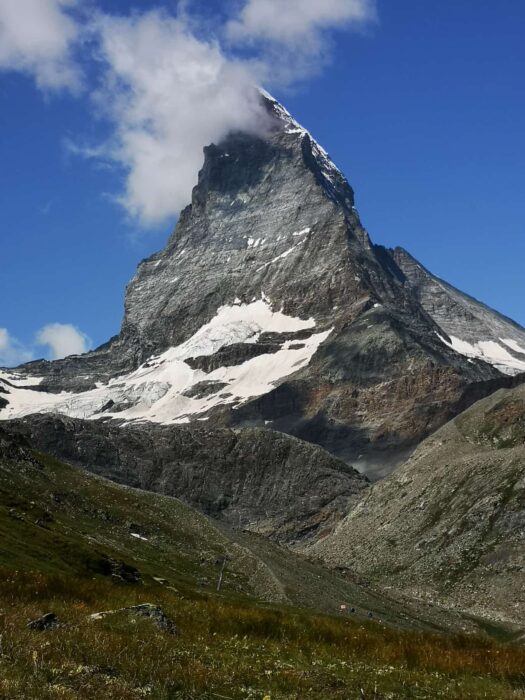
The Matterhorn on a sunny day, the Hornli Hut barely visible at the base of the northeast ridge on the right. Photo: Antonio Fernandez
Mont Blanc massif
Rockfall has affected all high Alpine peaks that are not covered by the shrinking glaciers or a permanent layer of ice and snow.
The risky Couloir de Gouter, on the normal route to Mont Blanc, is completely dry, and climbers are advised to cross cautiously. Two people died recently when hit by falling rocks, although they chose the coldest, safest time of day (2 am) to make their crossing.
At the same time, conditions change from day to day. During a chat last week, Chamonix guide Lucien Bocansaud told ExplorersWeb that he had been there a week ago and the couloir was in good condition, with no rockfall during the night.
Two weeks ago, climbers filmed a large rockslide down the gullies of the Tour Ronde, a popular peak in the Chamonix area, which is often used to acclimatize before attempting Mont Blanc:
The Chamonix-based Society of Safety and Prevention in the Mountains has reinforced the watch on conditions in the Mont Blanc and the surrounding areas of the Alps. All the reports and news are updated on their website, La Chamoniarde.