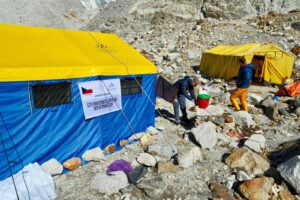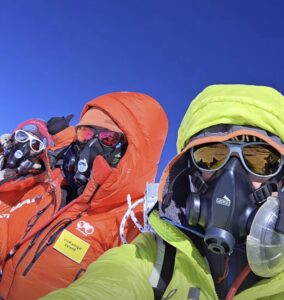
On 8,000m peaks, most climbers put their lives in the hands of local guides. Most of these excel in their performance, but Konstantin Smirnov of Russia has a different story to tell, after barely surviving on Makalu.
About 8 clients and 11 guides reached the summit of Makalu at around 11 am on May 9, 2026. Smirnov and his guide, Bhajuram Gurung, were part of the last group to top out. They were outfitted by Makalu Adventure, who had assigned Gurung as Smirnov’s summit guide.
Left behind
“On the way down, between 6:30 pm and 7 pm, my guide Bhajuram Gurung abandoned me at an altitude of approximately 7,900m and proceeded down alone to summit camp (Camp 3 at 7,500m),” Smirnov told ExplorersWeb.
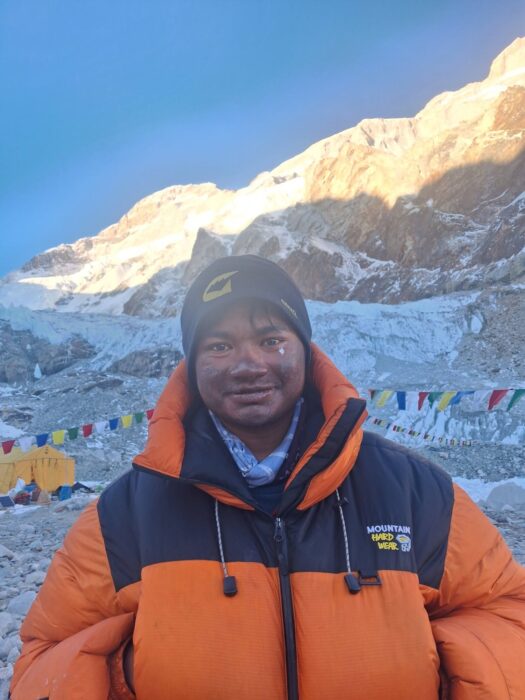
Bhajuram Gurunng on Makalu. Photo posted on May 12 on Gurung’s Facebook
That fact alone might not be the best possible behavior from a guide, but it might have been understandable if the guide had explained to his client that he had to go ahead for some reason (health problems, malfunctioning oxygen, or another emergency) and made sure his client was looked after. This was not the case.
According to Sonam Sherpa, a guide with an American team, Bhajuram Gurung arrived at the summit camp at 9 pm that day. He did not inform Base Camp or any other climbers at the summit camp that his client was higher on the mountain. On a side note, the Americans’ descent soon became tragic as well: Client Shelley Johanssen perished in an accident below Camp 3.
Meanwhile, on the upper slopes of Makalu, Smirnov walked down alone. “Snow was falling in the evening, so my progress was slow. At 9:30 pm at 7,720m, I stopped to rest and apparently fell into a high-altitude coma/sleep,” he explained.
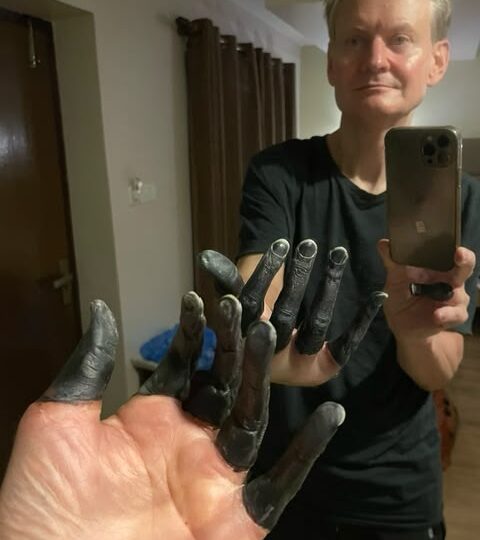
Smirnov had removed a mitten to do something and lost consciousness with the mitten off. As a result, he got fourth-degree frostbite, the most severe kind. At the time of posting this story, he was about to have all the fingers on his left hand completely amputated.
The Russian climber has an accurate account of his progress, thanks to the track registered for 33 nonstop hours on his Coros watch, including altitude, GPS, and heart rate data.
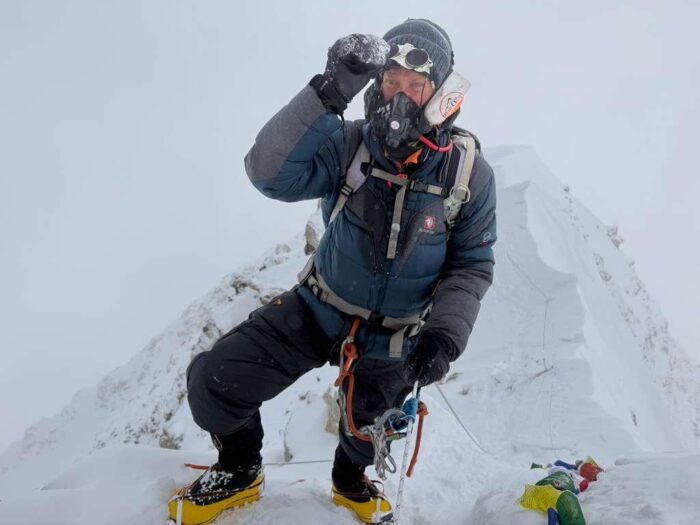
Konstantin Smirnov on Makalu. Photo: The Tourism Times
May 10: SOS
“At 5 am the next day, I woke up and was shocked to discover that my guide had left me to die high on the mountain,” Smirnov recalled. “I activated the SOS on my Garmin, dropped my backpack on the spot, and proceeded down along the fixed lines. By 7:30 am, I had descended to 7,600m, where the fixed lines ended, not far from the summit camp.”
The Garmin emergency team contacted Smirnov’s family and activated the emergency protocols. They contacted Mohan Lamsal, head of Makalu Adventure. The agency posted about Smirnov’s summit, but provided no further details:
“On May 10, Makalu Adventure repeatedly asked my guide to go up to help me, but he refused,” Smirnov said. “Eventually, I managed to lower myself to the summit camp by 5:40 pm, after a particularly tricky descent from 7,600m due to the absence of fixed lines.”
The outfitter then asked a highly experienced climber, Lakpa Rinjin Sherpa, to go up on foot and rescue the stranded climber.
“He left Base Camp (5,700m) at noon on May 10 and reached summit camp at 1 am on May 11. He gave me oxygen and water to bring me back to life,” Smirnov said. “I was just lying on the floor in the tent, as my guide did not help me at all.”
Waiting for him to die?
Smirnov repeats that Makalu Adventure asked Gurung repeatedly to go up from the summit camp and find his stranded client, but the guide refused.
“Then, when I reached summit camp, he just sat there waiting for me to die, so that there were no witnesses,” Smirnov said. “When Rinjin came, he simulated being in bad shape.”
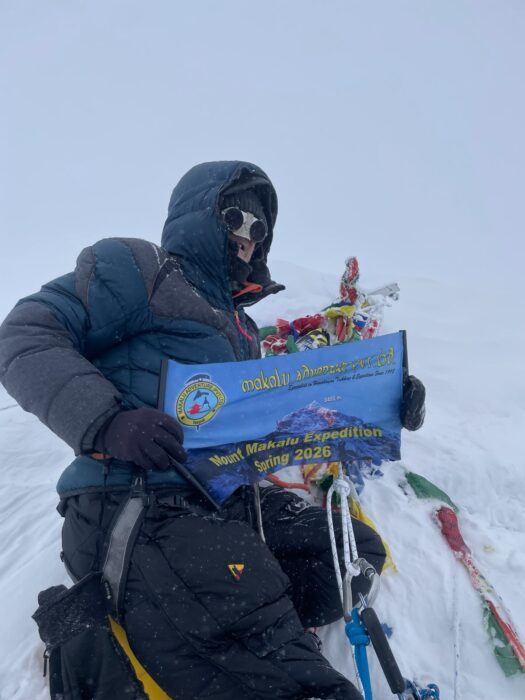
Konstantin Smirnov on the summit of Makalu on May 9. Photo: The Tourism Times
He [Bhajuram Gurung] only went out of the tent to meet me when I was about 100m from the tent. He met me close to the tent and I asked for water, as I had been without water for 30 hours. He did not have water for me. I asked for my medicine box. He gave me some garbage instead, so I just fell asleep.Next morning when the sun came up, he was sitting comfortably in his tent using oxygen. (We had plenty of it from our other climbers who had decided not to summit). I asked him what he had in his first aid kit. Turned out that he only had pills against diarrhea.
May 11: the descent
“On May 11, Rinjin Sherpa helped me descend along a steep section of the fixed lines to Camp 2 (6,600m) with a fully frostbitten hand and effectively saved my life,” Smirnov recalled. “The next morning, May 12, I was airlifted from Camp 2 (6,600m) to Kathmandu by helicopter.” (Check a video of Camp 2 below):
The climber received treatment at a hospital in Kathmandu for nine days, but there was no way to save the fingers of his left hand. “My right hand is ok except for one half-finger,” he said.
Makalu was Smirnov’s first 8,000er, but he was an experienced climber who had previously summited eight 7,000m peaks and attempted Gasherbrum II and Ama Dablam without a guide.
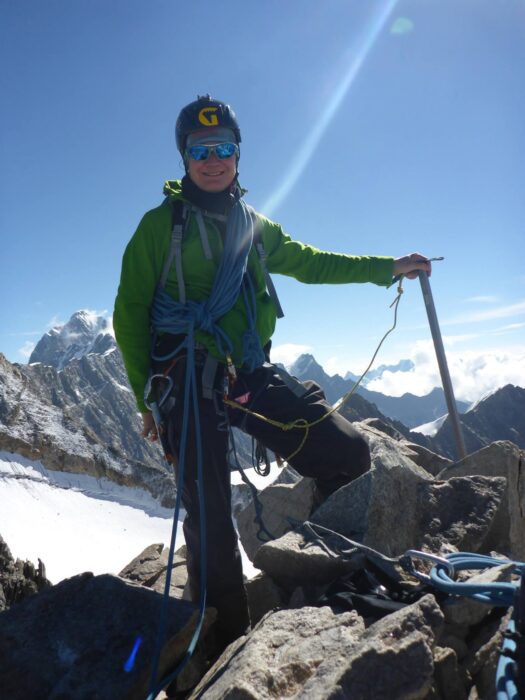
Konstantin Smirnov during a previous climbing trip. Photo by guide Yuri Koshelenko
Legal action
This is not the end of the story. What happens next may set a significant precedent for future expedition clients. Smirnov has pursued legal action against Makalu Adventure and the guide at the Commercial Court in Kathmandu through a local law firm, Imperial Law Associates. They are seeking financial compensation.
“It turns out that my guide was a trekking guide rather than a certified mountain guide,” Smirnov noted. In addition, they have also filed a criminal case against Bhajuram Gurung at the district police office in Khandbari, Sankhuwasabha.
“As there have been no similar cases to date, it took my lawyers some time to persuade the police to open the investigation,” Smirnov said.
Unfit guides
The climber is back home, but wants the public to be aware of this case. “I have many years of experience and climbed a lot with various guides — from Russia, Kazakhstan, France, the UK, the U.S., Peru. Never in my wildest dreams could I imagine that a guide would abandon a client high on the mountain,” he told ExplorersWeb.
Smirnov also said that he had discussed his case with several experienced Sherpas, and nobody could remember anything like that, either.
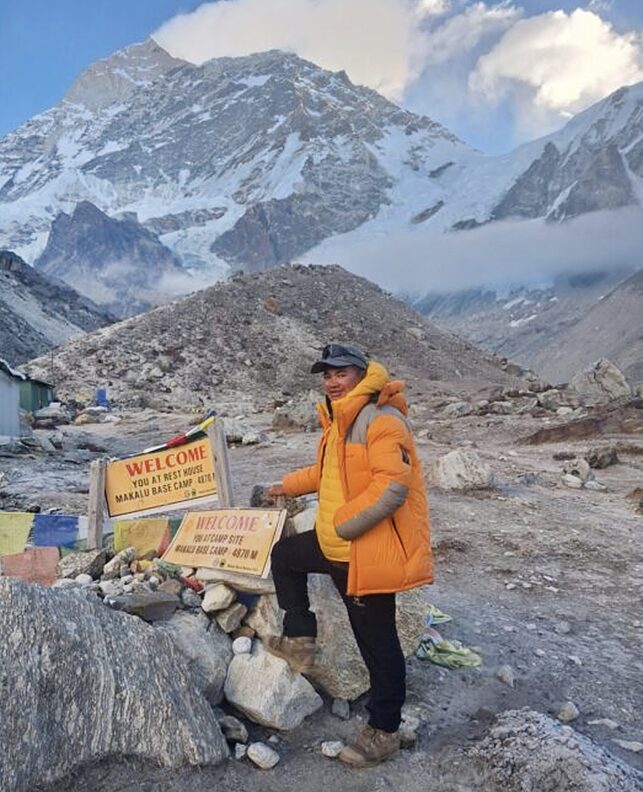
Bhajuram Gurung at Base Camp of Makalu. Photo: Facebook
Asked by ExplorersWeb, Smirnov confirmed he only met Bhajuram Gurung in Base Camp, and he was told he would be his guide. The team made two previous rotations with no reported issues.
“My guide [Bhajuram Gurung] was very helpful on both rotations,” Smirnov said. “He carried a lot of stuff to Camp 3 and it was clear he was strong, always very positive and helpful with cooking, etc. so I did not ask him questions about his experience.”
But then, we wondered, why did he behave that way after the summit?
I remember he approached me from behind and started shouting that I was too slow, and it was about to get dark. I noticed that the sun was indeed close to the horizon. So it was indeed about 6:30 to 7 pm. I replied that I was tired and could not go faster.I suspected he was worried because the battery in his flashlight was dead, so I gave him my spare flashlight. And I told him that walking at night would be no problem for him. And that is the last thing that I remember…
The company’s take
We asked Makalu Adventure for comments. They insisted Gurung was experienced and well-trained, noting he had previously climbed Ama Dablam and Annapurna IV. As for experience on 8,000’ers, Gurung guided on Manaslu but didn’t summit due to bad weather.
“If he is not a climbing guide, how can he take him to the top of Mount Makalu without any problems? [Smirnov] climbed successfully [to the summit] with our climbing guide’s help,” company director Mohan Lamsal told ExplorersWeb.
Lamsal blames the climber. “Konstantin [Smirnov] never listened to the safety instructions given by our guides,” he said, noting that the Russian remained on the summit for one hour and 10 minutes. “My guides requested him to go down quickly before they ran out of oxygen, but he never listened.”
Lamsal said the guide had to go down to Camp 4 on his own for safety reasons, as he was running low on oxygen.
Lamsal shared several certificates crediting Gurung with basic rescue skills, rock climbing grade I, hotel management, and a certificate to be a barista with climbing expeditions. He also has a Certificate of Basic Mountain Navigation and Hill Walking training, issued by Nepal Mountaineering Instructors Association (NMIA):
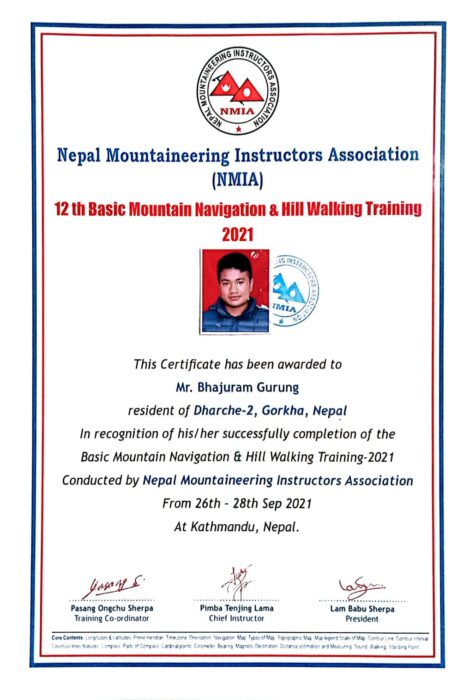
Certificate of Basic Mountain Navigation and Hill Walking training in the name of Bhajuram Gurung, issued by Nepal Mountaineering Instructors Association (NMIA)
He also provided a license by the Nepal Mountaineering Association which, they explained, is the required document to guide on the country’s 8,000’ers:
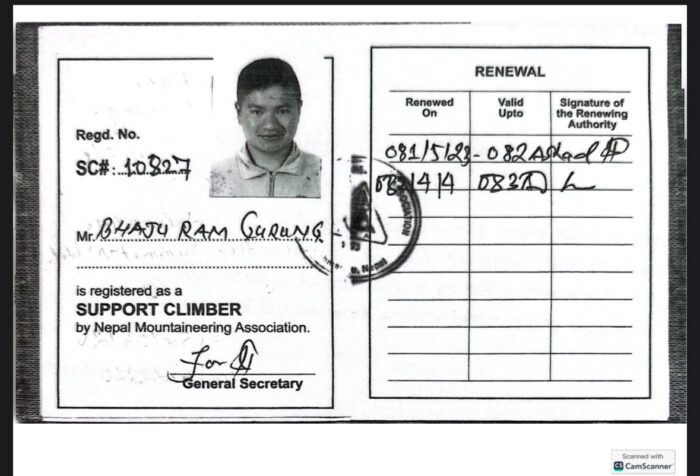
Support climber’s license by the Nepal Mountaineering Association
We have also asked Bhajuram Gurung for comments, and we are waiting for a reply.
2nd abandoned climber this season
This is the second case of a person abandoned on an 8,000’er that has reached Nepal’s courts this season. The other case relates to Hillary Dawa Sherpa, left behind above Camp 3 on Everest and ignored by his employers at Himalayan Traverse Adventure.
Dawa miraculously survived, and several guides’ associations in Nepal have pressured authorities to start an independent investigation, which is ongoing. That case also implied that the two guided clients on that team, Chris Thrall of the UK and Mariusz Chmielewski of Poland, had to descend on their own on a deserted mountain after the season ended. They had to help each other when one of them suffered a fall at a section of fixed ropes. It is unknown if either is considering legal action.
These two cases also offer an important lesson for future climbers and how important is to carefully check the credentials of mountain guides and the company’s resources, both for the clients and the guides.
NOTE on terms: While the term “Sherpa” is often used flexibly to refer to local guides and support staff working on 8,000’ers in Nepal, Tibet, and Pakistan, the Sherpas are a Nepalese ethnic group of Tibetan origin. Many but not all local guides in Nepal are of Sherpa heritage. Smirnov’s guide was a member of the Gurung community.