The ordeal of Hillary Dawa Sherpa, who was left behind on Everest to die and dragged himself to safety after a week on his own, was both a remarkable example of fortitude and a shameful tale of abandonment. And the testimony of Mariusz Chmielewski, a client who was also left frostbitten and without oxygen above Camp 3 that same day, is both scary and enlightening. Future Everest climbers reading the report he shared with ExplorersWeb may take a lesson from this and be careful who they climb with.
Context
Dawa worked for Himalayan Traverse Adventure (HTA), a small operator whose owners never requested a search party after their employee lost contact during the descent from Camp 4 on Everest, according to both Mariusz Chmielewski and Pemba Sherpa, director of 8K Expeditions. Chris Thrall of the UK and Chmielewski were the only two clients on the team, supported by Hillary Dawa and a second Sherpa, Pasang Kaji.
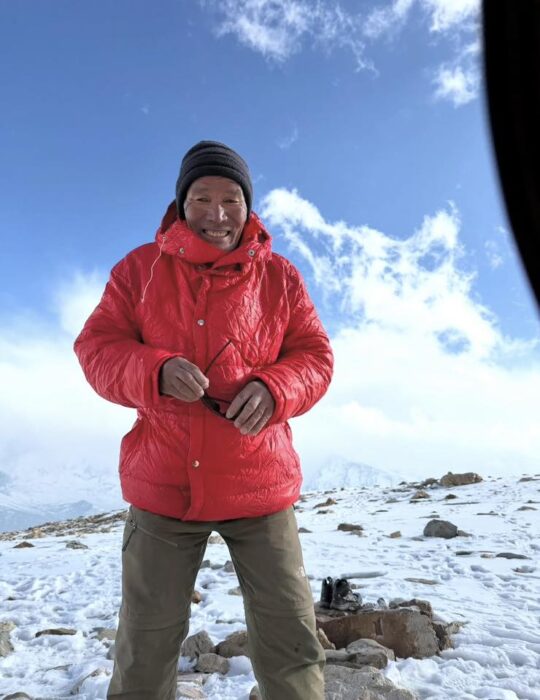
Hillary Dawa Sherpa during an expedition to Chulu East in April, 2025. Photo: Irem Erdem
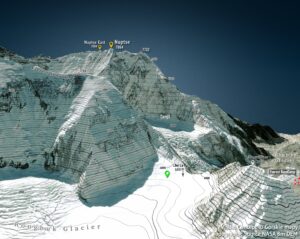
Thrall recently described their descent, and spoke of the point at around 7,600m (near the Yellow Band) where he last saw Hillary Dawa. Dawa told Thrall he was stopping for a break. Thrall also described how he found Chmielewski lying on the snow shortly below and helped him down the rest of the way.
We wrote extensively about this incident and asked some questions about that descent, which remain unanswered, such as the whereabouts of the second Sherpa, the lack of assistance to a sick client, and most of all, how no one took responsibility for a missing Sherpa who never showed up at Camp 3 during that descent.
At the time, Chmielewski preferred not to make any comments. Later, he told his story to Nepal’s authorities as part of the ongoing investigation. He also responded to ExplorersWeb’s questions, and his story is so shocking that we have decided to reproduce Chmielewski’s statement to us in his own words.
Chmielewski’s story: Why a small company
When the Nepalese climbed K2 in winter in January 2021, I contacted Nirmal Purja via Messenger. I asked him if he was planning expeditions to Mount Everest. Nims said he was so busy that he gave me his friend’s contact information. [Purja’s EliteExped had a particularly large team in the spring of 2021.] That’s how I got Dawa Sherpa from Himalayan Traverse Adventure Pvt. Ltd. I didn’t look for another agency, convinced that since I had a referral from such a recognizable person as Nirmal Purja, everything must be fine.
I started contacting Dawa Sherpa online, and everything seemed normal. He gave me directions to their website, etc.
Mariusz Chmielewski at the Khumbu Icefall. Photo: Mariusz Chmielewski
Note on Hillary Dawa:
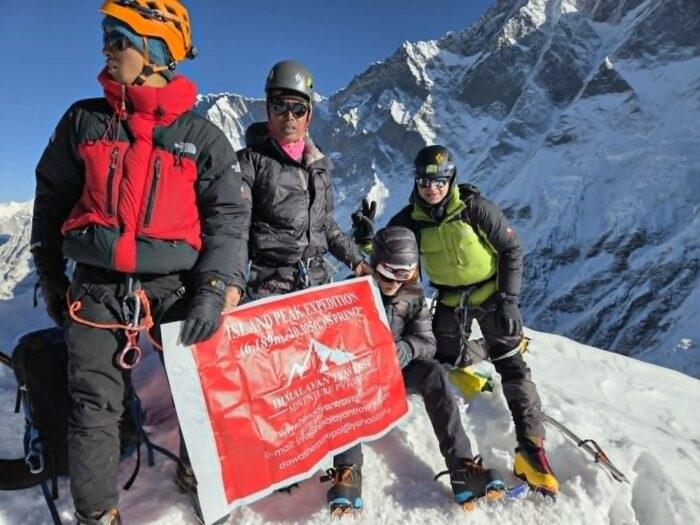
Ang Phurba Sherpa (the son of HTA’s owner, Dawa Sherpa) was coordinator and climbed with us up to Camp 2 and arranged some items in higher camps. We acclimatized on Island Peak before Everest, with Ang Phurba coordinating Pasang Kaji Sherpa and Sonam Sherpa.
Hillary Dawa Sherpa wasn’t listed in the expedition contract. He replaced Sonam Sherpa, who was sent home by the company when Chris Thrall got sick and flew from Base Camp to Kathmandu for a few days. Hillary Dawa simply filled in.
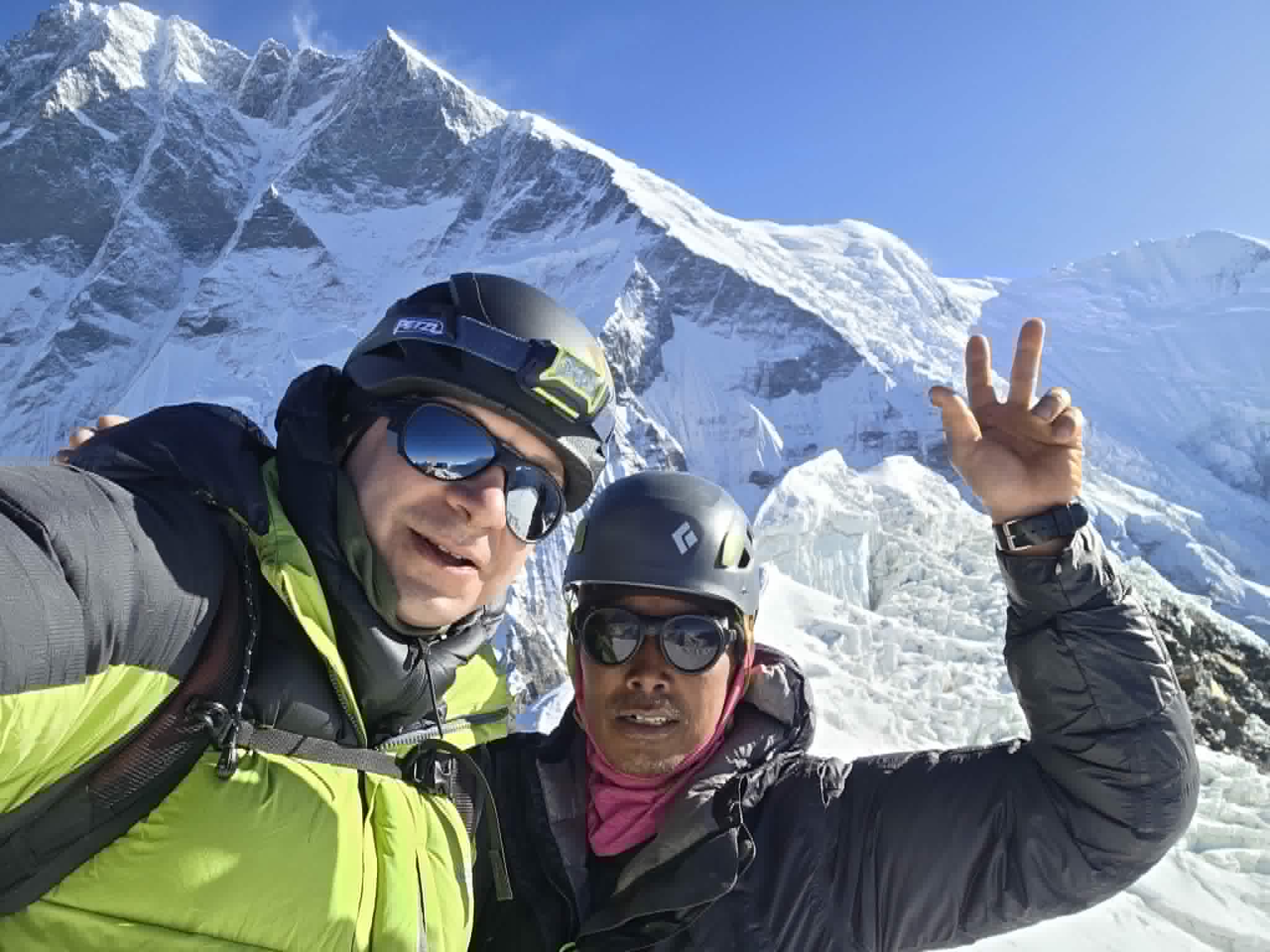
Mariusz Chmielewski, far right, on the summit of Island Peak. Photo: M. Chmielewski
During the acclimatization climb, nothing really aroused my suspicions, except for one day. After the second rotation, when I reached Camp 2 again after 15 hours of climbing from base camp (around 3:30 pm), I wasn’t given any food or water until the next day.
It turned out that Ang Furba Sherpa didn’t know how to use a stove, and Pasang Kaji Sherpa had injured his shoulder that afternoon. So I was left without food or water until the next morning. This was a serious oversight.
[Chmieleski later added the team then moved to Everest and did the usual rotation to Camp 2, tagging Camp 3.]
The late summit push
Following the weather forecast, we started for the summit at the last minute before the weather turned for the worse. After reaching Camp 4 on the night of May 26, Chris [Thrall] and I wanted to set off on the summit push around 4 pm on May 27. We started talking to Base Camp by walkie-talkie. Ultimately, Pasang Kaji Sherpa [the other Sherpa, besides Hillary Dawa] said we’d set off at 9 pm. I was ready at that time but waited until 10:30 pm for the rest of the group to be ready. So we set off at 10:30 pm.
As for this being at the end of the season, I don’t know about Chris, but I had no idea what happens at this time. I didn’t know that the ladders in the Icefall could be dismantled. It didn’t even occur to me that someone might want to do it so quickly.
Mariusz Chmielewski and Pasang Kaji Sherpa at a high camp. Photo: Mariusz Chmielewski
The long summit day
We set off as a team, as usual, but it quickly became clear that Chris and Pasang Kaji Sherpa were ahead of both me and Hillary Dawa Sherpa. (Pasang Kaji Sherpa had previously been my Sherpa for most of the expedition.) Hillary Dawa was more heavily loaded than Pasang Kaji, as he carried almost all the oxygen tanks to the Balcony. This was the final point where oxygen tanks are changed and the final summit push begins. This made Hillary slower, and he essentially trailed behind me. I had to wait for him to catch up with me to change tanks.
When Hillary and I reached Balcony, I asked him how many times he’d been to the summit. He told me he’d never been there. In this situation — and considering that Hillary wanted to go higher with me with a heavy backpack — I instructed him to stay at the Balcony while I began the ascent.
I continued higher until it began to get dark. My suit zipper was frozen, and I couldn’t close it. Also, my oxygen supply wasn’t sufficient for a safe descent, and the weather conditions were very changeable (increasingly strong winds and fog). So at about 8,450m, I decided to turn back. I descended back to Hillary Dawa, who was waiting at the Balcony, and began the descent to Camp 4. Hillary Dawa waited for Chris and Pasang Kaji Sherpa to return and descended with them.
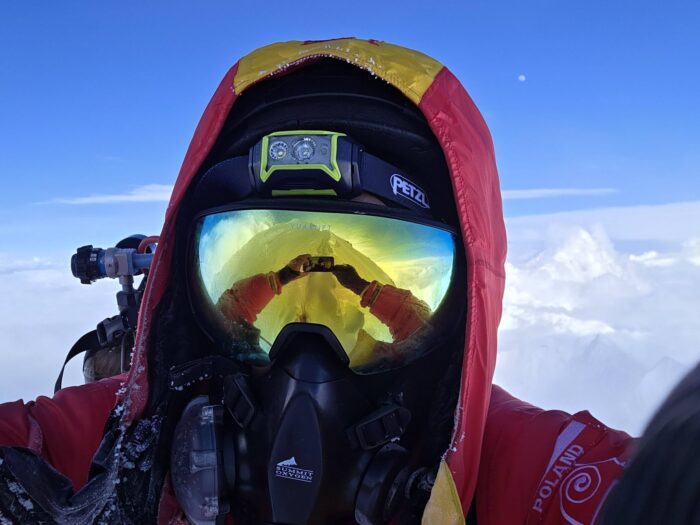
Mariusz Chmielewski takes a selfie during the summit push on Everest. Photo: Mariusz Chmielewski
Frostbite
The first symptoms of frostbite appeared at Camp 4 on the morning of May 29, after the summit attempt. Frostbite wasn’t the reason I decided to retreat (as the head of Himalayan Travelers Adventure claimed in one of his statements). I didn’t have any frostbite at the time. The immediate and most serious reason for my retreat was the insufficient oxygen.
Furthermore, I was sent to the summit with a Sherpa who had never been there. In reality, Himalayan Travelers Adventure didn’t fulfill their contract -– they didn’t provide me with the purchased oxygen or a suitable Sherpa to guide me to the summit.
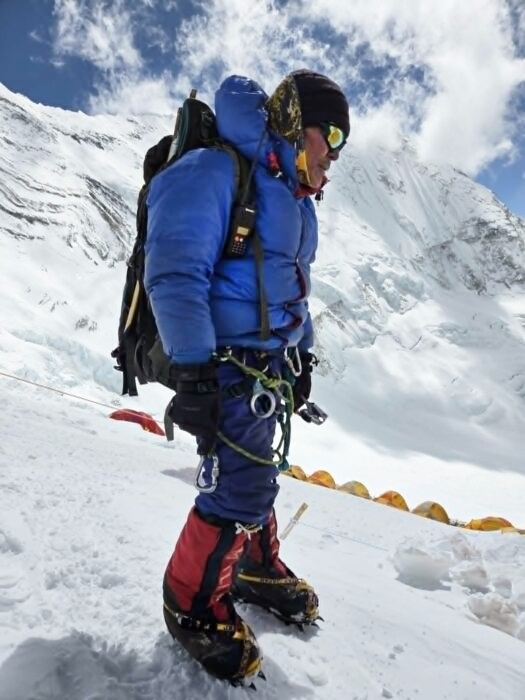
Hillary Dawa Sherpa on Everest. Photo: Mariusz Chmielewski
The descent
After descending to Camp 4 at night, we all stayed there until the next morning. Around 4 pm on May 29, we began our descent from Camp 4, heading for Camp 2. Pasang Kaji Sherpa had given me a tank with only 20 units of oxygen for this descent. I had purchased seven oxygen tanks, but Pasang Kaji said he didn’t have any more. Since this was only enough for about 30 minutes of breathing, I began descending first, to get as low as possible as quickly as possible.
Along the way, at a spot below Camp 4, where several tents were pitched, Pasang Kaji Sherpa caught up with me. I informed him that I was running low on oxygen and that my headlamp battery was low. Despite this information, the Sherpa didn’t didn’t assist me on my descent. (He had an oxygen tank and a working headlamp.) Pasang Kaji left me alone and continued down toward Camp 2, telling me to descend there slowly on my own.
So I continued down at my own pace. I knew Chris and Hillary Dawa were somewhere behind me, the last to emerge from Camp 4. I had run out of oxygen and didn’t have a working headlamp. At about 7,500-7,600m, I stopped to eat my lunch. While I was sitting in the snow, attached to a fixed rope (it was already after dark), Chris caught up with me.
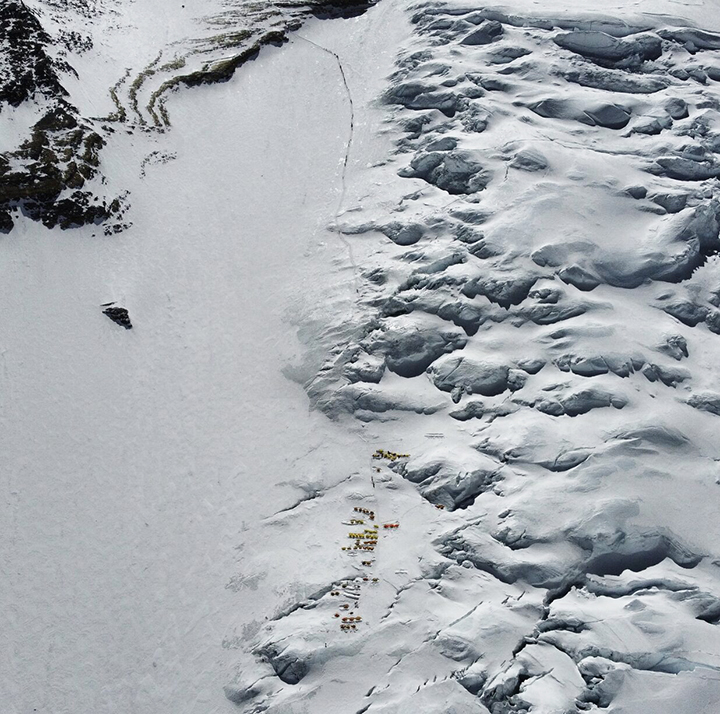
Aerial of the Lhotse Face, with the tents of Camp 3 and a line of climbers progressing up the face and to the left, toward the Yellow Band. Photo: Furtenbach Adventures
Clients alone at C3
Chris said he’d split up with Hillary Dawa and that Hillary seemed normal, but simply told him to continue down.
[Chris and I] began descending together. Chris had a working flashlight and a tank of oxygen. I asked him several times for two or three minutes of oxygen during the descent, and he lent it to me.
Together — at night and in a snowstorm that had begun in the meantime — we reached Camp 3. We spent about an hour and a half there in one of the abandoned tents. I then took a nap for about 40 minutes.
Chris heated the tent with a stove he found there, melted some snow, and made soup. There was no sign of Hillary Dawa. We had neither a walkie-talkie nor the satellite phone Chris had left with Hillary Dawa. A snowstorm was brewing, and we began to worry — we had no idea what could have happened.
Camp 2 to Base Camp
To save time and Chris’s remaining oxygen supply, we began our descent to Camp 2. In a snowstorm with very limited visibility, we pulled our fixed ropes out of the snow and reached Camp 2 in the early morning hours of May 30. Pasang Kaji Sherpa was already there. Using Pasang Kaji’s walkie-talkie, we informed Dawa Sherpa, the head of Himalayan Traverse Adventure, that Hillary Dawa was trailing last and was missing.
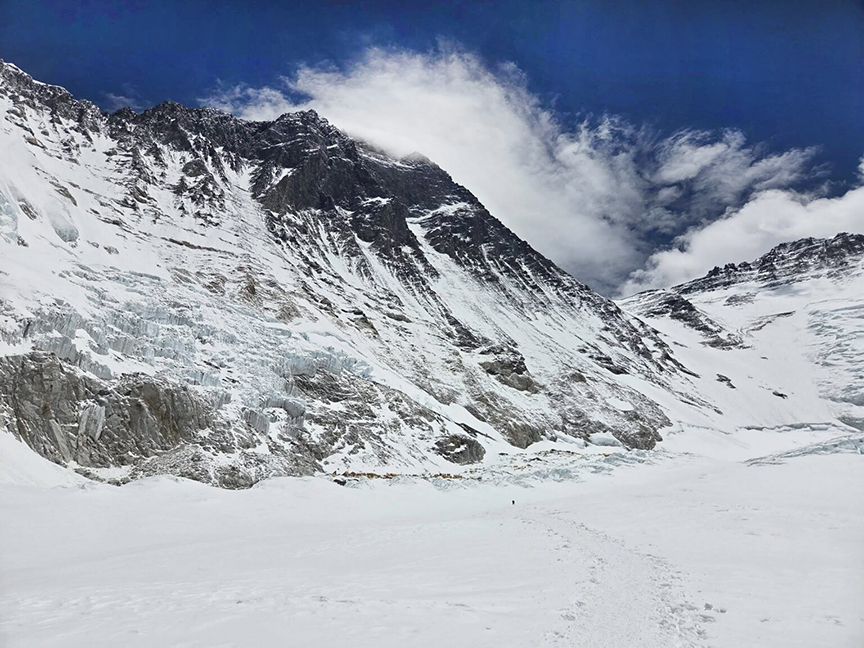
Camp 2 on Everest. Photo: Mariusz Chmielewski
No rescue attempt was made, and no Sherpa was sent to search for Hillary Dawa. We were ordered to descend to Base Camp with Pasang Kaji. After a few hours at Camp 2 — which I think we were the last to stay at, as I didn’t see anyone else there — we began our descent to Camp 1 and then through the Khumbu Icefall to Base Camp. It wasn’t easy. Fresh snow covered the handrails, and thick fog limited visibility. We didn’t reach Base Camp until around 4 am on May 31.
Frostbite worse than expected
After a day at Base Camp, washing up and packing my things, I decided I needed to see a doctor. I had frostbite blisters on my right thumb, index, and ring fingers. I was also coughing and feeling pain around my heart –- I probably bruised my ribs somewhere along the way. (Heart and lung tests revealed nothing.)
On the morning of June 1, a helicopter arrived and I flew to Lukla. In Lukla, we decided it would be best to go to the hospital in Kathmandu, and so we did. I flew there in a second helicopter. I spent five days in the hospital taking medication for frostbite -– it was rated as second-degree frostbite.
I’m now back in Poland. Treatment for the fingers will take weeks, and it could take up to a year for full sensation to return and a complete recovery.
Fortunately, they didn’t amputate anything, and I’m alive.
The aftermath
Immediately after Chris and I were informed (while at Camp 2) that Hillary was missing, Himalayan Travelers Adventure did not initiate any search efforts. When Chris and I arrived at Base Camp, Ang Furba Sherpa told me point-blank that Hillary was apparently dead. That was the assumption.
From what I understand, it wasn’t until several days later that 8K Expeditions, under which Himalayan Travelers operated, was informed of Hillary’s disappearance. Only then, at 8K’s initiative, did the search begin.
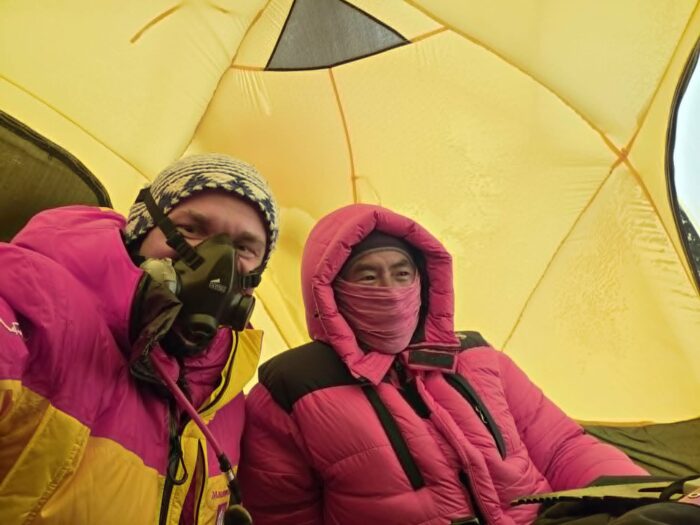
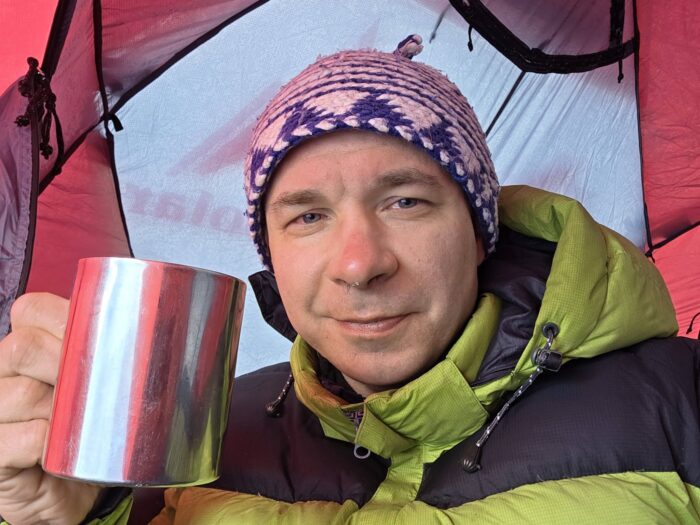
Mariusz Chmielewski at Camp 2, before the drama unfolded. Photo: Mariusz Chmielewski
When Hillary went missing and Himalayan Travelers Adventure didn’t launch any search, I felt helpless. I sensed something was wrong. While I was in the hospital, Ang Furba Sherpa from the company told me it was best not to contact the media about the matter. When, a few days later, I saw the first post online that Hillary was alive and had saved himself, I felt immense joy and relief.
Epilogue
In great news, Hillary Dawa Sherpa was released from the hospital today.
The dramatic episode has put a bitter end to an Everest season that was supposed to be remembered as the most successful in history.
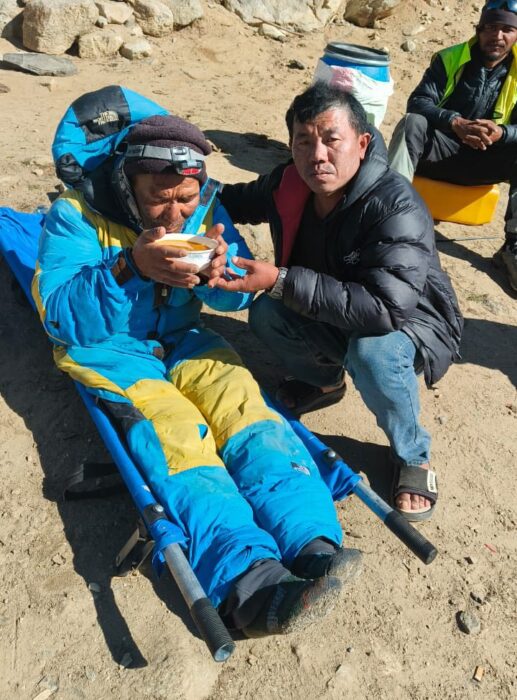
Hillary Dawa receives some soup at Everest Base Camp shortly after he was found. Photo: SPCC
Nepal’s Department of Tourism has launched an investigation, but so far has only mentioned the possibility of banning the company from operating on Everest. We previously tried to contact the owner of Himalayan Traverse Adventure and Ang Phurba for their side of the story, but received no reply.
Sherpa guides and some expedition leaders have demanded urgent changes to the regulations around Everest climbing to increase safety. These include previous experience for clients and proven skills and accreditations for the Sherpa supporters and guides. Future climbers should demand the same from any company they hire to outfit their expeditions.