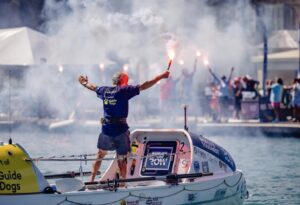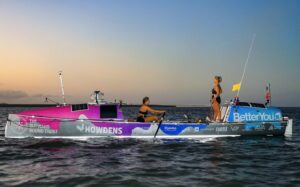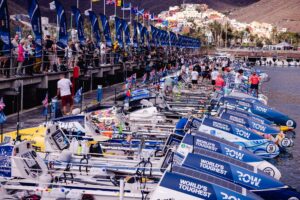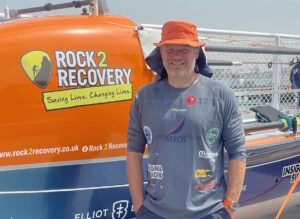
Since our last ocean rowing roundup, the World’s Toughest Row has a winner, and two solo rowers have been rescued.
World’s Toughest Row: The 2025 World’s Toughest Row, previously known as the Talisker Whisky Atlantic Challenge, started on December 14. Forty-three teams and 114 rowers pushed off from La Gomera in the Canary Islands.
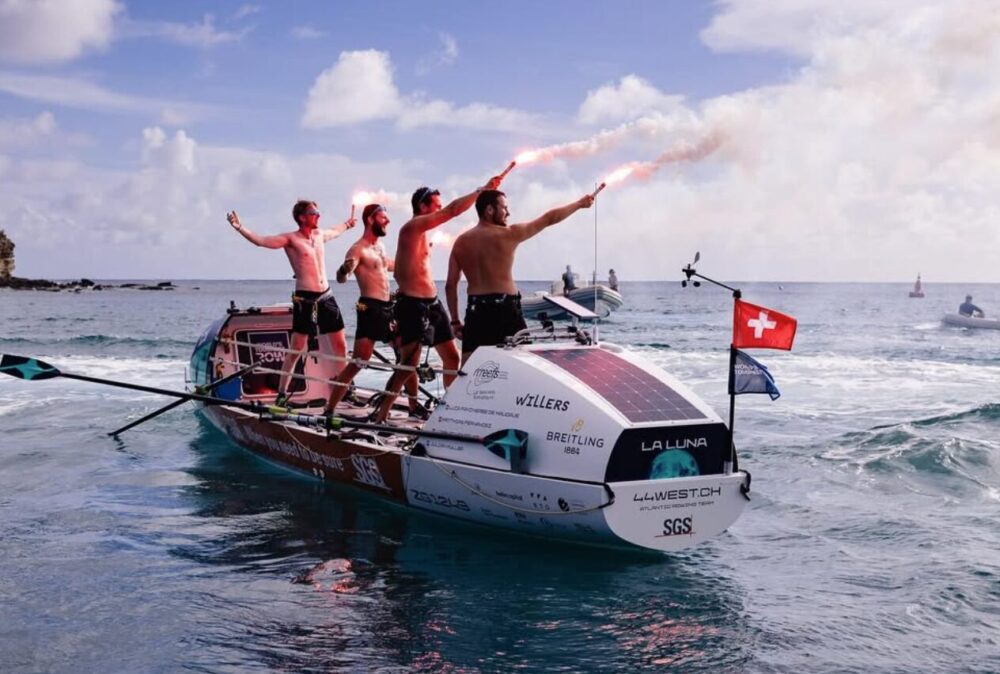
The winner of the 4,828km race across the Atlantic to Antigua was the Swiss four-man crew 44 West, made up of Matthias Fernandez, Luca Fayd‘herbe de Maudave, Lorenzo Henseler, and Julian Muller. They landed at Nelson’s Dockyard on January 14 after 32 days, 8 hours, and 8 minutes at sea.
Front runners
Since the start of the row, they have been at the front of the pack. All four men had significant rowing experience and had previously competed both nationally and internationally. For the last few years, they have been determined to cross the Atlantic, and their goal has always been to be the first crew across the line.
Kiwi Fondue, another four-man Swiss crew, took second place after arriving in Antigua on January 15. The remaining 41 teams are still battling their way to Nelson’s Dockyard.
Over the last month, many of the crews’ most incredible and nerve-wracking moments have come through their encounters with wildlife. In early January, the Busy Rowing team found itself surrounded by five or six whales. One came so close in its final dive that the crew thought it might capsize them. Just days later, three orcas followed another team, Row With The Flow.
Race statistics so far:
Overall Winners: 44West
Winning four: 44West
Leading trio: Southsea Scullers
Leading pair: Gone Fishin
Leading soloist: The Jasper
Longest-ever stage
Dave ‘Dinger’ Bell (UK): Bell is attempting the longest-ever, single-stage unsupported row. Starting on November 9, he left Peru, bound for Mauritius. Initially, he will row to Australia. He then hopes to continue through the Torres Strait, around the top of Australia, and into the Indian Ocean to Mauritius. In total, the nonstop stage will cover around 24,000km.
Nine weeks in, he is making good progress. At the start of January, he hit a big milestone: 3,000 nautical miles (approximately 5,500km) covered. He has about 18,500 km left. To celebrate, he treated himself to a chocolate bar. This week, his pace slightly slowed due to a lack of current, but he is still covering around 110km per day.
So far, there have been no major issues; in fact, his biggest problem of the last few weeks has been the seemingly endless flying fish. Though that might sound exciting, it has meant waking up to a number of dead, smelly fish on his boat every morning.
Earlier this week, Bell was considering a slight detour. His land team and weather router initially suggested rowing to the Marquesas Islands and anchoring for a few days to rest and make repairs.
However, the islands have strict rules about checking in and out, and Bell would have had to go ashore, which would have invalidated his unsupported row.
Instead, he is pushing west at a slower pace to allow himself time to recover and carry out some necessary tasks.
A short-lived attempt
Rebecca Ferry (UK): Ferry’s attempt to row across the Atlantic from Gran Canaria to Barbados was short-lived. Less than two weeks after setting off on December 15, she had to quit due to a failed autohelm. She was towed to Cape Verde.
Throughout her expedition, she provided few updates on her progress, but did note issues with the autohelm in the first few days. In total, she covered 1,237km of the 4,911km route.
Jari Saario (FI): The Finnish fireman was rescued during his attempt to row from Chile around Cape Horn and then across the South Atlantic to the Cape of Good Hope in South Africa. Had he completed the journey, it would have been an ocean-rowing first.
He set off at the start of November and successfully rowed around Cape Horn, the southernmost point of South America. He was steadily working his way across the South Atlantic Ocean in challenging conditions. Saario endured several storms when he had to sit on his para-anchor for safety. He lost equipment, and one morning, his boat hit an iceberg.
Bad to worse
Then on January 7, things went from bad to worse. He had issues with his rudder, and as he went into the aft cabin to investigate, a huge wave sent him flying headfirst into the cabin and flipped the boat over. Water rushed in, slowing the vessel’s self-righting time.
“As a result, the batteries got wet and caught fire,” he commented on social media. “At the same time, there was a lot of water in the cabins of the boat, which made it seem like the boat was going to capsize again immediately…I had to scoop water out of the cabins as hard as possible.
“[Then the] bag with my dry suit floated out and disappeared into the sea. The electricity was out, and the boat felt like it was sinking, and some critical equipment was lost. There was nothing I could do but press the distress call.”
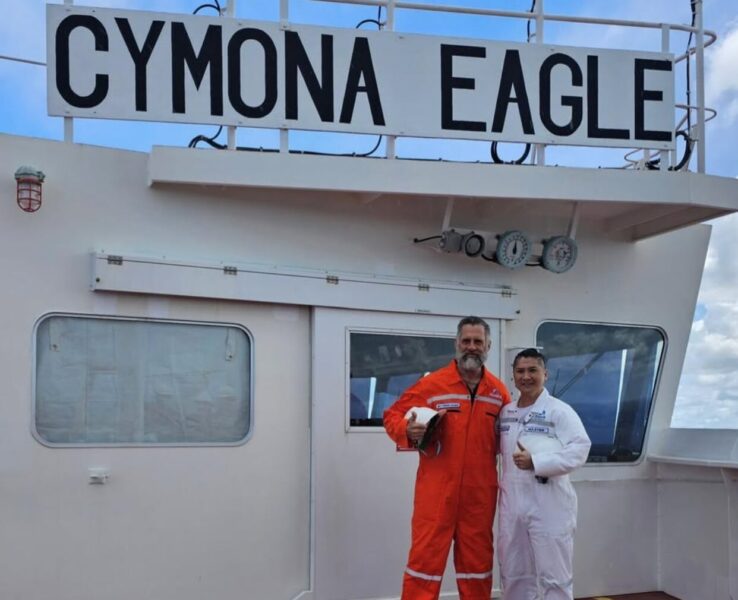
Jari Saario was rescued by the merchant vessel ‘Cymona Eagle.’ Photi: Jari Saario
He had completed around 5,000km of the 8,000km row and was stranded thousands of kilometers from any coastline. His remote position meant waiting for rescue. He was finally picked up by the merchant ship Cymona Eagle about three days later.