Since our last roundup, Chris Barbin has completed his North Pacific crossing, Louis Margot has started rowing again, and Dave Bell is drawing closer to Australia.
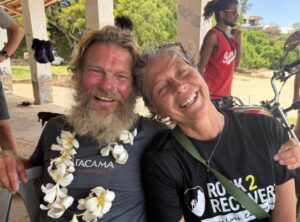
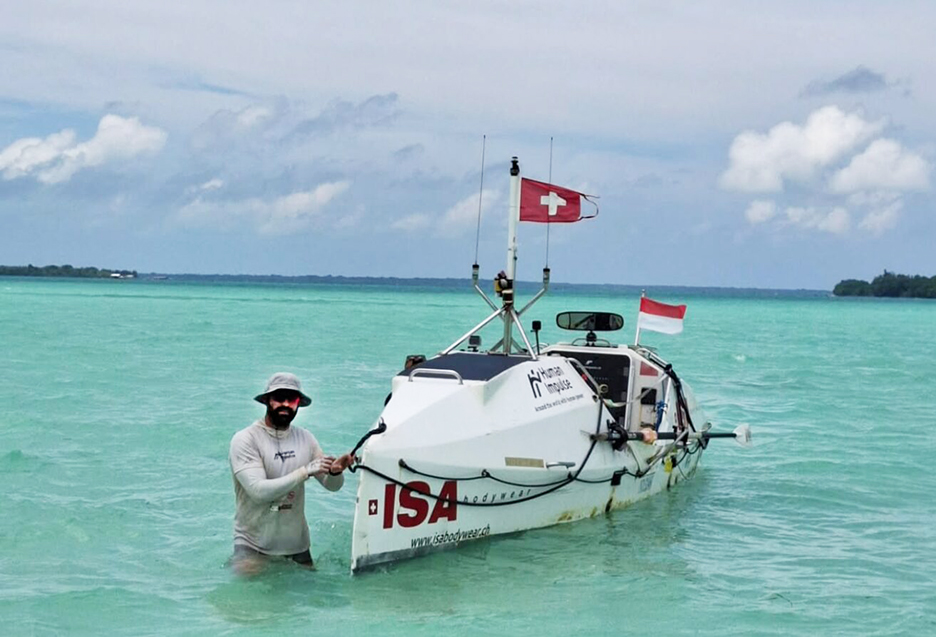
Louis Margot (CH): After months of delay, Margot has started rowing again on his round-the-world expedition. He began over two years ago, aiming to cycle and row his way around the globe. From his home in Switzerland, he cycled to Portugal, then rowed across the Atlantic to Colombia before once again hopping on his bike. After pedaling to Peru, he started his second rowing stage.
This stage, where he was forced to wait for weather windows, has been a long and stunted journey. Margot initially rowed to the Marquesas Islands before pausing to make repairs and rest. After waiting there for a few months, he continued onward to Waigeo Island, Indonesia, landing there on October 16. Then he had to wait again for what turned into months because of the monsoon.
More delays
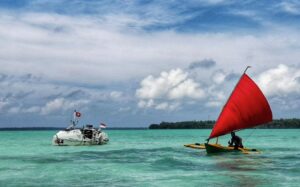
In January, he briefly took to the water again, moving to Kei Island. This only took two weeks, but allowed him to use the northwest winds to move south into a better location vis-à-vis winds and currents. Navigating through the coral reefs around the Indonesian islands and contending with the tidal currents for even that brief period was a shock to the system after months on land.
After a few more months landbound in the Kei Islands, Margot started rowing again on April 17. This marked the final rowing section of the entire journey. He is now zigzagging through the Indonesian islands, but after such long delays, motivation has been hard to find. However, at least the wind is now moving him in the correct direction.
Margot had planned to row to Singapore, but eventually realized just how difficult this would be due to heavy maritime traffic. So he changed course toward Surabaya, Indonesia. From there, he will continue through Java and Sumatra by cycling, walking, or running, crossing small stretches of water in a kayak until Malaysia. From there, he will cycle back to Switzerland.
The longest-ever, single-stage unsupported row
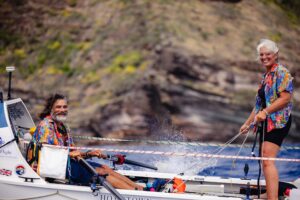
Dave ‘Dinger’ Bell (UK): Bell is attempting the longest-ever, single-stage unsupported row. He started in November from Lima, Peru, and has now been rowing for just over six months. He is currently crossing the Pacific Ocean to Australia. This is already a huge achievement, but he plans to continue much further.
If he reaches Australia in good shape, he will row onward to Mauritius. This will mean crossing from the Pacific into the Indian Ocean through the notoriously tricky Torres Strait. By mid-April, he was making such good progress that he had to reduce his rowing hours so that he did not hit the strait prematurely and have to contend with poor, out-of-season weather.
Claustrophobia and bed sores
Then suddenly, Bell went from almost perfect conditions to days trapped in his cabin, holding place on a para-anchor in high winds. He struggled with the claustrophobic cabin and suffered bed sores from staying in the same position as he waited out the bad weather.
Although he’s now off the para-anchor, the bad weather has continued. For the first time, he has had to wear his waterproof gear through heavy squalls with almost no visibility. Most troubling, his AIS device — for identifying other boats and allowing them to identify him — malfunctioned several times.
At the moment, he is in the Coral Sea, forging north toward the Torres Strait, which will be one of the trickiest parts of the entire row.
Row complete
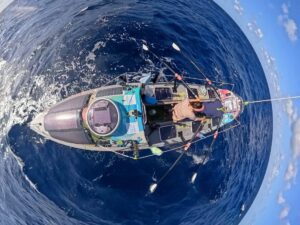
Chris Barbin (U.S.): Barbin completed his 2,400km row across the North Pacific Ocean on May 6. He started in Monterey, California, and landed in Punta Mita, Mexico, after 38 days at sea.
At the beginning of April, he struggled against headwinds, often moving in circles and some days barely moving. Luckily, as he moved into Mexican waters, this eased off, allowing him to make better progress. However, he has had to contend with shipping traffic, as he did near the California coast.
Approaching southern Baja, he had to drift through a shipping channel, leading to an anxiety-ridden 36 hours. For a day and a half, he had to constantly check where the big container ships were in relation to his tiny boat. Then he had a few days of smooth rowing until rounding Cabo.
Cabo chaos
Barbin always knew the section around Cabo, where currents and winds changed frequently, would be tricky. The conditions were indeed so brutal that he nicknamed the stretch “Cabo Chaos.” Though he made progress, he had to use every skill he had developed in his time on the water to navigate that small section.
Once through that, his world perked up. He knew he had made it. Ocean creatures were common, and even though conditions were not perfect, he described the last few days as magical.