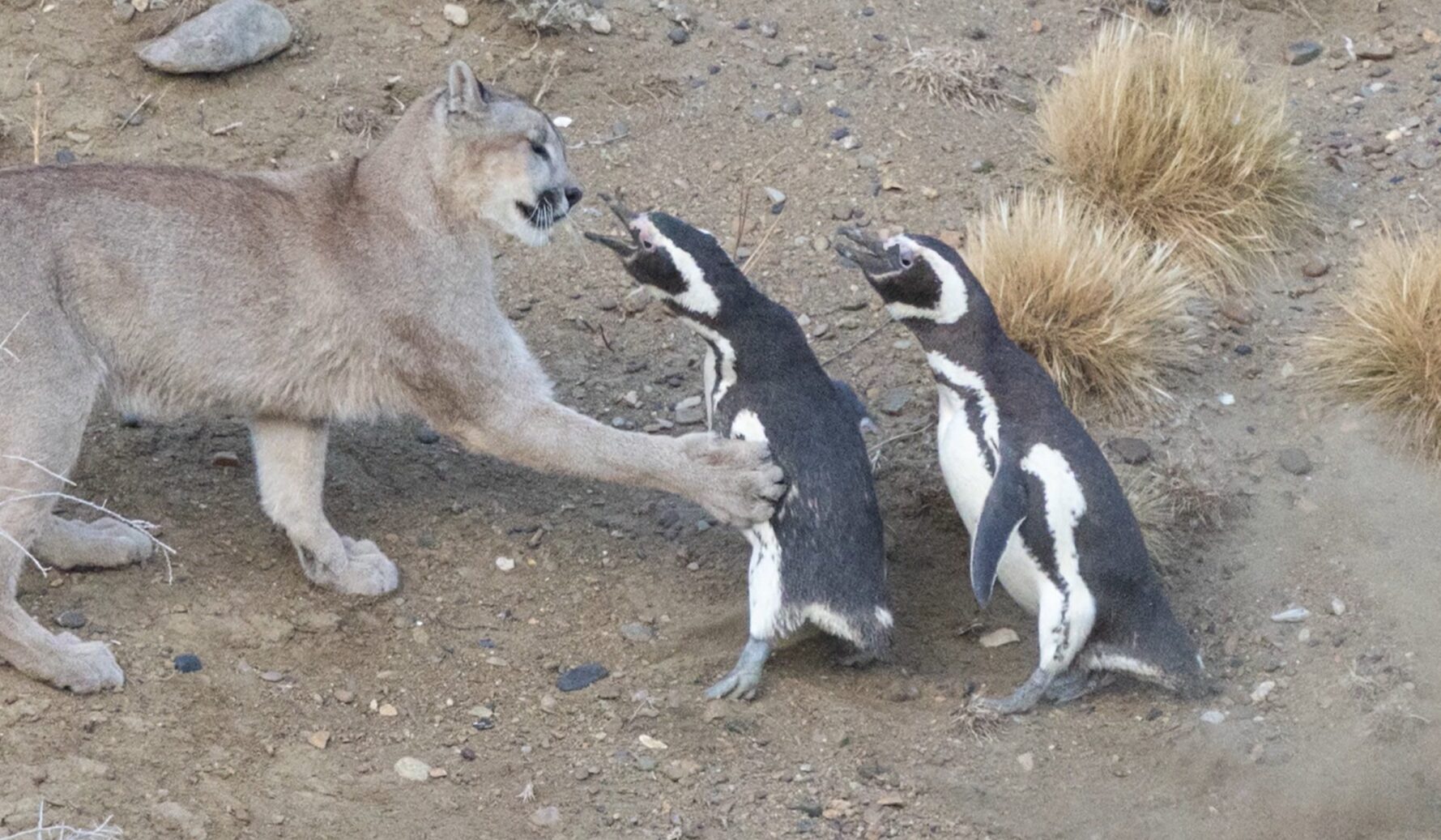
Reintroducing keystone predator species can have a near-miraculous restorative effect on ecosystems. This is what I would remind a Patagonian penguin who is feeling a bit down about his whole family being eaten by newly arrived pumas.
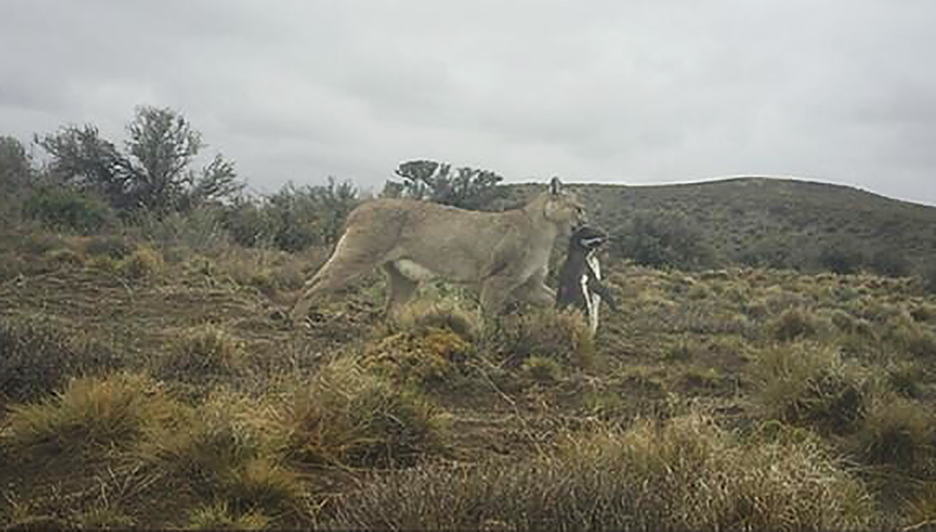
He may not like it, but this penguin gave his life to wildlife conservation. Photo: Serota et al
Trophic cascade
This new behavior is the latest change in an ongoing evolution of predator-prey dynamics on Argentina’s Patagonian coast. Before European colonization, pumas (also known as cougars, catamounts, mountain lions, and panthers) ruled the windswept and rocky tip of South America. Their prey were the abundant guanaco, a llama relative, and the lesser rhea, a large flightless bird.
But introducing or reducing even a single species can cause broad changes across an entire ecosystem, a phenomenon referred to as a trophic cascade.
European colonization transformed the landscape. Sheep and cattle replaced the native herbivores, and predators were culled to protect the livestock. With the loss of the foxes and pumas, however, came a new inhabitant: the Magellanic penguin.
Like their namesake, Ferdinand Magellan, these handsome waterbirds were interested in the colonial potential of the South American mainland. Prior to the 18th century, their colonies bred mainly on offshore islands. After the mainland predators disappeared, they established a large breeding colony on the coast of Patagonia, in the Monte León sheep ranch.

The Magellanic Penguin colony in Monte León National Park, Argentina. Photo: Tompkins Conservation
Puma on penguin violence
In 2004, the Monte León ranch became Monte León National Park, after conservation organizations purchased it and donated the 25 oceanfront acres to the Argentine National Parks Administration. Wild prey species trickled back in, including the puma. Soon after, local authorities monitoring conditions in the new park began hearing about puma attacks on the penguin colonies.
Now, a study using camera traps has confirmed extensive predation. A team led by ecologist Mitchell Serota placed 22 cameras in the colony from January to April, the middle of the penguin’s breeding season. Pumas visited nearly every night, more than 12 times as often as any other predator.
Pumas are incredibly adaptive animals, able to thrive in arid deserts, rocky mountains, open grasslands, and lush rainforests. We’re still learning about their behavior, with a recent study finding that they’re far more social than we previously believed. Penguin predation is a great example of their behavioral elasticity. Right now, it appears to be paying off, as the area around the penguin colony has the world’s densest concentration of pumas.
Despite this new danger, the population of Magellanic penguins is actually growing. However, this puma hunting behavior only emerged recently. It’s too soon to tell what its effect will be on the penguins, which only live in the area seasonally.