The Piolets d’Or for the best climbing expeditions of 2024 were presented at a gala yesterday in San Martino di Castrozza, Italy.
Along with the awarded climbers were important figures in worldwide alpinism, including Victor Saunders and Lindsay Griffith of the UK, Ines Papaert of Germany, Steve House of the U.S., and Young-hoon Oh of South Korea.
That day, the climbers gave a joint press conference, which evolved into a debate about alpine style and whether that rather purist term made sense anymore in the age of technology.
Vedrines breaking ground
Benjamin Vedrines of France demonstrated how modern alpinism is seeking new challenges and experiences driven by innovation. Vedrines received a unique Special Mention in the Piolets d’Or. For the first time, it recognized a combination of activities — some that Vedrines did in the European Alps, plus his speed ascent of K2.
Although not an alpine-style climb, his no-oxygen, Fastest Known Time ascent (10 hours 59 minutes from Advanced Base Camp at 5,350m to the 8,611 summit) was followed by a paraglider flight from the summit back to Base Camp.
“I love climbing, but I also love paragliding, I love ski touring, I love the big link-ups with my friend Leo Billon in the Alps…All these activities are different ways to perform in the mountains and to explore my own limits,” Vedrines told ExplorersWeb.
It’s not only about firsts
During the press conference yesterday, Ales Cesen of Slovenia, who was awarded for a new route in pure alpine style on Pakistan’s Gasherbrum III, raised a point that Vedrines had also mentioned to ExplorersWeb: that modern alpinism transcends first ascents and new routes. As Cesen explained, there are fewer and fewer unclimbed mountains, and those remaining might not be so interesting to climb. At the same time, there were exciting possibilities in repetitions done in a modern, superior style — for example, free climbing routes that previously required aid, speed ascents, ski descents, and so on.
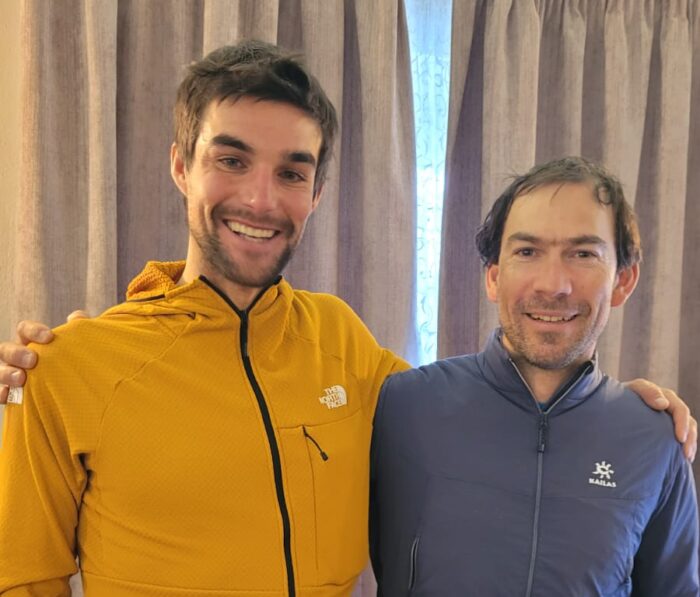
Benjamin Vedrines and Ales Cesen. Photo: Angela Benavides
“Paragliding descents have opened a new field of adventure,” Vedrines noted. “The wings weigh just one kilo, and they can be brought up by a single climber going light, with no need for porters or rotations like 30 years ago.”
That, he explained, has become the norm among the climbing community in the Chamonix Valley.
Technology helps creativity
Technologies like Google Earth, although not perfect, are increasingly helping climbers discover remote peaks to climb. Drones can locate otherwise invisible climbing lines.
“We will never run out of options,” said Dean Steadman of the U.S. Yashkuk Sar team. Spencer Gray of the U.S., who received a Piolet for his part in the first ascent of Kakur Kangri in Western Nepal, added: “Technology helps creativity.”
Asked by ExplorersWeb about the limits of what constitutes alpine style, Cesen replied: “No limits. Climbers should be free to climb as they please, as long as they are transparent and provide all the details on their climbs.” He also declined to stick to hyper-purist criteria.
“I believe one can fix one or two pitches from a bivy site, and the climb will still be alpine style if long enough,” he said. “[But] climbers must clearly state if and where they fixed ropes.”
Vedrines is a sterling example of that transparency. In his Jannu report to ExplorersWeb, he admitted that he and Nicolas Jean had fixed a highly exposed pitch on the upper side of the north face.
Social media sources
Yet, Steadman noted the increasing importance of social media and how easily dishonest climbers can share partial or false facts about their achievements. Cesen commented about how the media sometimes used secondary sources of information, which turned out to be inaccurate.
Then this writer was asked to share her thoughts. We advocated for thorough work based on reliable information, direct sources whenever possible, and proper citations indicating the origin of the information. We also highlighted the challenges that sometimes arise in obtaining unbiased, detailed, and honest information from social media.
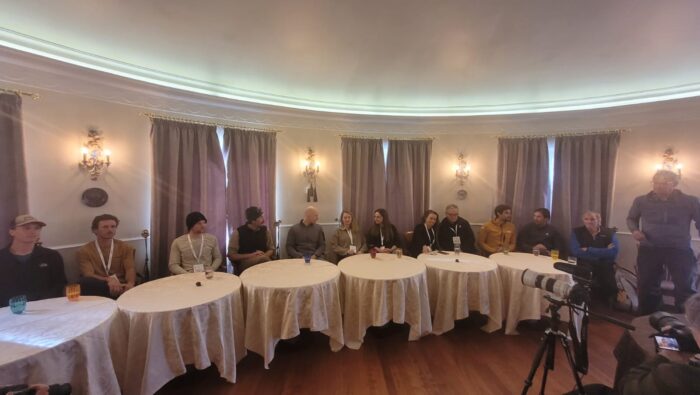
The press conference. Left to right, August Franzen, Cody Winckler, Dane Steadman, Ryan Griffiths, Spencer Gray, Anja Petek, Patricija Verdev, Olga Lukashenko, Alexander Odintsov, Benjamin Vedrines, Ales Cesen, Lindsay Griffin, and Christian Trommsdorf. Photo: Angela Benavides
In transition
The general feeling was that the meaning of alpine-style and alpinism was changing.
“The Piolets d’Or are currently in a transition process,” said Christian Trommsdoft, the driving force behind the awards and president of Chamonix’s High Mountain Group. “The Special Mention to Vedrines is one step, and…embracing the new techniques and technology is also a sign.”
The previous night, Trommsdorf took the floor to announce the Piolets d’Or group was considering including a new award for alpine rock climbing.
“For the moment, it is just the first step of an idea which will take at least two years to develop,” he told ExplorersWeb.