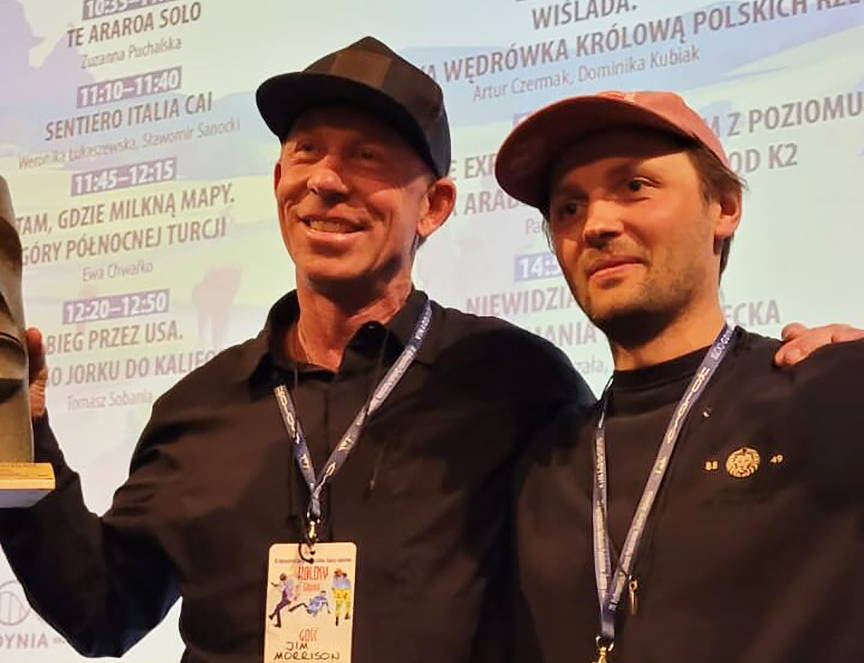
Everest skiers Andrzej Bargiel of Poland and Jim Morrison of the U.S. had hoped to summit from different sides of the mountain at the same time for a historic handshake. Timing decided otherwise, as Morrison’s ski descent took place three weeks after Bargiel’s. But the two finally met for the first time this past weekend at the Kolosy festival in Gdynia, Poland, one of the biggest adventure events in Europe.
“We didn’t get to high-five on the summit of Everest…but Jim made it to Poland, dropped by to visit me, and we caught up,” Bargiel said in a presentation about his ski descents of Everest, the Gasherbrums, and Patagonia to the thousands in attendance. The previous day, Morrison had spoken movingly of life and mountains, earning a standing ovation.
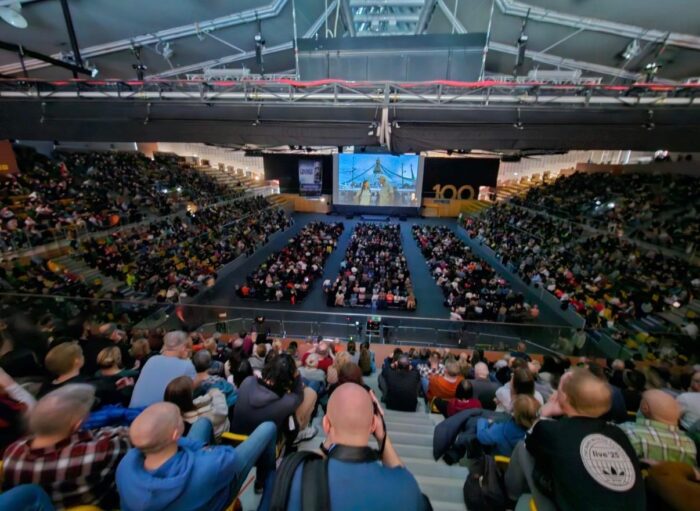
The Kolosy event, featuring mountaineers, sailors, cavers, and travelers, attracts thousands from all over Poland. Photo: Janusz Janowski
ExplorersWeb was there. We also attended a joint chat by the two skiers in front of the media, attendees, and even some Polish legends such as winter 8,000m pioneer Krzysztof Wielicki, Janusz Majer (the first to climb K2’s Magic Line), Amazon kayaker Piotr Chmielinski, and organizer Janusz Janowski.
Same expertise, different careers
Jim Morrison, 50, and Andrzej Bargiel, 38, have slightly different backgrounds in skiing. One grew up carving the slopes around Lake Tahoe, California, the other started in skimo competitions. Both were eventually drawn to the challenge of skiing down the highest peaks on Earth.
In 2018, Morrison and his life partner, Hilaree Nelson, skied from the summit of Lhotse. Months later, Bargiel made a no-oxygen descent of K2. That’s when they started following each other on social media.
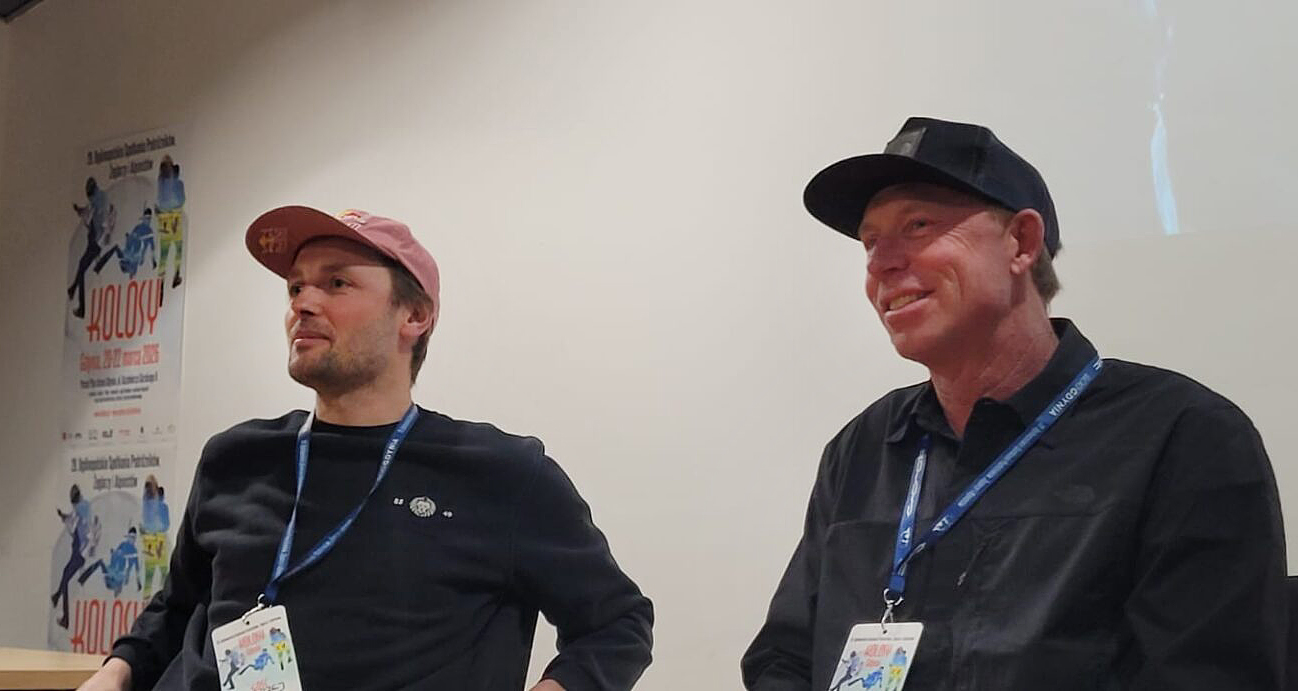
Andrzej Bargiel and Jim Morrison answer questions at the Kolosy gathering. Photo: Angela Benavides
Last fall, they both went to Everest, determined to ski from the summit after two failed attempts each. Both were supported by powerful teams and film crews, big sponsors, and all the secrecy they could muster, although news like that is hard to keep under wraps in the Himalaya.
On the Nepalese side of Everest, Bargiel assembled a strong climbing team, which fixed the Khumbu Icefall and the rest of the route just for themselves. There were no other expeditions in the post-monsoon season.
Meanwhile, on the Tibetan side of Everest, Morrison had a 12-member climbing team, a large film crew, and Base Camp support. The goal: to ski down a combination of the Japanese and the Hornbein couloirs.
“We tried to keep quiet about the expedition because we were trying to avoid any kind of trouble with the Chinese authorities, after overcoming huge difficulties to obtain the necessary permits,” Morrison explained. Still, Nepalese media leaked some details, which attracted attention to their project.
Ultimate challenge
Both skiers knew Everest would be an ultimate challenge. Bargiel could only ski across the treacherous Khumbu Icefall with enough snow on the broken glacier. That could only take place after the monsoon rains. After a previous attempt, he said he was sure the feat would not be possible at all in a decade, due to climate change.
For Morrison, the project was personal. He wanted to achieve a climb he had dreamed of all his life and planned it together for years with Hilaree Nelson, who perished on Manaslu in 2022. Morrison wanted to ski Everest as a tribute to her and also to his children, who also died years earlier with his first wife in a plane crash. Morrison explained that skiing has played a major role in overcoming such devastating tragedies.
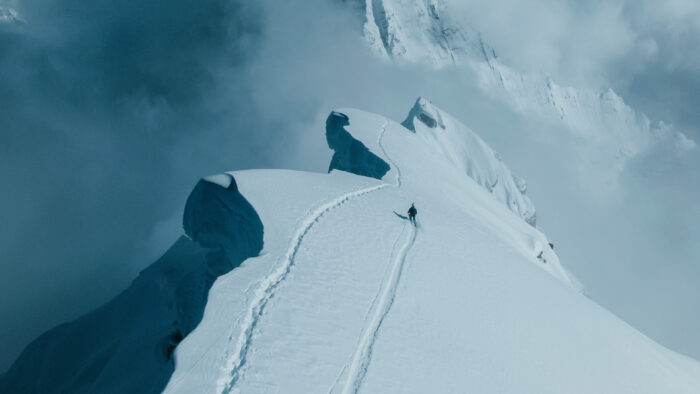
Andrzej Bargiel skis down the Hillary Step on Everest. Photo: Bartek Bargiel/Red Bull Content Pool
ExplorersWeb reported on Bargiel’s expedition in detail: the wait for the right conditions, his arrival at the summit with Lakpa Sherpa, and the two-day descent. His brother Bartek’s drone guided him across the most hazardous sections.
As he had previously done on K2 and the two Gasherbrums, Bargiel completed the climb and descent without supplementary oxygen, a mind-blowing physical and technical feat. On the descent, he stopped for the night at Camp 2 as darkness fell, since he needed good visibility to cross the Icefall. He completed the feat with great technical skill and relatively good conditions, hugging the flank of Nuptse.
Further details emerged during Bargiel’s talk.
Timing essential
“One of the main challenges was husbanding my strength and the time I took through [different sections of] the ascent, ” he said. “Timing was essential as I had to reach Camp 2 before darkness fell. If I had taken 30 minutes longer in some sections, I would have had to turn around,” he said.
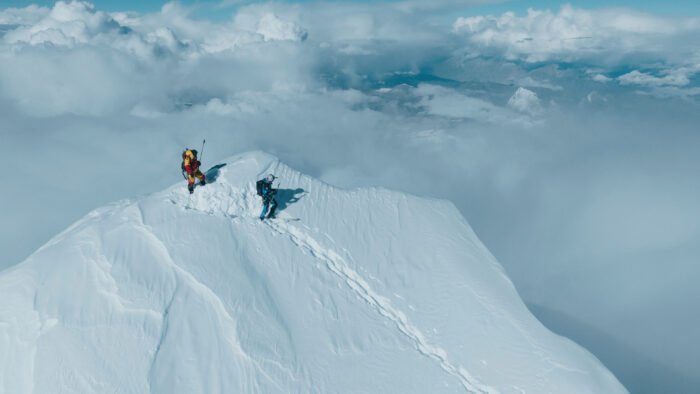
Andrzej Bargiel and Dawa Sherpa on the summit of Everest on Sept. 22, 2025. Photo: Bartek Bargiel/Red Bull Content Pool
The summit push was long and exhausting. The Sherpa team eventually ran out of oxygen and turned around. Near the summit, only three remained to break trail. “I had never been so tired in my life,” Bargiel said.
During the descent, Bargiel’s main challenges were assessing avalanche risk and navigating the Khumbu Icefall. “It was very complex because there were so many objective hazards. I only knew the route I followed when I saw the video footage in Base Camp. I was not aware I had been so close to the Nuptse Face.”
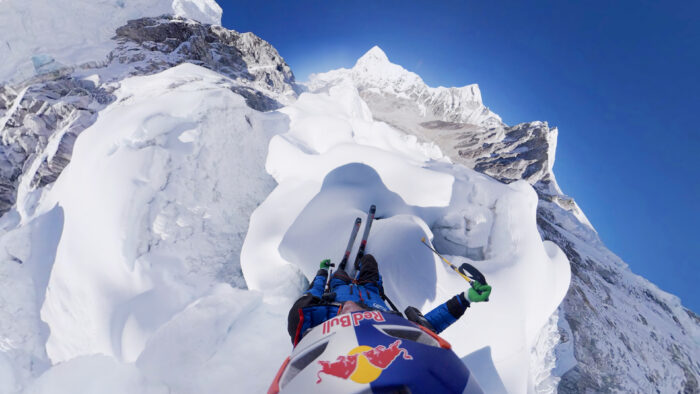
Andrzej Bargiel navigates through the jumbled Khumbu Icefall. Photo: Andrzej Bargiel/Red Bull Content Pool
He was also aware that he had to hurry because he needed to exit the Icefall before 8 am, or it would have become too dangerous. He said it took him three hours to ski down the Icefall.
You can watch the full documentary here. Below is a short version:
Hornbein Couloir
Meanwhile, Morrison’s team, headed by Topo Mena, Carla Perez, and Tico Morales of Ecuador, plus a Sherpa team led by Yukta Sherpa, tackled the Hornbein Couloir:
We had prepared thoroughly to climb the Hornbein, checking all info available and talking to nearly everyone who had been on the North Side of Everest. Yet, once there, the couloir is mind-blowing. We flew the drones up and down the wall, trying to find the right route. I can’t understand how Tom Hornbein and Willie Unsoeld, with the gear used in 1963 and only a photo of the face from afar, were able to find the route. It was only when we emerged to the sun on the upper snow slopes that I believed we were going to make it.
Jim Morrison on his way to the summit of Everest via the North Face. Photo: Jim Morrison/Instagram
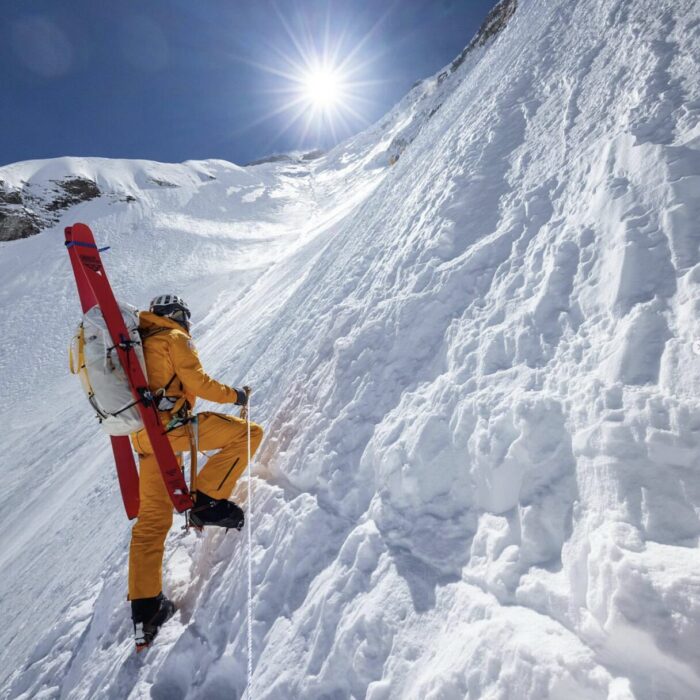
In fact, there was a last moment of uncertainty. “We had fixed the entire route, with over 4,000m of rope. Still, we ran out of rope shortly before reaching the top. It could have made the climbing team’s descent risky. Luckily, the head of the team went to the summit. We saw a brand new rope recently left by Andrzej Bargiel and Dawa, so we retrieved it and used it on our side of the mountain.”
In the group of summiters (check the Instagram post below), Morrison included his late partner, Hilaree Nelson, the ever-present motivation for him to be on Everest.
Spirits on the summit
The arrival at the summit was deeply emotional for Morrison. It still was when he recalled it in front of the audience.
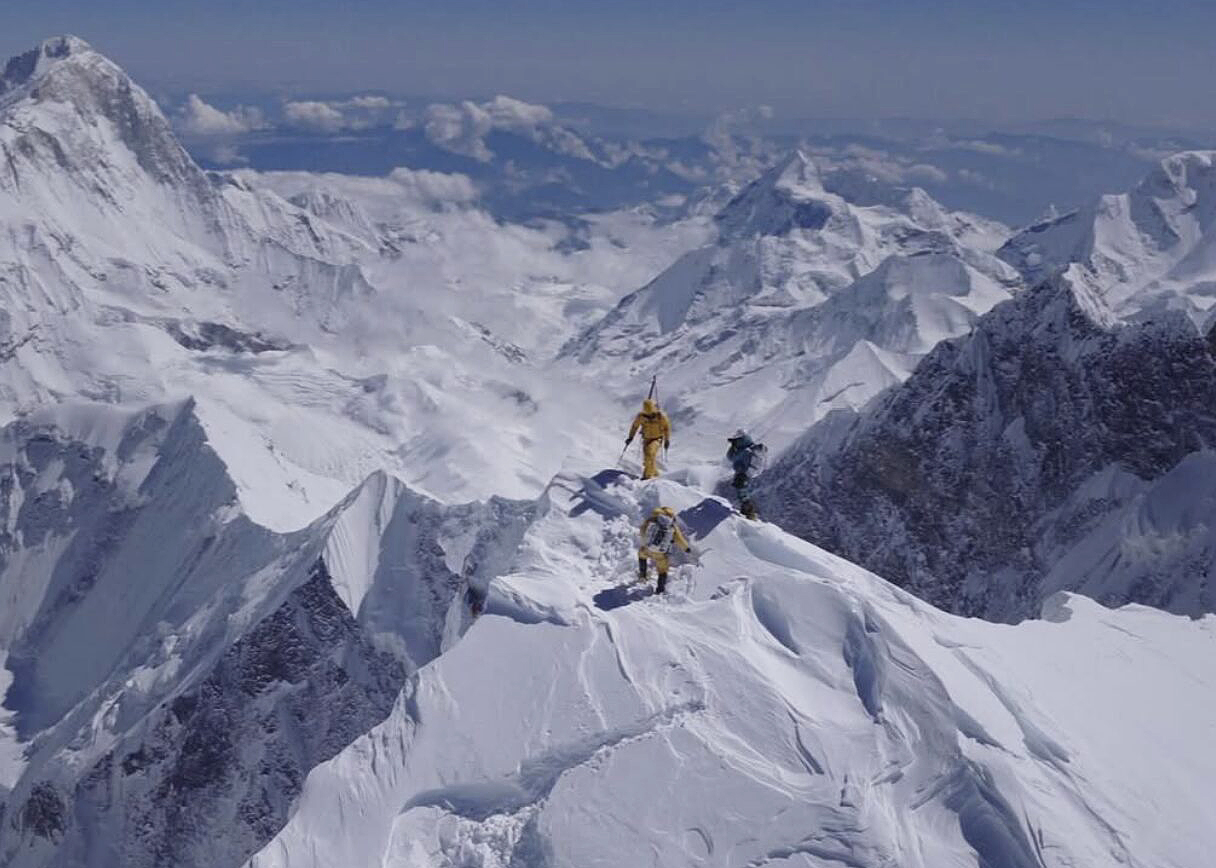
Drone image of Morrison and his team on the lonely summit of Everest. Photo: Jim Morrison/Instagram
“It was a deeply emotional moment; I could feel the presence of my children up there. I dispersed part of Hilaree’s ashes on the summit and stood with my emotions as the rest of the team waited in understanding. Then I completely focused on the descent ahead as I stepped onto my skis.”
Morrison took off his down suit and high-altitude boots. Within just three minutes, he began skiing down the nearly vertical couloir. It was the most difficult descent of his life.
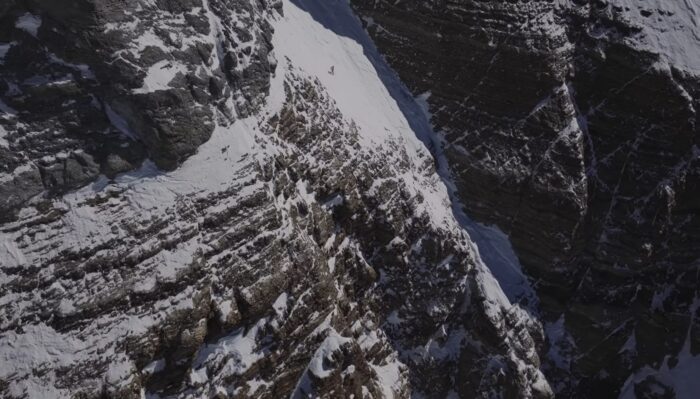
Jim Morrison looks tiny while skiing the huge Hornbein Couloir. Photo: Frame from the video shared by National Geographic on YouTube
The edge of the netherworld
“Up there, so close to the edge of the netherworld, I looked into the abyss and kept turning — soloing that immense horizon, pulled by Earth and sky in equal measure,” Morrison later wrote.
Unlike Bargiel, who enjoyed generally good snow conditions, the couloir surface was scarily hard. High winds had swept away all the loose snow, leaving it icy and unforgiving.
“I was aware that a single mistake would be the last,” he admitted. “I wouldn’t stop falling until the bottom of the face. Still, I was determined to ski the couloir, not to just descend it. I focused on linking one turn after another, one after another.”
On his harness, he carried an ice-axe, which is sometimes used as a safety tool on steep, committing ski descents, but he didn’t use it.
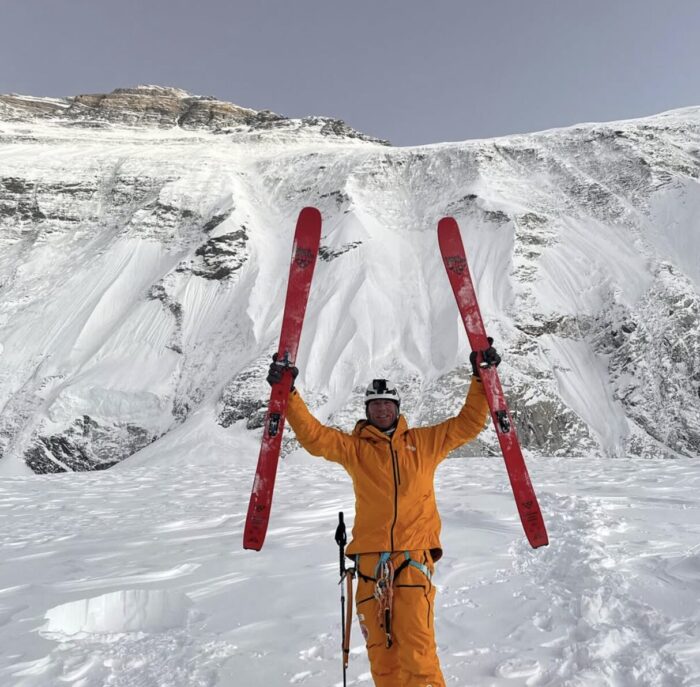
A triumphant Jim Morrison after skiing down Everest’s Hornbein Couloir. Photo: Jim Morrison/Instagram
Asked about the most joyful moment of the expedition, Morrison said that, after the extremely difficult descent, it was the moment when he reached the Rongbuk Glacier alive. However, he refuses to describe the feat as “crazy” or “Russian roulette,” as some in the audience suggested. “It was just very difficult,” he said. “I had prepared for that challenge all my life, and this is the kind of life I want to live.”
Sponsor National Geographic is working on a film about the expedition, directed by Oscar-winning Jimmy Chin, that will probably air this fall. Meanwhile, here’s a short teaser:
Skilled teams with oxygen
Both skiers climbed with big, highly skilled teams, using supplementary oxygen. Jim Morrison climbed on gas as well. However, climbing the Hornbein Couloir is an extremely rare feat. The U.S. team made just the sixth successful ascent since Unsoeld and Hornbein’s feat in 1963. Morrison has done the only ski descent of the Hornbein Couloir.
Andrzej Bargiel used no oxygen to summit Everest. Stepping on skis after climbing Everest through fresh snow, with only one person breaking trail in front of him, is an incredibly hard effort. Carving turns down the Geneva Spur (the team followed a direct variation, skipping Camp 3 due to avalanche risk) and the Lhotse Face to Camp 2 in near-darkness, and then navigating the Khumbu Icefall is likewise a huge feat.
As for skiing the Hornbein Couloir…well, Morrison is the only one to have tried it and survived. The American explained that once he had to step off his skis and rappel a 200m section because it was too dry, so from a purist point of view, his is not a complete descent. In that sense, there’s a challenge waiting for others to try.
Yet, the always humble Bargiel put Morrison’s achievement in context. “Ours was a bit easier,” Bargiel admitted. He also noted that improved equipment and technology, such as drones and weather forecasts, made both their ski descents easier than previous attempts.
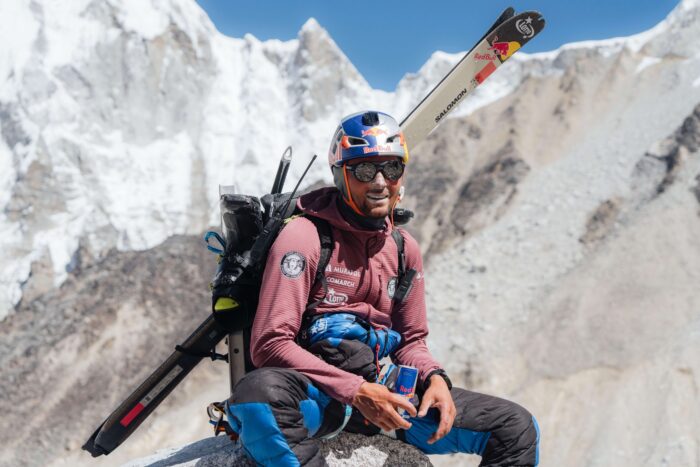
Andrzej Bargiel in Base Camp. Photo: Bartek Wlikowski/Red Bull Pull Content
Easier today
“There weren’t Sherpa guides back then, there wasn’t all that hype and the huge support as we had,” he said. “The new equipment helped us a lot, and we also had a greater awareness of risk management.
“What Davo Karnicar did was groundbreaking at the time. Even if he had some support during the ascent, he simply descended from the summit to Base Camp in one go.”
Then there was Hans Kammerlander, who climbed from the North Side completely on his own, and he went there in the spring, so there was simply no snow on sections of the descent. His advantage was finding the route fixed and trodden by other teams. “I think Karnicar actually did the first solid descent, and that was amazing at the time,” concluded Bargiel.
With or without O2
Jim Morrison used supplementary oxygen during both the ascent and descent. Asked if he considers a no-O2 climb and descent down the Hoirnbein possible, he said: “Yes, I certainly think it is. The route is very demanding, very steep, and direct, and it involves a lot of risk. It was too risky for me to consider a no-O2 expedition. My goal was to make the descent, and so I did.”
Bargiel agreed with Morrison that it would be an extremely difficult challenge. Yet, he simply doesn’t consider using oxygen on his climbs and descents. “I have a background as a skimo racer, so I have never tried oxygen,” he said. “It’s the natural way to ski to me. My endurance was high enough, and I suspect there aren’t many people who can move at such high altitudes relatively freely. That’s why skiing Everest without supplemental oxygen was possible for me.”
A trip together?
At the end of the talk, the usual question was what’s next. Both avoided specifics. Someone in the audience suggested they ski something together. They seemed open to the idea.
“It doesn’t have to be Everest, I think that’s enough of Everest for now,” Bargiel said. Then Jim Morrison added: “If we go to the summit of Everest together, I think I’ll use oxygen and help Andrzej find his way down to the Hornbein!”