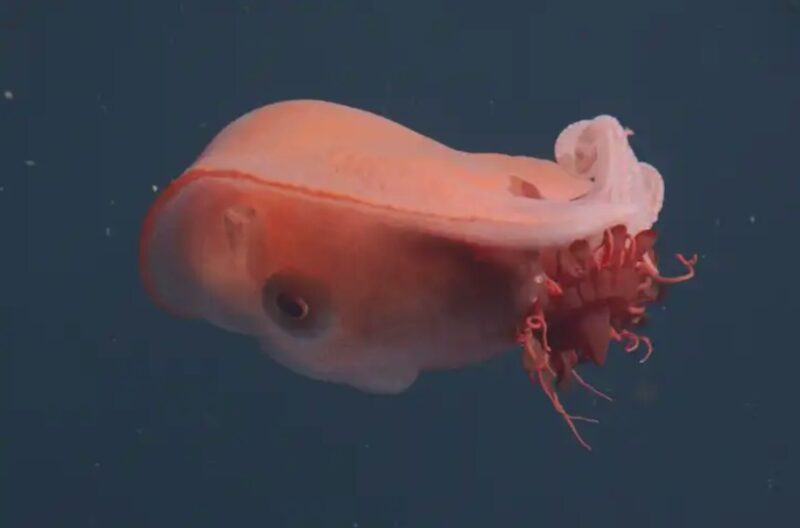
The elusive seven-armed blob octopus — yes, that’s a real creature — has been caught on camera for just the fourth time in 40 years.
Researchers were not looking for the octopus, but it wandered into their camera’s line of sight during routine survey work in Monterey Bay, California.
Using the remotely operated vehicle Ventana, they spotted the rare species 705m below the surface. Amazed by what they had discovered, they used the ROV to gather as much information as they could about the sea creature.
The deep sea is one of the most understudied areas of the ocean. Many of its inhabitants are so mysterious and rarely seen that any information on them is a huge step forward in marine research.
At the time, the seven-armed octopus was clutching a crimson red helmet jelly (Periphylla periphylla). Research on museum specimens indicated that the blob octopus feeds on gelatinous animals. Now, researchers have first-hand evidence. In 2017, a female was recorded carrying an egg yolk jelly, but it was unclear exactly why she was doing this.
Misleading name
The octopus varies massively in size. Females can grow up to a hefty 75 kilos, while some of the males are only eight inches long. The males are the reason this species used to be known simply as the seven-armed octopus.
The name is misleading; it actually has eight arms, like every other octopus. But the males keep one arm, the reproductive hectocotylus, tucked away under their right eye. This makes it look as if it has only seven arms. While mating, the males rip off this specialized arm and use it as a tool to transfer sperm to the female.
Although we rarely see them, Haliphron atlanticus plays a crucial role in deep-sea ecosystems. They act as a food source for swordfish, blue sharks, and sperm whales.