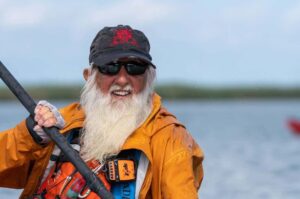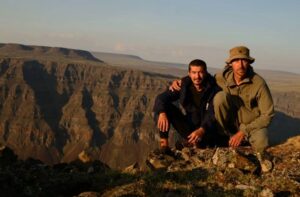
At 83, Peter Heebink thinks his days of month-long ski expeditions are behind him. There’s no doubt he has earned a rest. Between 1975 and 2020, Heebink spent every winter on self-supported ski and snowshoe expeditions in the Yukon, the Northwest Territories, British Columbia, and Alaska. On over 70 trips, he racked up more than 15,000km of backcountry travel in the company of a rotating cast of friends and family.
Heebink began his trips in 1972 after moving to the Yukon from the U.S. He had been a downhill skier, but with good downhill slopes hard to come by, he fell in love with cross-country skiing. His first trips were exploratory, not in their routes or the terrain, but in terms of gear, camping techniques, and mode of travel. His trips began as brief six or seven-day slogs in snowshoes but were soon month-long endeavors.
Working things out
In his first longer trip, in 1975, the ski trip turned into more of a hike.
“With haphazard planning, we set out with heavy backpacks and snowshoes for backup. There was no trail, and we were breaking through the deep snow in our wide, heavy skis and leather boots. Without skins, our skis were worse than useless. We quickly switched to snowshoes and carried our skis on our backs, where they stayed for the rest of the trip!”
It wasn’t until 1977 that Heebink first tried dragging a makeshift sled. “My friend Peter Carr dragged a Crazy Carpet [a thin piece of plastic used for tobogganing] wrapped around his backpack and attached with a rope. It flipped and flopped all over the place, but at least it reduced some of the weight on his back,” Heebink explained.
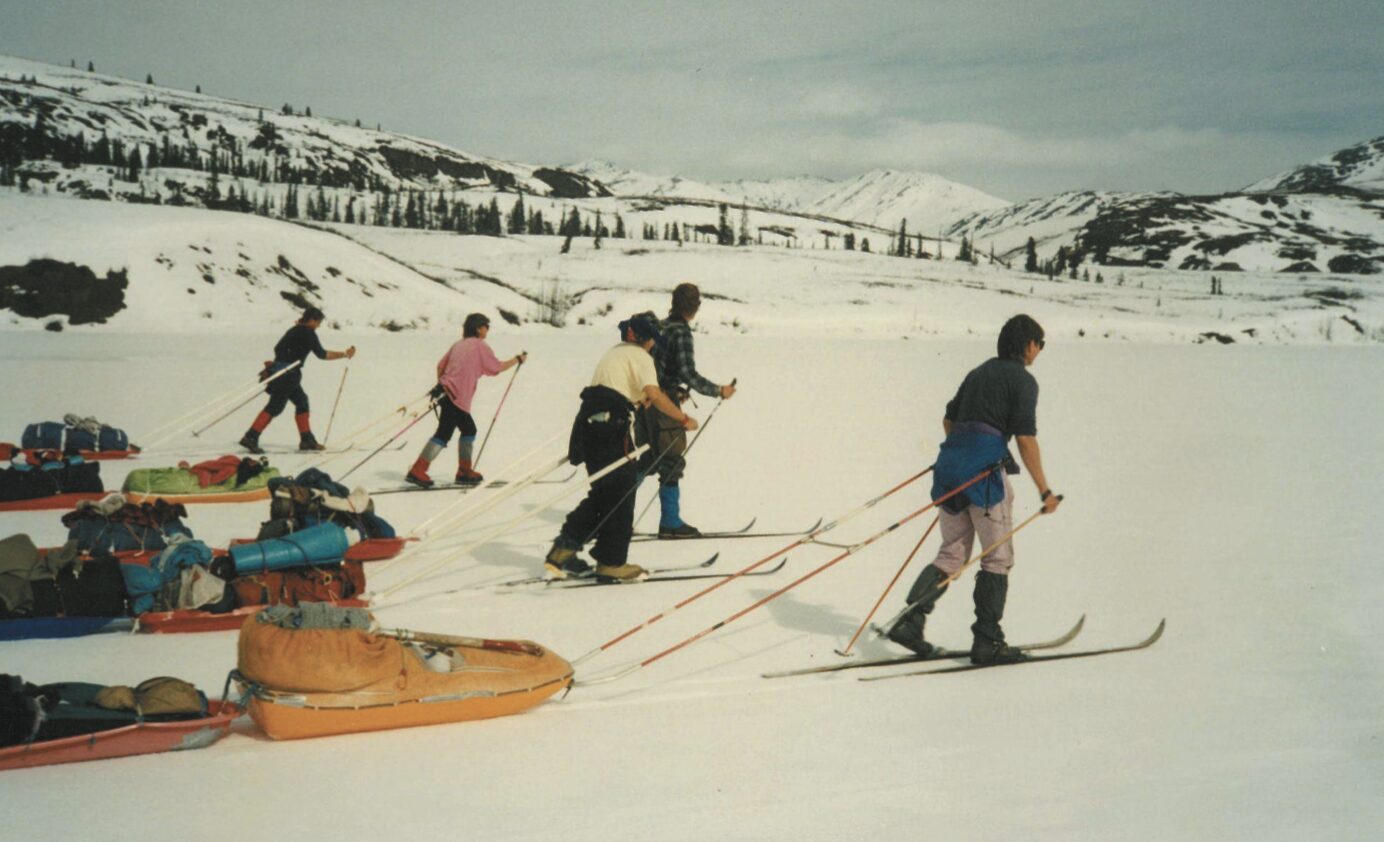
Eventually, sled trains had become the norm. Photo: Peter Heebink/Slogging North of 60
For a few years after, they used children’s sleds strapped together with rigid poles to stop them from flipping as easily. But Heebink still lugged a heavy backpack as well as dragged the sleds. It wasn’t until 1984 that he moved entirely to manhauling.
“[That year], I pulled three small pulks for 400km, from Old Crow to Herschel Island. I felt liberated and much more comfortable pulling my load rather than packing it. Plus, I found that a chain of three or four pulks would never flip, as they stabilize each other.”
Soon everyone had made the switch, and Heebink’s groups could move faster and farther.
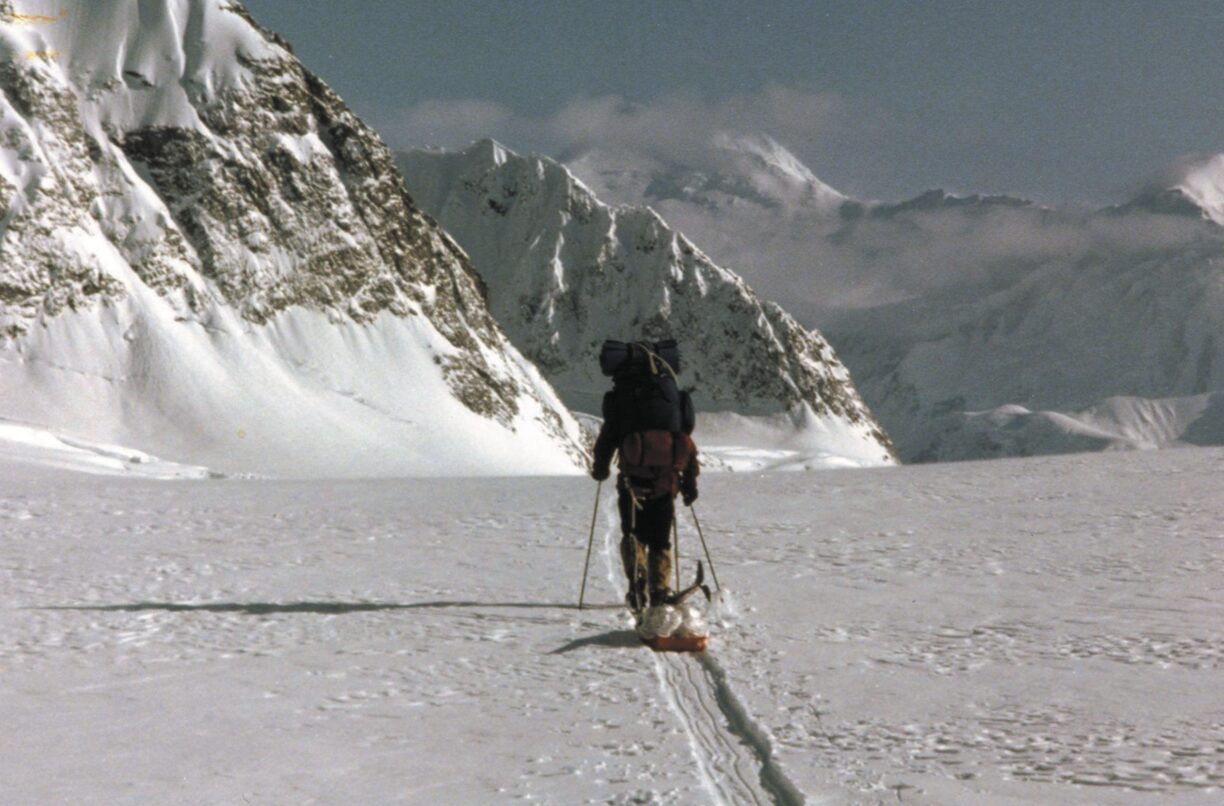
Heading toward Mount Logan. Photo: Slogging North of 60
A rotating cast of characters
Each year, Heebink planned new routes, stitching together sections of interesting terrain, or focused on places of historical or cultural significance. In addition to new routes, he was often joined by new friends. Over his 70 trips, more than 160 companions accompanied him. Some came for just one expedition, but many joined year after year.
“We did not screen,” Heebink explained, “if they were willing to go on this sort of trip, that qualified them. Masochism helped.”
Despite his relaxed entry requirements, the groups had remarkably few interpersonal problems, “though we did have a brother and sister one year who wouldn’t stop arguing.” The secret to harmonious travel was to have out any disagreements as quickly as possible and to recognize that many sour feelings were the result of what Heebink terms “the hate-the-person-in-front syndrome.” This describes the feeling of resentment toward whoever was leading their single-file line that day, either about the route they were picking, their pace, or if they had something in their sled you needed and they couldn’t hear you from the back.
Ski trekking is a good way to lose a few pounds and start a new romantic relationship (or end an existing one).
Certain routines were common to all Heebink’s expeditions: Evening campfires were important, overproof rum was essential, and everybody had to bring at least one surprise for the group.
Campfires and dingle sticks
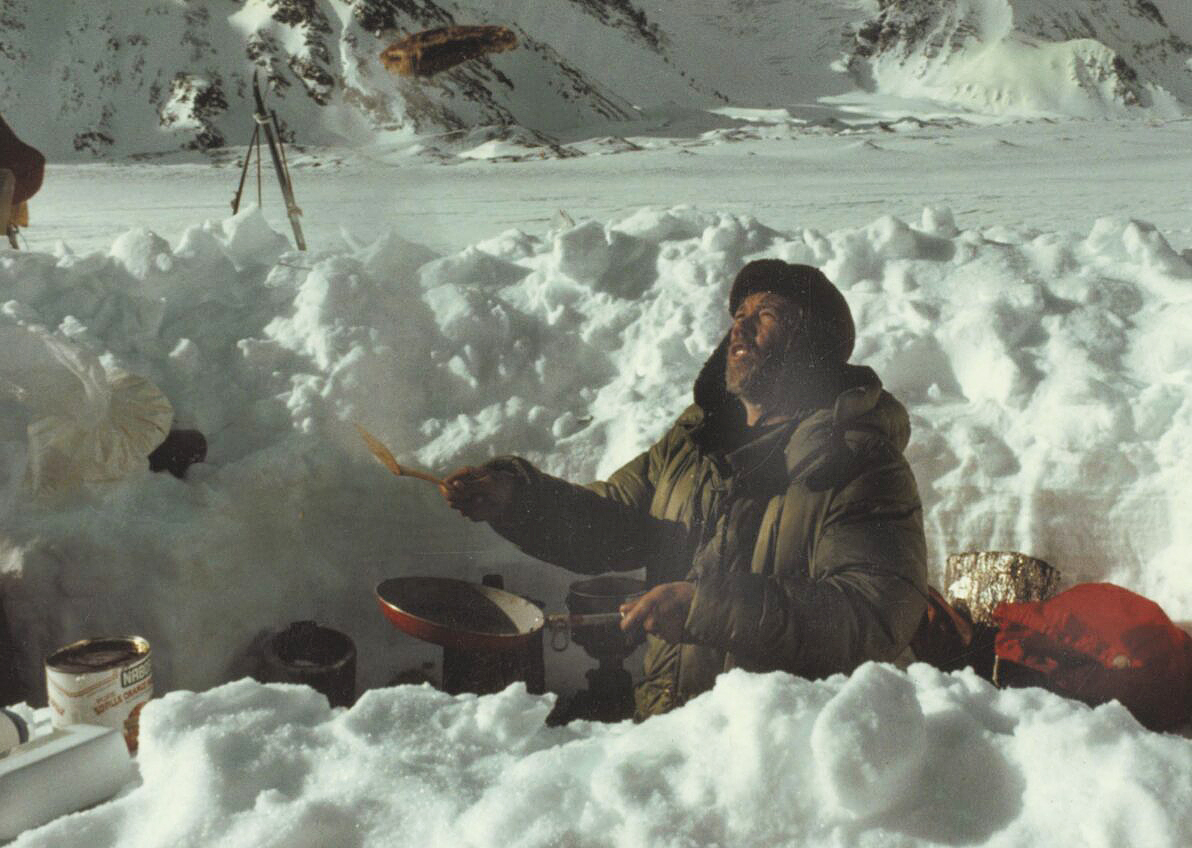
Like modes of transportation, the evening campfires evolved over Heebink’s first few trips. Soon they had a routine that involved digging down — sometimes as far as two meters — to build the fire on the ground.
“We found it self-defeating to build a fire on top of snow or ice — it will smolder but never get truly hot. Even on a bed of green logs (which we preferred not to use), it will eventually sink and turn into a smoke pit due to a lack of oxygen. On the windward side of our kitchen, we built a snow wall for wind protection and to hold the dingle stick.”
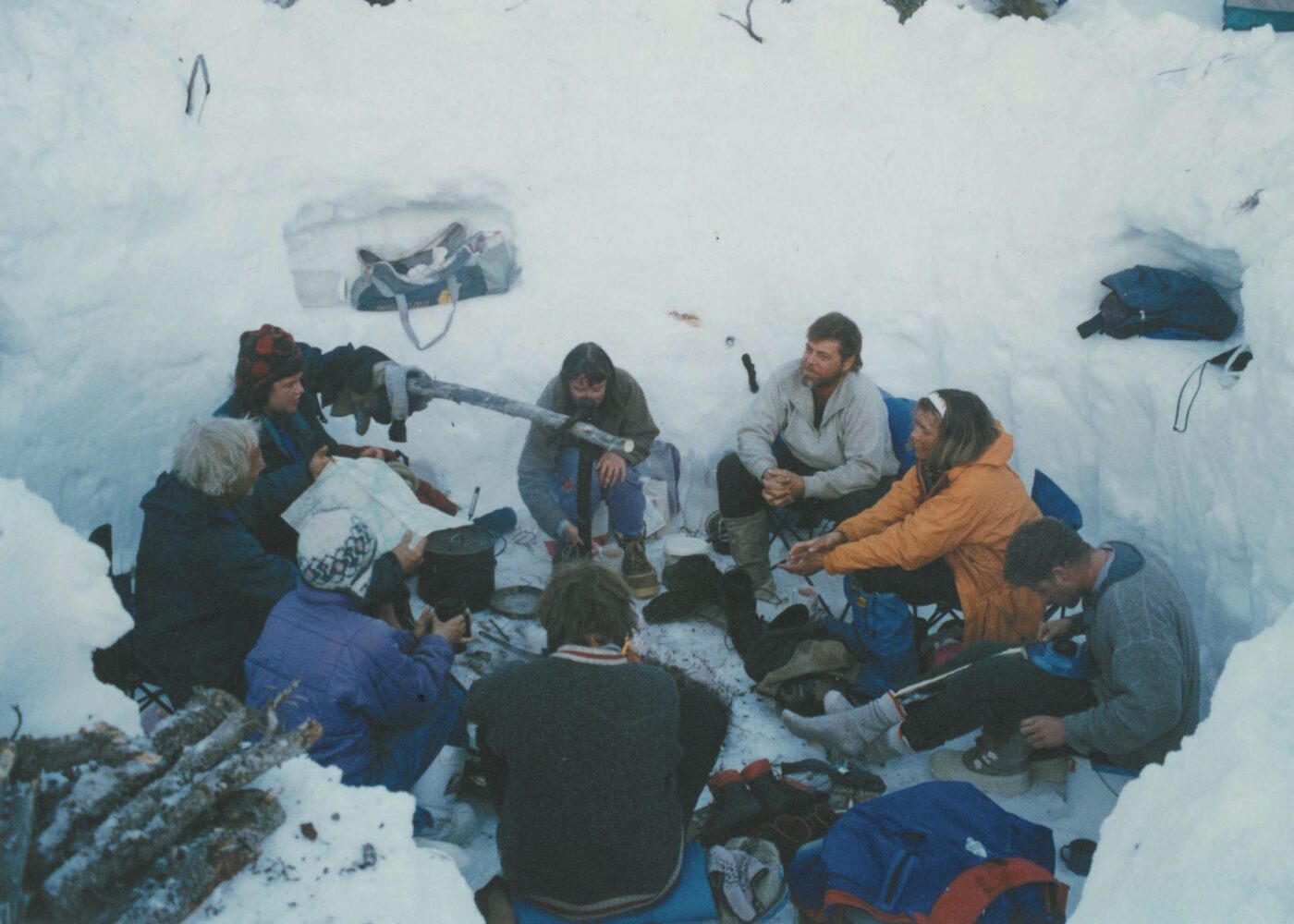
Sometimes it was necessary to dig extremely deep fire pits. Photo: Peter Heebink/Slogging North of 60
The dingle stick is a suitably chunky stick with notches carved for different heating points (points to hang pans for boiling, simmering, keeping warm, etc.). The stick doubled as a drying/dethawing place for clothing and boots. Cross-contamination wasn’t a worry: “A little sock juice never hurt anyone.”
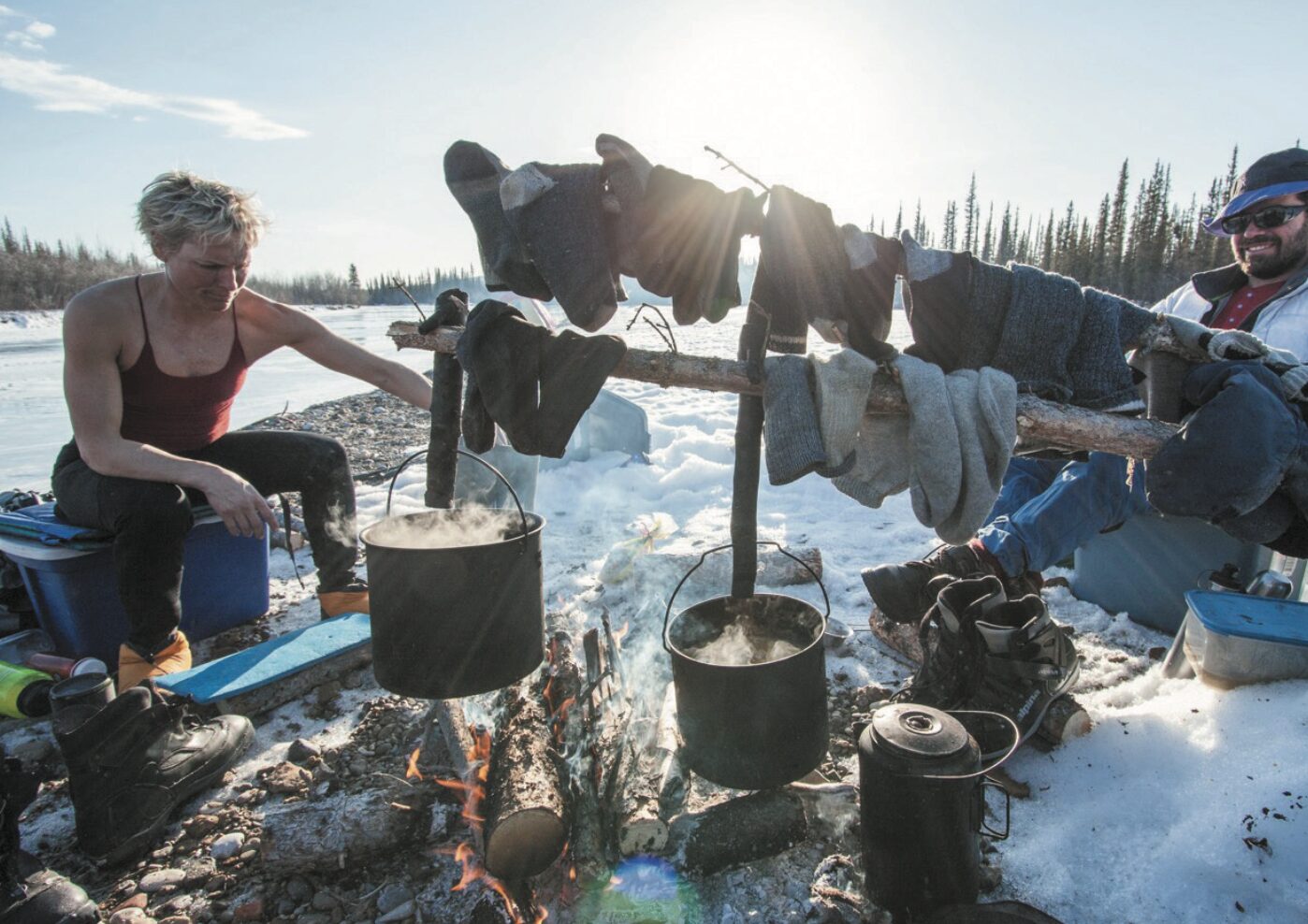
A dingle stick in use on a 2011 trip. Photo: Lee Carruthers/Slogging North of 60
Group surprises ranged from all the ingredients for a cocktail party to a full roast dinner (complete with an entire turkey) to a croquet set. Plenty of overproof rum was never a surprise, and though drinking it wasn’t mandatory, Heebink explained that nearly everyone eventually became a convert. “We had teetotallers at the start of trips but not usually by the end.”
Unique trips by a unique character
Heebink completed these trips quietly, without publicity or grandiose claims. “I don’t call them expeditions because I had too much fun,” he says. But many of his trips were impressive undertakings, long-distance slogs in extreme winter conditions in remote areas. His longest journey lasted 35 days and covered 800km.
At 83, he still enjoys short trips into the backcountry, but he says the big trips are probably behind him. Instead of planning his next winter haul, he has pulled together a book chronicling his many trips: Slogging North of 60: Half a century of ski trekking through the Yukon and beyond.
“I started trying to write up my trip reports and realized that they were kind of epic trips when I looked at them. And you think about your legacy, I don’t deny that,” Heebink laughs. “I hope it will be interesting for people to read who might want to learn more about the Yukon.”
The book is an entertaining read, with some hilarious anecdotes, and should provide inspiration for those thinking about getting out and doing something, whether in the Arctic or in their backyard. Not every trip needs to claim to be saving the planet, inspiring schoolchildren, or achieving a world first — a good campfire, some overproof rum, and good company in spectacular scenery is often enough.